These Royal Portraits Were Flattering Lies — Here’s What the Painters Were Told to Hide D
In 1539, a German painter named Hans Holbein was sent to the Duchy of Cleves with one of the most important jobs in Europe. Paint a portrait of a princess so that the King of England could decide whether to marry her. Henry VIII had buried one wife, executed another, and lost a third.
Now he wanted a fourth, and he wanted to see the goods before he committed. Holbein painted Anne of Cleves in soft, flattering light. Serene, symmetrical, lovely. Henry took one look at the little portrait and agreed to the match. And then Anne arrived in England, and the King met the woman behind the painting, and he was so appalled by the gap between the two that he called her, the story goes, a Flanders mare, refused to consummate the marriage, and had the whole thing annulled within months.
It is the most famous case of its kind, but it is not unusual. It is the rule. Because for 500 years, the royal portrait was never a photograph. It was a tool, a piece of propaganda, a diplomatic weapon, a Renaissance filter applied to faces that the public was never permitted to see as they really were.
This is the story of how the most powerful people on Earth catfished the world, one flattering brushstroke at a time. That is the legend, and it is worth telling because almost everyone has heard some version of it. But the record corrects two details before we go any further, and the corrections are the whole reason this story is more interesting than the myth.
Start with the insult. The phrase Flanders mare appears nowhere in the documents of Henry’s own reign. No ambassador wrote it down. No courtier recorded it. It surfaces for the first time more than 100 years after Anne was in her grave, in a history written by Bishop Gilbert Burnet in 1679, and then it is repeated and sharpened by the Scottish writer Tobias Smollett in 1748.
By the time it reaches us, it has the polish of something Henry actually said. He did not. And the phrase is wrong even on its own terms because Anne was not from Flanders. She came from Cleves, a German duchy on the lower Rhine. The most famous royal insult in English history was invented by men who were not born when the marriage happened, about a woman from the wrong country.
And then the harder correction, the painting itself. The legend says Holbein lied, that he slimmed and softened and flattered Anne into someone she was not, and that Henry rejected her the moment he saw the gap. But the contemporary record says almost the opposite. The English ambassador, Nicholas Wootton, who met Anne in person before she ever left for England, wrote that Holbein had expressed her image very lively, a faithful likeness, not a glamour shot.
When the marriage collapsed, Henry’s fury did not fall on the painter. Holbein kept his position and kept working for the crown. The blame fell on Thomas Cromwell, the minister who had engineered the match, and Cromwell would go to the block within months. If the portrait had been a fraud, the man who painted it would have been the first to suffer. He was not even scratched.
So, if the painting was honest, why did the king recoil? Here is what the historian Retha Warnicke spent a whole book arguing, and it is the version the evidence actually supports. By the time Anne landed, Henry no longer needed her. The marriage had been a diplomatic insurance policy, a Protestant German alliance against the threat of France and the Holy Roman Empire joining forces against England.
But the politics shifted, the threat eased, the alliance lost its urgency before the bride had finished unpacking. And on top of cold politics, there was the awkward, unglamorous truth of personal chemistry. Henry met Anne at Rochester on New Year’s Day, 1540, in disguise, expecting her to recognize the dashing king beneath the costume, because that was the game courtly love was supposed to play. She did not recognize him.
She regarded the strange older man with polite confusion and went back to looking out the window. Henry, vain, aging, and used to being adored, never forgave the cold opening. His own recorded words are not about a painting at all. “I like her not,” he said later to Cromwell. “I liked her before not well, but now I like her much worse.
” He complained, the morning after the wedding, of unpleasant smells and doubts about whether she was a virgin. He complained that she was “nothing so fair as she hath been reported.” And notice the word reported, not painted. The thing that had oversold Anne was the rumor mill.
The ambassadors and the praise that had run ahead of her, one report claiming she outshone the Duchess of Milan as the golden sun outshines the silver moon. The portrait was the most accurate part of the whole transaction. There is not a brushstroke in any of it. And the ending nobody puts in the legend is the one that settles the question for good.
Anne did not slink home in disgrace. She agreed to the annulment without a fight, and Henry, relieved and almost grateful, made her a deal that rejected bride in his reign ever got. She was given Richmond Palace and Hever Castle, the same Hever, as it happens, that had been the childhood home of Anne Boleyn.
She was granted the title of the king’s beloved sister, an income to match, and a standing at court above almost every other woman in England. She outlived Henry. She outlived every other wife he had. The woman the legend turned into a punchline, died comfortable, independent, and free in 1557, having quietly won the only game at that court worth winning, which was survival.
The painting did not betray her, the story did. So, why does the legend survive? Because the legend is better television than the truth, and because it points at something real, even when it gets the details wrong. The real thing is this: The portrait that crossed Europe to seal that marriage was never meant to be a neutral record of a human face. It was a working object.
It had a job, and understanding that job is the key that unlocks 500 years of royal imagery. Because once you see that the face in the frame was a decision, you cannot unsee it. So, let us talk about how court painters actually worked, because this is where the myth and the reality finally shake hands.
A royal portrait in the 16th century was not a selfie. It was a state document with a frame around it. When a king sat for his painter, the painting that resulted would hang in a palace, travel to a foreign court, be copied and recopied, and sent down the line to allies and enemies and prospective in-laws who would never in their lives stand in the same room as the sitter.
For most of the people who saw it, that painted face was the only face of the monarch they would ever know. So, the face had to do work. It had to say, “This person is healthy. This person is fertile. This person is pious and strong and legitimate and chosen by God to rule you.
” None of those things are facts about a nose or a chin. They are messages, and the painter’s job was to deliver the message. Think about what that meant in practice for a marriage. Two royal houses are negotiating an alliance across a continent. They cannot meet. The bride and groom may be in countries weeks apart, speaking different languages, and they may not lay eyes on one another until the contracts are signed and she is already standing on foreign soil.
The portrait is the only thing that travels ahead of her. It is the brochure, the dossier, and the first impression, all in one small panel of painted wood. A whole alliance, armies, money, the balance of power in Europe, can hinge on whether a king likes a face he has only seen in oil. So, the stakes on that one painting were not artistic.
They were the stakes of statecraft. And that is exactly why the practice went back centuries before Henry. As early as 1428, the Flemish master Jan van Eyck was sent all the way to Iberia to paint a Portuguese princess for the Duke of Burgundy, who was shopping for a wife by portrait. Henry’s own grandfather’s generation knew the drill.
When Henry VII went looking for a bride in 1502, he sent his ambassadors with instructions to find, in his words, “some cunning painter, and then to report back on the woman’s complexion, her figure, the very smell of her breath.” They did not want a flattering picture. They wanted intelligence. The portrait was a reconnaissance instrument.
This is where we have to hold a careful line, because it is easy to overstate it. Idealization was not the same as fraud. Almost every royal portrait flattered in the way almost every formal photograph today flatters. The good light, the right angle, the blemish quietly left out. That was the convention, and everyone on every side of it understood the convention.
It does not mean every royal portrait was a deliberate deception. In fact, the marriage market had built-in defenses against exactly that. When a foreign court was shown a prospective bride, they often demanded a full-length, full-face image, precisely, in the words of the National Gallery’s Susan Foister, so that any disfigurement could not be hidden.
“The whole point of of portrait,” she says, “was to ensure that a stranger marrying into the royal line was sufficiently personable for royal status. They wanted to be flattered. They also did not want to be lied to. And sometimes the line got crossed, and the receiving party was furious. Caroline of Brunswick, sent across the sea to marry the future George the IV, took one look at her fiance and said, “I find him very fat and by no means as beautiful as his portrait.
” The flattery cut both ways, and everyone knew the game was being played. So, the painter walked a tightrope. Too honest, and you insult a king who can ruin you. Too flattering, and you start a diplomatic incident the day the bride arrives. The skill, the thing Holbein was paid extraordinary sums for, was the ability to make a face look like it’s best possible self while still being recognizably itself.
And here is the part the legend gets exactly backwards. When Henry sent Holbein to paint Christina of Denmark, a young widowed Duchess he was considering before Anne, the painter was given a single sitting of about 3 hours in Brussels in the spring of 1538. He came back with a portrait so quietly magnetic that the Imperial Ambassador, Eustace Chapuys, reported the king, since seeing it, has been in much better humor than he ever was, making musicians play on their instruments all day long.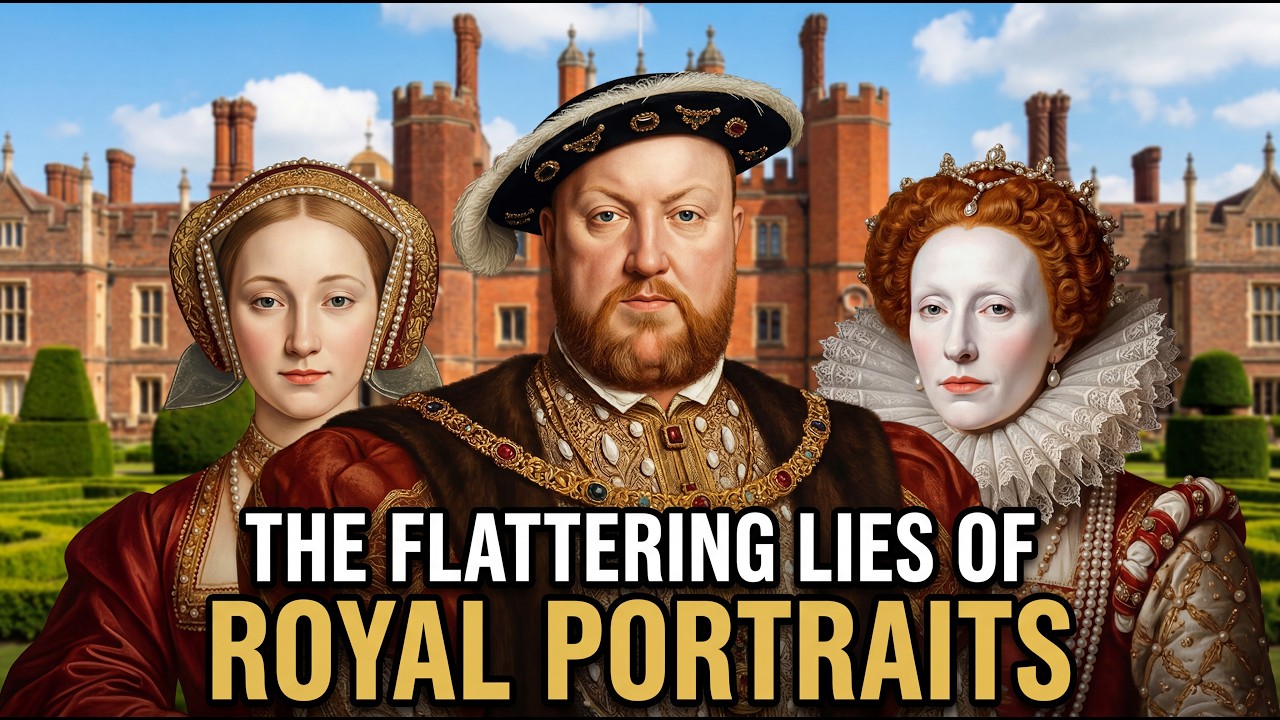
A single small painting put a tyrant in a good mood for days. That is the power of the object. That is why it mattered who held the brush. Christina, for the record, wanted nothing to do with him. She had heard what happened to English queens. But Henry loved the painting so much that he kept it until the day he died, and it hangs in the National Gallery in London still.
A portrait of a marriage that never happened, kept by a king who fell for the image and never got the woman. If you want one object that proves the portrait was a tool and not a record, it is that one. He didn’t keep it because it was true. He kept it because it worked. Now, follow the thread to the place where the flattering portrait stops being vanity and becomes something closer to a cover-up because there was one dynasty in Europe for whom the gap between the painted face and the real one was not about aging or a weak chin. It was about what their own blood was doing to them. The House of Habsburg ruled half of Europe for the better part of four centuries and they did it in large part by marrying each other, uncle to niece, first cousin to first cousin, generation after generation, deliberately, as policy, to keep the crowns and the territories inside the family. They were not careless about it. They were strategic. Every consanguineous match
was a calculation about land and succession, a way of making sure no outsider ever diluted the claim or carried a Habsburg crown into another house. By one estimate, across nearly two centuries, the great majority of marriages in the Spanish branch of the family were between close relatives. They believed the blood was the asset.
The blood was the empire and the family paid for it in the flesh. The most famous physical marker is the one historians still call the Habsburg jaw, a pronounced protruding lower jaw, an underbite so severe that in its worst cases, the mouth would not properly close.
You can trace it down the family portraits like a watermark. And in 2019, a team of researchers led by the geneticist Roman Vilas at the University of Santiago de Compostela did something nobody had quite done before. They used the portraits as medical evidence. They gathered 66 paintings of 15 Habsburg monarchs from the great collections, the Kunsthistorisches Museum in Vienna, the Prado in Madrid, and they handed them to 10 maxillofacial surgeons, asking them to diagnose from the paint the facial deformity in each face.
Then they compared the severity of the jaw to the degree of inbreeding in each subject’s family tree. The study, published in the Annals of Human Biology, found a clear positive relationship. The more inbred the king, the heavier the jaw. The paintings were honest enough, it turned out, to diagnose a genetic condition 500 years later.
But that honesty is precisely the thing the court painters of the time were working against. The last of the Spanish Habsburgs, Charles II, carried the most extreme version of the family’s inheritance. A jaw so pronounced that contemporaries reported he could not chew his food properly.
Alongside a long list of disabilities, the official paintings were careful to soften. He was sickly from birth, slow to develop, frequently unwell, and so visibly afflicted that his own court whispered he had been bewitched. And yet the painted Charles is a different proposition. The court painters who were handed that face had a near impossible brief.
Present a frail, struggling man as a healthy young sovereign, because the survival of the dynasty depended on the world believing the bloodline was strong. They could not erase the jaw entirely. It is right there in the portraits, which is how the surgeons could diagnose it centuries later. But they could control the rest.
The bearing, the robes, the steady gaze, the trappings of a functioning king. The portrait here is not flattering a vain king. It is hiding a genetic catastrophe from the courts of Europe who were watching very closely to see whether the Spanish line would produce an heir. It would not. Charles died without one, and the empire he could not hold together fell into a war over who would inherit it, the kind of war that redraws the map of a continent, all because a bloodline had quietly painted over its own collapse. And it touches a face this channel has met before, Margaret Teresa of Spain, the small solemn girl at the center of Velázquez’s Las Meninas, the most analyzed painting in the world. She was painted again and again as a child, and three of those portraits were packed up and sent across the continent to the Habsburg court in Vienna, where her
uncle, Leopold, was waiting to marry her. He was her mother’s brother. She married him at 15. She was dead at 21 after a string of pregnancies her body could not survive, only one child outliving infancy. The serene little infanta in the silk dress, sent abroad as a marriage portrait, was both the most beautiful image the Spanish court could produce, the advertisement for a marriage that the family’s own genetics had already doomed.
The painting did its job. The blood behind it did not. So, idealization for the Habsburgs had teeth. But the propaganda machine did not stop with hiding a jaw. Over the next century, it grew more sophisticated, more total, and more openly political, until the painted face was not just improved, it was engineered.
Go back to England and watch it happen in a single reign. Elizabeth I understood, better than almost any ruler before her, that her image was a political weapon, and she controlled it like one. Her whole authority rested on a paradox. She was an unmarried woman ruling alone in a century that did not believe women could rule.
And the longer she lived, the more the question of who would come after her naught at the kingdom. A queen with no husband and no child is a queen with no obvious future and a face that betrayed her age would have been read instantly as a clock ticking down. So, as she aged, her government made a decision.
The queen would not be allowed to look old. In the 1590s, her miniaturist, Nicholas Hilliard, devised what art historians now call the mask of youth, a single, fixed, idealized template of Elizabeth’s face, ageless and unlined, reduced to a few schematic flattering lines that every approved portrait from then on would copy.
The real Elizabeth was past 60. The painted Elizabeth was a smooth, eternal sovereign who would never die because a queen who looked mortal would have invited every ambitious man in England to start counting the days. At least 16 versions of that masked face survive. It is, in the most literal sense, a filter.
One approved image applied over and over, hiding the truth of a real face for a reason of state. The historian Roy Strong, who gave the mask of youth its name, saw it for exactly what it was, not vanity, but a deliberate instrument of government, a way of freezing time on a panel because time had become politically dangerous.
And to make sure no other version competed with it, the regime did something blunter. In 1596, the Privy Council issued an order. Officers were to seek out unseemly portraits of the queen that had given her great offense and have them defaced. Now, and this matters because it is the kind of thing that gets exaggerated into a myth of its own.
The order was not a command to destroy every honest likeness. It targeted what it called grossly inferior images by unskillful artisans, bad amateur copies, cheap and ugly, circulating among the public. It was quality control as much as censorship, but the instinct underneath it is unmistakable. The face of the monarch was state property.
You did not get to paint it however you liked. There was an approved version, and there was everything else. And the everything else could be scraped off a panel by order of the council. Then the machine matured into pure spectacle. By the time you reach Charles the First and his painter Anthony Van Dyck, the royal portrait has become theater on a wall.
Van Dyck was a Flemish master, a pupil of the giant Rubens, brought to London precisely because Charles wanted his kingship painted at the highest level Europe could supply. And Van Dyck delivered something new, not the stiff frontal icons of the Tudor century, but kings who looked relaxed, elegant, effortlessly born to rule, the very ease of them an argument for their right to the throne.
Look at the great equestrian portrait of Charles the First in the National Gallery. Over 3 and 1/2 m tall, the king mounted on an enormous horse, armored, serene, a baton of command in his hand, and the chain of the Order of the Garter at his throat, gazing down at you from far above your eye line, framed exactly like the bronze statues of mounted Roman emperors.
Everything in it says command, divinity, the unquestionable right to rule. And here is the quiet joke buried in all that majesty. Charles the First stood about 5 ft 4 in tall, with legs bowed from childhood rickets. The painting makes him a colossus. It is, in the most polished possible sense, a lie of scale.
Not a lie about his features, but a lie about his stature, his power, his place above ordinary men. The man on that horse is a Roman god. The man who sat for it was a small stammering king who believed God had handed him a country and who could not, in the end, hold it. Within a few years, the country would put that colossus on trial and take his head.
The portrait outlived the king it flattered and it is still trying, 400 years later, to tell you he was a giant. That is the through line and it is the whole point of pulling back this particular curtain. From a Tudor miniature carried across Europe to seal a marriage to a German painter vouching for a likeness while the legend called it a fraud.
To a small solemn infanta painted in silk and shipped to the uncle who would marry her. To a Spanish court painting a healthy young king over a dying bloodline. To an ageless mask laid over a 60-year-old queen. To a 5-ft king made into a Roman god. It is all the same machine. Different countries, different centuries, different painters of wildly different gifts and the same instinct running underneath every one of them.
The face the public sees is not the face that exists and the difference between them is where the power lives. And notice what that instinct is not. It is not, in most cases, a crude forgery. The genius of it is subtler than that. Holbein gave Henry an honest Anne and the legend still turned it into a lie.
The Habsburg painters left the jaw in the frame and still sold a dying dynasty as a living one. Hilliard reduced a queen to a few flattering lines and called it her face for the rest of her reign. The deception was rarely in the brushstroke that put something there that wasn’t.
It was in the framing, the scale, the light, the thousand quiet decisions about what to emphasize and what to let the eye slide past. That is what made it so durable. A clumsy lie gets caught. A beautiful, plausible, expertly painted improvement of the truth hangs on a palace wall for four centuries and teaches every visitor exactly what the sitter wanted them to believe.
The royal face you were shown was never the royal face that existed. It was the face that served power, painted by the best hands money could buy, hung where you would see it, and never permitted to be anything but flattering. The gap between the image and the reality was not an accident of any one painting. It was the entire purpose of the medium, and that is the part that should feel familiar.
Because we tell ourselves the curated face is a modern disease, the filtered selfie, the airbrushed magazine cover, the carefully chosen angle, the version of a person built for an audience instead of for the truth. We did not invent any of it. We just made it cheap. The most powerful people on Earth were doing it five centuries ago with pigment ground by hand and painters paid the wages of nobles on faces that hung in palaces and cross borders to decide the fate of kingdoms.
The gap between who you are and who you let the world see, that gap is the oldest performance in the building. Royalty was running it before the camera existed. Long before the filter and the airbrush, the most powerful people on Earth understood a simple truth. Whoever controls the image controls the story.
So, they hired the finest painters in the world not to record their faces, but to improve them. To slim the Habsburg jaw, to flatter the German princess, to turn frailty into majesty and ordinariness into divine right. Henry the VIII fell for it and never forgave the painting. The Habsburgs used it to hide what their own blood was doing to them.
And every serene royal face in every gallery you have ever walked through was a decision made by someone who knew exactly what they were hiding. The filtered selfie isn’t new. Royalty has been doing it for 500 years. They just paid more for the brush.