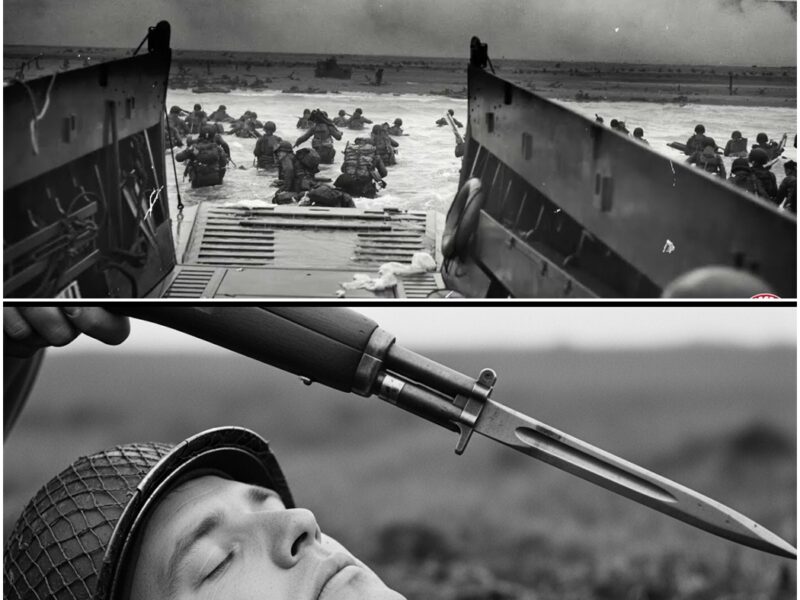
They Stabbed Him — He Played Dead, Then Killed 52 by Morning D
September 4th, 1944, 11:47 p.m., Sars-la-Bruyère, Belgium. Private First Class Gino Merli is lying in a foxhole with a dead man beside him. His assistant gunner took a bullet 3 hours ago, slumped sideways, and never moved again. Gino didn’t have time to check if he was breathing.
The Germans were still coming, and someone had to keep firing the machine gun. Now the firing has stopped. The Germans have pulled back, regrouping somewhere in the darkness, and Gino is alone with a corpse, a Browning M1919, and whatever ammunition he has left. He hears voices, German voices, getting closer.
Flashlight beams sweep across the foxhole, stop on the two Americans. A German soldier kneels down to check the bodies, standard procedure after an assault. Find the dead, finish off the wounded, collect weapons and intelligence. He draws his bayonet and jabs it into Gino’s buttocks. The pain is immediate and intense. Steel puncturing flesh, every nerve in Gino’s body screams at him to react, to fight, to do something. He doesn’t move.
The German jabs again, deeper this time, blood soaking into Gino’s uniform. He doesn’t breathe. The German grunts something to his comrades. They laugh. Two dead Americans, position secured. They move on to the next foxhole. By morning, 52 German soldiers will lie dead in front of his position, 19 of them directly in his line of fire.
And Gino Merli will earn the Medal of Honor for one of the most extraordinary displays of endurance and deception in World War II, all because he refused to flinch. Gino Joseph Merli was born May 13th, 1924 in Scranton, Pennsylvania. A coal town. Mine shafts and breaker buildings scattered across the Lackawanna Valley in the heart of the anthracite region that fueled America’s industrial revolution.
The army took Gino in July 1943. Gave him a uniform, three meals a day, and something he’d never had before, a purpose. For a kid who’d spent his whole life scraping by, it felt like salvation. Regular food, regular pay, a bed to sleep in, structure, discipline. The army wasn’t glamorous, but it was stable in a way nothing in Gino’s life had ever been stable.
They trained him on the Browning M1919A4, a 31-lb belt-fed machine gun that could fire 500 rounds per minute. In the right hands, a single Browning could hold off an entire infantry company. It could create what military called a beaten zone, an area where nothing could survive, where bullets came so fast and so continuously that advancing through them was nearly impossible.
Gino had the right hands. The instructors noticed it immediately. Steady, patient, accurate, the kind of machine gunner who could keep firing when everyone else had panicked and run. He shipped out in early 1944, destination England, assignment 18th Infantry Regiment, First Infantry Division, the Big Red One.
You need to understand what the First Infantry Division was in 1944 to understand what Gino was walking into. These men had already fought across North Africa, already stormed the beaches of Sicily, already buried more friends than they could count. They were hard, experienced soldiers who had learned through blood and death how to survive.
The kind of men who could smell an ambush before it happened, who could read terrain the way other people read newspapers. And they didn’t trust replacements. Why would they? Replacements were liabilities. Green kids who didn’t know the sounds yet, couldn’t tell incoming artillery from outgoing, couldn’t read the terrain, couldn’t keep their heads down when it mattered.
Replacements got themselves killed. Worse, they got the veterans killed. Gino arrived in England as just another new face, just another replacement who probably wouldn’t last a month. The veterans looked at him and saw a kid from Pennsylvania who’d never heard a shot fired in anger, never watched a friend die, never experienced anything that could prepare him for what was coming.
He would prove them wrong. But first, he had to survive Normandy. June 6th, 1944, D-Day, the largest amphibious invasion in human history. Gino’s regiment was scheduled for the second wave at Omaha Beach. Not the first boats, the ones that got torn apart by German machine guns the moment the ramps dropped, but close behind, close enough to see what had happened to the men who went before them.
They loaded onto landing craft before dawn. The English Channel was rough that morning, swells tossing the boats like toys. Men vomited over the sides, sick from the motion and the fear. The smell of diesel and salt water and terror filled the air. As they approached the beach, Gino could see the chaos.
Smoke everywhere, the crack of rifle fire, the deeper thump of artillery, bodies floating in the surf, bodies sprawled on the sand, bodies hanging from the obstacles the Germans had planted in the water to rip the bottoms out of landing craft. The The wave had been massacred. The German defenses were still intact, still firing, still killing anyone stupid enough to raise his head above cover.
The plan, the careful meticulous plan that generals had spent months perfecting, had fallen apart in the first few minutes. Colonel George Taylor, commanding the 16th Infantry Regiment, would later sum it up. Two kinds of people are staying on this beach, the dead and those who were going to die. Now, let’s get the hell out of here.
The 18th Infantry landed around 10:00 a.m. Gino jumped into waist-deep water and waded toward the carnage. The next 6 hours were a blur of running, crawling, shooting, and watching men die. Somehow, against all odds, they pushed forward up the bluffs, past the bunkers, through the wire, into France.
By nightfall, they were off the beach. They had cracked the Atlantic Wall and Gino Merli was still alive. The veterans looked at him differently after that. He wasn’t just a replacement anymore. He had walked through the same fire they had walked through and he had come out the other side. He was one of them now.
For 3 months, the first division pushed through France. The hedgerow country of Normandy was nightmare fighting. Every field was surrounded by ancient earthen walls, thick with vegetation, perfect for defense, and horrible for attack. The Germans would hide in one hedgerow, wait for the Americans to enter the field, and cut them down.
Then they’d fall back to the next hedgerow and do it again and again and again. Progress was measured in yards, in bodies, in fields that had to be taken one at a time, each one potentially full of men who wanted to kill you. Gino learned things in those hedgerows that no training could teach. How to listen for movement in the brush.
How to spot a machine gun nest before it spotted you. How to keep moving when every instinct screamed at you to freeze. How to kill without hesitation because hesitation got you killed. By September, the worst seemed to be over. The allies had broken out of Normandy. Paris was liberated.
The Germans were retreating so fast that supply lines couldn’t keep up with the advance. There was talk of being home by Christmas. The talk was premature. The Germans weren’t beaten. They were regrouping, preparing one last desperate defense of the fatherland. And in the small villages of Belgium, American units were about to find out just how much fight the Wehrmacht had left.
Sars-la-Bruyère was a village so small it barely appeared on maps. A handful of stone buildings clustered around a crossroads in the Belgian countryside. Farm country. Quiet. The kind of place where nothing important ever happened. On September 4th, 1944, Gino’s company was ordered to establish a roadblock on the outskirts.
Standard defensive position. Dig foxholes. Set up machine guns. Watch the approaches. Wait for orders. Gino was assigned to a section of 14 men. His foxhole covered the main road, the most likely avenue of enemy approach. He set up his Browning, checked his ammunition, and settled in for what he expected to be a quiet night.
Around 8:00 p.m., they spotted movement in the tree line. Figures emerging from the darkness. A lot of figures. The Americans opened fire. Muzzle flashes lit up the night. Germans screamed and scattered. For a moment, it seemed like a probing attack, a skirmish, nothing serious. Then more Germans appeared.
What had looked like a patrol was actually a full-scale assault. Hundreds of German soldiers attacking from multiple directions, coordinated and aggressive, professional troops who knew exactly what they were doing. The section leader made the only call he could make. They were being overrun. Fall back, regroup, live to fight another day.
Most of the section started pulling back. Some made it to safety. Eight were captured. Gino stayed. Machine gunners are trained to cover retreats. It’s part of the job. When your unit falls back, someone has to keep firing, keep the enemies heads down, buy time for the others to escape. That someone is usually dead within minutes.
Gino knew this. He’d been in combat for 3 months. He understood exactly what staying behind meant. He understood that the odds of survival were essentially zero. But Gino Merli had spent his whole life watching his father sacrifice everything for his family. Crawling into a mine every day, destroying his body so his children could eat. That’s what men did.
They stayed when others couldn’t. They paid the price so others didn’t have to. He stayed anyway. His assistant gunner stayed with him. The two of them alone in a foxhole with a single machine gun and whatever ammunition they had left, facing hundreds of German soldiers in the darkness. The Browning roared.
Belt after belt fed through the gun. Germans fell. Others took cover. The advance stalled. For hours they held. Two men creating enough chaos, enough death that an entire German assault ground to a halt. Every time the Germans tried to advance, the machine gun cut them down. Every time they tried to flank, Gino shifted fire and caught them in the open.
The night was noise and light and terror. Muzzle flashes in the darkness, explosions, screams in German and English, the constant hammering of the machine gun, so loud it made thought impossible. Then a German bullet found the assistant gunner. He slumped sideways, dead or dying. Gino couldn’t check, couldn’t stop firing.
The Germans were still coming, and if he stopped shooting for even a moment, they’d be on top of him. Now, it was just him. One man, one gun, hundreds of enemies in the dark. He kept fighting. At some point, Gino lost track of time. The night became a blur of firing and reloading, of muzzle flashes and screaming, of Germans falling and more Germans taking their place.
His ammunition was running low. His barrel was overheating. His hands were cramped from gripping the gun for hours. But he kept firing, because the moment he stopped, his retreating comrades would die. Then the Germans overran his position. There were too many of them coming from too many directions.
He couldn’t cover all the approaches. They were in the foxhole before he could react. Flashlights blinding him, rough hands grabbing at his weapon, German voices shouting commands he couldn’t understand, and then, silence. The Germans looked at the two Americans in the foxhole. One was obviously dead, slumped sideways with a bullet wound in his chest.
The other was slumped beside him, equally motionless. Standard procedure, check the bodies. A German soldier knelt down and drew his bayonet. What happened next should have been impossible. The bayonet went into Gino’s flesh. Not a gentle poke, a real stab, deep enough to draw blood, deep enough to cause genuine injury.
He didn’t move. Another stab. More pain, more blood. He didn’t breathe. Didn’t flinch. Didn’t make a sound. Every instinct in his body was screaming at him to react. The human nervous system isn’t designed to ignore pain. When something hurts you, you flinch. You scream. You fight back.
It’s automatic, hardwired into the deepest parts of the brain. Gino overrode all of it. Lay perfectly still while a German soldier stabbed him with a bayonet, checking to make sure he was dead. The German grunted, satisfied. Two dead Americans. Position secured. He stood up, said something to his comrades, and they moved on to the next foxhole.
The moment their backs were turned, Gino grabbed his machine gun and opened fire. Germans dropped. Others dove for cover. Complete chaos. They had just checked this position. They had stabbed both Americans. How was someone shooting at them? By the time they figured out what was happening, Gino had stopped firing.
He was slumped in his foxhole again, motionless, playing dead, waiting. It happened twice. A different group of Germans approached the position later that night. They didn’t know what had happened before. They saw two dead Americans in a foxhole, checked the bodies with bayonets, just like the first group had.
Gino didn’t move. Took the stabs. Let them walk away. Then he rose, grabbed his gun, opened fire, killed more Germans, and slumped back down again, playing dead, waiting for the next group. Think about what this required. Not just physical courage. Anyone who survives D-Day has physical courage. This was something else entirely.
This was control, the ability to override every instinct in the human body, to feel steel puncturing your flesh and not react. Most people can’t do that. Most people would flinch, would scream, would give themselves away. The pain would be too much. The fear would be too much. The sheer wrongness of lying still while someone stabs you would be too much.
Gino Merli did it twice. Took bayonet wounds, played dead, rose up and killed, played dead again, took more bayonet wounds, rose up and killed again. For 10 hours, alone in that foxhole, he repeated this cycle, fighting when he could, playing dead when he had to, never surrendering, never giving up.
That’s not just bravery, that’s willpower on a level that borders on superhuman. Dawn came slowly on September 5th, 1944. The fighting had stopped. The Germans had pulled back, demoralized by losses they couldn’t explain. Every time they’d tried to advance through this sector, something had torn them apart.
They didn’t know it was one man. They thought they were facing a fortified position, multiple machine guns, a force that couldn’t be broken. When the American counterattack came that morning, the Germans didn’t resist. They asked for a truce. 700 German soldiers laid down their weapons and surrendered.
The Americans advanced cautiously through the position, not quite believing it was over. They found German bodies scattered everywhere, shell casings carpeting the ground, signs of intense fighting that must have involved dozens of defenders. And in one foxhole, they found Gino Merli, still alive, still at his gun, covered in blood, most of it his own, some of it German.
His dead assistant gunner slumped beside him. Exactly where he’d fallen hours earlier. Spread out in front of the foxhole were 52 German corpses. 19 of them lay directly in Gino’s line of fire. One man, one gun, one night, 52 dead. Here’s the part that always gets me. When Gino’s commanding officer found him that morning, exhausted, bleeding from multiple bayonet wounds, surrounded by the men he’d killed, Gino had one request.
He asked to go to the village church to pray. Not for medical attention, though he desperately needed it. Not for food or water, though he hadn’t had either in hours. Not for rest, though he’d been fighting all night. He wanted to pray. His sergeant and a few other soldiers walked him to the small stone church in Sars-la-Bruyère.
They sat in the wooden pews while morning light filtered through the stained glass windows. And Gino prayed. For his assistant gunner, who had died beside him. For his comrades scattered across the Belgian countryside. And for the Germans he had killed. “No matter how bitter you were against the enemy,” Gino said years later, “you still had the heart to pray for him.
” Because he was in the same boat as you and I. He’d spent the night killing these men, watching them fall, hearing them scream, rising from the dead to cut them down, then playing dead again while their comrades stabbed him to make sure he was finished. And his first thought when it was over, his very first instinct, was to pray for their souls.
Because they were soldiers, too. Young men, far from home, following orders, caught up in something bigger than themselves. They had mothers who would never see them again, wives waiting for letters that would never come, Children who would grow up without fathers. Gino understood this. Even in that moment, even covered in their blood, he understood that the men he’d killed were human beings, just like him, trapped in a war that none of them had chosen.
That kind of compassion, after that kind of night, is something I can’t fully explain. It’s not something you learn. It’s something you are. When his commanding officer told Gino he was recommending him for the Medal of Honor, Gino pushed back. “Give it to my A-gunner,” he said.
“He deserves it more than I do.” His A-gunner was dead. Had been dead for hours. But Gino couldn’t accept recognition when the man who had stayed with him, who had fed the belts, watched his back, and died so that Gino could keep fighting, got nothing. They gave him the medal anyway. The Army doesn’t take no for an answer when it comes to heroism.
On June 15th, 1945, President Harry Truman placed the Medal of Honor around Gino Merli’s neck at a White House ceremony. The kid from the coal town, the high school dropout, the replacement who wasn’t supposed to last a month, standing in the rose garden with the President of the United States. And then he went home and did something unexpected.
Gino enrolled in high school. The same high school he dropped out of years earlier when his family couldn’t afford to keep him in school. He sat in classes with kids 5 years younger than him. Did the homework, took the tests, earned his diploma. He was 21 years old. He had a Medal of Honor. He could have done anything.
Speaking tours, book deals, political career. The whole country would have opened its doors. Instead, he finished high school because finishing what you start matters. Because his father, the coal miner who’d crossed an ocean with nothing, would have expected nothing less. After graduation, Gino got a job with the Veterans Administration.
Processing claims, helping veterans navigate the bureaucracy, cutting through red tape for men who’d given everything, and now needed help getting what they were owed. He did that for 30 years. 30 years of sitting at a desk, reviewing paperwork, making phone calls, fighting a different kind of battle for men who’d fought the same war he had.
The Medal of Honor hung somewhere in his house, but he never talked about it. When people asked about Belgium, about the foxhole, about the 52 Germans, he shrugged. Did what I had to do. That was it. That was all he ever said. In 1984, Gino returned to Normandy. Tom Brokaw was there, filming a documentary for the 40th anniversary of D-Day.
He walked the beaches with veterans who had stormed them four decades earlier. Listened to their stories, tried to understand what they had been through. Gino was one of them. Something about that trip planted a seed in Brokaw’s mind. These ordinary, unassuming men had done extraordinary things. Then they’d come home and lived quiet lives, raised families, built communities, never asked for recognition or praise.
That seed grew into The Greatest Generation, Brokaw’s best-selling tribute to the Americans who survived the Depression and won the war. Gino Merli’s story was part of the inspiration. He married Mary Santini Lemonselli in 1947. They had three children, Gino Jr., Philip, and Maria. His son Gino became a doctor, spent over 45 years at Thomas Jefferson University Hospital in Philadelphia, eventually rising to Associate Chief Medical Officer.
The coal miner’s grandson leading one of the most prestigious hospitals in America. One generation. That’s all it took. From the mines to medicine. From the darkness to healing. Gino’s brothers served too. Nicholas in the army. Chester in the army. Joseph in the Marines. Four Merli boys in uniform. All of them came home.
Not every family was so lucky. June 11th, 2002. Peckville, Pennsylvania. Gino was 78 years old. His health had been failing for years. Heart problems, kidney problems, Parkinson’s disease. The same slow deterioration that had taken so many of his generation. His wife Mary found him in the backyard.
Collapsed under a pear tree. They buried him at Our Mother of Sorrows Catholic Cemetery. Back in Lackawanna County. Back in coal country. A few miles from where he was born. The tributes came quickly. A veteran center named after him in Scranton. A state park. A street in Peckville. His name is everywhere now.
On buildings and street signs and historical markers. Most people who pass those signs have no idea who Gino Merli was. They see the name. They don’t know the story. That’s why I’m telling it. Here’s what the story of Gino Merli tells us. War doesn’t favor the biggest or the strongest or the most heavily armed. War favors the ones who refuse to quit.
The ones who keep fighting when fighting seems impossible. The ones who find a way. Anyway. To survive and prevail. At Sars-la-Bruyère. Gino Merli had every reason to give up. His unit had retreated. His assistant gunner was dead. He was alone. In the dark. Surrounded by hundreds of enemy soldiers.
The rational thing, the sensible thing, would have been to surrender and hope for mercy. But Gino wasn’t thinking about rational. He was thinking about the men who were retreating behind him. The men who would die if he stopped firing. He was thinking about the assistant gunner who had stayed with him and paid for it with his life.
So, he kept fighting. When he couldn’t fight, he played dead. When the Germans moved on, he rose and fought again. For 10 hours, alone, with bayonet wounds in his body and a dead friend beside him. And when it was over, when 52 Germans lay dead and 700 more had surrendered, his first thought was to pray for his comrades, for his enemies, for everyone caught up in the madness.
There’s a moment in every person’s life when they discover what they’re really made of. Most people never face that moment. They live comfortable lives, never tested, never pushed to the absolute limit of what a human being can endure. Gino Merli faced that moment in a foxhole in Belgium with bayonets in his flesh and death all around him.
He didn’t flinch. That’s not something you can fake. It’s not something you can learn in training. It’s something that lives deep inside a person waiting for the moment when everything else is stripped away. Gino Merli had it. The coal miner’s son. The high school dropout. The replacement who wasn’t supposed to last a month.
He had it when it mattered most.