Thomas Jefferson Was Not The Man We Were Taught He Was D
Thomas Jefferson didn’t just make history by winning the election in 1800. He made jaws drop at his inauguration, not because of what he said, but because of what he wore. While all of America’s founding fathers left behind powerful legacies, one name continues to spark admiration and controversy, Thomas Jefferson.
Hailed by many as one of the country’s greatest presidents, a visionary leader, and perhaps something far more sinister. Historians have debated the part he played in the continued rise of slavery in America. While the majority of his views seem uncommonly progressive, he still owned many slaves until the day he died.
When he was born on April 13th, 1743, his parents already owned a plantation, a source of income that would finance Thomas through his career. After 18 years of education under various tutors and in several different schools, Jefferson attended the College of William and Mary in 1761. While his intelligence was evident from the get-go, he also gained a reputation for spending much of his time partying and throwing his money away.
Having studied law and finishing his formal education by 1762, he gained admission to the Virginia bar 5 years later. He leaned progressive, much of which had to do with slavery reforms, and he fought to make it easier for slaves to receive emancipation. During his years as a lawyer, he strived to represent many slaves who wanted to be free.
From how he conducted his arguments, they stemmed from a seemingly strong belief that each person had an innate liberty and freedom. In 1757, Jefferson’s father, Peter, died and left his property to Thomas and his brother Randolph. Thomas had big plans for this land and by the late 1760s, he’d already started putting his fascination with architecture to use.
In 1768, he commenced building his forever home, a sprawling mansion named Monticello. Being a young up-and-coming lawyer, Jefferson was still one of Virginia’s most eligible bachelors until the 1770s. As the decade began, he entered a relationship with his third cousin, Martha Wayles Skelton, and they bonded over music and horseback riding.
After a couple of years, the two married on January 1st, 1772. Back in colonial times, it wasn’t always common for affluent people to enjoy marriage, but it’s said that Thomas and Martha were noticeably happy. However, as was more common at the time, only two of their six children survived till adulthood. By his early 30s, Jefferson had made waves in America’s burgeoning political landscape, becoming a delegate to the Second Continental Congress.
In 1775, this role started to carry more weight as the battles of Lexington and Concord kicked off the American Revolution. As Jefferson and the other delegates met in Philadelphia, they discussed their next step, knowing the colonies had had enough of Britain’s tyranny. Finally, they made a decision that defined history.
The concept came forward to draft and publish a formal declaration of America’s independence from British rule. Among the other delegates, Jefferson hit it off with a colleague from Massachusetts named John Adams. As their friendship grew, it also proved fruitful as Adams recognized Jefferson’s unique potential. Suddenly, with Adams’s endorsement, Jefferson found himself appointed to the Committee of Five tasked with writing the Declaration of Independence.
By June 28th, he produced the Declaration’s first draft, having written it almost entirely by himself. Although the delegates recognized America’s desire for independence, they hadn’t made the decision lightly. Britain held a tight leash, and such a declaration amounted to high treason. Jefferson and the other committee members knew this, but proceeded anyway and signed it on August the 2nd.
In 1779, Jefferson was elected the new governor of Virginia, a position he held for 2 years. In 1781, when the turncoat General Benedict Arnold invaded Virginia, Jefferson fled the enemy and contacted several commanders about the ongoing attack. Jefferson and Martha were married for 10 years before her health took a drastic turn for the worse.
Aside from ailments like diabetes and smallpox, the childbirths she had endured took a severe physical toll. Finally, shortly after the birth of their youngest, and after making Jefferson promise not to remarry, Martha died on September 6th, 1782. Although devastated, Jefferson carried on. With America’s victory in the Battle of Yorktown, the Revolution concluded, and 2 years later, Britain signed the Treaty of Paris, acknowledging the colonies’ independence.
Now a recognized sovereign nation, the colonies formed the new Congress of the Confederation. As he had done such a bang-up job before, Jefferson became Virginia’s delegate again. During this time, an issue arose when the national government acquired a massive stretch of territory northwest of the Ohio River. In response, Jefferson wrote the Land Ordinance of 1784, which not only argued for the government to divide the land into potential states, but also to ban slavery outright across their territories.
Recognizing Jefferson’s legal prowess and skill in negotiation, the Congress of the Confederation gave him an important but difficult job. Along with fellow former Committee of Five members John Adams and Benjamin Franklin, Jefferson received the task of negotiating treaties with other countries. Under Benjamin Franklin’s lead as minister to France, Jefferson began his international tenure with a trip to Paris in July 1784.
It was during this time that he reportedly fathered a child with one of his slaves, a young woman named Sally Hemings, who was around 15 years old at the time. Jefferson made friends everywhere, and while in Paris he grew closer to the Marquis de Lafayette. Already having significant experience from his aid in the American Revolution, Lafayette became an integral force in the new French Revolution.
After helping Lafayette write France’s Declaration, Jefferson knew it was time to return home. Leaving Paris in 1789, he traveled back to America eager to pick up where he left off. Although he was far away and against some of the more violent actions, he continued his support of the French Revolution.
As soon as Jefferson arrived home, George Washington threw him back into the fray with a request to be Secretary of State. This job was far from easy as he immediately faced America’s national debt and the question of its new capital. Not only that, but blocking him at every turn was the stubborn Secretary of the Treasury, Alexander Hamilton.
To deal with each state’s debt, Hamilton proposed that the government assume them collectively and create a national bank. On the other hand, Jefferson pushed for each state to deal with its own debt and wanted the nation’s capital in the south. Ultimately, the compromise of 1790 chose Hamilton’s plan and placed the capital farther north on the Potomac River.
In 1796, George Washington’s refusal to continue with a third term in office allowed Jefferson to reach for the highest station he could, the presidency. However, the candidate he was running against was an old friend. In a close culmination, Jefferson’s 68 electoral college votes were not enough to beat the 71 of his rival and new second president, John Adams.
According to the laws of the time, being in second place, Jefferson became vice president and stayed close to Adams. In 1800, Jefferson ran again and by this time the public’s view had largely turned against Adams as a result of several poor decisions. In this election, both Jefferson and his running mate turned rival, Aaron Burr, received the exact same number of electoral votes.
Therefore, as a tiebreaker, it was up to the House of Representatives to decide who would become the nation’s third president. They chose Jefferson. He attended his swearing-in ceremony on March 4th, 1801, immediately proving he differed from Washington or Adams, walking in with his friends in plain clothes.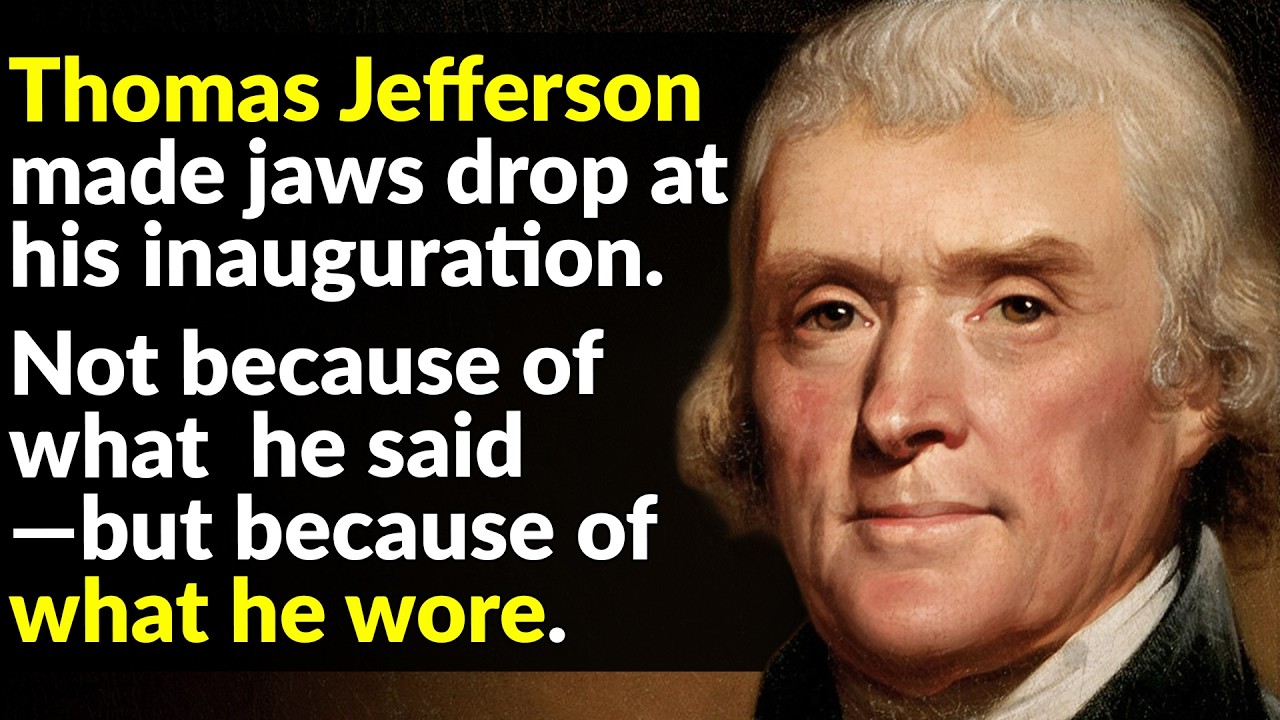
His disdain for needless formality was evident. Perhaps former President Adams would have had something to say if he’d actually shown up. Jefferson didn’t dwell too much on the absence of his old friend. Now America’s third president, he had big ideas. First, he faced the issue of mounting national debt.
With his new Secretary of the Treasury, Albert Gallatin, Jefferson thought up a series of solutions to eradicate the debt in 16 years. He started with the destruction of Hamilton’s fiscal system, including a reduction in taxes. Although Jefferson had supported the French Revolution, now that they were on America’s doorstep, he wasn’t so thrilled.
After France received ownership of Louisiana’s territory from Spain in 1800, Napoleon’s possible ambitions concerned Jefferson. So, he tasked Robert R. Livingston and James Monroe to negotiate a purchase of the territory. Little did he know Napoleon was thinking the same thing. Livingston and Monroe prepared for tough negotiations with France to buy Louisiana, but were pleasantly surprised to find that Napoleon had no intention of keeping the territory.
He not only saw it as unfeasible, but really needed the money to fuel his conflict with Britain. So, for $15 million, America purchased the almost 828,000 square miles of Louisiana land. With Louisiana secured, Jefferson turned his gaze to the unmapped territory further west, envisioning a new range of settlements.
After convincing Congress to fund an exploratory expedition, Jefferson tasked Meriwether Lewis and William Clark with charting their way through the new lands to the Pacific Ocean. Through all this land acquisition and exploration, the general public and those in power didn’t concern themselves with the land’s indigenous people, often seeing them as inferior.
However, Jefferson pushed back against this view and argued that while he thought their technology and culture weren’t as advanced, they were equal to the European colonists. In keeping with this view, he came up with an idea. Rather than eradicating or driving out America’s indigenous people, Jefferson believed in the concept of assimilation and living together peacefully.
According to what he called his civilization program, relations between the colonists and indigenous people would focus on how they could help each other and would encourage tribes to make federal purchases. Having grown tired of Burr as his vice president, Jefferson ran for re-election in 1804, but chose George Clinton to be his new running mate.
They’d go on to win in a landslide majority of 162 electoral votes to 14. Two years into his second term, Jefferson addressed the issue of the international slave trade. While it had been prohibited during the revolution, South Carolina had sent backpedaled to which Jefferson responded by urging Congress to criminalize it.
The importation of slaves was outlawed in 1807. While many admired Jefferson enough to vote for him multiple times, the list of those who disliked him grew. Through various blunders and responses to the situation between Britain and France, the American public began turning against him.
He’d spent his career trying to improve the new United States, but after several years as president, he found he could no longer keep up the struggle. After he finished his second term in 1809, James Madison succeeded him in office to whom he confided that relinquishing the presidency felt like being released from his chains.
Jefferson had been able to affect real change through his work as president. One of the most significant examples was his effort to decrease the massive national debt, and while he didn’t completely eliminate it, he chipped away a sizable $26 million. As Jefferson entered his 80s, several conditions continued to wear away at his health.
Suffering from rheumatism, a urinary disorder, and intestinal issues, he eventually became so weak and sickly by mid-1826 that he couldn’t leave his bed. Not long after becoming bedridden, his condition worsened, and he soon succumbed to his ailments. While surrounded by friends and family, Jefferson declined the painkillers offered by his doctor and uttered his final words in which he asked if it was July 4th.
It was and Thomas Jefferson died on Independence Day. Coincidentally, he wasn’t the only former president who died that day. A few hours later, John Adams died from a heart attack. As he hadn’t heard of Jefferson’s death, Adams’ final words were, “Thomas Jefferson survives.” To this day, historians still debate the question of where Jefferson stood on the issue of slavery.
Arguments for his character have ranged from claiming he was a proto-abolitionist who relied on slave labor to keep him in an influential position to him simply flip-flopping on the issue. Another topic that remains hotly debated is the question of how many illegitimate children Jefferson sired. Although some push back on this claim pointing to a lack of evidence, it’s widely believed that Jefferson fathered all of his slave Sally Hemings’ six children at Monticello.
Although Thomas Jefferson constantly attempted to end slavery in America, it’s important to remember that he still relied on and profited from his own slave labor. Still, in the long list of presidents since America’s founding, many often hold him up as one of the greatest.
His tolerant and peace-seeking attitude toward other races and religions is just one aspect that cemented him as one of America’s greatest leaders. Thanks for watching History X and Z. If you love uncovering the best stories in history, hit like and subscribe to keep exploring with us. If you enjoyed this video, check out the others on screen for more amazing history content.