What German Soldiers Said After Facing the Big Red One D
On a cold morning in October of 1944, in the smoking ruins of a German city called Aachen, an American officer stood over a group of exhausted prisoners and asked a simple question. Which American unit did you fear most on the entire Western Front? He expected a list. Paratroopers, maybe. Tank crews.
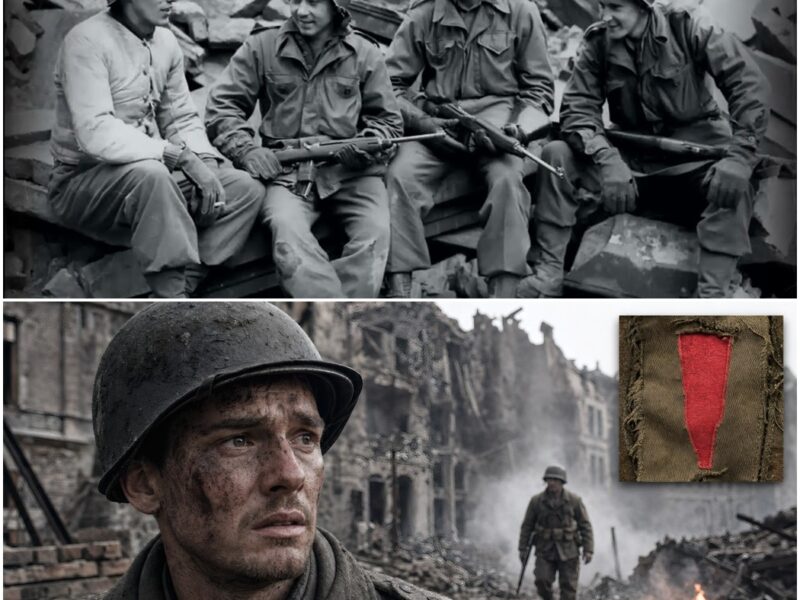
Fighter pilots screaming out of the clouds. Instead, a Wehrmacht sergeant, filthy and hollow-eyed, pointed at a torn shoulder patch lying in the rubble beside him. A red number stitched onto olive drab cloth. He did not know the unit’s official name. He did not need to. He had learned to recognize the shape of it from three continents away, in the sand of Tunisia, in the wheat fields of Sicily, in the hedgerows past a beach the world would later call Omaha.
He said only this, wherever that number appeared on the map, his own commanders redrew their lines. This is not the story you have heard. The paratroopers got the mini-series. The tank battalions got the war movies with two stars above the title. But if you ask the men who actually wore German field grey which American division haunted their letters home, their interrogation transcripts, their private diaries never meant for publication, the answer arrives again and again, unprompted, unpolished, and strangely consistent. Not the famous ones. Not the ones Hollywood remembers. A number. One. The big red one. Nobody in Washington invented that nickname. No public relations desk dreamed it up for a recruiting poster. It was born the way real reputations are always born, on the losing end of an exchange of fire, whispered by men who had every professional incentive to downplay their enemy, and chose again and again to tell the truth instead. Somewhere in the
space between the number stitched onto an American shoulder and the fear it produced in a German soldier’s chest lies an entire chapter of the war that popular memory quietly filed away. Tonight, we open that file. To understand why German soldiers spoke of one infantry division the way sailors once spoke of a reef, you first have to understand what that division already carried into the Second World War before it ever set foot on a beach.
The First Infantry Division of the United States Army was not a new formation improvised for this war. It was the oldest continuously serving division in the American regular army raised in 1917 for the trenches of the First World War where it had already earned a private catalog of firsts that its soldiers repeated like scripture.
First American division to reach France. First to fire an American shot at a German soldier in that earlier war. First to suffer American casualties. First to stage a major American offensive. Decades later in the Second War, it would add one more line to that list becoming the first American division to set foot on German soil itself.
And as a grim, almost sardonic footnote, one of the last to finally sail home. A division that measures its own history in firsts does not build a culture of caution. It builds a culture of collision. The shoulder patch that gave the division its name has its own quiet, almost embarrassing origin story.
During the First War, a soldier improvised a red numeral one from cloth taken, according to old regimental legend, from the cap of a German soldier killed in action. It was never meant to become an emblem of terror. It became one anyway because the men who wore it kept finding themselves at the front of every line the army needed to break.
By the time the division sailed for North Africa in November of 1942 as part of Operation Torch, the reputation was still theoretical. It would not stay theoretical for long. The man who shaped that reputation into something the enemy could recognize on sight was not a cautious man. Major General Terry de la Mesa Allen was by 1942 already something of an anomaly in an army increasingly obsessed with polish and procedure.
He had been shot in the face in the previous war and refused evacuation. He had once ridden 300 miles across Texas in a cavalry endurance race and won it. He drank hard, disliked paperwork, and built his division not around discipline in the parade ground sense, but around an almost tribal aggression.
The conviction that the first division existed to attack and that any hour not spent attacking was an hour wasted. His assistant division commander, Brigadier General Theodore Roosevelt Jr., son of the former president, walked the front lines with a cane from old war wounds and a pistol he rarely needed to draw because his presence among the forward foxholes did more for morale than any metal ceremony could.
Together, Allen and Roosevelt built something German intelligence officers would spend the next 2 years trying and failing to fully explain in their reports. A division that fought like it had nothing left to lose because in its own mind, it never had anything to prove twice. The first serious test of that reputation nearly broke it before it began.
In February of 1943, inexperienced American forces collided with veteran German panzer divisions at a mountain pass in Tunisia called Kasserine. The result was a rout. American tanks burned in the defiles, green infantry broke and ran under fire they had never trained to withstand. German officers who had spent years fighting the Soviets and the British filed reports back to Berlin that dripped with contempt for the American soldier.
A German panzer commander who fought at Kasserine later described the American units facing him in those first days with open scorn, writing that they came apart under pressure like men who had trained for a parade rather than a war. That contempt did not survive the month. 3 weeks after Kasserine, at a dusty crossroads called El Guettar, the first infantry division met German armor again.
This time dug in, prepared, and waiting to finish what Kasserine had started. What happened instead became the first time in the entire war that an American army formation defeated a German panzer counterattack in a straight offensive engagement. Allen’s infantry held their ground under a tank assault that should have scattered them, then pushed forward into positions the Germans had considered unassailable.
A German prisoner captured in the days following El Guettar told his interrogators, almost with disbelief in his voice according to the transcript, that the Americans in front of him had stopped behaving like the soldiers his officers had described only weeks earlier. He said it was as though an entirely different army had replaced the one that broke at Kasserine.
It had not been replaced, it had simply been for the first time taken seriously by its own high command and unleashed. The distinction mattered enormously to the men who lived through it, and it mattered even more to the German officers now forced to revise their assessment of the enemy across from them.
Word moved through Wehrmacht channels the way bad news always moves through an army, informally, faster than the official reports could keep up. Watch for the red numeral. It does not run twice. Sicily, five months later, offered the Germans a chance to test that lesson under far worse conditions. On the 9th of July, 1943, the largest amphibious invasion the world had yet seen put the 1st Infantry Division ashore near the town of Gela, into what General George Patton himself had privately identified as the single most dangerous stretch of the entire Allied landing zone. He had fought to get Allen’s division assigned to that exact beach, reportedly telling Eisenhower that he wanted, in his own blunt phrasing, those particular soldiers and no others for the job. He got his wish, and the wisdom of it became clear within hours. German and Italian armor counterattacked toward the beachhead almost immediately, Panzers rolling to within roughly 2,000 yd of the waterline while American troops were still unloading equipment onto open sand.
Naval gunfire from offshore cruisers helped blunt the assault, but it was Allen’s infantrymen dug into shallow scrapes in the ground with nothing heavier than bazookas and grenades, who let the tanks roll past their positions, and then turned to cut down the German foot soldiers advancing behind them, separating armor from infantry in a maneuver no manual had specifically prepared them for.
A German infantry officer who survived that counterattack near Gela wrote afterwards that the Americans on that beach fought with a discipline under fire that his own briefings had assured him did not yet exist in the United States Army. From the beachhead, the division fought its way inland through 37 punishing days, taking 18 towns across brutal mountain terrain, and colliding at the town of Troina with some of the toughest resistance of the entire Sicilian campaign.
German defenders launched no fewer than 24 separate counterattacks trying to hold that town. And one German officer among the defenders later admitted that the position had been ordered held at any cost because losing it meant losing the anchor of the entire German line on the island. It fell anyway to a division that outside observers on Patton’s own staff were now calling without exaggeration the hardest fighting formation in the Mediterranean theater.
And then, at the peak of that reputation, the division lost both of the men who had built it. In the final days of the Sicilian campaign, Terry Allen and Theodore Roosevelt Jr. were quietly relieved of their commands, officially for questions of discipline, in reality for a tangle of personal and political reasons among senior American generals that historians still argue about today.
Allen learned of his own relief while his photograph was still on the cover of a national magazine celebrating his division’s victories. It was, by any honest measure, one of the strangest command decisions of the American war. A division’s architects removed at the exact moment their design was proven correct.
Allen would return within a year to lead an entirely different division, the 104th into Germany with the same aggressive spirit intact. But the 1st Infantry Division itself now belonged to a new commander, a disciplined exacting officer named Major General Clarence Huebner, who inherited Alan’s fighting spirit and welded it for the first time to a level of precision that the coming invasion of France would demand absolutely.
That invasion arrived on the 6th of June, 1944, and it placed the 1st Infantry Division at the single most heavily defended stretch of coastline the Allies would face that day, a beach the planning maps labeled simply Omaha. What followed there deserves to be understood not as one battle, but as three simultaneous German perspectives on the same catastrophe, because the way the German defense described that morning changed hour by hour as the reality in front of them refused to conform to what their own doctrine had told them was possible. In the first hour, from the bunkers overlooking the sand, a German machine gun crew serving the defenses above Omaha reported almost clinical confidence, logging that the landing forces in front of them were being cut down in the surf faster than they could organize, and that no organized assault seemed capable of surviving the beaten zone below the bluffs. For a while, that assessment was not wrong. Entire companies of the 16th Infantry Regiment suffered casualty rates approaching 30% within the first hour alone, cut down before most of them had
cleared the waterline. Colonel George Taylor, commanding that regiment from the exposed sand itself, is remembered for one of the starkest lines of the entire war, telling the men pinned against the shingle that only two kinds of soldiers were going to remain on that beach, the dead and the ones who were about to die, so they had better start moving inland immediately.
It was not poetry. It was the only kind of order that could still function in that moment, and the men obeyed it. By the second hour, the tone in German positions had already begun to shift. A German war correspondent embedded with the coastal defense described watching, through binoculars, small isolated clusters of American soldiers doing something his training had not prepared him to expect, continuing to advance individually up draws and gullies even after their officers had been killed and their formations had disintegrated into chaos. He wrote that the landing should, by every rule of warfare he understood, have been thrown back into the sea by mid-morning and that its survival could only be explained by an almost animal stubbornness in the individual American infantryman that no manual could account for. By the third hour, a captured German battalion staff officer, questioned shortly after the beachhead was finally secured, offered the most complete of the three assessments, admitting under interrogation that his defensive plan
had assumed the invaders would break under sustained fire within the first 30 minutes and that instead, the beach had somehow generated its own momentum, small groups of Americans linking up, finding gaps in the wire and climbing the bluffs from directions his own gun positions could not cover.
Three different German voices, three different hours of the same single morning and the same widening realization running through all of them. The plan had accounted for panic. It had not accounted for men who kept moving forward anyway. By nightfall on the 6th of June, Omaha Beach belonged to the Allies at a human cost the division would carry for the rest of its existence.
Clarence Huebner, the very general who had replaced Allen after Sicily, had led his men through the single deadliest morning most of them would ever experience and had done it with the exacting discipline his predecessor had once been accused of lacking. The lesson German commanders drew from that day would follow the division for the rest of the war.
This was not a unit that could be stopped by killing its momentum in the first hour. It had to be stopped, if it could be stopped at all, before it ever reached the water’s edge and by autumn of that same year, no German position on the entire Western Front would manage that either.
The autumn of 1944 brought the division to a German city itself, Aachen, the first city on German soil that any Allied force would capture in the entire war, and the psychological weight of that fact was not lost on either side. For the German High Command, losing Aachen meant losing the sacred principle that the war had not yet touched the homeland.
For the roughly 5,000 German soldiers and Volkssturm militia defending it under Colonel Gerhard Wilck, holding the city became less a tactical necessity than a symbolic last stand ordered directly by Hitler himself to be defended to the last man. What followed through October of 1944 was urban combat of a viciousness that the division’s earlier campaigns, for all their brutality, had rarely matched.
American self-propelled artillery pieces fired directly into individual buildings at point-blank range, leveling entire city blocks one structure at a time because the alternative, clearing each building room by room against fanatical defenders, cost too many lives to sustain indefinitely. A German communications officer trapped inside the collapsing perimeter radioed a report to his superiors describing the American method with something close to professional horror, noting that the attackers seemed willing to demolish an entire city rather than lose a single additional soldier taking it street by street, and that no defensive position, however well prepared, was surviving contact with that kind of firepower for more than a matter of hours. On the 21st of October, with barely 20% of the city’s original structures still standing and his own defenses reduced to isolated pockets of exhausted men, Colonel Wilck surrendered the ruins of Aachen to the division that had encircled it. It marked the first time in the Second
World War that a German city fell to an invading army on any front, east or west, and the men who accomplished it were the same Red Numerical One that had first tested itself against German armor at El Guettar 19 months and three campaigns earlier. There was no time to savor the victory. Within weeks, the division found itself committed to one of the grimmest chapters of the entire war on the Western Front, a dense, freezing tangle of pine forest along the German border called the Hurtgen Forest, where visibility dropped to a few meters. Artillery shells burst in the treetops and rained shrapnel downward onto men with no overhead cover, and the front line barely moved for weeks despite catastrophic losses on both sides. Two entire rifle companies of the 26th Infantry Regiment, designated simply E and F, were effectively annihilated in the fighting, reduced to fragments of their original strength within days. Replacement soldiers, many of them barely trained, were fed directly into
the same foxholes their predecessors had died defending, and within 3 days, those replacements had killed roughly 1,200 German soldiers holding off a determined tank and infantry counterattack. A German infantry veteran, reflecting decades later on the fighting inside that forest, described it not as a battle in any conventional sense, but as a machine that consumed men on both sides indiscriminately, and admitted that of every unit his forces faced in that forest, the one bearing the red numeral seemed to absorb losses that should have broken it and simply kept attacking regardless. To understand why German assessments of this particular division remained so consistent across 3 years and four separate campaigns, from the deserts of Tunisia to the forests of the German frontier, requires looking past individual battles toward something closer to institutional culture. Most American divisions of the Second World War were raised, trained, and shipped to war as complete units, sharing a single collective experience of combat from their first battle onward. The First Infantry Division carried something
different into every engagement, a chain of veteran non-commissioned officers and company-grade officers stretching back in some cases to the trenches of the previous war, men who had personally absorbed and then deliberately passed down the aggressive, forward-leaning instincts that Terry Allen had once tried to instill by force of personality alone.
Even after Allen himself was gone, that inherited instinct did not disappear. It became doctrine, transmitted from sergeant to private in the particular unglamorous way real military culture actually spreads, through example under fire rather than through any manual. German intelligence summaries compiled across the Tunisian, Sicilian, and Normandy campaigns noted this pattern with a kind of grudging professional respect rarely extended to American formations in general.
Where other American divisions were frequently described in German assessments as capable but conventional, the 1st Infantry Division appeared again and again in language reserved for units the Wehrmacht considered genuinely dangerous, a designation German staff officers did not hand out casually because admitting an enemy’s competence meant admitting your own plan needed to change because of it.
By the time the war in Europe ended in May of 1945, the division had fought for 443 days across eight separate campaigns, absorbed nearly 5,000 men killed in action, and over 17,000 wounded, and produced 17 recipients of the nation’s highest award for combat valor. It had gone first into North Africa, first into a German city, and it was, fittingly, among the last American combat divisions to finally sail home, closing the same circle its own soldiers had traced back to the trenches of 1917.
And yet ask most people today which American infantry division German soldiers feared most in the Second World War, and the honest answer is that most people cannot answer at all because popular memory of that war was shaped less by which units the enemy actually respected and more by which units happened to produce the most compelling post-war television.
A single acclaimed mini-series built an entire generation’s mental image of the American infantryman around one airborne regiment’s experience in Normandy and beyond, a story worth telling and worth remembering, but one that occupied so much cultural space that it quietly crowded out formations whose own documented record, measured in the enemy’s own words rather than in screen time, arguably surpassed it.
The 1st Infantry Division fought longer, bled more, and was named more consistently by German officers as their most dreaded American opponent than almost any other formation in the entire European theater, and it remains for most viewers simply a patch, a red numeral without a story attached.
That erasure was not accidental so much as it was structural. The men who fought at El Guettar and Gela and Troina came home to a country eager to move forward, not backward into memory, and the officers who might have shaped that memory, Allen and Roosevelt among them, had already been quietly sidelined by their own command before the war even ended, denying the division the kind of postwar champions that other units found in their surviving generals.
Terry Allen died in 1969, having spent decades watching younger, more polished commanders receive the historical credit his own reckless brilliance had helped make possible in the first place. Theodore Roosevelt Jr. did not live to see any of it, dying of a heart attack in France barely a month after leading troops ashore at Utah Beach with a different division.
On the same day his old comrades from the 1st were fighting their way off the sand at Omaha. So, return for a moment to that cold October morning outside Aachen, to a defeated German sergeant pointing at a torn red numeral lying in the rubble of his own broken defenses. He did not know he was describing a division that history would later half forget.
He only knew what his own eyes and his own fear had taught him across a year and a half of retreating in front of that patch, from a mountain pass in Tunisia to a beach in Normandy to the ruins of his own nation’s first fallen city. The Germans did not need Hollywood to tell them which Americans to fear. They learned it the way soldiers have always learned such things, in blood, in defeat, and in the particular unglamorous honesty of men writing home about the enemy who kept beating them campaign after campaign long after every rule of war said they should have stopped. That honesty survives in archives most people will never read. Tonight at least it survived long enough to be heard.