What REALLY Happened to Britain’s 9.2-Inch Heavy Howitzers After WW1 D
By November 1918, intelligence estimated that some 692 of these monstrous siege howitzers remained in British service, scattered across gun parks and battery positions from Flanders to the Ryan bridge heads. They had fired more than 3 million rounds of high explosive during the war, earning a reputation as the most feared counter weapon on the Western Front.
Now, with the guns falling silent, an entirely different question presented itself. What does an empire do with hundreds of obsolete siege weapons once the war that justified them has ended? The 9.2 in howitzer had begun life almost as an experiment. A single prototype, nicknamed mother by the men who served it, fired its first round in action on 31st October 1914, and within weeks it had been inspected by field marshal Sir John French and visited by the Prince of Wales himself.
So unusual was this new class of heavy ordinance. 16 production examples were ordered almost immediately, followed by 16 more within the month. By the time the armistice was signed at Compa, the design had matured through two principal marks. The improved Mark II entering service in December 1916 with a longer barrel and a range extended to nearly 14,000 yards.
What had started as a curiosity had become the backbone of British siege artillery, equipping dozens of batteries of the Royal Garrison artillery and by 1918, batteries crewed by Australian, Canadian, and American gunners as well. Peace brought no immediate certainty about the future of this weapon.
Whilst German technology captured on the battlefield was subject to demolition and confiscation under the disarmament terms soon to be codified at Versailles, Britain’s own howitzers faced a different and in some ways more mundane fate. The brutal arithmetic of postwar economy. An empire exhausted by four years of total war, staring down enormous debts and a public mood demanding retrenchment could not simply keep hundreds of 14 ton siege pieces standing idle in French fields.
The guns that had helped win the war were about to become a liability that someone would have to pay to store, maintain, or dispose of. The situation at war’s end was one of extraordinary scale and disorder. Batteries were found still in placed around Comre and along the Hindenburg line, some freshly relocated during the final 100 days offensive, others having barely fired a shot before the gun stopped.
Some equipments were in near pristine condition, having only recently left the Vicers or Coventry Ordinance Works production lines. Others were worn nearly smooth in the boar after years of continuous fire, their recoil systems leaking hydraulic fluid. Their platform sunk deep into churned Flanders mud.
Transport alone posed a formidable challenge since each howitzer required three separate loads. Its body and cradle, its bed and its barrel moved on purpose-built wagons that were themselves in short supply as the army demobilized around them. Depos at Lohav, Calala, and the Channel ports filled with dismantled ordinance awaiting shipment home, whilst officers of the ordinance directorate debated which examples merited retention, which should be sold as scrap, and which, if any, deserved a place in the nation’s memory. Unlike the German equipment being cataloged and confiscated under the Interallied Control Commission a few hundred miles to the east, these were British-built weapons crewed by British, Australian, Canadian, and American gunners alike, and there was no treaty clause compelling their destruction. That absence of legal obligation made the decisions that followed feel in some ways more arbitrary and more painful for the men who had served the guns. A weapon judged too expensive to ship home might simply be abandoned where it stood, whilst one earmarked for a training establishment might survive for
another two decades. The debate that mattered here was not disarmament but economy. whether the Treasury could justify the cost of shipping, storing, and maintaining several hundred 14 ton siege pieces at a moment when the entire machinery of the wartime state was being dismantled around them.
Subscribe if you’re enjoying this look at the quieter, less discussed side of the Great War’s aftermath. Britain’s own handling of the Howitzers fell to the War Office and its newly formed disposal and liquidation commission, tasked with converting the vast surplus of the wartime army into cash or usable stock for a peaceime force.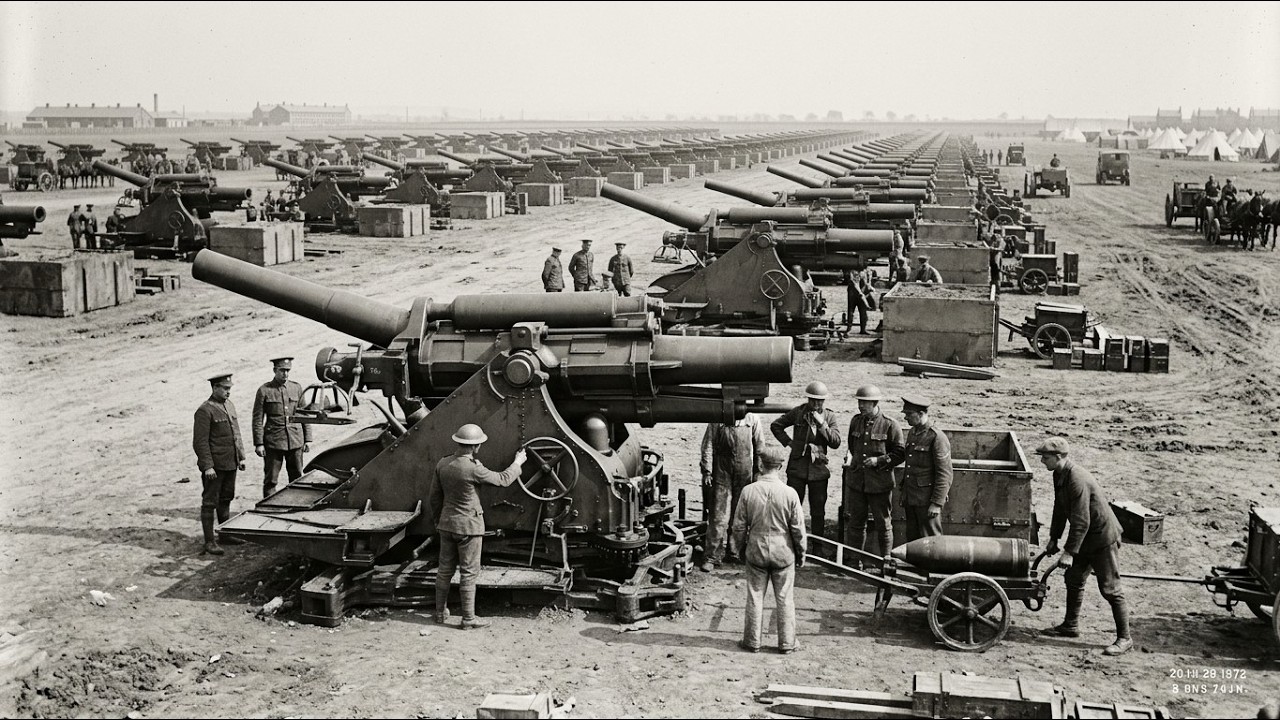
Roughly 200 examples were earmarked for retention, distributed amongst training establishments at Lark Hill and Schubberiness, where Mother herself, the original prototype, was fired until she was quite worn out and finally retired to storage. The remainder, several hundred equipments scattered across France and Belgium, were assessed for repatriation.
And by the autumn of 1919, shipping priority had shifted overwhelmingly towards men rather than machinery, meaning many howitzers sat abandoned in French depots for a year or more before anyone arranged their return. Those that did come home were often sold at public auction as scrap steel, their barrels cut for furnace stock at a time when the iron and steel trade desperately needed raw material for reconstruction.
Some carriages stripped of their valuable bronze and brass fittings were left to rust in ordinance yards at Wulitch and Chillwwell. Their fate a matter of bureaucratic indifference rather than deliberate policy. Canada’s contribution to the 9.2 2-in howitzer story ran through the Canadian corps’s heavy artillery groups whose gunners had crewed British supplied equipments throughout the war’s final campaigns.
When the core demobilized through 1919, Canadian authorities showed considerably less appetite than the British for retaining such heavy siege pieces given Canada’s smallstanding peaceime garrison requirements and the great majority of Canadian crude howitzers were simply returned to British ordinance control rather than shipped across the Atlantic.
A handful were retained as instructional pieces at Canadian artillery schools and later found their way into militia armories, whilst the bulk rejoined the general pool of surplus equipment awaiting disposal in France. Australia’s Imperial Force followed a broadly similar pattern, though with one important difference.
A deliberate program of returning selected weapons as war trophies for Australian towns and cities. a practice that saw field guns, howitzers, and captured German ordinance alike shipped home to stand in parks and outside town halls as permanent memorials. Whilst the majority of trophy guns distributed to Australian municipalities were captured German pieces rather than Britishbuilt 9.
2 2-in howitzers. At least a small number of the latter were secured through the Australian war record section for eventual display, reflecting the strong sentiment amongst returning servicemen that the guns which had supported their advances at Ver’s Bretonu and Monsan deserved to be remembered rather than melted down.
The American expeditionary forces experience differed again. American heavy artillery units had trained on and operated British supplied 9.2 2 inch howitzers during 1918 since American industry had not produced its own equivalent siege piece in time for the war’s end. Once hostilities ceased, the United States Army had little interest in retaining foreign ordinance for which no domestic ammunition supply chain existed, and virtually all American crude examples were returned to British stocks in France during the demobilization of 1919. A small number were shipped to the United States for technical evaluation by the ordinance department at Aberdine proving ground where engineers studied the vicer’s designed recoil mechanism and wheel and breach system for lessons applicable to future American heavy artillery development. Though the howitzer itself was never adopted for American service disposal once the decision had been made proceeded with the same brisk economy that characterized so much of Britain’s postwar demobilization. The Ministry of Munitions, working alongside the Disposal Board, oversaw the sale of
hundreds of complete equipments and spare barrels to scrap metal contractors through 1920 and 1921. A period when the collapse in post-war metal prices meant the government often recovered only a fraction of the gun’s original manufacturing cost. Steel works in South Wales and the Midlands absorbed much of this material, feeding a domestic industry hungry for recycled ordinance-grade steel during the difficult transition to peaceime production.
Some carriages were simply broken up on site in France rather than shipped home at all. The cost of transport judged not worth the residual scrap value. Ammunition stocks running into the low millions of unfired 290lb high explosive shells presented their own hazard. And considerable quantities were disposed of through controlled demolition at ranges such as shoe buress where obsolete shell had long been destroyed under controlled conditions rather than risk deterioration in storage.
By the mid 1920s, the overwhelming majority, probably in excess of four-fifths of the wartime total, had been scrapped, sold, or expended, leaving only a modest retained establishment for training and a scattering of memorial pieces. What survived did so for a mixture of reasons, sentiment, training utility, and simple bureaucratic inertia.
The retained training equipments at Lark Hill and Schubess formed the nucleus of the Interwar Royal Artillery’s heavy howitzer expertise. And it was from this small surviving pool that a limited number were returned to active service with British forces during the Battle of France in 1940.
A startling reappearance of Great War ordinance in an entirely different conflict before the remainder were withdrawn to home defense duties for the rest of the Second World War. The original mother prototype barrel survives today mounted on a Mark1 carriage and is preserved by the Imperial War Museum in London, one of the most recognizable single artifacts of British siege artillery anywhere in the world.
Further examples can be found at the Royal Artillery Historical Trusts collection, now based at Lark Hill. Whilst the Australian War Memorial in Canra holds artillery pieces from the same family of ordinance amongst its trophy collection, the baseboard and military museum in Canada and several regimental museums across the Commonwealth retain component parts, breach mechanisms, and instructional sections rather than complete equipments, a reflection of how thoroughly the bulk of the type was broken up rather than preserved whole. Restoration of what does survive has been a slow and painstaking business. Decades in outdoor storage left many retained carriages badly corroded. Their hydronneumatic recoil cylinders long since drained and seized. And volunteers working with regimental trusts have spent years tracking down replacement gauges, sighting equipment, and small fittings that were removed and lost during the original scrapping drives of the 1920s. Complete, correctly matched equipments, barrel, cradle, and bed, all from the same mark and in original condition, are now exceptionally rare since so many surviving barrels were paired with mismatched carriages during
the years when spare parts were simply cannibalized from whatever stock remained in ordinance depots. Occasional battlefield finds still surface, buried gunpits and collapsed in placements along the old western front, occasionally yielding fragments of breach mechanisms or carriage iron work. Though a complete recovered equipment has not emerged from French or Belgian soil in living memory, what remains today then is a handful of static, largely immobile survivors, valued as much for their rarity as for their engineering. Each one representing perhaps one in 300 of the guns that stood ready along the front when the armistice was signed. The 9.2 in howitzer’s technical legacy outlived the guns themselves. Its well-in breach block and hydronneumatic recoil system refined across two marks under wartime pressure informed the design thinking behind Britain’s later BL 7.2 in howitzer of the second world war itself created in the early 1940s by reboring worn 8-in barrels along similar principles. The weapon’s central place in the Royal Artillery’s own self-image is perhaps best captured by its
selection as the symbolic gun depicted on the Royal Artillery Memorial at Hide Park Corner unveiled in 1925. a permanent monument choosing this weapon above all others to represent the Gunner’s war. That such an iconic and feared piece of equipment could nonetheless be reduced within barely a decade from 692 examples to a bare handful of survivors says a great deal about how quickly even the most formidable wartime technology can vanish once its usefulness has passed.
It began as a single experimental barrel tested in the Welsh hills at Riyetta in the summer of 1914 and within four years it had become the weapon chosen to represent an entire arm of the British army in bronze at Hyde Park Corner. Most of the 692 howitzers that saw the armistice were gone within a decade, cut up for scrap steel or expended on the ranges, and only a scattered handful headed by Mother herself remain to be seen today.
If you found this video insightful, watch what happened to Britain’s captured German heavy artillery after World War I next. It explores how thousands of enemy guns seized along the retreating front were cataloged, tested, distributed as war trophies to towns across Britain and the Commonwealth, and in most cases quietly melted down within a generation.
Like this video, subscribe, and hit the bell for more. Thanks for watching.