What REALLY Happened to Britain’s Lee-Enfield Rifles After WW1 D
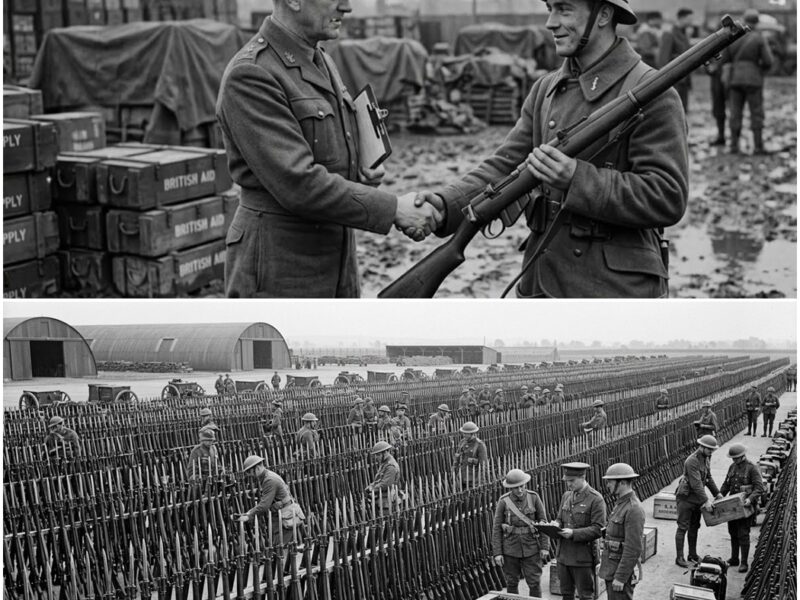
By November 1918, intelligence and quartermaster records suggested that well over 3 and 1/2 million Lee-Enfield rifles had passed through British and Imperial service since 1914, scattered from the depots of Woolwich to the trenches of Flanders, from Salonika to Mesopotamia, from Gallipoli’s beaches to the training camps of Aldershot.
When the guns fell silent on the Western Front, the question facing the War Office was not how to defeat an enemy, but how to manage an empire’s worth of surplus weaponry, much of it still perfectly serviceable, all of it suddenly without an obvious purpose. What followed was not a single tidy story, but a tangled decade of storage, sale, conversion, gifting, and slow attrition that would determine which rifles survived to become collector’s pieces, and which vanished into furnaces, foreign arsenals, or forgotten corners of the world. The situation in the weeks after the armistice was one of almost overwhelming abundance. Royal Small Arms Factory Enfield, together with contractors including BSA in Birmingham and the Standard Small Arms Company, had produced rifles at a pace scarcely imaginable before 1914, and by the war’s end, monthly production figures alone sometimes exceeded 100,000 units. Millions of Short Magazine Lee-Enfield Mark III rifles, the standard infantry weapon since 1907, sat in ordnance depots at Weedon, Chilwell, and Woolwich, whilst hundreds of thousands
more were being shipped home from theaters across the globe. Return convoys brought rifles back from France in numbers that overwhelmed the receiving depots. Some estimates placed return stock at over 2 million rifles within 18 months of the armistice. Many arrived filthy, rusted, or damaged, requiring inspection and refurbishment before they could even be classified as fit for reserve stock.
The immediate logistical challenge was not destruction, but simply storage. Warehousing space, oil, grease, and manpower were all in short supply, and the Ordnance Department found itself managing an inventory problem of extraordinary scale at precisely the moment demobilization was stripping away the very personnel needed to manage it.
Unlike German war material, subject to the disarmament clauses of the Treaty of Versailles and the scrutiny of the Inter-Allied Control Commission, Britain’s own rifles faced no external mandate for destruction. The debate here was economic rather than political. What should a peacetime empire, its treasury drained by four years of war, do with millions of serviceable rifles it could not possibly need again on such a scale? Some argued for retention against future contingency. Others, particularly in the Treasury, pushed hard for disposal and cost recovery. This tension between hoarding, selling, and scrapping would shape the rifles’ fate for the following two decades. Britain’s own handling of the surplus proceeded along several tracks simultaneously. The War Office retained a substantial reserve, recognizing that the reduced peacetime army, the Territorial Force, and Officer Training Corps units across the country would all continue to require rifles for drill and range work. Depots such as Weedon in Northamptonshire became vast repositories, their sheds holding rifles in reserve of war condition, cosmolined
and racked by the hundred thousand, some of which would remain there essentially untouched for over 20 years. Simultaneously, the government authorized the sale of substantial quantities of surplus, both domestically through licensed dealers and internationally. Rifles were sold to dominion governments, to police forces throughout the empire, and to civilian shooting organizations, including the National Rifle Association, whose Bisley ranges absorbed thousands of Mark III rifles, converted or retained for target shooting. The Royal Navy and Royal Air Force conducted parallel but smaller-scale retention exercises, keeping rifles for shore establishments and ceremonial units, respectively. Though naval small arms policy remained subordinate to War Office direction throughout the period. France’s interest in British rifles was limited, but not absent. French forces had used small numbers of Lee-Enfields early in the war under supply-sharing arrangements. And after 1918, French arsenals evaluated captured and surplus allied small arms alongside German Mausers as part of a broader post-war assessment of infantry rifle doctrine. Though France’s own Lebel and Berthier
systems remained dominant and no large-scale French adoption of the Lee-Enfield followed, French technical missions did examine British ammunition standardization and magazine-fed rifle designs during discussions in 1919 and 1920 about possible common Allied ordnance standards, discussions which ultimately produced no binding agreement, each power preferring to retain its own logistics chain.
The United States, having entered the war late and equipped many of its own troops with the Pattern 1917 Enfield, a rifle mechanically related to the Lee-Enfield family but chambered for the American .30-06 cartridge rather than the British .303, took a more particular interest in comparative testing. At Springfield Armory and at Aberdeen Proving Ground in Maryland, American ordnance officers conducted trials comparing the Lee-Enfield’s rear locking bolt and 10-round magazine against the front locking Springfield M1903 and the P17. American reports, several dated through 1919 and 1920, noted the Lee-Enfield’s exceptionally fast bolt action cycling, attributable to its rear locking lugs and cock-on-closing design, and its 10-round capacity, double that of most contemporary rivals, as genuine tactical advantages, even as they favored the Springfield’s inherent accuracy for their own service purposes. These findings fed into interwar American discussions of semi-automatic rifle development, though the connection
to the eventual M1 Garand program was one of comparative lesson rather than direct lineage. If you’re finding this deep dive into post-war ordnance history interesting, consider subscribing. More consequential than any Allied technical mission was the scattering of Lee-Enfields across the wider world through arms sales and colonial policing needs.
Thousands were transferred to Dominion forces in Australia, Canada, New Zealand, and South Africa, where they continued in militia and reserve service for years, and where Lithgow in Australia continued domestic Lee-Enfield production entirely independently of the surplus question. Rifles were sold or gifted to smaller allied states including Belgium and Portugal, whose own war-depleted armories welcomed the influx.
Egypt, Iraq, and other territories under British administration or influence received quantities for police and levy forces. Perhaps most significantly for the rifles long-term legacy, the interwar Indian Army, already a major user of Lee-Enfields before 1914, absorbed enormous additional stock. The rifle factory at Ishapore near Calcutta continued manufacture and later produced its own variants for decades afterwards, ensuring the pattern’s survival in active military service long after Britain itself had largely moved on. Despite this wide dispersal, a great many rifles simply could not be usefully retained, and systematic reduction of stock proceeded steadily through the 1920s rather than in any single dramatic purge. Obsolete or damaged rifles, particularly older Long Lee-Enfields and Magazine Lee-Metford patterns still lingering in reserve from before 1907, were condemned in batches and broken up for scrap metal. Their walnut furniture salvaged or burned, and their steel components melted down at commercial
scrap yards under War Office contract. Records from Weedon and other central depots describe periodic condemnation boards convening to assess stock condition with rifles found beyond economical repair marked for destruction. Contemporary Ordnance Department returns suggest that several hundred thousand rifles were formally struck off charge and scrapped between 1920 and 1930 alone, a figure dwarfed by the millions retained but still substantial.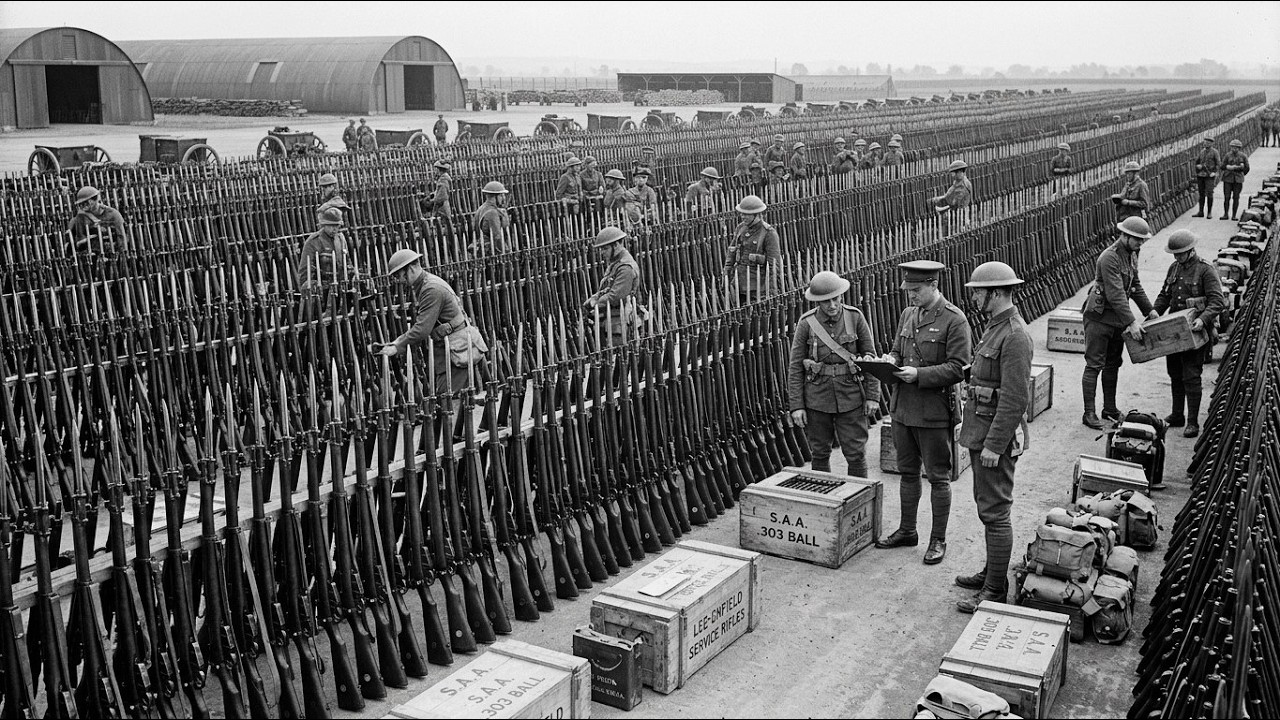
Economic pressure drove much of this. Metal reclamation offered modest revenue at a time of severe fiscal constraint. Storage costs for unwanted stock were constant drain, and successive governments, mindful of the 10-year rule’s assumption that no major war was imminent, saw little reason to maintain reserves at wartime levels.
Unlike German chemical stockpiles, which posed genuine safety hazards requiring careful demolition, rifle disposal was comparatively mundane, a matter of cutting bolts, drilling receivers, or simply crushing actions before the resulting scrap was sold on. What is harder to quantify, and largely lost to record-keeping gaps of the period, is precisely how many individual rifles were scrapped as opposed to sold, converted, or quietly retained by returning soldiers who never handed theirs in, a leakage that official inventories could never fully capture. The rifles that did survive owe their existence to several overlapping factors. Continued military utility was paramount because the basic Lee-Enfield pattern remained in first-line or reserve British and Commonwealth service through the Second World War and into the 1950s in the improved number four Mark I form, enormous numbers of earlier Mark III and Mark III rifles were retained, reconditioned, and reissued rather than scrapped, a continuity almost without parallel among former Great War infantry rifles. Surviving examples today can be found in
the collections of the Royal Armouries at Leeds, the Imperial War Museum in London, the National Firearms Centre, and numerous regimental museums across Britain, whilst substantial numbers remain in private and collector hands, sold through licensed dealers as deactivated or historic firearms, particularly rifles bearing identifiable factory markings from Enfield, BSA, or Lithgow.
Restoration specialists today prize rifles with intact matching serial numbers on bolt and receiver, features often lost through decades of arsenal refurbishment and part swapping. Corrosion, sporterization for civilian hunting use during the interwar decades, and the simple attrition of a century’s handling have all reduced the pool of rifles in original 1918 configuration, making unaltered Mark III examples with clear wartime proof marks genuinely scarce and valuable to collectors today, whilst the far more common number four variants from the Second World War era remain comparatively affordable and plentiful. The Lee-Enfield’s post-war afterlife carries a legacy quite different from that of captured German technology. Rather than being studied briefly and and destroyed, it remained in front-line or reserve use for the better part of another 40 years. It’s rear locking bolt and rapid-fire capability influencing British small arms doctrine well into the era of the number four and eventually the L1A1 self-loading rifle. It’s continued manufacture in India, Australia, and elsewhere meant that a rifle designed in the 1890s and
mass-produced for the trenches of 1914 to 1918 remained a working military tool into the 1960s in some armies, an extraordinary span for any infantry weapon. One can be seen in museums today from Leeds to Canberra represents only a fraction of the millions once racked at Weeden, a reminder of how thoroughly even the most abundant wartime equipment can be dispersed, converted, and quietly worn away by the ordinary passage of peacetime decades.
The rifles that filled those depot sheds in November 1918 did not vanish in any single dramatic reckoning. They were sold, gifted, reissued, reconditioned, and only gradually scrapped. Their fate decided not by treaty commissions, but by the slower arithmetic of empire, economy, and continued utility. From the millions once in store, only a comparative handful remain today in fully original condition, prized precisely because so many others simply carried on working until they wore out.
If you found this video insightful, watch what happened to Britain’s surplus Vickers and Lewis machine guns after World War I next. It explores how these weapons, unlike the rifle, faced a much swifter and more selective post-war culling. Like this video, subscribe, and hit the bell for more. Thanks for watching.