What REALLY Happened to Britain’s QF 18-Pounder Field Guns After WW1 D
By November 1918, some 10,169 QF 18-pounder field guns had been produced for British and Imperial service, more than any other artillery piece fielded by any nation during the Great War. When the guns finally fell silent at 11:00 on 11th November 1918, thousands of these weapons stood scattered across France, Flanders, Italy, Salonica, Mesopotamia, and Palestine.
Their crews uncertain what would happen next. Some had fired continuously for 4 years, others had only just arrived from the workshops of Woolwich, Coventry, and Elswick. All of them now faced an uncertain future, and the decisions made about their fate over the following 2 decades would shape the character of British artillery right up to the Second World War.
The 18-pounder had entered service in 1904 as the standard field gun of the Royal Artillery, and by the war’s end, it had become the backbone of British firepower on every front. Roughly 99 million rounds had been fired from these guns during the conflict, an almost unimaginable expenditure that had driven the shell crisis of 1915 and reshaped British industrial policy.
When the armistice came, the War Office found itself administering an enormous surplus. Guns still in France with the British Expeditionary Force, guns held in depots across the United Kingdom, guns in transit, and guns already sold or gifted to Dominion and Allied forces. Precise reconciliation of numbers proved difficult, but post-war audits suggested that somewhere between 6,500 and 7,000 examples remained serviceable or repairable at the point demobilization began in earnest during 1919. The immediate post-war situation was one of retrenchment rather than triumph. Britain, having borrowed heavily to finance the war, faced enormous pressure to reduce military expenditure, and artillery, being both numerous and expensive to store, became an early target for economy. Guns were withdrawn from the old Western Front battlefields around Ypres, the Somme, and Arras through 1919, hauled by lorry and rail to ordnance depots at Woolwich, Weedon, and Chilwell. Others returned more slowly from Mesopotamia and Palestine, where Imperial forces continued garrison
duties well into 1920. A smaller number, damaged beyond economical repair or abandoned during the retreats of spring 1918, were simply left where they lay. Later recovered by French and Belgian farmers clearing their fields or by battlefield salvage contractors working under license from the Commission for the reconstruction of the devastated regions.
Unlike the German weapons the Allies had raced to secure and study, the 18-pounder posed no mystery to its own government. The debate in Whitehall was not whether to examine it, but whether to keep it at all. Successive rounds of the Geddes Axe, the sweeping economy measures of 1921 and 1922, named after Sir Eric Geddes, forced the army to justify every gun it wished to retain.
The result was a program of retention, modification, sale and scrapping that unfolded gradually across the 1920s, driven as much by Treasury pressure as by tactical judgment. Britain’s own handling of the surplus followed several parallel paths. The Royal Artillery retained a substantial core of roughly 3,000 guns for home and Imperial defense, distributed amongst regular and territorial units, though ammunition reserves were drawn down sharply to save money.
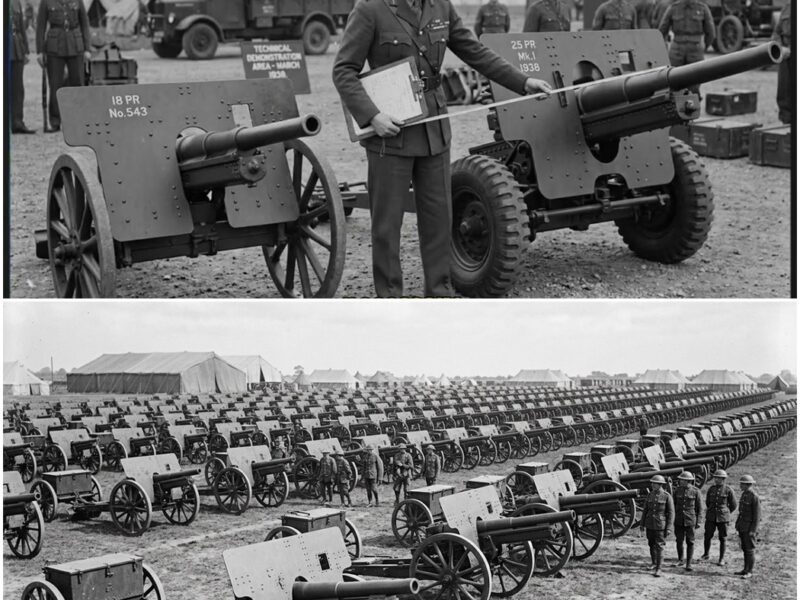
At the Woolwich Arsenal, and later at the Royal Ordnance Factory at Nottingham, engineers began a modification program intended to extend the gun’s service life. Box trails were gradually fitted in place of the original pole trail on many equipments during the 1920s, improving the elevation and therefore the range, work that culminated in the Mark IV and Mark V variants, still listed in army inventories as late as 1938.
Woolwich also became the principal center for technical trials, testing new ammunition natures including gas shell canisters leftover from wartime stocks, and later experimenting with the split trail carriages that would eventually inform the design of the 25-pounder that replaced the 18-pounder entirely by the outbreak of the Second World War.
France, Britain’s principal wartime partner, took a more limited interest in the 18-pounder specifically, since the French army already possessed its own famous 75 mm field gun in vast numbers and had little appetite for adopting a foreign caliber. French technical missions did, however, inspect British ordnance depots near Rouen and Le Havre during 1919 as part of the broader inter-allied liaison on surplus munitions disposal, chiefly to coordinate the clearance of shared depot space along the old lines of communication, rather than to acquire the guns themselves. A small number of 18-pounders were transferred informally to French territorial defense units in the immediate post-war period as stopgap equipment, but these were withdrawn and scrapped by the mid-1920s once French rearmament programs resumed. The United States, by contrast, had adopted a licensed version of the 18-pounder during the war itself, and this connection shaped its post-war interest considerably. American forces had received several hundred British pattern guns for training purposes at Camp Jackson and
elsewhere before American industry began producing its own equivalent. And after the armistice, the US Army’s Ordnance Department retained a number of these weapons for comparative trials at Aberdeen Proving Ground in Maryland. Aberdeen’s testing program through 1919 and 1920 examined the 18-pounder’s recoil system and ammunition alongside captured German 77 mm guns, feeding directly into American thinking about the standardization of the eventual M1897-derived 75 mm field gun that would serve the US Army into the interwar years. Most of the American-held examples were declared surplus and sold for scrap by 1922, though a handful survived as static training pieces at ordnance schools. The Dominions took a markedly different approach, one driven less by technical curiosity than by the practical need to establish or rebuild home defense forces on a limited budget. Canada received a substantial allocation, several hundred guns shipped home through Halifax during 1919 and 1920, which formed the backbone of the Canadian militia’s field artillery for
the next two decades and were still in use, heavily modified, when Canadian gunners went to war again in 1939, Australia likewise brought home a large contingent of guns that had served with the Australian Imperial Force, distributing them amongst militia artillery batteries in New South Wales, Victoria, and Queensland.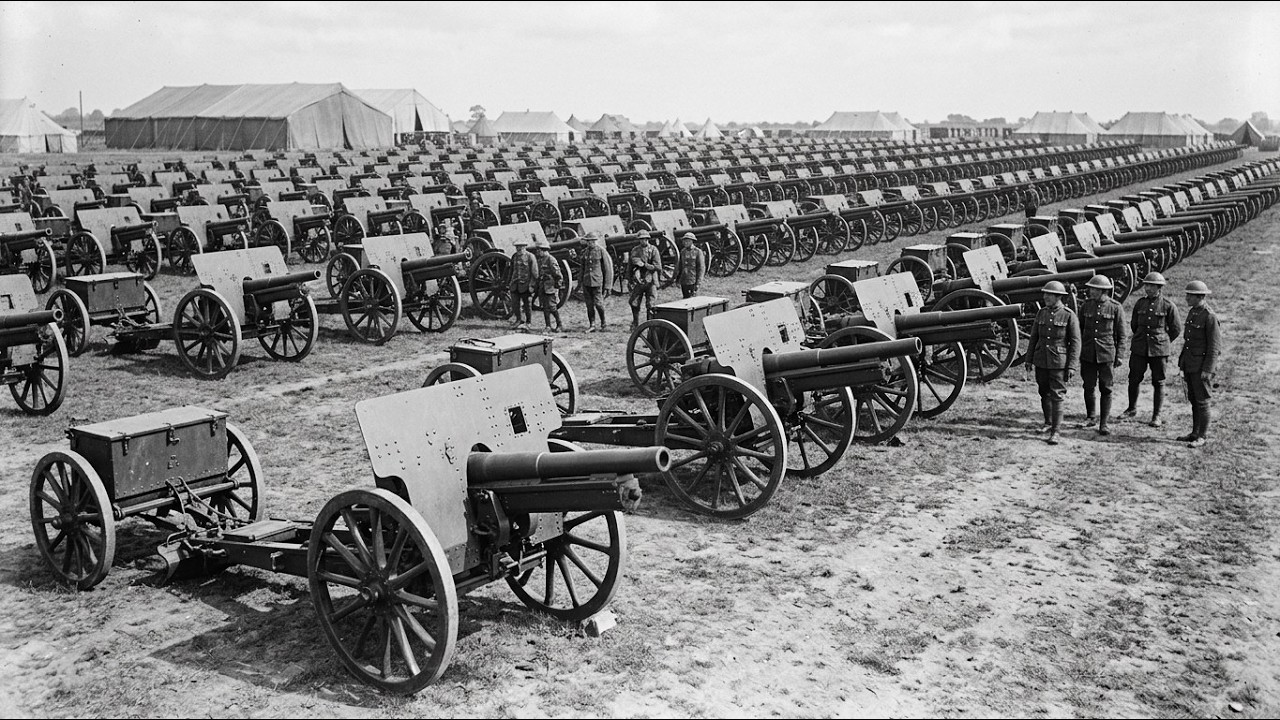
Several of these guns, having fired on the Somme and at Villers-Bretonneux, later found themselves defending Australian coastal batteries during the Second World War before finally being retired. India retained a considerable number for the Indian Army’s mountain and field batteries, while South Africa received a smaller allocation for its own permanent force.
New Zealand’s contingent, modest in number, nonetheless remained in service with territorial units at Trentham and Papakura until well into the 1930s. If you’re finding this deep dive into post-war history interesting, consider subscribing. Beyond the formal empire, Britain also sold or gifted surplus 18-pounders to a number of smaller powers seeking to rebuild or establish artillery arms after 1918.
Belgium, its own artillery devastated by four years of occupation and fighting, received several dozen guns as part of post-war reconstruction assistance administered through the Inter-Allied Reparations Commission. Portugal, whose Expeditionary Force had served on the Western Front, likewise took delivery of a modest allocation for home defense.
Estonia and Latvia, newly independent and fighting wars of their own against Bolshevik and German forces in 1919 and 1920, purchased or received British 18-pounders through arms transfers coordinated by the British Military Mission to the Baltic. Equipment that saw genuine combat use in the Baltic Wars of Independence before those young states were themselves overrun in 1940.
The systematic disposal of the remaining surplus proceeded steadily through the 1920s under Ordnance Board and War Office direction, guided less by any single treaty commission, since Britain faced no equivalent of the disarmament clauses imposed on Germany at Versailles, than by straightforward economic necessity. The Ministry of Munitions, wound down through 1919 and 1920, transferred responsibility for surplus stock disposal to the Disposal and Liquidation Commission, which auctioned or scrapped enormous quantities of equipment to recover value for the Treasury. Guns judged beyond economical repair, roughly 2,000 of the total surplus by most post-war estimates, were broken up for scrap steel at depots including Weeden, Woolwich, and the Royal Arsenal’s own dismantling yards. Their bronze and gunmetal fittings sold separately to offset costs. A further quantity, difficult to quantify precisely from surviving records, but estimated at several hundred equipments, was expended entirely in trials, proof firing and gunnery training, worn out through use on ranges at Larkhill and Shoeburyness,
rather than deliberately destroyed. Economic pressure, rather than sentiment, governed nearly every decision. Steel prices, the cost of storage, and the sheer expense of maintaining obsolescent ordnance all weighed against preservation. And by the mid-1930s, the active gun park had shrunk considerably as the 25-pounder began to enter production.
What survived did so more by accident than design. Approximately 20 to 25 complete 18-pounders are known to exist in public collections worldwide today, a remarkably small fraction of the original production run. The Imperial War Museum in London holds a well-preserved example on display, one of the guns most closely associated with the weapon’s wartime service.
The Royal Artillery’s own historical collection, now housed at the Royal Artillery Museum’s archive, following the closure of the original Woolwich site, retains several equipments including examples of the later box trail modifications. In Canada, the Canadian War Museum in Ottawa displays a gun with direct provenance to Canadian Corps service, whilst several more stand as static memorials outside armories in Kingston and Winnipeg.
Australia’s War Memorial in Canberra holds at least two examples, one retaining battle honors from the Western Front. A small number of privately restored guns appear periodically at events run by heritage artillery societies in Britain. Their carriages rebuilt using surviving technical drawings held at the National Archives at Kew, though authentic wartime examples with verified unit provenance remain exceptionally rare and highly prized amongst collectors.
The 18-pounder’s real legacy, however, lies less in the handful of surviving equipments than in what it taught British ordnance designers about the limitations of Great War field artillery. It’s comparatively short range, fixed pole trail, and reliance on shrapnel as much as high explosive all informed the specification eventually issued for its replacement.
The Ordnance QF 25-pounder, which entered service from 1938 and became arguably the finest field gun of the Second World War, drew directly on lessons learned from decades of 18-pounder service, adopting the split trail and heavier shell weight that wartime experience had shown to be necessary. In this sense, the older gun’s most enduring contribution was not battlefield glory, but the accumulated unglamorous data of a generation spent firing, modifying, and eventually discarding it. Preservation challenges compounded the scarcity. Guns kept outdoors as memorials for decades suffered badly from corrosion, and many carriages lost their original wooden wheels and elevating gear long before anyone considered restoration a priority. Several of the equipments now on display in Britain and the Dominions have been rebuilt using replacement parts fabricated from wartime drawings since original spares vanished from stores by the 1950s. Occasional discoveries still occur. Battlefield archaeologists working former Western Front positions near Ypres and the Somme have, on rare occasions, recovered gun
components and even complete barrels from collapsed dugouts and filled-in gun pits, findings that periodically add fragmentary pieces to museum collections rather than complete equipments. A wrecked limber and partial carriage recovered from farmland near Passchendaele in recent years now forms part of a regional display in Belgium, a reminder that the old battlefields have not yet finished yielding their evidence.
There’s also a moral dimension worth noting, distinct from the straightforward accounting of guns scrapped or preserved. The 18-pounder’s ammunition supply included gas shells during the war’s final 2 years, and the post-war handling of these chemical stocks, destroyed under controlled conditions at ranges including Port and Down rather than dumped indiscriminately reflected a growing if imperfect awareness of the dangers such munitions posed even after the fighting ended.
Unlike the deliberate scuttling of the German High Seas Fleet or the forced destruction of German aircraft under Inter-Allied Control Commission supervision, Britain’s disposal of its own artillery was an entirely domestic and largely unspectacular affair driven by budgets rather than treaties. And it is consequently attracted far less historical attention than the more dramatic fates of enemy equipment.
What remains today is a strikingly small physical record of a weapon that fired more shells than any other British gun in history. The vast majority were reduced to scrap within 15 years of the armistice, their bronze recycled and their steel melted down long before anyone thought to preserve them systematically for posterity.
That so few survive is itself a quiet lesson in how quickly even the most ubiquitous instruments of a great war can vanish from the landscape once the fighting stops and the accountants take over. If you found this video insightful, watch what happened to Britain’s Mark IV tanks after World War I next.
It explores how these pioneering armored vehicles were scrapped, sold abroad, and studied by foreign armies eager to master the new weapon of mechanized warfare. Like this video, subscribe, and hit the bell for more. Thanks for watching.