What REALLY Happened to Britain’s Rolls-Royce Armoured Cars After WW1 AI D
French and British commissions were never required to race for this particular prize because the prize was already British, but a different race began the moment the guns fell silent on 11th November 1918. A race to work out what should happen next to a vehicle that had already proven itself the most versatile fighting machine of the war and whose real career, remarkably, was only just beginning.
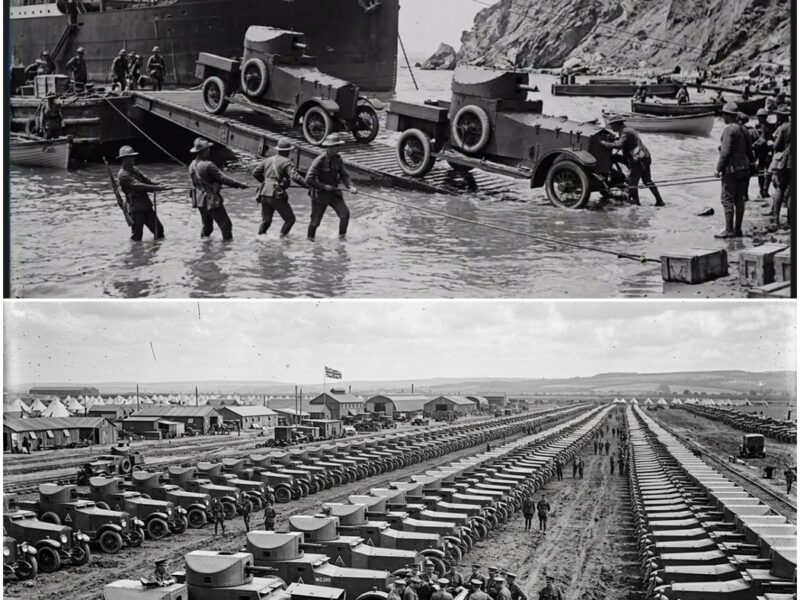
Whilst infantry demobilized by the million and generals argued over the peace, a small fleet of armored cars built on the humble chassis of the Rolls-Royce Silver Ghost sat in depots from Ireland to Iraq waiting what they were for now. By 1918, around 120 of these vehicles had been produced since the Admiralty first requisitioned Silver Ghost chassis in September 1914.
They were odd, elegant things. An opulent gentleman’s touring car turned into a 4.7 ton fighting vehicle wrapped in 12 mm of armor plate topped with a rotating turret carrying a single .303 Vickers machine gun and capable of a startling 72 km/h on good roads. Six Royal Naval Air Service squadrons have been raised around them, 12 cars to a squadron, and they had fought in France, in German Southwest and East Africa, at Gallipoli in April 1915.
And most famously, across the deserts of the Middle East where a young intelligence officer named T.E. Lawrence judged a squadron of nine of them more valuable than rubies in his campaign against the Ottomans. What mattered now, with the war over, was not what these cars had done, but what would become of them.
Unlike the tanks, aircraft, and artillery being surrendered by a defeated Germany, the Rolls-Royce armored car posed no question of enemy technology to be seized, studied, or destroyed under the disarmament clauses of the Treaty of Versailles. It posed a quieter, more practical question that the British Empire would spend the next two decades answering, whether an expensive, aging design built for a war that had ended could still earn its keep policing an empire that had not. The situation at the armistice was one of dispersal rather than concentration. Vehicles that had served on the Western Front, in Russia under Commander Oliver Locker-Lampson’s independent squadron, and across the Sinai and Palestine campaigns were scattered across depots in France, Egypt, and Southern England. Many worn down by years of desert sand and mud with little proper maintenance. The Russian detachment, which had reportedly covered extraordinary distances with barely a mechanical failure, had already been withdrawn following the 1917 revolution. Its cars abandoned or handed over amid the chaos. In Egypt, cars that had supported
Lawrence’s Arab revolt and General Allenby’s advance into Palestine remained serviceable and crucially close to the theaters where Britain’s post-war problems were about to multiply. Unlike German equipment being cataloged by the Inter-Allied Control Commission for destruction, no one in London seriously proposed scrapping a design that had just demonstrated at minimal cost how a handful of armored vehicles could dominate open desert terrain against irregular forces.
The debate in Whitehall was not destroy versus preserve, but modernize versus retire. And it was settled in favor of modernization remarkably quickly. That decision was driven by geography as much as sentiment. Between 1919 and 1922, Britain found itself simultaneously fighting an insurgency in Ireland, suppressing a nationalist uprising in Egypt, garrisoning a newly acquired and deeply unstable Mesopotamia, and watching unrest spread through Palestine and Transjordan under the fresh mandates awarded at the Paris Peace Conference. Keeping large garrisons of infantry across all these territories was financially impossible for a treasury exhausted by four years of war. The armored car, cheap to run and devastating against tribal levies or poorly armed rebels, offered an answer. And it is this post-war imperial mission, rather than anything that happened at Compiègne, that truly decided the vehicle’s fate. Ireland became the first proving ground for that decision. During the War of Independence, Rolls-Royce cars of the 1914 and early 1920 patterns were deployed by British
forces to protect road convoys against ambush by the Irish Republican Army, whose flying columns had already shown a talent for isolating and destroying motorized patrols. When the Anglo-Irish Treaty created the Irish Free State in December 1921, Britain transferred 13 of these vehicles to the new National Army, which put them to immediate use in the Civil War of 1922 and 1923 against anti-treaty forces, most notably in the recapture of Cork and Waterford.
One of these cars, nicknamed Sliabh na mBan, was traveling in the convoy ambushed at Béal na Bláth in August 1922, the engagement in which General Michael Collins was killed. Remarkably, that same vehicle remains on the Irish Army’s books today, brought out for ceremonial duties, making it very likely the oldest armored fighting vehicle still formally in service anywhere in the world.
12 further Irish cars soldiered on into the 1940s before being stripped and sold off in 1954, though one, known to collectors as Danny Boy or Tom Keogh, survives today in private British hands, albeit fitted with replica bodywork rather than its original armor. Whilst Ireland absorbed a handful of veteran cars, the far larger commitment lay in the Middle East, and here Britain’s approach diverged sharply from anything attempted in Ireland or India.
Rather than simply retaining wartime vehicles, the Air Ministry and War Office undertook a genuine redesign program. In 1920, the original cars were rebuilt at Woolwich Arsenal in London as the Rolls-Royce 1920 pattern, fitted with thicker radiator armor and new wheels carrying solid metal rims better suited to rough terrain.
A Mark IA variant soon followed with a commander’s cupola added to the turret roof. A furthermore thorough redesign in 1924 produced the Rolls-Royce 1924 pattern Mark Maharba, of which roughly two dozen were built new rather than converted, incorporating a permanent cupola and refined turret. These modernized cars became the backbone of what the Royal Air Force, which had assumed responsibility for policing much of the Middle East from 1921 under the doctrine of so-called air control, termed its armored car companies. Number 1 Armored Car Company operated the Rolls-Royce cars proper, whilst number two company ran a parallel fleet of Fordson based conversions in which worn out Rolls-Royce armored bodies were mated to cheaper Fordson lorry chassis, a pragmatic economy measure suited to the punishing conditions of Iraqi and Egyptian desert patrol work. This RAF led approach, combining aircraft for reconnaissance and rapid punitive strikes with armored cars for ground patrol and convoy escort, allowed Britain to hold down Mesopotamia, Transjordan and Palestine with a
fraction of the troop numbers a conventional garrison would have required. Squadrons operated out of Baghdad, Amman and airfields across the Palestine mandate through the 1920s and into the 1930s, suppressing tribal uprisings and later policing the Arab revolt of 1936 to 1939. India presented a different variant of the same problem.
There, cars were rebuilt from 1921 as the Indian pattern, featuring a lengthened roomier hull and a distinctive domed turret carrying four separate ball mountings for machine guns rather than the single Vickers gun of earlier models. The configuration considered better suited to the open frontier fighting expected along the Northwest frontier against Pathan tribesmen.
Contemporary assessments suggest roughly 76 of the modernized cars remained in active service across the empire by the early 1920s. A figure that testifies both to careful maintenance and to how few new vehicles were actually required once the design had been properly updated. If you are enjoying this look at how Britain quietly kept a First World War design in frontline service for a quarter of a century, do consider subscribing for more.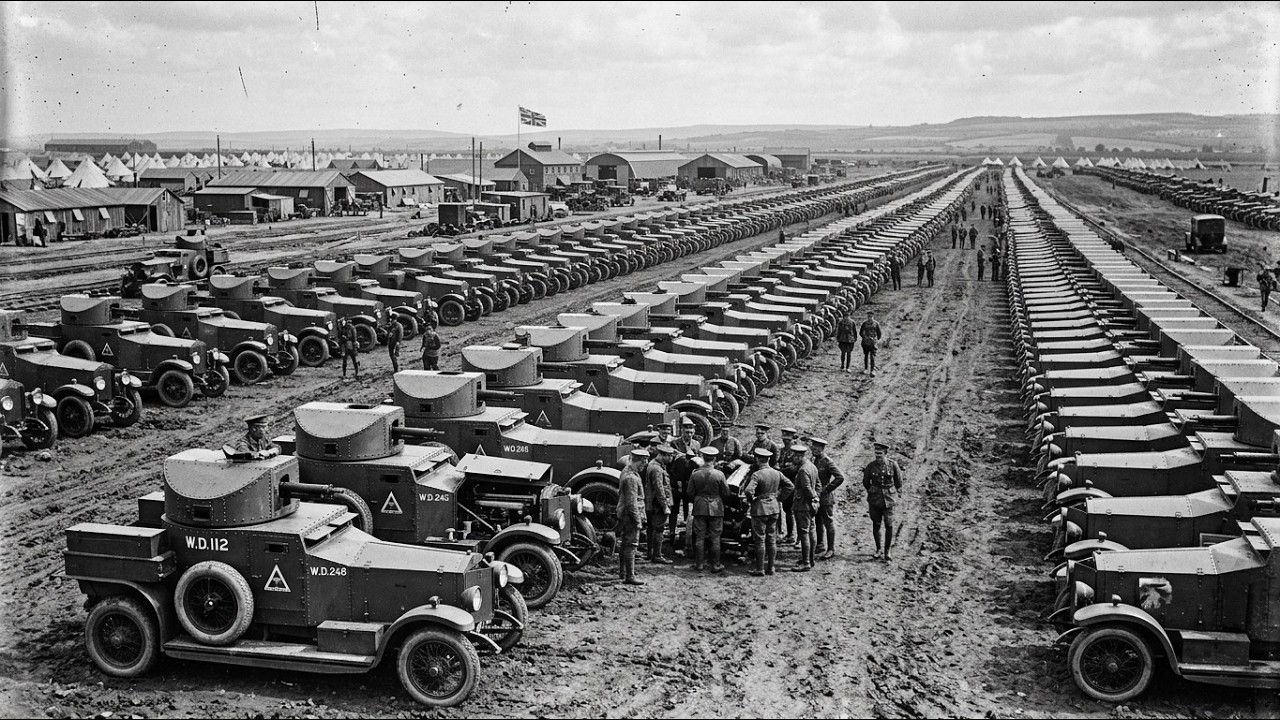
Elsewhere, small numbers of cars found their way even further afield. Detachments served in Shanghai during the 1920s protecting the international settlement amid China’s fractured warlord politics and in Sudan and other corners of British Africa where similar policing duties applied. None of this amounted to a formal disposal program of the kind that scrapped Germany’s high seas fleet or dismantled its heavy artillery under Allied supervision.
There was no inter-Allied control commission overseeing the Rolls-Royce armored car, no treaty clause demanding its destruction. Instead, attrition did the work that treaties did elsewhere. Cars were worn out by desert sand, damaged beyond economic repair, or simply judged obsolete as newer designs such as the Crossley and later Guy and Daimler armored cars entered service through the late 1920s and 1930s.
Numbers thinned steadily rather than dramatically. From around 120 built during the war to perhaps 70 or 80 surviving into the early 1920s after the first wave of modernization to much smaller operational core by the outbreak of the Second World War. What losses occurred were losses to hard service in the scrapyard rather than to any deliberate scheme of elimination.
And precise attrition figures for individual theaters such as Palestine or Iraq were never systematically recorded, leaving historians to estimate rather than state survival rates with confidence. Remarkably, a genuine remnant of the design was still on active operations when the Second World War began.
In 1940, around 34 Rolls-Royce cars still serving with the 11th Hussars in Egypt were hastily modernized. Their old turrets replaced with open-topped mountings carrying a .55 caliber Boys anti-tank rifle, a .303 Bren light machine gun, and smoke grenade launchers. And they were pressed into the earliest actions of the Western Desert Campaign against Italian forces around Bardia and Sollum, more than a quarter of a century after the type first went to war.
It is a striking testament to the soundness of the original 1914 design that a vehicle conceived to fight the Kaiser’s forces was still drawing enemy fire when Britain went to war with Mussolini. What survives today is scarce but well cared for. The Tank Museum at Bovington in Dorset holds a running 1920 pattern car built in Derby and armored at Woolwich in October 1920.
A vehicle that served in Ireland, Shanghai, and Egypt before patrolling the Norfolk coast during the Second World War and later carrying Queen Elizabeth II on ceremonial occasions. Museum staff regard it as one of the finest exhibits in their collection. Another 1920 pattern car, previously displayed at the RAF Museum in Hendon, now stands at the RAF Regiment Heritage Centre at RAF Honington.
A further example is preserved privately at Eaton Hall in Cheshire, seat of the Duke of Westminster, and is occasionally shown to the public on charity open days. In Ireland, the Defence Forces maintain Slievenamon in running order for state ceremonies, a direct physical link to the death of Michael Collins.
And in private British ownership survives Danny Boy, one of the cars sold and stripped by the Irish Army in 1954, since fitted with replica armor to approximate its original form. The design’s real legacy lies less in any single surviving vehicle than in the doctrine it helped create. The marriage of light armored cars with aircraft in RAF-led Imperial policing shaped British colonial military thinking throughout the interwar years and influenced the armored car designs from Crossley to Daimler that succeeded it. It also offers an uncomfortable historical footnote. A vehicle built to fight a European war spent most of its working life enforcing British rule over Arab, Irish, and South Asian populations who had little say in the matter, a fact that sits alongside its undoubted mechanical excellence. The race that never quite happened at the armistice turned out not to matter because there was no rival power competing for this particular prize. What is remarkable instead is how long Britain kept using it. From the deserts of the Hijaz to the streets of Cork to the sands outside Bardia, a car designed in 1914 was still earning its place in
the line more than 25 years later. If you found this video insightful, watch what happened to the German armored cars and captured Allied vehicles Berlin was forbidden from keeping after the First World War next. It explores how the Treaty of Versailles stripped Germany of its own fledgling armored car fleet and what became of the handful that slipped through the net.
Like this video, subscribe, and hit the bell for more. Thanks for watching.