What Really Happened To Captain James Cook? D
What Christopher Columbus did for America, Captain James Cook did for the Pacific, with all the baggage that entails. A restless explorer who never knew when to stop, Cook paid a high price for his ambitions. Yet, his shocking decline and infamous end have been shrouded in mystery for centuries. For years, it was said that Captain James Cook’s enemies cannibalized his remains.
That was a lie, but the truth is somehow even more chilling. Born in November 1728 in Yorkshire, England, as the second of eight children, Cook wasn’t always drawn to marine life. He spent his post-school days helping his father manage a farm, and then settled in the village of Staithes to work as a shop boy, a job he was hopelessly bad at.
It was only after he giving up these moderate ambitions, and as a somewhat desperate plan B, but Cook became a merchant navy apprentice. Suddenly, a whole new world opened up. Cook had a meteoric rise through the ship’s ranks. Despite his difficulties cutting it as a shop boy, he gained a reputation for extraordinary competence at sea, and excelled at many intellectual skills required of sailors, including algebra, navigation, and astronomy.
He didn’t shy away from the physical side, either. In 1755, in his mid-20s, he joined the Royal Navy on the cusp of the Seven Years’ War. And within months, he helped Britain capture a French warship and sink one other. Yet, these weren’t the only things he learned. While moving up the ranks during the Seven Years’ War and fighting in North America, Cook met the officer Samuel Holland and saw him use a plane table device to survey the area.
Cook was immediately intrigued, and Holland taught him top-of-the-line techniques to accurately map out coastlines. Cook would go on to be revered for his mapping work. And it helped British Major General James Wolfe infiltrate Quebec and win the famous Battle of the Plains of Abraham. The most terrible moment of Cook’s young life happened during wartime, but by complete accident.
While he was master of the HMS Grenville surveying the coast of Newfoundland, his powder horn exploded and completely mangled his right hand. The injury left a lifelong distinctive scar, one that played a significant role in his future. Eventually, Cook grew into an intimidating and competent man. And he had a reputation for remaining cool and rational even in the most chaotic of situations.
And believe it or not, he reportedly remained completely sober and celibate while on his voyages. Cook had an innate sense of his crew’s mood, but he hated pandering to it. He refused to let priests aboard his ships. His demeanor, though usually calm, would erupt in the face of incompetence or back talk from his men.
On a personal level, he rarely confessed his thoughts or feelings to anyone, even those closest to him. On a professional level, he tended to keep even major decisions to himself, a habit that would not serve him well. In 1762, Cook married Elizabeth Batts, the daughter of his mentor Samuel Batts. Both James and Elizabeth were practical people, and it was a very efficient marriage.
The couple had six children in total, though three of them didn’t live past infancy. Starting in 1768, Britain recruited Cook to lead a scientific voyage aboard the HMS Endeavour to observe the 1769 transit of the planet Venus from the island of Tahiti. They chose Cook for his adeptness at navigation and astronomy, but also because they thought he could keep a secret.
Although Cook’s voyage on the Endeavour had the stated aim of viewing Venus, in reality, a Britain was after something much bigger, land. In the form of Terra Australis, an enormous continent rumored to be much bigger than the real Antarctica or Australia. They believed it existed in the Earth’s Southern Hemisphere to balance out the amount of land in the north.
And if it did exist, Britain wanted to be the first to find it. After all, colonizing the hypothetical continent could lead to untold riches. So, in addition to Cook’s astronomical orders, Britain issued him confidential aims to claim any undiscovered lands for the current monarch, King George the third.
But this was a tall order for one particular reason. Sea travel was dangerous for all the reasons you might imagine, but nothing was more feared in the 18th century than scurvy. Sailors who spent months and years on water without fresh produce often suffered from severe vitamin deficiency. Though at the time, no one knew what the cause was.
This resulted in fatigue, bleeding gums, and eventually death. The longer the voyage, the bigger the risk. The most incredible part is, Cook reportedly never lost a crew member to scurvy. His secret was a mix of his usual discipline and very unusual luck. To combat scurvy, Cook insisted on certain diet restrictions and standards of ship cleanliness.
And though not all of these directives were useful, some of them were vital to their survival. Perhaps most effective of all, he banned his men from skimming the salt fat from copper boiling pans, a common occurrence at the time. As it happened, ingesting copper compounds prevents the absorption of vitamins.
So, having sailors avoid the practice was a godsend. In April 1769, Cook did what he publicly set out to do, arriving in Tahiti and observing the transit of Venus. He and his men then spent the time on the island getting to know the native residents, even observing them surfing, likely becoming the first Europeans to observe the sport in progress.
As we go on, you’ll see they were the first Europeans to witness a lot of things. Yet, despite this idyllic setting, there were signs of tension that would one day become explosive. That June, Cook and his crew committed an unforgivable act. Without asking anyone, they took rocks from a sacred marae to use as the ship’s ballast, a sacrilegious move that the Tahitians despised.
Unfortunately, it got worse. When the Tahitians later took several items from the crewmates, Cook refused to see it as recompense and took action. Instead of asking around about who the culprit was, Cook decided to punish the island indiscriminately. He took two canoes for ransom, regardless of who owned them, until the Tahitians returned the items.
In this moment, Cook took a liking to this method of coercion and used it again almost immediately. By July, two of Cook’s men, preferring to stay in Tahiti, deserted the crew. They married local women and went into hiding. In yet another disproportionate and indiscriminate response, Cook took one of the local chiefs hostage in order to compel the inhabitants to reveal the deserters.
The ploy worked once more, and Cook soon sailed onwards, content. Cook’s next stop was New Zealand, where he met with the Maori people and was most likely the first European to communicate with them. But, these triumphs for Britain were still marked with tensions and violence. One skirmish between Cook and the natives left several Maori dead.
Around this time, Cook also witnessed the Maori eating the flesh of their enemies. After his brief visit to Australia, Cook returned to England in July of 1771. But he didn’t stay for long. Cook and his crew spent literally years at sea, but the restless explorer rested exactly 12 months on his home shores before itching to sail again.
And he readily accepted a second voyage with the Royal Society. This time, Britain sent him with the specific intent to find Terra Australis once and for all. And Cook personally chose to command the HMS Resolution alongside Tobias Furneaux, who commanded the HMS Adventure. They left in July of 1772, and it began to fall apart almost immediately.
Tobias Furneaux’s style of command was not in sync with that of Cook’s. Furneaux almost immediately deviated from Cook’s dietary regime, and just a month after setting out, 20 of his men contracted scurvy, one of whom died. The ships also kept losing each other, and in October, a storm resulted in them separating permanently.
Thanks to this early hiccup, Cook’s HMS Revolution spent much of the second voyage traveling in search of Terra Australis alone. Even as Cook became increasingly sure that no such continent existed. When his crew passed the Antarctic Circle, again the first Europeans to do so, no land was in sight. He simply couldn’t fathom that anything was out there.
In this particular case, he was wrong. On January 18th, 1773, just one day after crossing the Antarctic Circle, Captain Cook came as close as 75 miles to the continent of Antarctica, but he would never step foot on it. After another year of searching in a large loop, then hitting pack ice and being unable to go any further, Cook admitted he had reached the limits of his expertise.
Around the time that he gave up on Terra Australis, Cook experienced a severe illness aboard the ship, becoming bedridden and terrifyingly constipated. His crew were thrown into such a panic that, in order to get some kind of fresh provisions into him on an otherwise barren ship, they killed their pet dog and turned it into soup and fed it to their ailing captain.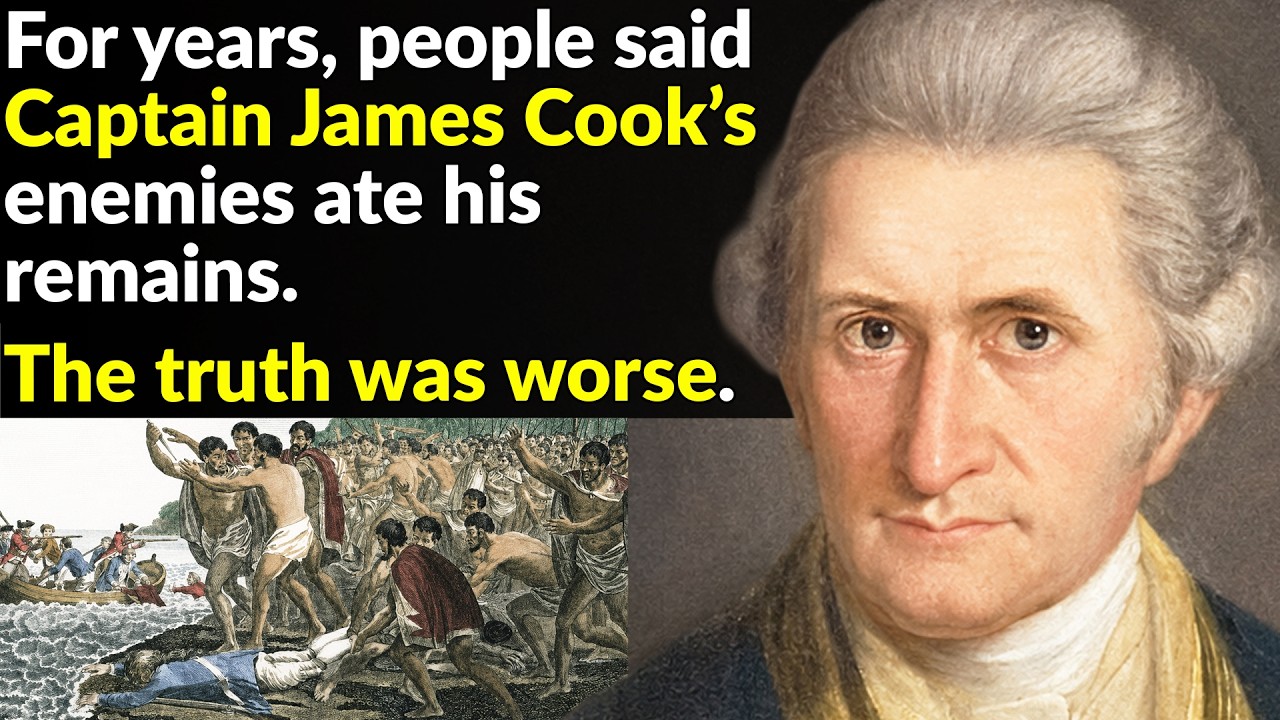
One way or another, Cook survived. But then again, a more silent doom was moving through the crew. As you might imagine, the sailors had intimate relations with women across their voyage. As was his MO, Cook abstained, but this didn’t stop him from worrying that his men were passing European diseases to their lovers and onto the rest of the population.
He was tragically correct. Many Pacific Islanders experienced the horrors of gonorrhea and other STDs for the first time thanks to the Resolution and other similar ships. Cook returned to England in 1775 with little to show for it, except for his conviction that the continent of Terra Australis just did not exist.
But it didn’t matter. His voyage, as well as his track record in combating scurvy, made him an instant celebrity. He became a fellow of the Royal Society, met writer James Boswell, and was called, quote, “the first navigator in Europe.” Cook’s retirement consisted of a cushy position as a captain of Greenwich Hospital and a pension of 230 British pounds per year.
And this made him absolutely miserable. By now, he was 47 years old and suffered from mental and physical exhaustion, as well as possible diseased gallbladder. But at the same time, he missed his days of exploration. But then an opportunity fell right into his lap. When Cook heard that the Admiralty now wanted to find the fabled Northwest Passage connecting North America to Asia, he immediately jumped at the opportunity.
Initially, he was just supposed to be a consultant for the expedition. But in a meeting where he was supposed to help select officers, he declared that he would lead the voyage himself. Turns out, the Admiralty loved his decision, even if he had a notoriously quick temper and was past his prime. Before setting out on his third expedition, everything looked to be in impeccable order.
For one, Cook took control of the HMS Resolution again, with trusted long-time crew member Charles Clerke commanding the Discovery. In addition, Britain concocted yet another cover story for their true goal of the Northwest Passage. They insisted they wanted to return the Polynesian native Mai, who had come to visit Britain, to his home Tahiti.
Cook’s command over his crew was deteriorating. When he experienced theft on board his ship after sailing from New Zealand, Cook decided to punish everyone by cutting meat rations. And the disgruntled crew responded with a hunger strike. In response, his use of flogging as punishment became more frequent than ever before, with some men enduring as much as 60 lashes.
Something changed in Cook. In his third voyage, Cook no longer seemed to possess any true drive of exploration. Much to his crew’s confusion, he now left many of the islands around him untouched. As a result, he became more closed off and reclusive. His men began to whisper that something was deeply wrong with Captain Cook.
But even they couldn’t predict the bloody outcome. All hell broke loose after the Polynesians stole a goat from his crew. Cook decided he would get the goat back no matter the cost. And together with a portion of his men, they completely ravaged the island. He burned homes, crops, and especially canoes with no sign of stopping until the goat was finally returned.
The other crew members, as well as the natives, were aghast at this disproportionate attack. But Cook wasn’t done just yet. Deterring theory was now a complete obsession for Captain Cook, and he had no mercy when it came to punishing offenders. When a valuable sextant was stolen from the ship, he tracked the culprit down in no time at all, locking him up aboard the Resolution.
He then cut off his ears as a permanent sign of his shame, and sent him back to shore. His men were too afraid to go against him. After leaving his ward Mai in Tahiti at the end of 1777, Cook began the true aim of his expedition in earnest, setting off for the Northwest Passage. But in January 1778, he instead found something else, the Hawaiian Islands, a paradise no European had ever seen.
Luckily, the natives spoke the same language as the Tahitians thanks to an ancient migration route. And Cook and his men were able to communicate with them, even if they no longer had Mai. Cook’s attempt to find the Northwest Passage over the next few weeks proved both futile and miserable. Storms and hostile winds continually hindered the voyage, and Cook’s deteriorating mental state was no help either.
He started making huge errors, including when he missed the 10-mi wide passage off Unimak Island into to Bering Sea. And the very next day, ran his ship aground after pushing too far in the fog. Around October of 1778, Cook, now nearly 50 years old, gathered his men together and finally conceded that they were never going to find the Northwest Passage in these conditions.
But much to their surprise, that didn’t mean they were going home. Cook wanted to sail south again toward Hawaii to try again next year. It was an entirely unnecessary plan and it spelled his end. The events of Cook’s life after anchoring in Hawaii in 1779 will always have an air of mystery surrounding it.
But according to most historians’ interpretations, the islanders, having heard of his previous journey to their islands, mistook Cook for a deity. Specifically, the rain god Lono. He had, after all, arrived during the Makahiki, the harvest festival that worshipped Lono. And his ship route was reminiscent of certain Hawaiian religious lore.
A massive crowd of 10,000 people gathered to greet Captain Cook. Cook even met with the Hawaiian chief, King Kalaniopu’u, who gave him a magnificent feather cape in recognition of his admiration. And the pair of them eventually exchanged names. As you could imagine, it didn’t take long until tensions began to surface between Cook and the Hawaiians.
In his usual MO, Cook promptly and unpopularly punished a native with flogging for thieving. Then, in an ironic twist, some of his sailors stole religious artifacts from one of the Hawaiian shrines, much to the outrage of the natives. Cook’s luck was about to turn for the worse.
Soon after his arrival, Makahiki season ended, ushering out the time of Lono and ushering in the season of the war god Ku. In other words, Cook in his identity as Lono was no longer ascendant, and the natives likely began to wonder why one of their gods was outstaying this phase of life. In fact, after a month, the king and the priests anxiously asked Cook when he planned to leave.
Cook wisely took the hint, packing up and sailing out on February 4th. But just days after his departure, the Resolution’s main mast broke in a gale, and Cook and his crew were forced to return to Kealakekua Bay to repair it, landing just a week after they left. At this point, though, both sides had grown very tired of one another.
But the presence of Lono this deep in the season of Ku was really awkward for the Hawaiian priests. It dawned on them that Cook was not a deity at all, but a normal man. The atmosphere now grew more tense than ever as the Europeans repaired their ship, starting with petty thefts popping up here and there.
Then, on February 14th, 1779, everything reached a boiling point. That day, Cook found out that the Discovery’s large cutter, an extremely useful vessel at sea, was stolen. Incensed, he fell back on his tried and true strategy. He decided he was going to hold King Kalaniopuu for ransom until the cutter was returned.
Without telling him his motives, Cook convinced the king to walk over to the ship with him. Until one of Kalaniopuu’s wives, sensing danger, ran down to the beach with two chiefs and pleaded with him not to embark. Soon, a crowd of two to 3,000 Hawaiians gathered near the area. Then, just as Cook tried to persuade Kalaniopuu to continue walking, horrible news reached the masses.
On the other side of the bay, some of Cook’s men had shot another chief in an unrelated altercation. Suddenly, the Hawaiians long simmering resentment and doubts about Cook and his men turned into rage. A warrior threatened the captain with a dagger and a stone, and before long the entire crowd was throwing stones at Cook’s men with the Europeans firing their rifles in response.
The marines managed to fire just one round before the growing crowd of Hawaiians fell on them and they had to retreat. But Cook never escaped. Another Hawaiian clubbed him on the back of the head and the group surrounded him stabbing and beating the false god to death as his men watched from the boats.
When the scene calmed down, four marines were dead alongside their captain. Though many more Hawaiians perished that day as well as in the days that followed. In accordance with his status as a high-ranking enemy, the Hawaiians dismembered Cook, burnt him, and then distributed his parts among various chiefs on the island.
Though it should be stated that his body was never eaten. In fact, it was partially returned. Nowadays, modern historians have suggested a new tragic reason for his disturbing end. Tracking the change in Cook’s mood and personality from his first to his third voyages, some believe the captain may have suffered from some mental or physical illness.
One that made him cruel, impulsive, and ultimately spelled his doom. A day later, King Kalaniopuu allowed priests to return part of Cook’s thigh to his crew. And 3 days later, more parts, including his legs, arms, and hands made their way back to the ship. Gruesomely, Cook’s men were able to identify his remains by the distinctive scar he had gotten on his hand decades ago in the Seven Years’ War.
Throughout this time, some Hawaiians asked officers when Lono would return and if he would seek vengeance. Charles Clerke, who had been commanding the HMS Discovery, now took over as leader of the expedition. He cautioned the men against full-scale retaliation and, after burying what he had of Cook at sea, set off as soon as he could.
The ruined voyage still clung to Cook’s plan and sailed north again to find the Northwest Passage, once more to no avail. Exhausted and empty-handed, the crew finally returned to England in October of 1780. By this point, the news of Cook’s death had already made its way there. Captain James Cook’s brutal death is now viewed as a cautionary tale of one man’s obsession and hubris, not to mention the hubris of the entire colonial project.
In some ways, he was a great man, but ultimately, his deeds and decisions left behind a legacy of cruelty and shame. Thanks for watching History Exposed. If you love uncovering the best stories in history, hit like and subscribe to keep exploring with us. If you enjoyed this video, check out the videos on screen for more amazing history content.