What Shocked German Command When Patton Closed on Bastogne First… D
December 22nd, 1944, 1700 hours. A radio operator crosses the frozen command room at German Army Group B headquarters. He hands Field Marshal Walter Model a decoded intercept. Model reads it once, then again. American armor, Third Army markings, engaging German positions at Martelange, 20 km south of Bastogne.
His eyes move to the wall map. The pins still show Patton’s divisions near Metz, 100 miles away, exactly where they were two days ago. But the intercept doesn’t lie. Patton has pivoted an entire army 90° in under 3 days. He’s already here, guns firing, closing on Bastogne. The 7-day buffer German intelligence had counted on, the window to crush 101st Airborne before Allied reserves could arrive, just collapsed.
And with it, Hitler’s last offensive in the west began to die. Three weeks earlier, the Reich Chancellery war room, Berlin. Hitler’s commanders gather around a table covered in maps of Belgium and Luxembourg. The plan is elegant in its brutality. Strike through the Ardennes, split the Allied front, seize Bastogne, drive to Antwerp.
General Alfred Jodl traces phased objectives on acetate overlays. Breakthrough by December 17th, Bastogne by the 23rd, Meuse river crossings by the 27th. Field Marshal Model studies the blue markers representing American positions. He asks the only question that matters. How long before Patton counterattacks from the south? Colonel Horst Stumpff from Foreign Armies West spreads reconnaissance photos across the table.
Patton’s Third Army is committed to a grinding offensive in the Saar, 90 miles southeast of Bastogne. Disengaging those forces, turning north, driving through winter roads, minimum 7 days, more likely 10. Even Patton can’t defy logistics and geography. The math is clean. Hitler approves. Model returns to his forward headquarters with operational orders built on one certainty.
Time is on Germany’s side. But in war, certainty dies first. Mid-December 1944. Deep inside a frozen pine forest, Field Marshal Walter Model’s mobile headquarters, a converted command bus, hums with confidence. The German offensive has ripped a 50-mile bulge into the Allied front. Bastogne is completely surrounded.
The 101st Airborne Division is isolated, running dangerously low on ammunition, and from the German perspective, it cannot hold much longer. Inside the command bus, staff officers mark each day’s westward advance with red grease pencils across a large operations map. Far to the south, blue markers representing General George S.
Patton’s Third Army remain fixed along the Siegfried Line, stretching from Thionville to Saarbrücken. Every morning briefing reinforces the same conclusion. Patton’s six divisions are deeply committed to fierce attacks against heavily fortified German positions. Pulling them out of that offensive and sending them toward Bastogne would require approval from Supreme Headquarters, a massive redeployment of supplies, and the difficult task of moving thousands of vehicles across Belgium’s snow-choked roads.
The Wehrmacht’s calculations are clear. 7 days at minimum. Model’s operations staff predicts Patton could not possibly arrive before December 28th or perhaps even the 30th. By then, Bastogne will have fallen. German forces will have consolidated their positions nearly 40 miles farther west. Any American counterattack would slam into reinforced defensive lines instead of an exposed German spearhead.
Model quietly lights a cigarette. Outside, fresh snow muffles the distant rumble of artillery. He studies the map one last time. More than 100 miles separate Patton from Bastogne. On paper, every margin of the offensive appears secure. Every variable has been calculated. But in war, distance, like certainty itself, can disappear overnight.
December 20th, a Luftwaffe reconnaissance report arrives. Heavy traffic on roads north from Arlon. Supply convoys possibly. Model’s staff files it without alarm. Then the morning of the 21st, a signals officer enters carrying a radio intercept transcript. American transmissions. Third Army encryption.
Emanating from Arlon, not from Metz, where Patton’s headquarters should be. Model sets down his coffee. His finger traces Arlon on the map. 30 miles south of Bastogne. He looks at his intelligence chief. Confirm this. Third Army cannot be in Arlon. Over the next 6 hours, more intercepts arrive. Habay-la-Neuve, Neufchâteau, each position closer to Bastogne.
Each timestamp hours apart. The clean blue markers on Model’s map are becoming fiction in real time. A motorcycle courier arrives at dusk with aerial photographs. American tank columns, Shermans, half-tracks, supply trucks, moving north on the Arlon-Bastogne Highway. Not scattered units, core-level formations in column, driving toward the guns.
Model spreads the photos across the foldout table. The first cold edge of doubt settles in. Outside, the wind picks up through the pines. The operational timeline, so carefully constructed, is starting to crack. Evening, December 21st, 1944. A German unit south of Bastogne reports radio contact with American armored forces.
The identification is unmistakable. Combat Command B, Fourth Armored Division. Patton’s spearhead. Field Marshal Walter Model immediately demands confirmation. Just 3 days earlier, the Fourth Armored Division had been fighting near Saarburg, nearly 90 miles to the southeast. Now it is only 12 miles south of Bastogne, engaging German rear guard positions.
Inside the command bus, silence replaces confidence. Staff officers hurriedly recalculate their maps and timetables. The realization is staggering. Patton has disengaged six divisions from active combat, pivoted his entire army 90 degrees, and driven it north across frozen roads in less than 3 days.
One operations officer studies the fuel consumption reports before looking up. Sir, if he’s moving this fast, his supply lines must be dangerously exposed. He’s vulnerable. Model slowly shakes his head. No, he’s not vulnerable. He’s here. The maneuver defies every expectation of Allied logistics. Under standard Wehrmacht doctrine, such a massive reorientation would require at least a week of planning, coordination, and preparation.
Patton has done it in just 3 days, sacrificing caution for speed. The 7-day safety margin, the foundation upon which the entire Ardennes Offensive had been planned, has vanished, reduced to a devastating 72-hour miscalculation. Model immediately orders the headquarters bus to relocate farther west. As the engine roars to life and the vehicle pushes through the snow-covered forest roads, he keeps his eyes fixed on the operations map.
The red arrows showing the German advance toward the Meuse suddenly seem far less certain. The blue markers are no longer distant. They are barely 20 km away. And they are still closing. December 22, morning. A motorcycle courier arrives frostbitten and exhausted. He carries a field report from the front.
Six hours of fighting against American armor, Shermans, Stewarts, half-tracks, all marked with Third Army insignia. With him is a captured map case taken from a destroyed US command vehicle. Inside are operation orders signed by Major General Hugh Gaffey, Fourth Armored Division. Dated December 20th.
The objective is written in blunt English. Relieve Bastogne. Attack axis Arlon, Martelange, Bastogne. No delays. Model has relocated to a stone farmhouse near Houffalize. He spreads the captured documents across a wooden table scarred with cigarette burns. General Heinrich von Lüttwitz, commander of the 47th Panzer Corps, stands across from him reading the intercept.
Winter light cuts through cracked windows. Model’s breath fogs in the cold. He traces the American advance with one finger. Arlon to Martelange to Assenois. A direct corridor into Bastogne. Then he taps a blue circle on the map. His own forces encircling the town. Von Lüttwitz looks up. If Patton reaches Bastogne before we take it, the southern flank collapses.
Outside, Panzer engines start. Units begin to redeploy. Model lifts the field telephone. He connects to OB West. His voice is flat, stripped of emotion. Patton is here. Redirect Ninth Panzer Division south. Immediate. He sets the phone down gently. The 7-day buffer, the 10 days of safety, the ironclad mathematics, gone in a single phone call. December 22, 1944.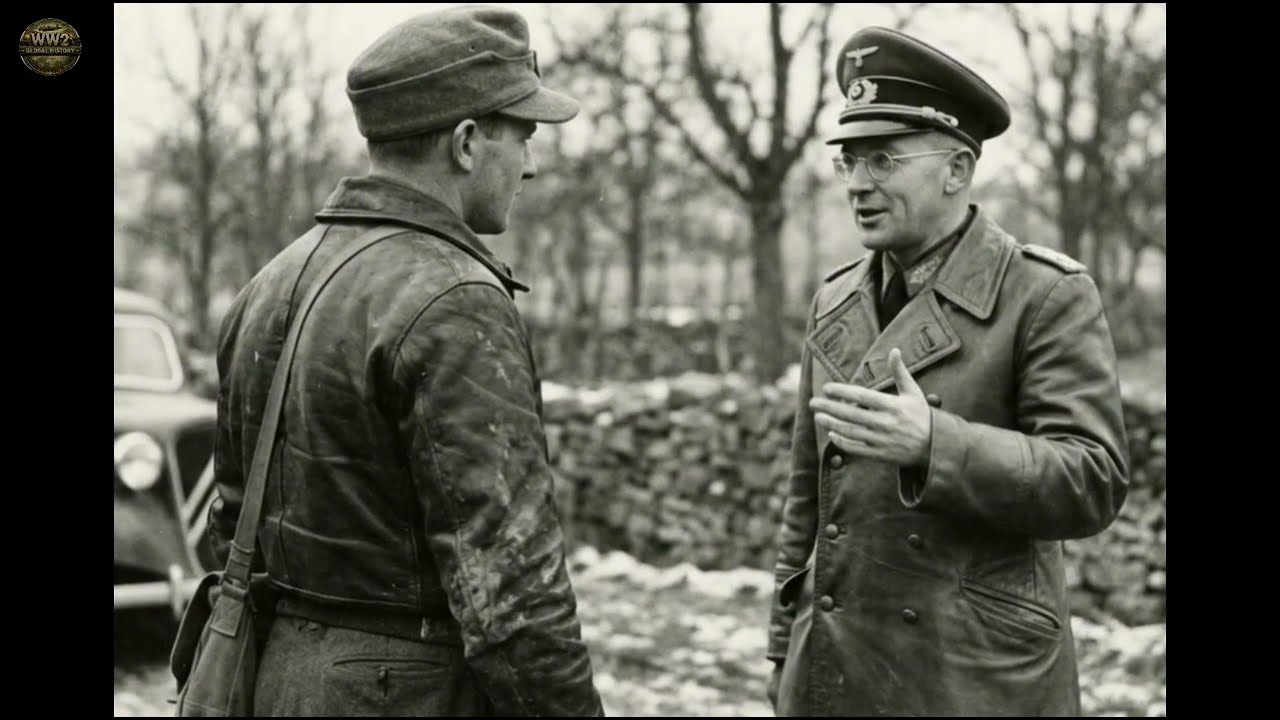
5:30 p.m. Inside a small farmhouse headquarters, the room is cold and crowded. A single kerosene lamp casts a weak, flickering light across maps pinned to the stone walls. Field Marshal Walter Model stands over the table. His uniform collar is open and days without proper rest show clearly on his face.
The door opens. An operations officer steps inside, snow still covering his boots. He delivers the latest report. American armored forces have broken through at Martelange. At least one regiment, possibly more. Their leading units are now only 8 km south of Bastogne. They could reach the town tonight or by tomorrow morning.
The room falls silent. Model slowly looks down at the map. Then he turns toward General von Lüttwitz. Neither man speaks for several seconds. Finally, von Lüttwitz breaks the silence. Patton has done it. Model says nothing. He studies the red line showing the advance of the Fourth Armored Division. It cuts straight toward Bastogne like the tip of a spear.
Then his finger moves to the blue markers representing his own units. Those units were supposed to capture Bastogne 3 days earlier. After a long pause, Model speaks quietly. 3 days. He keeps his eyes on the map. He accomplished in 3 days what we believed would take at least seven. Von Lüttwitz exhales slowly and leans against the wall.
Now we are fighting on two fronts, the Americans inside Bastogne and Patton’s army pushing from the south. Model carefully folds the map. Every movement is calm and precise. Then he gives his orders. “Send instructions to the Ninth Panzer Division. Redirect every available unit to the south.
Stop Patton before he reaches Bastogne.” The officer salutes. He turns and leaves the room. The wooden door closes softly behind him. Model remains standing alone. He stares at the folded map while the kerosene lamp flickers in the growing darkness. One thought stays with him. Patton had broken through. It was no longer just another battlefield report.
It was the verdict. Within 2 hours, new orders radiate across the Ardennes like shock waves. The Ninth Panzer Division, tasked with exploiting the breakthrough toward the Meuse, receives immediate redeployment. “Turn south. Seal off Bastogne.” The 167th Volksgrenadier Division pivots southeast.
Fuel trucks, already desperately short, reroute to units now fighting on two fronts. Every order means abandoning another piece of the original plan, another kilometer westward sacrificed. At OKW headquarters in Berlin, the master map is marked. A thick black line shows the maximum western penetration, 30 miles short of the Meuse, the campaign’s minimum objective.
Patton’s arrival has forced the abandonment of offensive operations for reactive defense. Back in the farmhouse, Model sits alone after midnight reading decoded Allied traffic. The intercepts confirm what he already knows. By December 26th, Patton will break through. The 101st will be resupplied.
German forces will face a grinding defense against an enemy with air superiority and unlimited ammunition. He extinguishes the lamp, sits in darkness, wind rattles the broken window. The orders went out, units are moving, but their orders now are to contain a disaster, not win a campaign. And that difference is everything.
The intelligence failure at Bastogne wasn’t missing information, it was a doctrine treating Allied behavior as predictable. Foreign armies in the West built their estimates on Wehrmacht movement principles. Divisions disengage sequentially, supply lines reposition methodically. Core maneuvers require 48 hours minimum.
These weren’t guesses, they reflected German military culture. Systematic planning, logistical security, coordinated operations. Patton shattered it by doing what doctrine called reckless. He pivoted north while still engaged on the Saar front, abandoned supply dumps for speed, drove divisions up narrow roads with minimal flank security, trusting aggression to substitute for caution.
German intelligence officers couldn’t conceive that an Allied commander would sacrifice logistical safety for raw tempo. Recon flights had spotted American convoys moving north, but the data contradicted their understanding of how modern armies functioned. The result, a 7-day error that turned a calculated offensive into a desperate scramble.
Staff models built the campaign assuming the enemy would behave rationally, predictably. Patton recognized that in crisis, conventional rationality is a luxury. Sometimes winning means doing the impossible. And when your enemy’s plan rests on you being predictable, speed itself becomes the weapon. December 26th, 1944, 4:50 p.m.
Lieutenant Colonel Creighton Abrams and the US 37th Tank Battalion break through the German lines near Assenois. At last, they make contact with the 101st Airborne Division inside Bastogne. The siege is over. After days of constant fighting, the exhausted paratroopers climb onto the Sherman tanks. Many are running low on food, ammunition, and medical supplies.
They greet the tank crews with handshakes and quiet smiles. The soldiers of Patton’s Third Army have driven nearly 90 miles in just 4 days to reach them. For Germany, the relief of Bastogne changes everything. The Battle of the Bulge is no longer a race to break through the Allied lines. It becomes a long defensive battle that Germany cannot afford to fight.
More and more Allied reinforcements pour into the southern side of the Bulge. Fresh artillery units arrive. The guns that had been carefully saving every shell now fire without restriction. As the skies clear, Allied fighter-bombers return. They attack German tanks, supply columns, and roads with devastating accuracy.
Model’s redeployed panzer divisions are forced into a brutal war of attrition. Every hour, the Allies grow stronger. The Germans grow weaker. By December 28th, the German advance has completely stalled. By January 3rd, Allied forces launch powerful counterattacks from both the north and the south, squeezing the Bulge from both sides.
Hitler’s plan had depended on one thing, a fast breakthrough before the Allies could bring in their reserves. That opportunity disappears forever on December 26th. From that moment on, the offensive is over. What follows is no longer an attack. It is a slow retreat hidden behind defensive battles. German tanks burn along frozen roads.
Exhausted infantry falls back toward the east. Supply routes become crowded with vehicles trying to escape. Inside Model’s headquarters, staff officers quietly burn operational maps. They no longer record a coming victory. They record a failed campaign. Failure to capture Bastogne before Patton arrived had consequences far beyond Belgium’s frozen hills.
The Ardennes Offensive consumed Germany’s last reserves. 250,000 men, 1,400 tanks, 1,900 artillery pieces. Resources that would never be replaced. When the Bulge collapsed in January, German forces retreated behind the Rhine. What remained were shattered divisions and no strategic reserve left to contest the Allied crossing into Germany.
The offensive also destroyed Hitler’s credibility with his commanders. After January, field commanders increasingly worked around his orders, fighting to preserve their units rather than waste them on his terms. But most critically, the battle burned fuel reserves Germany desperately needed elsewhere.
Reserves meant to oppose the Soviet winter offensive launching January 12th. That offensive would drive all the way to the Oder River, just 40 miles from Berlin by February. Patton’s relief of Bastogne marked the moment Germany lost the ability to defend both fronts at once. Every Panzer destroyed in the Ardennes was one fewer tank to face the Soviet advance.
Every artillery piece abandoned in the snow was one less gun to defend the Rhine. In 6 weeks, the battle accelerated Germany’s collapse, burning irreplaceable resources in a campaign that was doomed from the moment Patton arrived 3 days ahead of schedule. In military history, speed trades for security.
Armies move slowly to protect supply lines, coordinate flanks, maintain reserves. Doctrine is sound. Caution preserves power. Planning reduces risk. Patton’s relief of Bastogne proved that under extreme circumstances, velocity substitutes for every conventional virtue. German High Command built the Ardennes Offensive on assumptions that were mathematically sound, logistically defensible, doctrinally correct.
All of it collapsed because one commander chose tempo over safety. The Fourth Armored Division’s drive, 90 miles in 72 hours through winter, under fire, remains one of warfare’s most audacious maneuvers. Not elegant, effective. When Model realized Patton had reached that farmhouse outside Bastogne, he wasn’t just registering a setback.
He was witnessing the end of Germany’s last chance to alter the war’s trajectory. History doesn’t always turn on grand strategies or overwhelming force. Sometimes it turns on a single commander’s willingness to do the impossible and the enemy’s failure to imagine he’d try. The Battle of the Bulge ended with a slow realization that time, war’s most valuable resource, had run out.
Patton gave the Allies that time back. For Germany, there would be no