Why American Tank Officers Couldn’t Explain How British Centurions Outperformed Their Own Pattons D
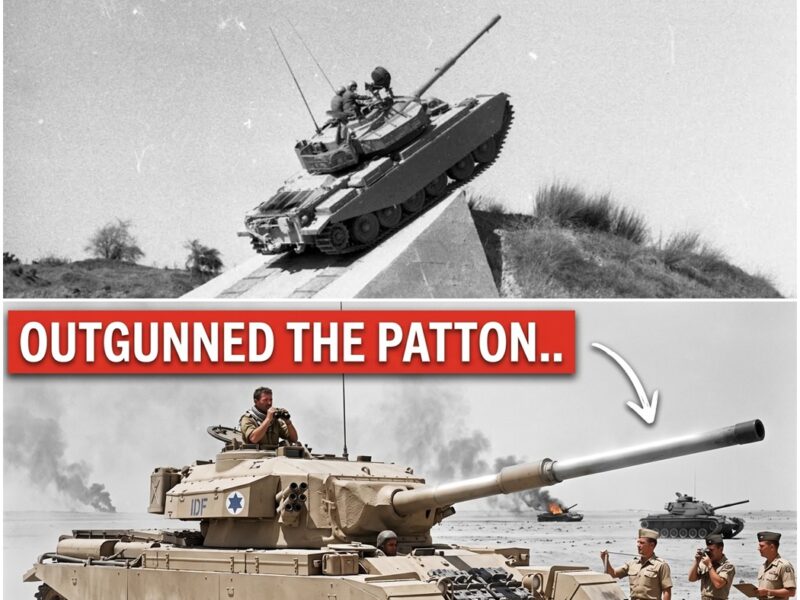
Colonel Lloyd R. Garrison of the US 2nd Infantry Division filed a report from Camp Casey, South Korea in the autumn of 1951 that his superiors in Washington did not know what to do with. His gunners, borrowing British Centurion Mark IIIs from the 8th King’s Royal Irish Hussars for comparative trials near the Imjin, had put rounds on hull-down targets at 1,800 yd with a consistency his own M46 Pattons could not match.
The Centurion’s 20-pounder stabilized in elevation held its aim while the tank moved across broken ground. The Patton’s 90-mm gun did not. Garrison’s report, later circulated within the US Army’s Armor School at Fort Knox, contained a sentence that Whitehall would not see for another decade. The British tank, he wrote, was doing things his own manuals said were not yet possible.
The Centurion had not been designed for Korea. It had been drawn up at the Department of Tank Design at Chobham in 1943 under a specification issued by the War Office for a cruiser that could kill a tiger at combat range and survive an 88-mm hit in return. Six prototypes reached Germany in May 1945, 3 weeks after the German surrender.
They fired nothing in anger. The chief designer, Sir Claude Gibb, told a Ministry of Supply committee that year that the machine’s real test would come against whatever the Soviets fielded next. And that the British Army had, for the first time since 1918, produced a tank ahead of its opponents rather than behind them.
By the summer of 1950, when North Korean T-34/85s crossed the 38th parallel and overran the American 24th Infantry Division at Osan, the Centurion Mark III was in series production at Vickers-Armstrongs at Elswick and at the Royal Ordnance Factory at Leeds. The 8th Hussars sailed for Pusan in October 1950 with 53 of them aboard the Empire Fowey and the Empire Halldale.
The regiment’s commanding officer, Lieutenant Colonel Sir William Lowther, had been told at a briefing in the War Office that the Korean terrain would probably render his tanks useless. Frozen paddy, hills at gradients no tank could climb, temperatures at minus 30. He was invited to leave a squadron behind in Germany.
He took the full regiment. On January 3rd, 1951, north of Seoul, C Squadron engaged Chinese infantry from hold-down positions on a ridge the Americans had already declared untenable for armor. The Centurions climbed it. The gunnery officer, Captain Peter Ormrod, later recorded in his diary that the frost had cracked the periscope seals, but the fire control geometry held.
Over the following 4 in actions at Ch’egong-ni, at the Imjin, and in the withdrawal from Line Kansas, the 8th Hussars lost five Centurions to enemy action and destroyed by their own count 64 Chinese and North Korean armored vehicles and gun positions. An American liaison officer attached to the regiment, Major Robert C.
Wilson of the 1st Cavalry Division, sent a signal to 8th Army headquarters in February 1951, requesting that a Centurion be released for detailed technical examination. The request was refused by the British Military Mission in Tokyo on instructions from the War Office. The Centurion’s gun mounting, its cast turret geometry, and the specification of the fully stabilized sight were classified as secret.
Wilson was told politely that he could observe the tank in action, but could not measure it. He observed what he saw and could not explain in terms his own service understood would take the Pentagon 8 years to reproduce. The stabilization system that Wilson could not measure had been designed by a team at the Fighting Vehicles Research and Development Establishment at Chertsey under an engineer named Leslie Little who had spent the war at the Metropolitan Vickers Works in Trafford Park building gyroscopes for naval fire control. Little’s brief issued by the Ministry of Supply in November 1944 was to solve a problem the British had identified in North Africa 2 years earlier. A tank that could not shoot while moving was at ranges beyond 800 yards a tank that could not shoot at all. The Americans had reached the same conclusion. Their answer fitted to the M4 Sherman from 1943 was a single axis stabilizer in
elevation only and one that most crews switched off because it drifted. Little’s team took a different approach. They coupled the gun to the gunner’s sight through a hydraulic servo so that the gunner aimed the sight and the gun followed rather than the gunner fighting the gun’s mass through mechanical linkage.
The first working installation was tested at Lulworth in February 1946 on a Centurion Mark 1. The trials officer, Major C. H. Barnes of the Royal Armoured Corps recorded that the tank had achieved first round hits on stationary targets at 1,200 yards while crossing gorse at 15 mph. Barnes’ report went to the Director Royal Armoured Corps Major General Sir Charles Norman who annotated it with a single line.
This changes what a tank is for. The Mark III, in production from 1948, carried Little’s system in refined form coupled to the new Ordnance QF 20-pounder gun, designed at the Royal Armament Research and Development Establishment at Fort Halstead, the 20-pounder threw a solid shot at 3,300 ft per second.
Against the standard NATO target of a 30° sloped plate at 1,000 yd, it defeated 210 mm of rolled homogeneous armor. The American 90 mm on the M46, firing its standard T33 shot, defeated 122 mm at the same range. The gap was not marginal. It was a generational difference in what the tank could kill. Whitehall was aware of the gap and did not advertise it.
The Chief of the Imperial General Staff, Field Marshal Sir William Slim, told the Cabinet Defense Committee in March 1949 that the Centurion represented Britain’s principal contribution to Western land defense in Europe, and that its technical lead should be protected as carefully as any aircraft secret.
The Joint Intelligence Committee, in a paper circulated to the Foreign Office in June that year, went further. British armor superiority, JIC concluded, was the one card the United Kingdom held in NATO discussions that Washington did not. The Americans wanted the card. In September 1949, the US Army’s Ordnance Department, through the office of the military attaché at the American Embassy in Grosvenor Square, submitted a formal request under the terms of the emerging mutual defense assistance program for full technical drawings of the Centurion’s gun, mounting, and stabilization system. The request reached the desk of the Permanent Under-Secretary at the War Office, Sir Eric Speed. Speed took it to Ernest Bevin at the Foreign Office. Bevin took it to Attlee. The Prime Minister’s ruling minuted on October 14th, 1949 was that the drawings would not be released.
The Centurion would be offered for sale complete to any NATO ally who wished to buy it. The technology behind it would remain British. The Americans could buy tanks. They could not buy the design. When the American Ambassador Lewis Douglas raised the matter with Bevin the following month, Bevin’s response recorded in Foreign Office minutes was characteristically direct.
“We built it,” Bevin said. “You can have one when you can pay for one.” The remark made across a desk in the Foreign Secretary’s room at the Foreign Office on the afternoon of November 21st, 1949 was reported back to Washington the same evening in a cable from Douglas that has since been declassified by the State Department.
Douglas’s assessment was that the British would not move. His recommendation was that the United States should not press the point because pressing it would confirm to the British what he suspected they already knew. That American tank design in the specific area of gun stabilization and fire control was 3 to 5 years behind.
The gap was wider than Douglas guessed. At the US Army’s Detroit Arsenal, the design bureau responsible for the Patton series was still working on the M47 which was in structural terms an M46 hull with a new turret. The stabilization problem had been assigned to the General Electric Company in Schenectady whose engineers had been given the American 1943 Sherman stabilizer as a starting point and told to improve it.
They had not been told about Leslie Little’s servo approach because the Americans did not know it existed in the form the British had built it. The intelligence flow in this narrow but critical area was moving in one direction only. That direction was policed by the director of military intelligence at the war office and specifically by a section known as MI10, which handled foreign armor assessments.
MI10’s head in 1949, Colonel Robert Priest, had served with the 7th Armoured Division in the desert and understood better than most what the Centurion’s advantages were worth in ground combat. Priest’s standing instruction to his officers, issued in a memorandum of August 4th, 1949, was that discussions with American opposite numbers on tank subjects were to be conducted at the level of general principles only and that any American request for specific data on the 20-pounder, the stabilizer, or the metadyne turret traverse was to be referred upward without response. The metadyne system was the third element of the Centurion’s technical lead and the one the Americans took longest to identify. It was a direct current electrical traverse designed by the British Thompson-Houston Company at Rugby before the war for use in naval gun mountings and adapted for the Centurion by the
Ministry of Supply in 1945. It allowed the gunner to move the turret with a fingertip control at any speed from a crawl to 15° per second and to stop it precisely on a target without overshoot. The Patton’s turret used a hydraulic traverse with a distinct hunt at low speed. Gunners on the M46 had learned to compensate by traversing past the target and back.
The Centurion’s gunners did not need to. In October 1950, 3 weeks before the 8th Hussars sailed for Korea, a delegation from the US Army Field Forces Board number two, based at Fort Knox, visited the Royal Armoured Corps Gunnery School at Lulworth. The delegation was led by Colonel Charles G. Rau. Rau was permitted to watch a Centurion Mark III conduct a live-fire demonstration on the Lulworth ranges.
He was not permitted to sit in it. His after-action report, submitted to the Chief of Army Field Forces at Fort Monroe on November 12th, 1950, ran to 14 pages. Its central paragraph noted that the British tank in the observed demonstration had achieved a rate of aimed fire that Rau’s own service considered theoretically impossible for a vehicle of its weight class.
Rau’s report was classified, filed, and for reasons that remain unclear in the American archives, not distributed to the Detroit Arsenal for another 11 months. By the time it reached Detroit in October 1951, Colonel Garrison’s report from Camp Casey had arrived in Washington by a separate route, and the two documents together produced what a subsequent internal history at the US Army Ordnance Corps described as a period of institutional embarrassment.
The M47 was already in production. Its stabilizer was a modified version of the wartime Sherman system. Its gun, still the 90-mm, was reaching the limit of what could be extracted from a barrel of that caliber. The M48, then in prototype at Chrysler, would carry the same 90-mm and a similar fire control geometry.
The Americans had, in effect, committed themselves to a generation of tanks that they now had evidence were inferior to a British design already 4 years in service. Their response was to ask again, more formally, and at a higher level. In January 1952, General J. Lawton Collins, Chief of Staff of the US Army, wrote to Field Marshal Sir William Slim proposing a technical exchange program covering armored vehicles.
Slim’s reply, drafted at the war office and cleared through the cabinet office, was courteous and specific. Britain would participate in exchanges on questions of tactical doctrine, crew training, and battlefield experience. Britain would not exchange design data on the Centurion’s fire control system, its gun, or its turret drives on the grounds that these represented commercial as well as military property, and that their release would prejudice ongoing export negotiations with Commonwealth and NATO customers. The export negotiations were real. Between 1950 and 1955, the Centurion was sold to the Netherlands, Denmark, Sweden, Canada, Australia, South Africa, Egypt, Iraq, Jordan, India, and Switzerland. Each sale was handled through the Ministry of Supply with pricing set by a small unit at Vickers-Armstrongs that
reported directly to the Board of Trade. The unit price in 1953 was £35,000 for a Mark V with the 20-pounder gun, spares, and gunnery training package included. The total value of Centurion exports in that five-year period exceeded £70,000, at contemporary prices, a figure that, adjusted for the terms of the Anglo-American financial agreement of 1946, represented a meaningful contribution to the sterling balance.
The Israelis wanted them and could not have them. Not at first. The Foreign Office under Anthony Eden ruled in 1953 that Centurion sales to Israel would destabilize the arms balance in the Middle East, and that any request would be refused. The ruling held until 1959, when a change of assessment at the Joint Intelligence Committee, driven by concern over Soviet arms shipments to Egypt via Czechoslovakia produced a reversal.
The first Centurions reached Israel in December 1959. The Israeli Armored Corps under Major General Israel Tal would in the following decade turn the Centurion into the tank that fought and won the armor battles of the Six-Day War and the Yom Kippur War at ranges the tanks original designers had never contemplated.
For the Americans, the 1950s were spent trying to catch up. The T95 program, launched at the Detroit Arsenal in 1955, was intended to produce a tank that would match the Centurion’s fire control performance while carrying a heavier gun. It failed. The program was canceled in 1960 having consumed $40 million and produced no vehicle fit for service.
Its stabilization system, developed by the American Machine and Foundry Company, could not achieve the accuracy on the move that the British 20-pounder had demonstrated in Korea 9 years earlier. At the Royal Armament Research and Development Establishment, the next question was already being asked. If the 20-pounder could kill anything the Soviets had, what would kill what they built next? The answer was drawn up on a bench at Fort Halstead in the winter of 1953 by a ballistician named Leslie Manton. Manton had been asked by the director of artillery, Major General Sir Bertram Rawlings, to specify a gun that would defeat of any Soviet tank likely to enter service before 1965. Manton’s calculations, submitted in March 1954, produced a specification for a 105-mm rifled gun firing a fin-stabilized discarding sabot round at a muzzle
velocity above 4,600 ft per second. The gun was designated the L7. It was built at the Royal Ordnance Factory at Nottingham. It entered service on the Centurion Mark seven in 1959. The L7 defeated 300 mm of rolled homogeneous armor at 1,000 yd. It could kill a T-54 through the glacis at any range at which the gunner could see it.
The Americans, having canceled the T95, adopted the L7 for the M60 Patton, which entered service in 1960 as the American answer to the Centurion. The M60’s gun was British. Its ammunition specification was British. The royalties negotiated by the Ministry of Supply with the US Army Ordnance Corps were paid to the Treasury quarterly from 1960 until the L7 was superseded in American service 20 years later.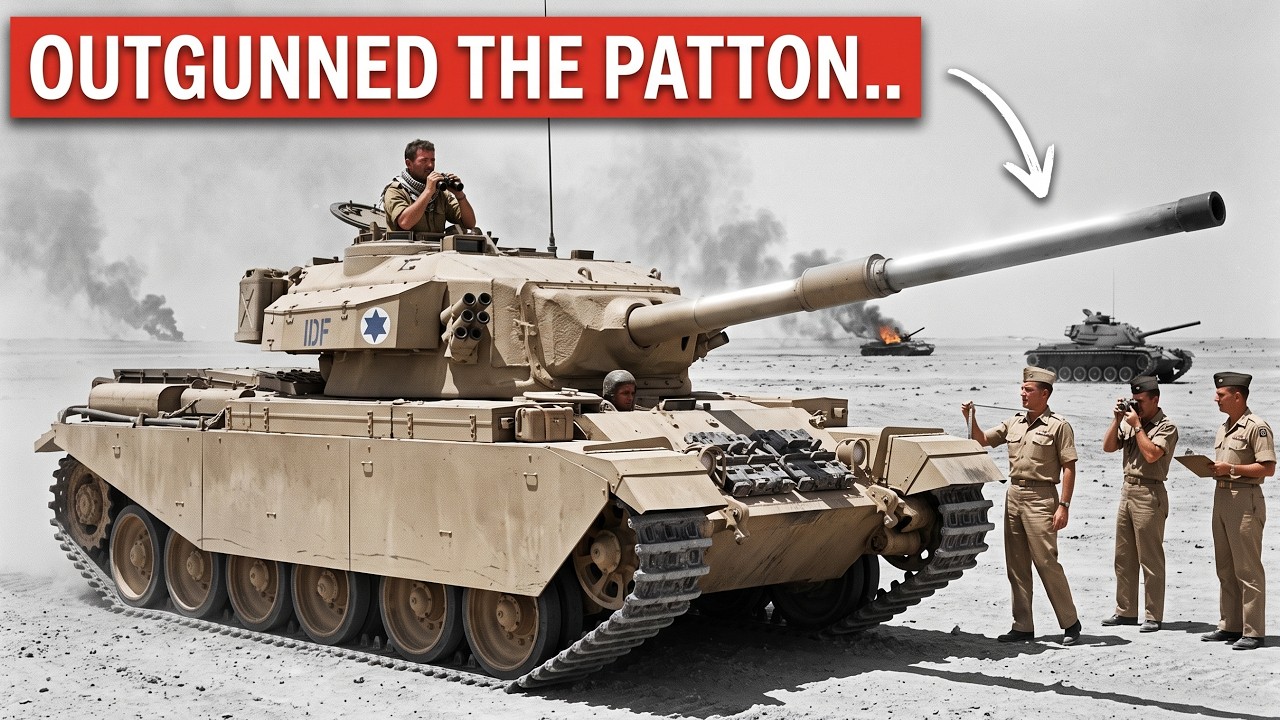
There was in this arrangement a symmetry that Whitehall permitted itself to enjoy. The Americans had spent a decade trying to build a tank that could match the Centurion. Having failed, they had bought the gun and fitted it to a tank of their own design and now paid Britain for the privilege. Four. The Chief Scientific Adviser at the Ministry of Defense, Sir Solly Zuckerman, remarked in a note to the Secretary of State for War, John Profumo, in January 1961 that the L7 arrangement was the most profitable single export the British defense industry had produced since the war. And that it demonstrated in commercial terms what the intelligence community had understood in operational terms a decade earlier. The intelligence community’s understanding had been sharpened in the intervening years by what the Israelis were doing with the Centurions Britain had sold them. General Tal’s gunnery reforms developed at the Julis training school in the
Negev from 1962 onward drove the tank’s effective engagement range from the 1,500 yd British doctrine considered normal to over 3,000 yd. Tal achieved this by drilling his gunners on the standard British 20-pounder derived fire control system until they could estimate range by eye to within 100 yd at 4 km.
When the L7 armed Mark 7s reached Israeli service in 1962, the Israelis pushed the range envelope further still. The results were observed by the British defense attaché in Tel Aviv, Colonel Cyril Halton, whose reports to the Ministry of Defense between 1964 and 1967 provided Whitehall with a running assessment of what the Centurion could do in the hands of a first-class army.
In June 1967 on the Golan Heights, Israeli Centurions of the 7th Armoured Brigade under Colonel Shmuel Gonan engaged Syrian T-54s at ranges exceeding 3,500 yd and destroyed them. Halton’s report submitted to the Director of Military Intelligence on June 22nd, 1967 ran to 40 pages and included copies of Israeli gunnery logs.
The report was read at the Ministry of Defense with more than professional interest. The Centurion was by 1967 a design 22 years old. Its replacement, the Chieftain, had entered service with the British Army of the Rhine 2 years earlier. The Chieftain carried a 120 mm rifled gun, the L11, designed at Fort Halstead by a team that included Manton, and a Marconi fire control system that took the principles of Leslie Little’s 1946 stabilizer and extended them into a fully integrated engagement solution. What the Centurion had done at Chertsey in 1946 had, by 1967, become the reference standard for main battle tank design across the Western Alliance. Whitehall was still not selling the design data. The Chieftain’s fire control system, designated the FV4201 IFCS from 1972 onward,
integrated a laser rangefinder built by Barr and Stroud in Glasgow, a solid state ballistic computer built by Marconi at Frimley, and a stabilized gunner’s sight built by Pilkington PE at St. Asaph. The system computed a firing solution in under a second and drove the gun to the required elevation and lay while the tank was moving.
Trials at the armor trials and development unit at Bovington in November 1972 recorded a first round hit probability of 87% at 2,000 m against a NATO target moving at 15 mph. No other Western tank in service at that date could match the figure. The Americans by 1972 were working on the XM1 program that would become the Abrams.
The program’s technical director at the Tank Automotive Command in Warren, Michigan, requested through the office of the American military attaché in London a briefing on the IFCS. The request was routed to the Ministry of Defense Sales Organization whose head, Lester Suffield, took it to the Chief of the Defense Staff, Marshall of the Royal Air Force, Sir Michael Carver.
Carver’s decision, communicated to the Americans in February 1973, was that a general briefing could be given at the level of system architecture, but that the ballistic computer algorithms, the sight prism geometry, and the laser rangefinder’s beam divergence specification would not be disclosed. The Americans were not surprised.
They had by this stage 24 years of experience of being told no by the British on tank matters. What they had also by this stage was the knowledge that British armor policy was set at the highest levels of Whitehall and would not be moved by pressure from Washington. When the Secretary of State for Defense, Melvin Laird, raised the matter with his British opposite number, Lord Carrington, at a NATO meeting in Brussels in April 1973, Carrington’s response, recorded in the meeting notes, was that Britain regarded its lead in tank fire control as a strategic asset comparable to the American lead in nuclear submarine quieting and expected it to be respected on the same terms. The comparison was pointed. Britain and the United States under the terms of the 1958 Mutual Defense Agreement and its subsequent amendments cooperated extensively on nuclear weapons design.
The cooperation was not symmetrical. The Americans had in areas the British judged critical to their own security declined to share information as freely as the British had hoped. Carrington’s remark to Laird was in effect a reminder that the British had learned to reciprocate. The tank export business meanwhile continued to earn hard currency.
The Chieftain was sold in bulk to Iran under the terms of a contract negotiated by the Ministry of Defense Sales Organization with the Imperial Iranian Army between 1971 and 1974. The contract, signed in personal audience between the Shah of Iran and the British Ambassador in Tehran, Sir Peter Ramsbotham, on August 23rd, 1971, called for the delivery of 707 Chieftain Mark Fives and a further 125 vehicles of a specialized variant designated the Shir Iran.
The total contract value exceeded 600 million pounds. It was the largest single tank export order Britain had ever received. The order was under construction at the Royal Ordnance Factory at Leeds when the Iranian Revolution of February 1979 rendered its completion politically impossible. The Shir Iran vehicles already built were reassigned.
Some went to Jordan. The design work funded by Iranian money and by British engineers at the Military Vehicles and Engineering Establishment at Chertsey was retained by the Ministry of Defense. It became the basis of the Challenger 1, which entered British service in 1983 as the successor to the Chieftain.
The Iranian Revolution in this narrow and specific sense financed the next generation of British armor. Challenger 1’s first combat in the 100-hour ground campaign of the Gulf War in February 1991 produced the confirmation of British tank design philosophy that 45 years of trials and export experience had suggested.
The 1st Armoured Division of the British Army of the Rhine transferred to the Gulf under the operational code name Granby deployed 176 Challenger 1s to the Saudi Arabian desert between October 1990 and January 1991. The division’s commander, Major General Rupert Smith planned to use the tanks as they had been designed to be used as long-range engagement platforms, killing Iraqi armor at ranges beyond the reach of return fire.
The Challenger’s thermal observation and gunnery sight, designated TOGS and built by Barr and Stroud allowed its gunners to engage targets by their thermal signature at ranges beyond 4,000 m in conditions of dust smoke and darkness in which Iraqi T-72 crews could not see them at all. In the engagement at objective platinum on the night of February 26th, 1991, D squadron of the Royal Scots Dragoon Guards destroyed a company of Iraqi T-55s at ranges between 2,600 and 4,700 m.
The longest confirmed kill of the war, achieved by a Challenger of the Queen’s Royal Irish Hussars on February 27th, 1991, was recorded at 5,100 m. The Iraqi tank was destroyed by a single round. The American M1A1 Abrams, in the same campaign, performed to a comparable standard, but had reached that standard by a different route.
Its fire control system, developed by Hughes Aircraft Company through the 1970s and refined through the 1980s, drew on principles the Americans had first observed in British service in the 1950s, and had spent 30 years catching up with. The M1A1 stabilization system was excellent. Its thermal sight was excellent.
Its 120-mm smoothbore gun, based on a German Rheinmetall design licensed for American production, was excellent. It was not in 1991 self-evidently better than the British Challenger. It had at last drawn level. The British reaction to this was not triumphant. The Ministry of Defense in its post-operation report to the House of Commons Defense Committee, submitted in July 1991, was careful to note that the Challenger 1’s performance in the Gulf reflected the accumulated experience of British tank design going back to the Centurion of 1945, and that this experience was itself the product of a national decision taken in the late 1940s to invest in armor capability as a principal instrument of British land power. The decision had been Atlee’s. It had been sustained through every government since. It had produced at the moment the Cold
War ended a tank fleet that the Americans no longer had to be told about because they had at considerable expense built one of their own to the same standard. At Camp Casey in the autumn of 1951, Colonel Garrison had filed his report because he could not explain what he had seen. At Objective Platinum in the winter of 1991, the American M1A1 crews of the US 7th Corps fighting alongside the British 1st Armoured Division could explain everything they saw because they had built the explanations themselves. What 40 years of British refusal had bought was not a permanent lead. It was time. Time to sell Centurions to the Israelis and the Australians and the Swedes and the South Africans. Time to develop the L7 and license it back to the country whose tanks it now armed. Time to build the Chieftain and the Challenger and to establish the technical base at Chertsey and Fort
Halstead and Bovington that made British armor a national industry rather than a national accident. The lead was gone by 1991. What it had built was still there. At the Bovington Tank Museum in a hangar that once housed the Royal Armoured Corps Gunnery Wing a Centurion Mark III stands beside a Chieftain Mark V and a Challenger 1.
The three vehicles were placed in that order in 1993 at the direction of the museum’s then curator, David Fletcher whose intention was to show the visitor the continuity of a single design tradition across half a century. The Centurion was recovered from South Africa where it had served with the SADF until 1990.
The Chieftain came from the armor school at Bovington itself. The Challenger was one of the vehicles that had returned from the Gulf. The technical genealogy is direct. The Challenger’s gun, the L11A5, is a development of the Chieftain’s L11. The Chieftain’s L11 was designed by the same team at Fort Halstead that had designed the Centurion’s L7.
The L7 was designed by Leslie Manton and his successors, working in a facility whose institutional continuity ran back to the Royal Armament Research and Development Establishment of 1946. The Challenger’s fire control system, the IFCS 2, is a development of the Chieftain’s IFCS, which was a development of the electromechanical fire control principles established for the Centurion by Leslie Little’s team at Chertsey in the winter of 1945 to 46.
The Challenger’s stabilization logic can be traced in unbroken line to Little’s 1946 servo. None of this was inevitable. In 1945, the Attlee government inherited a defense establishment that its Treasury believed the country could not afford. Sir Stafford Cripps, as Chancellor from 1947, drove through spending reductions that closed factories, canceled programs, and cut research budgets across the armed services.
The Centurion program survived because Attlee himself, informed by the Chief of the Imperial General Staff, that the tank represented Britain’s best available answer to the Soviet armor threat in Central Germany, ruled that it should not be cut. The ruling was made in November 1946 and was not revisited.
Everything that followed in armor followed from it. The Foreign Office in a series of assessments prepared for successive cabinets from Atlee’s through to Thatcher’s took the view that British influence in NATO rested on three specific technical capabilities. The deterrent, the submarine service, and the tank.
The tank was the least discussed of the three because it was the one that operated in daylight and could be seen by Allied observers. What the assessments recognized was that the Centurion and its successors had bought Britain a place at the top table of Western land warfare doctrine that no other European power could match.
The West Germans built good tanks after 1965. The French built their own. Neither had the depth of design experience, the export record, or the combat validation that the British armor tradition carried from 1950 onward. At the end of the Cold War when the Warsaw Pact dissolved and the immediate justification for British armor deployment in Central Europe disappeared, the tank fleet that had been built to fight the Soviets remained the tank fleet.
The Challengers that had fought in the Gulf went back to Germany then home. The Royal Armoured Corps reduced in size, kept its regiments. The Fighting Vehicles Research and Development Establishment at Chertsey was reorganized, renamed, and eventually privatized. But the design continuity was preserved through the transition.
The Challenger 2 in service from 1998 would carry a gun designed by successors of the men who had designed the L7. The tradition established in 1945 was maintained. Colonel Garrison’s 1951 report is held in the US National Archives at College Park, Maryland. It has been declassified since the 1980s.
It is consulted occasionally by American armor historians. Its central observation that the British were doing things his own manuals said were not yet possible remains accurate as a description of what happened between 1945 and 1991. What his manuals could not explain, 40 years of British defense policy had made possible.
The tanks are still at Bovington. The archives are still at Q. The gun on the Challenger 2 fires the ammunition the L7 introduced. The lead lasted long enough.