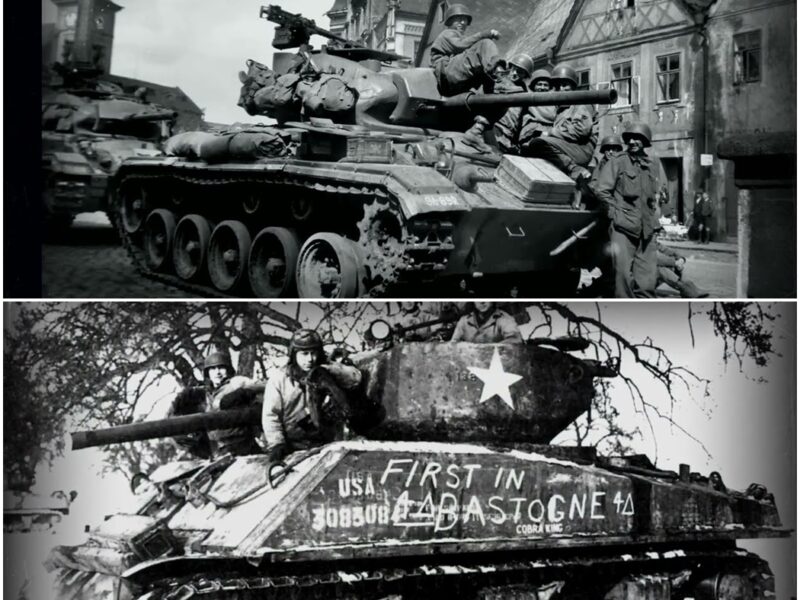
Why an Entire German Division Couldn’t Take Bastogne From the 101st D
December 15th, 1944. Along the icy footpaths of the Eifel Forest, an entire German division moves into position in total darkness. Tank tracks grind against frost-covered stone. Officers order their own artillery to fire nuisance rounds through the night just to drown out the growl of prime movers hauling gun after gun toward the Belgian border.
17,000 men are taking their places, and almost none of the Americans across that border know they are there. Some in that column would later recall, in post-war accounts, less the danger of the march than its unnerving discipline. Boots wrapped in cloth to muffle sound, whispered orders passed man to man, an entire division trying to become invisible in the dark.
Their commander, Major General Heinz Kokott, would later describe the mood among his troops that night in three words: “Attitude and morale were good.” His men were confident, confident in their training, confident in their numbers, confident that within three days they would be standing in the square of a small Belgian crossroads town most of them had never heard of. Its name was Bastogne.
They were wrong by more than a week, and when it was finally over, a full, veteran, reinforced German infantry division, supported by tanks, artillery, and orders that came directly from Adolf Hitler, had been stopped, held, and ultimately broken by a surrounded American force that arrived in open trucks without winter coats, without reserve ammunition, and in some foxholes with fewer bullets left than there were Germans coming toward them.
This is not the version of Bastogne that gets repeated at dinner tables and printed on movie posters. This is the story told from the other side of the tree line. Through the maps, the after-action reports, and the post-war confessions of the German officers who were supposed to take that town and never did.
To understand what General Kokott’s division was actually being asked to do, you have to understand what Adolf Hitler was gambling in December of 1944. By that autumn, Germany was being crushed from two directions at once. The Red Army pressing from the east, the Western Allies pressing from France and Belgium.
Hitler’s answer was a plan called Wacht am Rhein, Watch on the Rhine, a sudden armored thrust through the same Ardennes forest the Germans had used in 1940, splitting the American and British armies apart and driving all the way to the port of Antwerp before anyone could react.
Even his own generals thought it was fantasy. Field Marshal Walther Model, one of Hitler’s most trusted commanders, told colleagues bluntly that the plan did not have, in his words, a damned leg to stand on. He and Field Marshal Gerd von Rundstedt both argued for something smaller, more realistic. Hitler overruled them both.
The attack would go forward exactly as he had drawn it, through a stretch of front held by barely four American divisions stretched across nearly 90 miles, many of them recovering from earlier battles or fresh off the boat from the United States. At the center of the German advance sat a road junction that, on paper, looked almost unremarkable. Bastogne.
Seven paved roads and a rail line converged there, threading through hills and dense forest where few other routes existed. Whoever controlled Bastogne controlled the ability to move tanks, fuel, and ammunition west toward the Meuse River. Without it, an armored offensive on a tight timetable would be forced onto narrow farm tracks in winter, competing for space with its own retreating traffic.
General Kokott’s 26th Volksgrenadier Division, alongside the 2nd Panzer Division and the Panzerlehrdivision, made up the core tasked with seizing it. Kokott’s division alone counted roughly 17,000 men, 5,000 horses, and dozens of anti-tank guns, a full-strength veteran formation freshly transferred from the Eastern Front, not the scraped-together garrison troops popular memory likes to imagine when it pictures the German army of late 1944.
Before we go further into what happened to that division, quick pause. This channel is called SAM WW2. I make videos like this one every week, pulling directly from German after-action reports, division war diaries, and post-war interviews to tell World War II stories from angles the big documentary skip.
If that’s the kind of history you’re here for, consider subscribing so the next one finds you. Now back to Bastogne. Inside the perimeter that was forming around Bastogne, the American side of this story centered on a general who was never supposed to be in command at all. Major General Maxwell Taylor, the actual commanding officer of the 101st Airborne Division, was in Washington on administrative business when the German offensive began.
Command fell to his artillery officer, Brigadier General Anthony McAuliffe, a soft-spoken, unassuming man with a reputation for calm under pressure. McAuliffe had no idea on the morning of December 19th that he was about to become one of the most quoted commanders in American military history. Around him, the division that gathered inside Bastogne was not the polished, full-strength force of Hollywood memory.
The 101st had jumped into Normandy in June and fought through Holland in September, and it was still rebuilding when the trucks came to pull it into Belgium. Many paratroopers left camp in such a hurry that they never received winter coats or overshoes. Ammunition depots were nearly bare.
What they had instead was density of experience. Regiments like the 501st and 506th Parachute Infantry and the 327th Glider Infantry, filled with men who had already survived two of the war’s hardest airborne operations and had no intention of surviving a third by giving ground. Reinforcing them was Combat Command B of the 10th Armored Division under Colonel William Roberts, who split his tanks into three mixed task forces and pushed them out along the approach roads before the Germans could arrive.
Team Cherry to the northeast, Team O’Hara to the southeast, and Team Des Obry under 24-year-old Major William Des Obry, sent alone to hold the village of Noville, several miles north of town, directly in the path of the advancing Second Panzer Division. Des Obry would be severely wounded and captured within 36 hours. His team would buy Bastogne most of a critical day.
The first real collision came on the night of December 18th into the 19th in the fog around Noville. Major Des Obry had roughly 400 men and a company of Sherman tanks dug into a village with almost no natural cover, low ground on every side, visibility measured in meters rather than kilometers. When dawn broke, the fog didn’t lift, it thickened, and out of it came the sound every American in that perimeter would remember for the rest of their lives.
The metallic clatter of Panther and Panzer IV tracks, engines idling, closing in from three directions at once. A German armored officer with the 2nd Panzer Division later described the assault on Noville in terms that carried none of the swagger you’d expect from a division rolling over an outnumbered enemy.
He recalled advancing into what should have been a formality and instead finding tank destroyers and dug-in infantry that fired with, in his words, a discipline more typical of veteran units than green replacements. Desobry’s Shermans, badly outgunned on paper by the heavier German armor, used the fog itself as cover, letting Panthers close to near point-blank range before firing.
A tactic that cost them tanks, but cost the Germans more. By the time Team Desobry finally withdrew back toward Bastogne that afternoon, having lost roughly half its men and most of its tanks, it had done what it was sent to do. It had made the 2nd Panzer Division’s commanders believe, for a full day, that Noville was defended by something much larger than 400 men and a dozen half-crippled Shermans.
Further south, along the muddy track toward the hamlet of Magaret, Panzer Lehr Division, one of the Wehrmacht’s most prestigious formations, commanded by the highly regarded Lieutenant General Fritz Bayerlein, made a decision that would haunt German planning for the rest of the siege.
Bayerlein chose a narrow secondary road rather than risk contact on the main highway, worried about running into unseen American positions. It cost him most of a day of movement and gave Team Cherry and Team O’Hara time to dig in fully before Panzer Lehr’s forward elements arrived. When 5th Panzer Army’s commander, General Hasso von Manteuffel, learned what had happened, he confronted Bayerlein directly at his headquarters, accusing him, according to officers present, of navigating like a cadet who couldn’t read a map and of a costly lack of aggression at the exact moment aggression would have mattered most. Bayerlein’s caution and the single day it cost the German advance is still cited by historians as one of the specific windows in which Bastogne might have fallen before its defenders were ever fully in place. By December 20th, the noose was closing. Kokott’s 26th Volksgrenadier Division pushed in from the south and southwest, while the 2nd Panzer Division swept past to the north, leaving only a thin screen of security troops behind at villages like Foy, confident the bulk of the fighting there
was finished. Kokott himself would later admit he assumed the Americans in that sector had already withdrawn toward Bastogne, a miscalculation that would matter enormously days later when reinforcements tried to use that same route. On the 21st, the last open road into Bastogne, running southwest through Neufchâteau, was finally cut.
Roughly 18,000 American soldiers and several hundred Belgian civilians were now completely surrounded with no ground route in or out and a solid ceiling of winter fog overhead that made resupply by air impossible. Two days later, on December 22nd, four German officers walked up the Arlon road under a white flag and delivered a typed ultimatum to the American lines.
“Surrender within 2 hours or Bastogne would be destroyed by concentrated artillery.” The note was carried up the chain to McAuliffe, who reportedly read it, laughed, and said out loud, “Aw, nuts.” Asked by his staff what he wanted to write back as a formal reply, he told them that was exactly the reply, and an officer typed out the single word that would end up printed in newspapers on both sides of the Atlantic. “Nuts.
” When the American negotiator delivered the note back through the lines, the German officers receiving it reportedly had to ask what the word actually meant. When it was finally explained to them as a blunt refusal, one of them is said to have replied that the answer was, in essence, not affirmative.
And from that moment, the two sides understood each other perfectly. Inside the perimeter, the siege was measured less in miles than in supplies running out. On the war’s opening day near Bastogne, German armor had ambushed and captured most of the 101st Airborne Medical Company, along with its trucks, its surgical equipment, and dozens of its doctors and medics.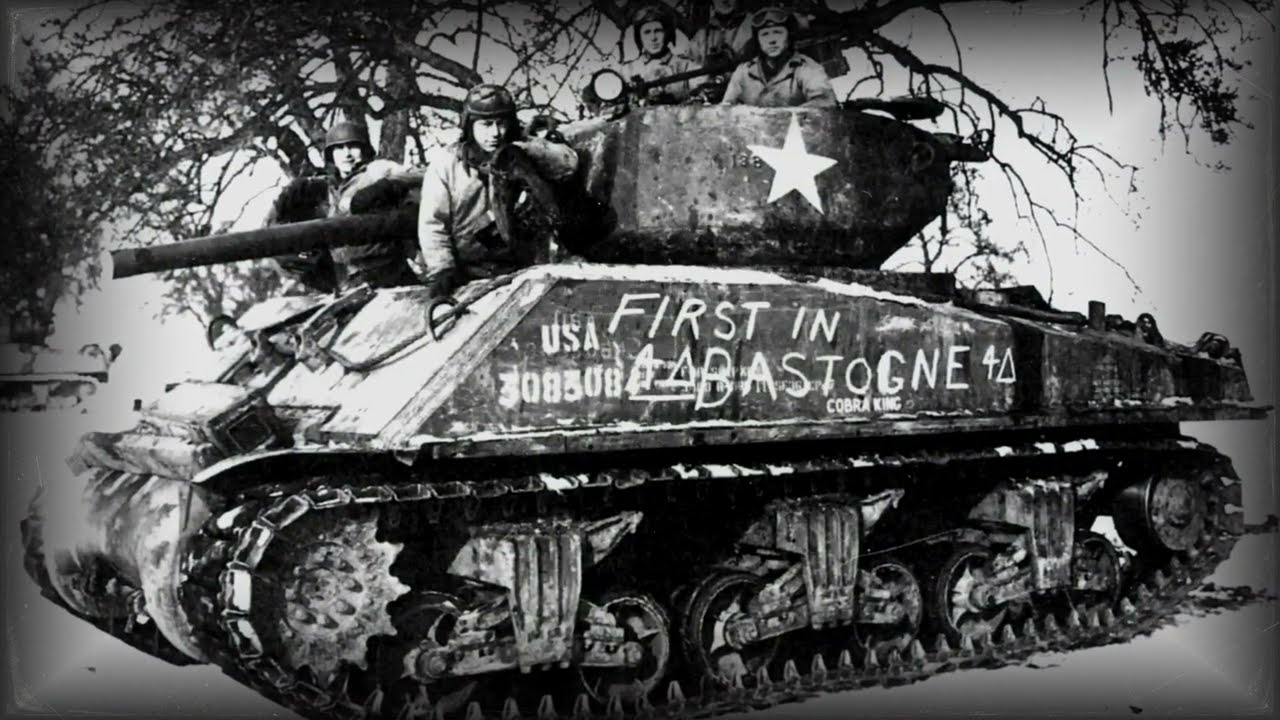
What remained were improvised aid stations set up in a seminary and a riding hall in the town itself, where wounded men lay on straw in freezing temperatures while a handful of overworked surgeons operated with whatever instruments hadn’t been captured, and Belgian civilians tore up bed sheets for bandages.
Frostbite alone put men out of action by the dozens. Foxholes dug into frozen ground offered barely a foot of depth before hitting rock-hard earth, and soldiers on watch learned to move their toes constantly through the night just to keep circulation going. On the other side of the wire, German soldiers of Kokott’s division were enduring a version of the same misery without any illusion that time was on their side.
Fuel for their vehicles was, for the moment, adequate. Kokott’s forces had captured American supply stocks during their advance, but artillery and mortar shells were running low, and resupply columns struggled over the same shattered single-lane roads that were choking their own attack. Kokott would later note, with a kind of professional bitterness, that he had no idea his opponents inside the perimeter were rationing ammunition just as desperately as he was.
From his side of the line, every American barrage looked like proof of a garrison with fire to spare, when in truth some batteries were counting individual shells before firing them. Two armies, surrounding and surrounded, were each convinced the other held an advantage neither actually had.
On paper, none of this should have been close. Kokott’s division alone outnumbered the entire Bastogne garrison, and it wasn’t fighting alone. It had armor support, artillery, and a corps commander willing to throw additional battle groups from Panzer Lehr into the effort. So, why, across more than a week of continuous attacks from virtually every direction, could one reinforced German division not force its way into a town with no natural fortifications ringed by open farmland? The first answer is artillery, and specifically American artillery discipline. Bastogne’s defenders were desperately short on shells, but every American gun inside the perimeter had been wired into a single fire direction network that could mass the fires of multiple battalions onto one target within minutes. German officers, including Kokott, noted with unease that whenever American guns fired, they fired in concentrated coordinated barrages rather than the scattered harassing fire his own gunners were using to conserve ammunition. The second answer is geography turned into a weapon. Every
road converging on Bastogne became in effect a funnel the Americans could pre-register with fire, forcing German armor off the pavement and into muddy fields where tanks bogged down and infantry became exposed. And the third answer arrived from the sky. Through December 22nd, a thick unbroken fog sat over the entire Ardennes, grounding every Allied aircraft and giving German columns freedom of movement they would never see again.
On December 23rd, the fog lifted. Clear, brutally cold blue skies opened over Bastogne for the first time in a week. What troops on the ground nicknamed, only half joking, the Patton weather, because General Patton’s staff chaplain had literally been ordered to write a prayer for it. Waves of C-47 transport planes dropped ammunition, food, and medical supplies directly onto the perimeter, while rocket-firing P-47 Thunderbolts began hunting German armor in the open for the first time since the offensive began.
For Kokott’s division, the clear skies did not just resupply the enemy. They ended in a single afternoon the one advantage that had let a numerically inferior American perimeter survive a week of concentric attack, concealment. Denied a quick collapse, the German corps commander, General Heinrich von Lüttwitz, gambled on one final concentrated blow.
Rather than continuing to grind against the entire perimeter, he would mass Kokott’s freshest reserves against a single weak point on the western side of town, near the villages of Scham and Hemerolle and try to punch straight through before American reinforcements from Patton’s advancing Third Army could arrive.
Reinforced with a fresh battle group of the 15th Panzergrenadier Division and dozens of tanks, the attack was set for the early hours of December 25th, Christmas morning. Under cover of pre-dawn darkness and a returning patch of ground fog, roughly 18 German tanks and several hundred infantry crossed open snowfields west of Hemroulle, moving in near silence with their engines throttled low.
For a brief, terrifying stretch, it worked. German armor broke clean through the thin American line near Champs and began rolling toward the division’s own artillery positions and command post. Close enough that clerks, cooks, and headquarters troops grabbed rifles and bazookas to defend their own gun lines. One American artillery officer who lived through that morning would later describe watching enemy tanks appear out of the mist close enough to make out the crewman’s faces.
With almost nothing standing between the guns and the German column except whatever weapon a man happened to be holding. Then the fog thinned and the geometry of the battlefield flipped completely. Tank destroyers from the 705th Battalion, American Sherman tanks held in reserve, and massed artillery firing directly over open sights tore into the exposed German column from multiple directions at once.
Of the roughly 18 tanks that had broken through at dawn, more than a dozen were burning or abandoned in the snow within 2 hours. German infantry that had advanced alongside them, now without armor support and caught in open ground, were cut down or forced to surrender in the same fields they had crossed in triumph only hours earlier.
A German war correspondent attached to the offensive, reviewing the wreckage days later, wrote only that the attack had achieved a breakthrough with nothing left to exploit it. One sentence that captured how close and how final the failure had been. Kokott’s division, the formation given sole responsibility for taking Bastogne, had thrown its best remaining armor into one last assault and lost it in a single morning.
The next day, December 26th, tanks from the 4th Armored Division of Patton’s Third Army, spearheaded by a task force under Lieutenant Colonel Creighton Abrams, punched through the thinning German ring near the village of Assenois and linked up with the perimeter. The siege, technically, was over, but the fighting around Bastogne did not stop for another 3 weeks as Hitler, reportedly furious that the town had held and then been relieved, ordered his commanders to have it cleared regardless of cost. Kokott’s division, bled down by more than a week of continuous attack, was folded into renewed efforts to pinch off the corridor Abrams had opened, efforts that also failed. By the time the wider Battle of the Bulge finally ground to a halt in late January, American casualties across the entire 6-week campaign totaled nearly 77,000 killed, wounded, and missing. German losses are estimated as high as 100,000. Inside Bastogne itself, the 101st Airborne Division and its attached units suffered roughly 3,000 casualties defending a perimeter that, at its lowest point,
held barely more than 20,000 men against a corps that had thrown over 50,000 at it. Field Marshal Gerd von Rundstedt, reflecting on the campaign afterward, said plainly that the failure at Bastogne had broken the backbone of the entire Western Offensive. For its defense of the town, the 101st Airborne received the Distinguished Unit Citation, the first time in the history of the United States Army that an entire division had been awarded that honor at once, equivalent officers said at the time to pinning the Distinguished Service Cross on every single man who had held that perimeter. Kokott’s 26th Volksgrenadier Division, meanwhile, spent the following weeks being ground down further in the retreat back toward Germany. Its ranks so thinned by the fighting around Bastogne that it would never again field the strength it had carried into the Ardennes that December. There’s a particular kind of irony buried in this story, and it has nothing to do with famous last words. General Kokott was not a fool, and his division was not weak. 17,000 veteran troops, fresh from real combat experience,
reinforced with armor and artillery, and operating under direct orders from the German High Command, were assigned one single objective, take a lightly held road junction from a division that had jumped into it without winter coats or reserve ammunition. They had every material advantage.
They failed anyway, and their own commanders after-action account, calm, professional, entirely free of propaganda, describes an American defense that out thought them at nearly every turn. From artillery discipline to the exploitation of terrain to the sheer stubborn refusal of a surrounded perimeter to accept its own encirclement as a reason to surrender.
That is the version of Bastogne that rarely makes it past the one-word punchline of nuts. Not a lucky stand by desperate men, but a documented repeated tactical defeat of a full German division by an outnumbered force that simply would not move. Kokott wrote it down himself. So did the men under him.
17,000 soldiers moved into the ice-covered paths of the Eiffel Forest on December 15th, confident they would take a small Belgian town within 3 days. An entire American Airborne division made sure they never did.