Why an Entire SS Division Couldn’t Take Carentan From the 101st D
6:00 in the morning, the 13th of June, 1944. One mile southwest of a small Normandy town called Karantan, the fog has not yet burned off the marsh grass, and a Panzer Grenadier of the 17th SS Panzer Grenadier Division lies flat against the cold earth, watching a farmhouse called the Manoir Donville through the gray halflight.
Behind him, assault guns, halftracks, veteran infantry pulled from a division built specifically to crush exactly this kind of American position. In front of him, American paratroopers who have been fighting almost without sleep for seven straight days. By every rule of war, his division should own this ground by noon.
We were told the town would fall before the sun was fully up. A soldier of that division would later admit to his capttors. We were told the Americans there were finished. They were not finished. By the time the sun set on the 13th of June, an entire German division reinforced by the survivors of one of the finest paratroop regiments in the Vermacht had thrown everything it had at a thin, exhausted, badly outnumbered line of American paratroopers dug into the hedgeros outside Karantan.
And it had failed, not almost failed, failed completely, decisively in front of German officers who had every professional reason to expect otherwise. Most Americans who know anything about D-Day know Omaha Beach. Many know Beststone 6 months later when the same American Airborne Division would again refuse to break. Almost no one knows what happened at Karantan in the week after the landings when American paratroopers took a town the German high command considered essential to hold and then defended it against a full strength SS division sent specifically to take it back. This is the story some of those German soldiers did not want to write home about. A few of them wrote about it anyway. To understand why Germany would commit an entire Panzer Grenadier Division to retaking one small market town, you have to look at the map the way the German high command looked at it on the night of June 6th. The Allied invasion had landed on five beaches. Two of them, cenamed Utah and Omaha, were American. Between those two beaches lay a gap of flooded low-lying ground, and in the
middle of that gap sat Karantan, a town of only a few thousand people with one asset that made it worth far more than its size suggested. Roads. Nearly every route connecting the American forces coming ashore at Utah to the American forces bleeding onto Omaha ran through or beside Carantan.
If the Germans held the town, the two beach heads stayed dangerously separated, each one vulnerable to being isolated and destroyed on its own. If the Americans took it, the beach heads became one continuous front, almost impossible to split apart. Both sides understood this within days of the landings. German commanders pressed for a counterattack that could sever the American line at exactly this seam before it hardened.
The town had to be denied or retaken immediately if it fell. Standing in the way of that plan at first were the paratroopers of the sixth falam jagger regiment under Colonel Friedrich Vanderhete, nicknamed by the allies the green devils for the color of their jumps and the ferocity with which they fought.
They were not conscripts pulled off farms. They were among the most capable infantry Germany still had in Normandy, and they had orders to hold Karantan at any cost. Facing them, paratroopers of the 101st Airborne Division, the Screaming Eagles, who had dropped into Normandy in the black hours after midnight on June 6th, scattered across miles of flooded farmland, far from their intended landing zones, and who had spent the days since, fighting their way, unit by broken unit, toward objectives most of them had never actually reached on schedule. By the time the direct assault on Karantan began, many of these men had not slept properly in four days. Before we go further into how this fight actually unfolded hour by hour, if stories like this one, the kind of documented American history the popular war movies leave out are what you’re looking for, this channel Sam WW2 is building exactly that, one battle at a time. It costs nothing to follow along for what comes next. Now back to the ground outside Carranton, where German paratroopers had every reason to feel confident and where that confidence was about to be tested
by one American battalion attempting something German officers would later call close to suicidal. In the days just before the American assault, the mood inside the sixth falger regimen’s positions was not fear. It was professional certainty. Vanderhite’s men had fought in Russia, in Italy, in the earlier campaigns that had made German airborne troops a name the allies respected and feared in equal measure.
They held the high ground around the causeway approaches. They had artillery registered on every open stretch of road, and they had watched through field glasses, American paratroopers stumbling toward them across terrain that offered no cover at all. “Let them come down that road,” one Falam Jerger sergeant reportedly told his squad in an account recorded after the war.
“There is nowhere for them to go but into our guns.” He was describing Purple Heart Lane, though nobody had named it that yet. It was a narrow causeway across flooded marshland, drainage water on both sides, no cover of any kind, leading to a set of small bridges over the Meline River, and beyond them the town itself.
The man ordered to take it was Lieutenant Colonel Robert G. Hole, commander of the third battalion, 502nd parachute infantry regiment, a Texan born at Fort Sam Houston in 1915, the son of an army doctor, a West Point graduate who had transferred into the still new and unproven American paratroops when most of the army considered the whole idea an experiment.
Cole was known in his battalion less for speeches than for a booming voice and a flat refusal to send his men anywhere he would not go first. On the night of June 9th, Cole started up that causeway with roughly 400 men. German artillery, mortars, and machine guns dug in around a farmhouse called Ingu Farm turned the exposed roadway into a corridor of fire within the first 100 yards.
There was nowhere to take real cover except the drainage ditches on either side, and even those were exposed to plunging mortar fire from the higher ground the Germans held. Men went down in twos and threes with almost every burst that came in. The battalion pressed forward anyway because the alternative, retreating back down an equally exposed road in daylight, was no safer than continuing.
By dawn on June 11th, after a full night pinned against the causeway bank under continuous fire, only around 265 of Cole’s original 400 men remained fit to fight. Cole made a decision that morning that would define the rest of his short life. Artillery support had proven unreliable in the marsh terrain.
difficult to coordinate through the fog and the drifting smoke of burning hedge. His men were being ground down where they lay and staying in place meant losing the battalion piece by piece without ever reaching the objective. So Cole called for smoke to screen the final stretch of open ground, ordered his men to fix bayonets and prepared to lead the charge himself.
Picture it as it actually happened. Smoke rounds landing in a gray arc across the field. The Meline River on one side, the road to Carantan on the other. 265 exhausted men, most of whom had not eaten a real meal in days, rising out of the mud on a whistle blast and running straight at dugin German machine guns because staying still had become more dangerous than moving.
Cole himself picked up a rifle and bayonet from a fallen soldier and went first. It is recorded as the first deliberate ordered bayonet charge by American forces in the entire Second World War. And it happened not in some screenwriters invention, but on a real stretch of Normandy farmland against German paratroopers who by more than one account did not fully believe it was happening until American soldiers were already inside their positions.
The charge broke the German line at Inguof farm. It also costs battalion more than a 100 additional men killed or wounded in the space of a few minutes on top of everything already lost on the causeway the night before. A German paratrooper of the sixth falure maker regiment captured shortly afterward told his American interrogators something that would be echoed in different words by more than one German soldier who fought the 101st that week.
They came at us like men who had already decided they were dead. He said that is a very difficult enemy to stop. Robert Cole would be recommended for the Medal of Honor for what he did that morning. He would not live to receive it. 3 months later in Holland during Operation Market Garden, he was killed by a German sniper while directing an air strike.
He never learned that the United States had approved the highest award the country can give a soldier for what he did outside a town most Americans today have never heard of. With the causeway broken open, the road into Caranton lay exposed and on June 12th, American paratroopers entered the town itself.
Resistance inside Caron turned out to be lighter than expected. Vanderhhata’s surviving Falsher Jagger, battered by days of continuous Allied naval and artillery bombardment, had already pulled back into the countryside southwest of town during the night, choosing to preserve what remained of the regiment rather than be annihilated, defending streets that could no longer realistically be held.
For the Americans, the town’s fall on June 12th felt briefly like the end of the fight for Karanton. It was not. It was the end of only the first half. German high command understood immediately what an American-h held caron meant and moved to correct it before the position could be reinforced. Overnight, the survivors of the sixth faller regiment were resupplied and joined by fresh assault guns and panzer grenaders of the 17th SS Panzer Grenadier Division.
Gots von Burickingan, a full strength division under Wernern Austinorf that had been forming and training in western France for exactly this kind of mobile counterattack. It had tanks, self-propelled guns, and infantry numbers the exhausted American paratroopers in Karanton simply did not have.
There is a detail worth pausing on here because it rarely makes it into the popular telling of this battle. Farther west at a small village called Grains, a scattered group of American paratroopers from the 82nd Airborne Division dropped miles off target on D-Day itself had dug in around a church and for 2 days fought off German reconnaissance elements trying to move the 17th SS Panzer Grenadier Division toward Carantan by the fastest available route.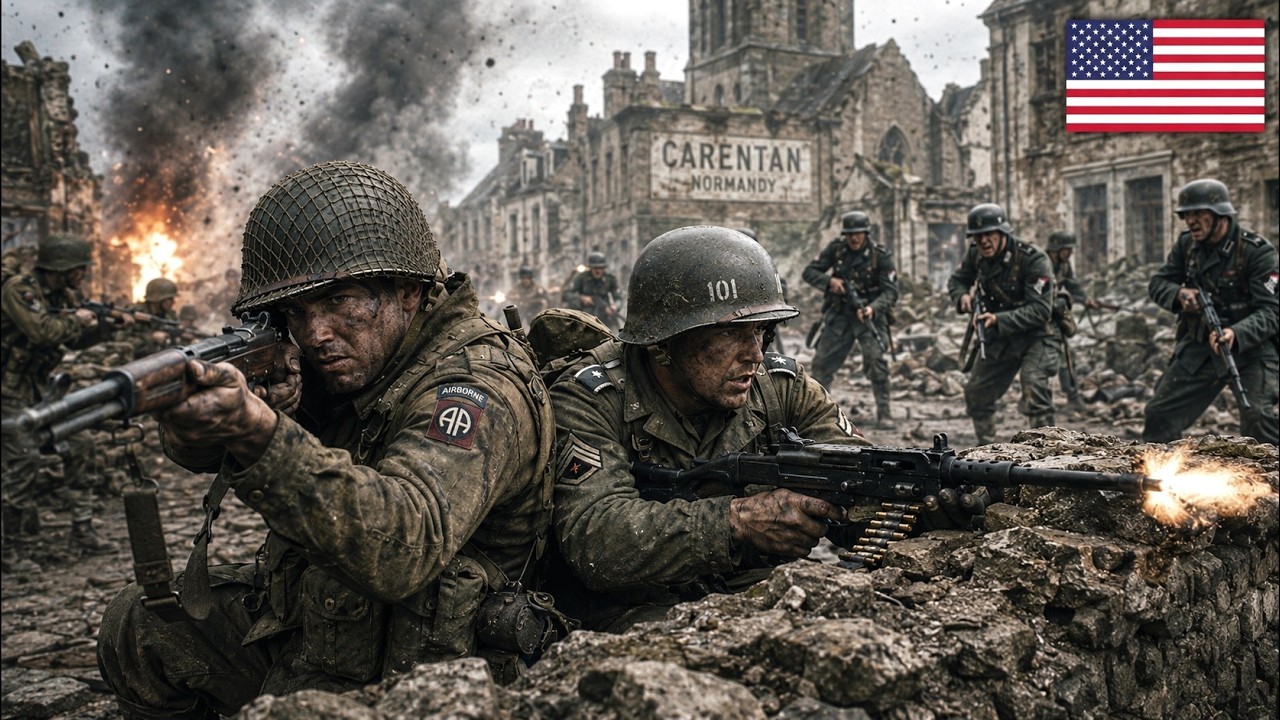
We lost an entire day to a handful of Americans who should not even have been there. One German officer involved in that advance later admitted that delay paid for in American blood and after the position at Grains finally fell in a massacre of French civilians and captured Americans by the German troops who overran it is a real part of why the 17th SS did not reach Corantan in time to save the town on June 12th and overlooked mostly forgotten standby men dropped in the wrong place helped by the time that made everything that followed possible. By the night of June 12th, the tactical picture southwest of Carantan looked on paper badly lopsided in Germany’s favor. A combined force of an SS Panzer Grenadier Division and a veteran paratroop regiment backed by armor and artillery was preparing to strike a thin American line still holding ground it had bled for only hours earlier. The terrain itself was Normy’s famous Boage country, sunken lanes barely wide enough for a single vehicle. hedge rows thick enough to stop small arms fire and hide
an anti-tank gun at 10 paces, fields no larger than a tennis court boxed in on every side by earth and banks and bramble. This terrain cut both ways. For the Germans, it offered cover to mass a counterattack unseen until the last possible moment. For the Americans dug into those same hedgeros, it offered exactly what light infantry needs against armor.
Choke points, blind corners, and killing ranges measured in yards rather than m. The American position southwest of Karentan along the road toward the village of Bapt was held by companies of the 501st and 506th Parachute Infantry Regiments. Still worn down from the previous week’s fighting, still short on ammunition and sleep, and in most units still at well under full strength.
What the German attackers underestimated was cohesion. These were men who had trained together for over a year in many cases, who trusted the soldier on either side of them without question, and who had already survived a night jump into darkness. A week of broken unit combat and a bayonet charge across open marshland.
A division built around armor and firepower was about to discover that firepower alone does not always break men who have already decided individually and collectively not to move. At dawn on June 13th, the Germans struck first, advancing northeast toward Carentan just as American units nearby were preparing their own attack to expand the perimeter southwest of town.
The two forces collided almost by accident and the German assault backed by tanks and heavy artillery fire hit hard and fast. The 51st parachute infantry regiment holding the American left flank took the worst of it. Under sustained tank and infantry pressure, they were forced to give ground, then to withdraw almost entirely, opening a gap the Germans pushed straight into.
On the American right, fox and dog companies of the 506 regiment were driven back as well, fighting a retreat through hedro after hedro. By midday, the spearhead of the German attack had advanced to within roughly 500 yardds of Carranton itself, a town that had cost so much American blood to take 3 days earlier stood on the edge of falling right back into German hands.
One American company did not break. Easy Company of the 506th Parachute Infantry Regiment, commanded by First Lieutenant Richard Winters, anchored its position against a railway embankment on the American right flank and refused to give the ground behind it. Reinforced by a battalion of the 502nd Regiment rushed forward under fire.
Winters’s men held that line while the American position on either side of them bent and in places broke around them. A Panzer Grenadier officer of the 17th SS describing that stretch of the fighting afterward put it this way. We had more men, more guns, and armor they could not match in the open, he said. And still, there was one company that would not move.
One company held an entire flank against us. For hours, the outcome of the battle hung on a narrow strip of hedge and a company that refused to retreat. Then, in the early afternoon, the sound the Germans least wanted to hear on that battlefield reached the American lines. The engines of Combat Command A, Second Armored Division, arriving with Sherman tanks to reinforce the paratroopers.
American armor rolled directly into the German assault, and the entire character of the fight changed within minutes. Infantry and light anti-tank crews that had been holding their own against other infantry, now faced tanks of their own, while the paratroopers, who had spent the morning being pushed back, turned immediately to press forward again alongside the armor.
A wounded German soldier of the 17th SS, taken prisoner that afternoon, described the moment the tanks appeared in blunt terms to his capttors. “Until then, it was a fair fight,” he said. After the tanks came, it was not a fair fight anymore, and it was not in our favor. The German counterattack, which had opened the morning with every material advantage on its side, collapsed by evening.
An entire SS Panzer Grenadier Division, reinforced by one of the Vermach’s most respected paratroop regiments, had thrown its full weight at a battered American line for a full day of fighting, and had been unable to retake a town it needed to hold at almost any cost. American troops, not German officers, gave that stretch of road its lasting name.
borrowed half- jokingly from a western film many of them had watched before shipping out for Europe, Bloody Gulch. The cost on both sides was heavy. American casualties in the fighting for Corentin and at Bloody Gulch ran into the hundreds, spread across paratroop units already thinned by a week of continuous combat.
German losses, particularly inside the 17th SS Panzer Grenadier Division, were severe enough that the division spent weeks afterward rebuilding before it could be committed to major action again. Vanderhhata’s sixth falier regiment which had fought with real skill and real cost both defending and then trying to retake Corentin had effectively been fought to exhaustion in under a week of continuous contact.
Strategically, the failure at Bloody Gulch closed the door on Germany’s best remaining chance to sever the link between Utah and Omaha Beach in the critical first week after the landings. From that point forward, the American beach heads functioned as one continuous front and the buildup of men and material that would eventually break the German army out of Normandy.
altogether could proceed without the constant threat of the invasion being cut in half at its weakest seam. One German staff officer writing after the war about the failure to retake Karant offered a blunt assessment that stands as well as any German testimony from that week.
We had judged them by what we expected from new soldiers. He wrote by Karant they were no longer new soldiers. That was our mistake and it cost us the town and perhaps more than the town. And yet, of all the actions fought by American paratroopers in the Second World War, Carrington occupies a strange place in public memory, it is not entirely unknown.
A well-known television production dramatized part of Easy Company’s role in the fighting, and anyone who has watched it has technically seen a version of these events play out on screen. But watch how the story usually gets told and how it usually gets remembered afterward as one episode inside a longer story about one company rather than as what the full engagement actually was.
A battle in which an entire American airborne division took a strategically vital town from veteran German paratroopers and then days later still exhausted and under strength stopped a full SS division cold in the fields around it. Compared to Omaha Beach or the later defense of Baston, Corentton rarely gets mentioned for what it actually represents.
One of the clearest demonstrations in the entire Normandy campaign of what American airborne infantry could do against superior numbers in armor when the men on the ground simply refused to lose. Go back to that Panzer Grenadier lying in the wet grass at dawn on June 13th, watching the men to Donville through the fog, certain his division would own Corin by noon. He was wrong.
And the reasons he was wrong are not mysterious or accidental. He was wrong because a battalion commander named Robert Cole decided a bayonet charge across open ground was worth the cost rather than watch his men die in place a few yards at a time. He was wrong because paratroopers scattered off target near a church in Gray’s bought two days nobody had planned for.
He was wrong because one company under Richard Winters held a railway embankment while the units on either side of it fell back. And because American Sherman tanks arrived at almost the exact hour that line could not have held much longer without them. None of that was luck stacked on luck. It was the product of an airborne division trained to fight fractured, alone, and outnumbered from the moment its boots left the aircraft.
Meeting exactly the kind of chaotic close-range hedro fight it had been built for, Germany sent an entire division to correct what it saw as a temporary setback outside a market town nobody outside Normandy had ever heard of. What that division discovered instead, in the words of soldiers who were there and lived to say so afterward, was that the Americans holding that ground did not fight like men waiting to be relieved.
They fought like men who intended to still be standing on that road when it was over. They were.