Why Britain Threw Away The ‘Failed’ Turret Poland Turned Into Ukraine’s Deadliest Gun D
Somewhere in the Donbas, the autumn of 2022. The light is going and the air smells of wet clay and diesel. The man crouched over the fire control screen used to teach mathematics. That is not a colorful detail. That is his qualification. He knows what a parabola is. He knows what happens to a number when you change one term inside it.
And he has spent his war watching Russian guns exploit an equation he could not solve. His name, the one he gives to the cameras, is Vasyl. He commands a battery. For months, the arithmetic of his war has been simple and humiliating. The enemy’s guns reach further than his. That is the whole of it.
When a Russian battery fires, his crews take the impact and then they take the choice. Fire back and fall short, or move and lose the ground. Tonight, the equation is different because tonight he is standing beside something new. It is a howitzer, and it is wrong in a way he cannot immediately place.
The chassis is Korean. Everyone knows this. The engine note is German. The shell in the rack is NATO standard. And the turret, the great square box that holds the gun, is British. It is a box the British army never actually used. He gives the order. The barrel is long, longer than anything he has commanded.
And when it fires, there is no great gout of flame, no signature to trace. His gunners say the round leaves the barrel almost politely. 30 seconds later, the vehicle is moving, and the shell is still in the air traveling towards a Russian gun position whose crew believed it was out of reach. By every rule they had been taught, it was.
Vasyl tries to explain what he is looking at, and the explanations do not fit. This is not a new gun. The design is 30 years old. This is not a superior weapon from a superior industry, because the industry that designed the turret rejected it. This is not even a British howitzer, though the most important part of it is.
This is not a story about a Polish howitzer. This is a story about what happens when a nation solves the hard problem and then throws the answer away. Part one. To understand what Vasyl was seeing, we have to go back, not to the invasion, but to a British decision taken in the last years of the 20th century by serious people for serious reasons, the British Army had a gun it was proud of, the AS90, built by Vickers as a private venture, ordered in 1989, 179 of them, for around 300 million pounds.
It entered service in 1993. It was accurate, it was tough, and it was fast. Three rounds in 10 seconds into action and out again in under a minute. In Iraq, the British land component commander, General Robin Brims, called its accuracy phenomenal, and a defense minister told Parliament it managed a 92% availability rate in the desert.
The Royal Artillery had good reason to like it. But it had a ceiling, and the ceiling was written into the barrel. The gun was 39 calibers long. Barrel length is the multiplier. Longer barrel, more time for the propellant to push, more velocity, more range. 39 calibers gave the British 24.
7 kilometers with a standard shell, around 30 with an assisted round. The rest of NATO was going to 52 calibers. 52 calibers reaches past 30 kilometers as a matter of routine, and past 40 with the right round. The difference between 24 kilometers and 40 is not a specification. It is the difference between shooting at the enemy’s guns and being shot at by them.
The British knew this. That is the part that matters. They knew it from the beginning. The original requirement had specified stretch potential, extra range achievable by changing only the barrel. The upgrade program was called the extended range ordnance and modular charge system. In the trade, it acquired a better name, Braveheart.
96 British howitzers were to receive a 52-caliber barrel. Development approval came in September 1993. In June 1999, the defense secretary, George Robertson, stood up in the House of Commons and announced the contract. It went to Marconi Electronic Systems, around 75 million pounds. He was pleased to tell the House that the extended range barrels would be manufactured at the Royal Ordnance Factory in Nottingham, about 50 jobs.
A modern gun for a modern army. Look at the logic on its own terms because it was sound. Britain had a proven vehicle. It needed only a new barrel and a new propellant charge. It would leapfrog a generation without buying a new fleet. Every assumption in that plan was reasonable. Every professional who signed it was competent.
The model worked right up until it did not. Part two. The barrel was never the problem. That is the detail that gets lost. And it is the hinge of everything that follows. The 52 caliber ordnance worked. British metallurgy was not at fault. British gunnery was not at fault. What killed the program was the thing you load in behind the shell.
A modern long gun does not use a fixed cartridge. It uses modular charges, blocks of propellant the crew stacks like coins. One for a short shot, six for a long one. It is elegant and it is the only way to squeeze a 52 caliber barrel for everything it has. Britain first tried a unimodular system. It ran into trouble. In July 1995, the approvals committee switched to a modular charge from Somchem, a South African firm inside the Denel group.
It promised something genuinely valuable. Dramatically reduced barrel wear. Then it failed a test Britain refuses to compromise on, insensitive munitions. The requirement that ammunition sitting inside a vehicle will not detonate when that vehicle is hit or burns or is struck by fragments. It is a safety standard written in the blood of earlier wars and the Somchem charge could not meet it.
So the program died. The forecast service date had already slid from February 2003 to July 2005. Around 2001 to 2002, the Ministry of Defense terminated it and the National Audit Office duly recorded it among the canceled. Be precise here because the temptation is to sneer and sneering would be wrong.
The Ministry did not cancel Braveheart out of stupidity. It canceled it because a specific chemical formulation in a specific propellant block failed a specific safety threshold. That was a real failure. In isolation, the decision was defensible, but the argument turns on one word.
Britain treated a failed charge as a failed program. It threw out the barrel with the propellant, and it never went back. The Royal Artillery kept its 39 caliber gun, and for the next 20 years, while France and Germany and Poland went long, British gunners went to war with a shorter reach than their allies. The turret went on a shelf.
It did not stay there. Someone else had been watching the trials. What happened next in a steelworks in southeastern Poland would take 25 years to matter. When it mattered, it would matter more than anyone in Nottingham could have imagined. But first, if this deep dive into British engineering is holding you, hit subscribe.
It costs nothing, and it helps the channel grow. Now, the record. Part three. In 1997, Poland went shopping for a turret. Not a howitzer, a turret. That distinction is the whole Polish story. Poland wanted a modern 155 mm gun, but it intended to build the vehicle itself in Poland at a state foundry called Huta Stalowa Wola.
So, it ran a competition for the gun and the turret alone. The German Panzerhaubitze 2000 competed. The British AS90 M Braveheart competed. In June 1999, the British entry won the firing trials, in part, and I am not embellishing this, because the British actually turned up and shot. In July 1999, Huta Stalowa Wola signed a license agreement with GEC-Marconi, soon to be BAE Systems.
Six complete turrets, the full technical data pack, the right to build the thing in Poland permanently. Read that sequence again. In 1999, the same firm sold the same design twice. Once to the British Army, which would cancel it. Once to Poland, which would not. And then Poland very nearly threw it away, too, because the Polish chassis was a disaster.
The hull drew on the T-72 and PT-91 lineage, and it cracked. Structurally cracked. A report in 2011 blamed the quality of the whole steel. The engine overheated then went out of production all together. Eight howitzers were built on that chassis and eight were found wanting. Poland had a world-class turret bolted to a vehicle that was tearing itself apart.
This is the moment the whole thing should have died. A canceled British upgrade sitting on a failed Polish hull. Two national embarrassments welded together. What saved it was the war. In 2014, Russia took Crimea and lit the Donbas. And the argument inside the Polish Defense Ministry stopped being about industrial pride.
In December 2014, Poland signed a license with Samsung Techwin, later Hanwha, for 120 chassis from the South Korean K9 Thunder. It was an admission of failure. It was also the correct decision. The first Korean hull arrived in mid-2015. The definitive vehicle passed acceptance in April 2016.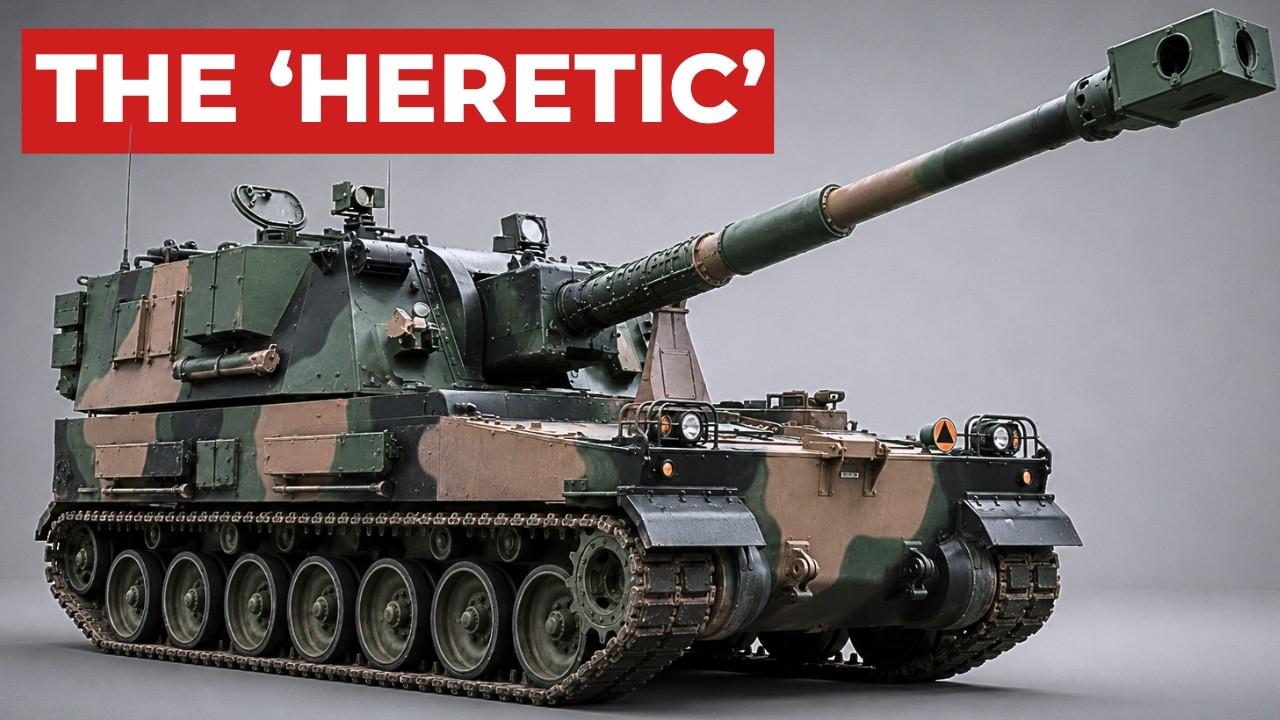
A British turret, a Korean chassis, a German engine, a 52 caliber barrel, Rheinmetall at first, later built by the Poles themselves, Polish fire control. They called it the Crab. Here is the number the case turns on. 4.649 billion złoty, roughly 1.1 billion dollars. 96 howitzers signed for in December 2016, plus command vehicles, ammunition carriers, and repair vehicles organized into four divisional fire modules of 24 guns each.
Poland was not buying artillery pieces. It was buying an artillery system built in a factory it owned on a license it held outright. Britain had bought 179 AS90 howitzers and up-gunned exactly zero of them. Why could Britain not simply do what Poland did? Because Britain had bought a barrel. Poland had bought a license.
Britain owned the outcome of a program. Poland owned the means of production, the drawings, the tooling, the right to change her mind. When the charge failed, Britain had nothing left to iterate with. When the chassis failed, Poland changed the chassis because everything else was already hers.
That is not a technical difference. It is an institutional one, and it is the reason one nation now has a 40-km gun, and the other went looking to borrow one. If your father, grandfather, or uncle served with the Royal Artillery, or if you have stood on a gun line yourself in any army, I would be grateful to read the unit below.
The people who understand what 15 km of range actually buys you are the people who have had to do without it. Part four, the realization arrived in January 2023, and it arrived disguised as generosity. Britain announced it would donate AS90 howitzers to Ukraine, around 30 in the first tranche, 20 battle ready, 12 stripped for spares, then more.
By May 2025, the reporting was unambiguous. Britain had given away essentially the entire fleet, around 68 vehicles. The British Army no longer operates the type at all. To replace them, the United Kingdom bought 14 Swedish Archer howitzers, 14. The Deputy Chief of the General Staff, Lieutenant General Sharon Nesmith, said Archer fires further and faster than any artillery system previously in British service, and that it filled a gap left by British support to Ukraine.
Both halves of that sentence are true. Together, they are an indictment. The gap existed. The Archer fires further precisely because the AS90 could not, and 14 guns is not a fleet. It is a placeholder. The long-term answer is expected around 2029. Now, hold that against Poland. In late May 2022, Poland gave Ukraine its first 18 Krabs out of its own army stocks.
Within about a week, the first battery was firing in the Donbas. By October, the Ukrainian Defense Minister, Oleksii Reznikov, confirmed the true figure, three divisional modules, 54 gun howitzers, given, not sold. On the 7th of June 2022 at the Huta Stalowa Wola Works, Ukraine signed a commercial contract for around 60 more, 3 billion zloty, roughly $700 million.
The The Prime Minister, Mateusz Morawiecki, called it one of the largest defense export contracts Poland had signed in 30 years. He was not exaggerating. The factory’s capacity at the time was perhaps 20 to 30 vehicles a year. They were right that the charge had failed. They were right that a propellant which cannot pass an insensitive munitions test has no business inside a fighting vehicle.
What they were wrong about was the shelf life of the answer. They believed a cancelled program was a closed one. In a workshop in Ukraine, a gun commander with the call sign Kolchugi of the 26th Artillery Brigade had by then fired both the German Panzerhaubitze 2000 and the Krab. Asked to compare them, he gave the kind of answer only a man who has done the job gives on the characteristic that mattered most to him, accuracy.
He found the Krab to be the more precise of the two. His personal opinion, he said, nothing more. The Panzerhaubitze 2000 is the finest self-propelled howitzer in Western Europe. The Krab is a cancelled British turret on a Korean tractor. The man firing both of them preferred the Krab. Part five.
So, why did Britain throw it away? Not out of incompetence. Britain wrote the requirement, funded the development, ran the trials, and got the ordnance right. Then it hit a propellant that could not be made safe, and it stopped. What Britain lacked was not engineering. It was the institutional refusal to let a solved problem stay solved.
The program was cancelled, the file was closed, and nobody reopened it for 20 years. Poland hit the same class of failure. Her chassis cracked. Her engine died. On any honest reading, her program was in worse shape than Braveheart ever was. Poland replaced the broken component and kept the answer. Britain’s metric was the program.
Poland’s metric was the capability. Now, be honest about what the Krab is not. It is not invulnerable. Its armor was never built for the war it is fighting. Ukrainian analyst Oleksandr Kovalenko has been blunt about this. Of the Krabs lost or damaged, around half fell to Russian Lancet loitering munitions carrying warheads of 1 to 3 kg, and the Krab’s protection was never enough to stop them.
Crews weld cage armor over the roofs and hope. The vehicle is dense with automation, which makes it superb to fire and difficult to repair anywhere near the front. Damaged guns are dragged rearward. Some of them the whole way to a hidden workshop in Poland. Independent visual documentation has confirmed dozens destroyed or damaged.
That number will grow, and still Kovalenko’s verdict, having cataloged those losses himself, was that it is more reliable, more precise, longer-reaching, and more autonomous than anything Soviet-made that Ukraine had before. Moscow’s line has been that the Krab will not cope with Msta-S and the Hyacinth.
It is worth saying plainly why that claim collapses. The standard Msta-S reaches around 24.7 km. That is the same reach as the British howitzer Britain gave away because it was not enough. The Krab reaches around 40 with a base bleed round, and past 50 with a precision shell. The Russian high command is not describing a fight.
It is describing a hope. The cell, the mathematics teacher, said something very simple about his new gun. It was much better than what he had before. The mobile equipment gets them out of harm’s way quickly. That was all. No triumph in it. Just a man who had spent a year on the wrong side of an equation, and who was now, at last, on the right side of it.
That is the verdict, and it belongs to the engineers as much as to the gunners. To the Vickers designers who built a turret good enough that a foreign army would stake a national program on it. To Bartłomiej Zajas and the men and women of Huta Stalowa Wola, who took a rejected British design, a cracked Polish hull, and a Korean chassis, and would not let the thing die.
To Calucci and the 26th Artillery Brigade, who are firing it tonight. Britain built the answer and could not hold on to it. Poland could not build the answer and would not let it go. The turret is the same turret it always was. If you want the next chapter, the story of the 14 guns Britain bought to fill a hole that need never have existed, subscribe, and I will bring you the record.