Why Britain’s Most Common Tank Could Only Stop Rifle Bullets? D
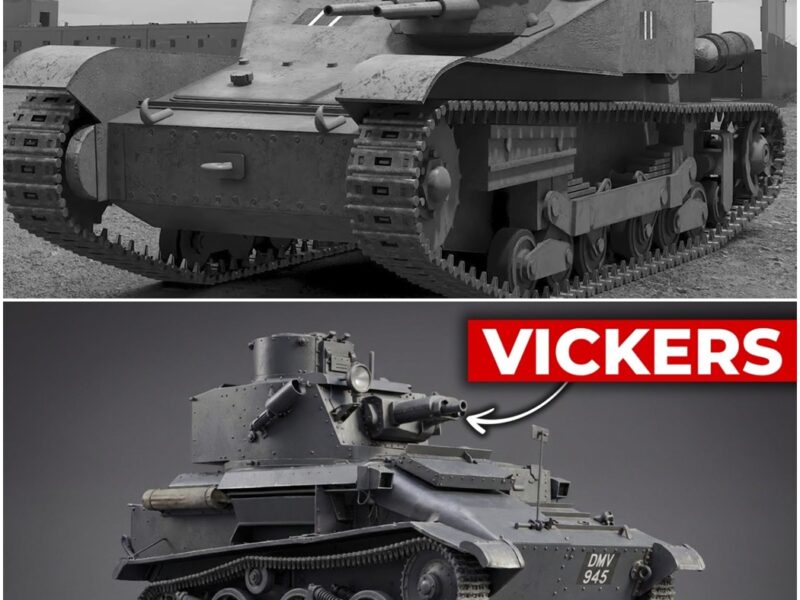
May 1940, northern France. A three-man crew sits inside 5 tons of riveted steel, listening to the sound of German cannon fire getting closer. Their tank, the Vickers light tank Mark VI, is the most common armored vehicle in the British Army. Its armor is 14 mm thick. A standard German anti-tank rifle can punch through it at 800 m.
The 20-mm cannon on a Panzer II can destroy it at over 500 m. The crew’s main weapon is a .50-in Vickers machine gun that cannot penetrate a single German tank on the battlefield. They know this. Every crew knows this. The driver sits in the front left hull, hunched below a thin plate that would not stop a heavy machine gun round.
The gunner and commander stand on a platform inside a turret barely large enough for two men, peering through vision slits at a battlefield where everything they can see can kill them, and nothing they carry can kill it back. 331 of these tanks are about to be lost in a single campaign. This is the story of how two decades of budget cuts, doctrinal confusion, and institutional complacency sent British tankers to war in what amounted to armored coffins on tracks.
It is also a story of extraordinary courage from crews who knew exactly what they were driving and fought anyway. The Vickers Mark VI was not designed for the war it was sent to fight. It was designed for a war the British government hoped would never come. Its origins trace back to 1925, when Major Gifford Le Quesne Martel built a tiny one-man tracked vehicle in his garage and demonstrated it to the War Office.
That demonstration inspired two engineers, Sir John Valentine Carden and Vivian Loyd, to develop their own designs. Their Carden Loyd Mark VI tankette, completed in 1928, became one of the most globally influential armored vehicles of the interwar period. The Soviets copied it as the T-27. The Italians developed it into the L3/35.
The Poles built the TK series. When Vickers-Armstrongs acquired Carden Loyd Tractors in March of 1928, Carden became the company’s chief tank designer. From that tankette, the Vickers light tank series evolved through six marks in barely a decade. The Mark I of 1929 was a two-man vehicle with a single .
303-in machine gun. By 1936, the Mark VI had grown to a three-man crew and added a .50-in Vickers heavy machine gun alongside the .303. It also carried a number seven wireless set, giving it better radio communication than most contemporary tanks. That was a genuine innovation. The War Office declared it superior to any light tank produced by other nations.
That assessment was dangerously complacent. It ignored a fundamental question. Should a machine gun-armed reconnaissance vehicle make up the bulk of a modern army’s armored strength? The War Office had specified a vehicle to perform reconnaissance and colonial policing, roles where the primary threat was rifle fire from tribesmen on India’s northwest frontier, not anti-tank guns on a European battlefield.
Keeping armor thin kept weight under 5 tons. Keeping weight low kept costs down. And keeping costs down meant you could buy more of them. The answer, according to the specifications, was clearly no. The Mark VI B, the principal production variant, weighed 5.2 long tons. Its Meadows six-cylinder petrol engine produced 88 horsepower, pushing it to 35 mph on roads.
The armor ranged from 14 mm on the turret front down to just 4 mm on the hull floor. That thin steel was riveted, not welded. A hit that failed to penetrate could still spray the interior with lethal rivet heads. The .50-in Vickers fired a proprietary 12.7 by 81-mm cartridge, significantly weaker than the American .
50 caliber round. It could penetrate roughly 15 mm of armor at 100 yd. That meant it could barely defeat its own armor class at point-blank range and was useless against anything with 20 mm of protection or more. Carden himself never saw his final design go to war. He died in an aircraft accident on the 10th of December, 1935.
His successor, Leslie Little, oversaw three subvariants. The Mark VI A with a repositioned cupola, the Mark VI B, the main production model, with roughly 1,087 built, and the Mark VI C, which arrived too late to matter, swapping the Vickers guns for a 15-mm Besa capable of penetrating 27 mm at 100 yd.
Total production across all variants reached approximately 1,682 tanks between 1936 and 1940. Now, before we get into the disaster these tanks were sent into, if you’re finding this deep dive into British armor interesting, consider hitting subscribe. It takes a second and helps the channel grow.
Now, back to the question of how Britain ended up sending machine gun tanks to fight cannon-armed Panzers. The answer begins on the 15th of August, 1919, when the British government adopted the 10-year rule. This directive instructed the armed forces to plan on the assumption that no major war would occur within the next decade.
Proposed by Winston Churchill as Secretary of State for War, the rule was made self-perpetuating in 1928, automatically rolling forward each day. It was not formally abandoned until the 23rd of March, 1932. By then, the Great Depression ensured continued austerity regardless. The consequences for tank development were devastating. The Experimental Mechanised Force, a pioneering combined arms brigade formed at Aldershot in 1927, was disbanded for lack of funding.
The Vickers 6-Ton Tank, arguably the most influential design of the late 1920s, was rejected by the British Army on cost grounds. The Soviets adopted it as the T-26. The 16-tonner medium tank was canceled in 1932, eliminating Britain’s only viable medium tank program. Defense spending hovered around 2% of gross domestic product.
Germany was spending 8%. When rearmament finally accelerated in 1937, the Mark VI was the only tank the War Office could order in quantity. Cruiser and infantry tank designs existed only as troubled prototypes. In September 1939, Britain fielded 1,002 Mark VI light tanks, 79 cruiser tanks, and 67 Matilda I infantry tanks.
Only two Matilda IIs, the sole British tank capable of standing up to German armor, were available at the outbreak of war. The Mark VI made up 87% of Britain’s entire tank strength. The 1936 decision to mechanize all cavalry regiments with light tanks had massively inflated demand. Light tanks were cheap.
They were fast. And if they were not horses, they were at least the nearest thing available. Britain’s greatest tank theorists, J.F.C. Fuller, B.H. Liddell Hart, and Percy Hobart, warned throughout the 1930s that the force was inadequate. They were marginalized. Hobart, who formed the 7th Armoured Division, was forcibly retired in 1940 and found serving as a corporal in the Home Guard before Churchill recalled him. The bill came due in France.
Approximately 340 Mark VI light tanks crossed the English Channel with the British Expeditionary Force. They equipped seven divisional cavalry regiments at 28 tanks each and filled a significant portion of the 1st Armoured Division. They were thrown into the cruiser tank role, screening advances and counterattacking against German Panzer IIs, Panzer IIIs, and Czech-built 38(t) vehicles they could neither damage nor survive against.
The Battle of Abbeville on the 27th of May, 1940, crystallized the catastrophe. The 1st Armoured Division attacked the German bridgehead with roughly 180 tanks, many of them Mark VIs. The division had been rushed across the channel piecemeal. Many tanks arrived at the docks still packed in shipping grease.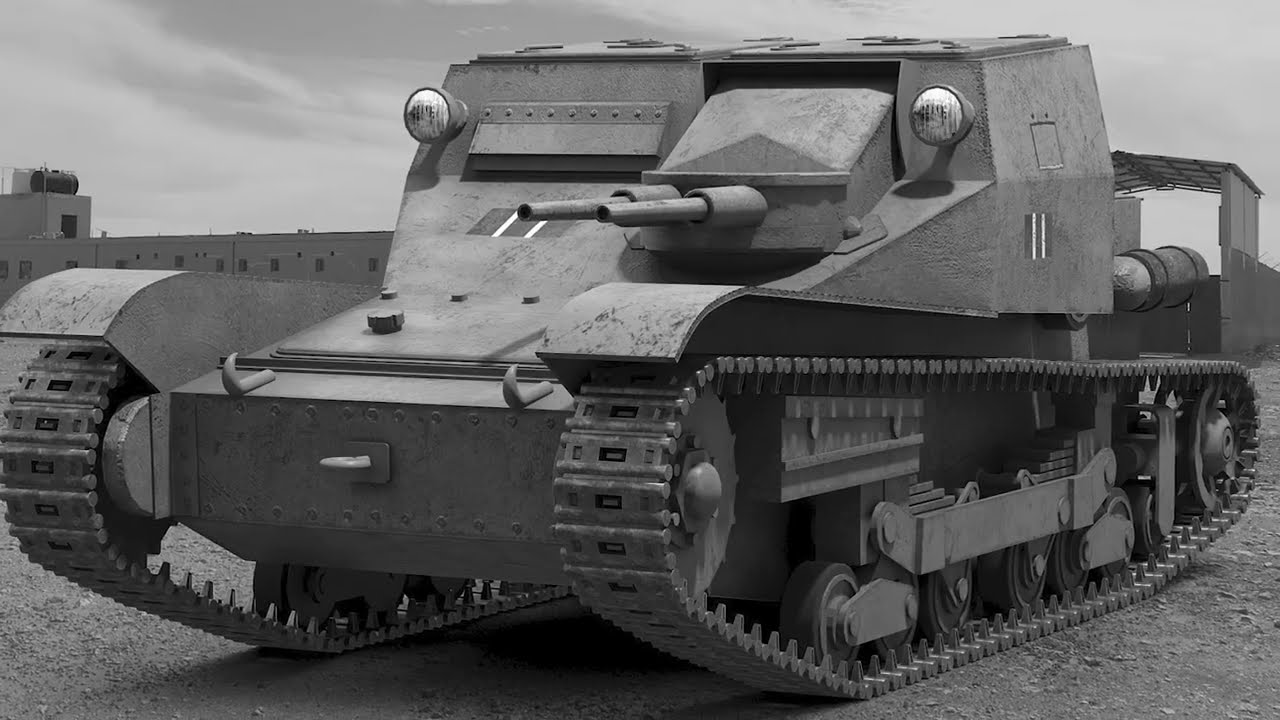
Crews had no time for maintenance, no time for reconnaissance, no time to coordinate with infantry or artillery. They attacked unsupported against prepared German positions with anti-tank guns dug in and zeroed on the approaches. 51 light tanks were knocked out. 65 cruiser tanks were lost. 55 more broke down mechanically before reaching the enemy.
German casualties totaled 40 killed and 110 wounded. The 1st Armoured Division ceased to exist as a fighting formation in a single afternoon. During the retreat to Dunkirk, the remaining Mark VIs were simply abandoned. Tanks could not be loaded onto evacuation ships. Crews drove their vehicles into ditches, drained the oil, ran the engines until they seized, smashed instruments with hammers, and walked away.
Some crews had no time even for that. Many vehicles were left intact, keys in the ignition, ammunition still loaded. The Germans captured enough to give them a formal designation, Leichter Panzerkampfwagen Mark VI B (735 e). They used them for training into the autumn of 1942. In a bizarre and humiliating twist, the Wehrmacht converted 34 captured Mark VIs into self-propelled artillery pieces mounting 10.5 cm and 15 cm howitzers.
These served with the 227th Infantry Division on the Eastern Front through 1944. German engineers had found a use for the Mark VI that the British Army never could, as a cheap chassis for real weapons. Of the roughly 340 Mark VIs sent to France, approximately six were evacuated.
331 were destroyed, disabled, or captured, a loss rate exceeding 98%. The Mark VI’s story did not end in France. In North Africa, during Operation Compass from December 1940 through February 1941, roughly 200 Mark VI Bs served with the 7th Armoured Division, the famous Desert Rats, against Italian forces equipped with similarly thin-skinned L3 tankettes and Autoblinda armored cars.
Their speed proved valuable for outflanking and pursuit across the open desert. Crews helped capture over 20,000 prisoners at Beda Fomm in February 1941. The tank’s Horstmann coil spring suspension handled desert terrain reasonably well, and its reliability in hot conditions was adequate for short engagements, but the limits remained absolute.
At Mechili on the 24th of January, six Mark VIs were destroyed by Italian M13/40 medium tanks for no Italian loss. The M13/40 carried a 47-mm gun and 30-mm of armor. Against a properly armed opponent, speed alone was not enough. On Crete in May 1941, the Mark VI achieved perhaps its most dramatic moment when German paratroopers dropped on Heraklion on the 20th of May.
Six light tanks of the 3rd King’s Own Hussars charged immediately into the landing zone, engaging Fallschirmjäger with machine guns and running them over with tracks. At Galatas on the 25th of May, two Mark VIs supported a New Zealand counterattack that temporarily recaptured the village. In Greece, the 4th Hussars’ Mark VIs fought a holding action so aggressive the Germans reportedly believed they faced an entire armored division.
The comparative picture explains why these acts of courage so rarely translated into survival. Against the German Panzer I, armed only with twin 7.92-mm machine guns behind 13-mm of armor, the Mark VI held a marginal edge. Its .50-in gun could theoretically penetrate at close range. Against the Panzer II, carrying a 20-mm auto cannon behind up to 34.
5-mm of armor, the Mark VI was dramatically outclassed. The Panzer II could destroy it beyond 500-m while remaining immune to return fire at any range. Against the Panzer III with its 37-mm gun or the Panzer IV with its 75-mm gun, engagement was suicide. The French comparison is particularly instructive.
The Renault R35 carried 43-mm of cast armor. The Hotchkiss H39 had 45-mm. Both were impervious to the Mark VI’s guns. France built its light tanks to resist antitank weapons at infantry support pace. Britain built its to outrun threats it could not survive. The difference in philosophy would cost hundreds of crews their lives.
The American M3 Stuart, which replaced the Mark VI in British service from late 1941, offered 38 to 51-mm of armor, a 37-mm antitank gun, comparable speed, and legendary reliability. British tankers called it honey. According to accounts from the History of War Project, the replacement came much to the relief of the crews who’d been fighting in Mark VIs.
The name honey said everything about what they thought of what they had been driving before. Brigadier Vivian Pope, tank adviser to the commander of the British Expeditionary Force, distilled the lesson after France. “We must have thicker armor on our fighting tanks,” he wrote, “and every tank must carry a cannon.
” That single sentence captured the Mark VI’s two fatal flaws. The institutional response reshaped British armored doctrine permanently. The rigid system of infantry tanks, cruiser tanks, and light tanks began to collapse under the weight of its own contradictions. Infantry tanks grew faster. Cruiser tanks grew thicker.
The Valentine combined heavy protection with greater speed and cheaper production. The Cromwell and the Comet were progressively better cruisers approaching true medium tank capability. The culmination was the Centurion of 1945, often considered the world’s first true main battle tank, deliberately unifying armor, firepower, and mobility in a single design.
The Centurion carried a 17-pounder gun that could destroy any tank in the world, frontal armor that could stop most antitank weapons, and enough speed to keep up with an advance. It was, in every sense, the anti-Mark VI. Britain never again produced a dedicated light tank for frontline armored formations. The Vickers Mark VI was not a bad reconnaissance vehicle.
It was fast, mechanically simple, and equipped with wireless communication ahead of most contemporaries. As a tool for patrolling the Khyber Pass or policing Palestine, it was adequate. The tragedy was not the tank itself, but the institutional failure that made it 87% of a major power’s tank fleet on the eve of the largest mechanized war in history.
The 331 lost in France were a bill for the 10-year rule, for the canceled medium tank programs, for the rejected Vickers 6-ton, for the marginalization of Hobart and Fuller. The crews who fought in Mark VIs, charging antitank positions at Abbeville, running down paratroopers on Crete, bluffing Panzer divisions in Greece, proved that courage is not a substitute for equipment, but it is sometimes all that remains when equipment fails.
14-mm of steel, three men, and a machine gun against a continent of cannon. That was what Britain sent to war in 1940.