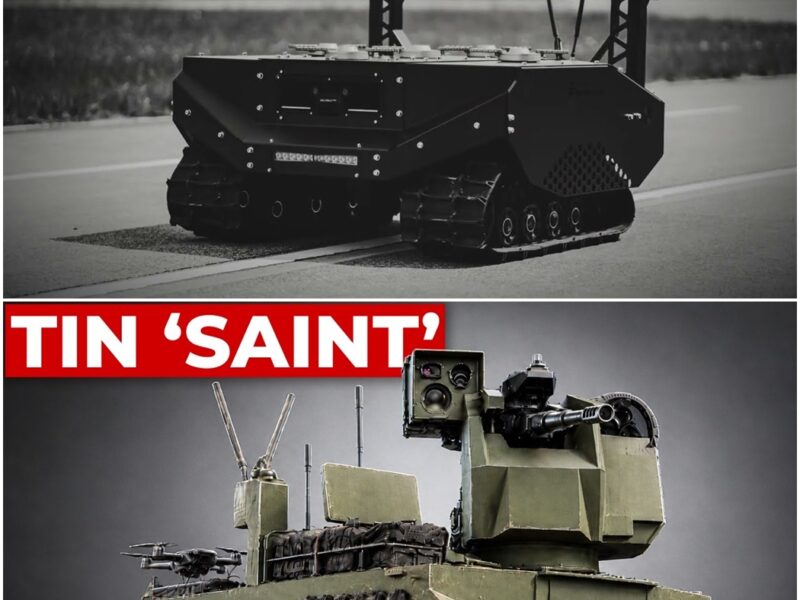
Why Britain’s Top General Says No British Tank Will Ever Fight Again Without This ‘German’ Robot D
Spring 2026, somewhere along the eastern front in Ukraine, in a dugout roofed with logs and earth, three operators watch a screen. The picture is gray and it jumps. It is a drone feed looking down on a strip of shattered tree line that no living man has crossed in daylight for months.
The ground there is seeded with mines and ranged by artillery to the meter. To walk into it is to be counted among the missing before nightfall, and yet something is moving into it. Low, patient, tracked. A machine the size of a small car carrying no one. The operators lean in. On the feed, the machine reaches the enemy position. Then a second machine.
Then the small aerial drones above them. There is no shout on the radio because there is no one out there to shout. No stretcher party waiting at the tree line. No infantry rising from the trench to take the ground. The position falls anyway. It is taken and held by machines alone. One of the operators has done this work for 2 years.
He has watched men go into that killing ground but not come back. He reaches for the old words to describe what he is seeing, an assault, an advance, a breakthrough, and none of them fit because every one of them was built around a human body going forward first. Here is the thing the old words cannot hold.
For the first time, the most dangerous job on the battlefield, going first, has been handed to something that does not bleed. This is not a story about a robot. This is a story about the day the tank stopped being able to fight alone. The machine goes first now. Part 1. To understand why that empty assault matters, you have to understand the faith it broke.
For a hundred years, the tank was the answer to a single question. How do you move firepower across ground that is trying to kill you? The answer was armor. Steel thick enough to shrug off the splinter and the bullet, an engine strong enough to carry it, a gun big enough to matter. Put those three things together and you had the master key to modern land war.
The tank did not just fight on the battlefield. For a century, it decided where the battlefield was. Every serious army built its plans around that fact. The concentration of armor at the decisive point was the closest thing land warfare had to a law of physics. Mass tanks won at Kursk. Mass tanks won in the desert.
Mass tanks rolled to Baghdad in 100 hours. The doctrine was not stupid. It was the distilled experience of five generations of soldiers, and it was right for almost all of that time. No army believed in it more completely than the one that invaded Ukraine in 2022. The Russian high command staked its war on armored mass.
Thousands of tanks driving forward to break a smaller enemy by sheer weight. On paper, in the old arithmetic, it should have worked. To see how deep this faith ran, you have to go back, not to Ukraine, but to a cold field in England in 1916. Because the tank was itself once the impossible machine that broke a worldview.
In the winter of 1915, the war in France had frozen into trenches. The machine gun and the barbed wire had made the attack a form of suicide, and the finest military minds in Europe had no answer. The answer, when it came, did not come from them. It came from a naval committee. Winston Churchill, then running the Admiralty, set up a body to build what he called land ships.
A committee of sailors, engineers, and eccentrics working on a land problem the generals had given up on. In a factory in Lincoln, an agricultural engineer named William Tritton and a naval officer named Walter Wilson bolted together a box of steel on tracks. They called the first one Little Willie.
The second, the real ancestor of every tank that followed, they called Mother. To keep it secret, they told the factory workers they were building water carriers, mobile tanks for water. The cover name stuck. That is why, to this day, we call them tanks. In September of 1916, on the Somme, a handful of these machines crawled toward the German lines.
Most broke down. The crews could barely see and cooked inside the steel. And still, where they appeared, the impossible happened. The line that had held for 2 years, that had swallowed a generation, began to move. Pause on that. The tank was born British, born from a committee of amateurs, born as the cheap unthinkable thing that broke the experts’ certainty.
A hundred years later, it would be the tank’s turn to be broken. And the arithmetic that broke it was a sum the old world would have refused to believe. They would have told you it was absurd that a machine costing a thousand pounds, flown by a teenager with a few days of training, could destroy a tank costing twenty million pounds and take four skilled men with it.
That the cheapest object on the field could kill the most expensive. In the old faith, such a trade was a freak, a bad day, never a plan. Their reasoning was not insane. It was built on the data they had. Armor had dominated for a century, so of course they assumed it would go on dominating. The problem was not the logic.
The problem was that the data was a hundred years out of date. The model worked right up until the moment it didn’t. Part two. So, what is the machine in that dugout feed? What is the thing now being handed the most dangerous job on the battlefield? Its name is Gierion. It is built by a company called ARX Robotics.
And the first surprising thing about it is where it comes from. Not from one of the great British defense houses, not from an American giant. It comes from Munich. The firm was founded by three former officers of Germany’s armed forces, the Bundeswehr. Mark Feitfeld, Stefan Röbel, and Maximilian Wied.
Men who had commanded soldiers, who had seen what the modern battlefield does to a human being, and who left the army to build the thing they wished they had carried. The Gierion began as a research project at Germany’s own defense university. It grew into what is now, by the company’s own account, the largest producer of uncrewed military ground vehicles in Europe.
The machine itself is deliberately unremarkable to look at. It is tracked, low, and small enough to ride inside a standard armored personnel carrier. It carries up to 500 kg. It runs for around 40 km on a charge. It can be driven by a soldier from cover, or sent along a route on its own, picking its way past obstacles. But the specification is not the point.
The point is what those numbers let a soldier stop doing. 500 kg of payload means the ammunition and the water no longer have to be carried forward across open ground on a man’s back. 40 km of range means a wounded soldier can be pulled out of a position without a stretcher party crossing the killing zone to reach him.
The Gilyon is a mule, an ambulance, a scout, and a mine clearer, depending on what you bolt to its back that morning. And in its newest form, revealed in 2025, it carries a weapon, so that the very first contact with the enemy, the moment of maximum danger, can be made by something no one loves and no family waits for at home.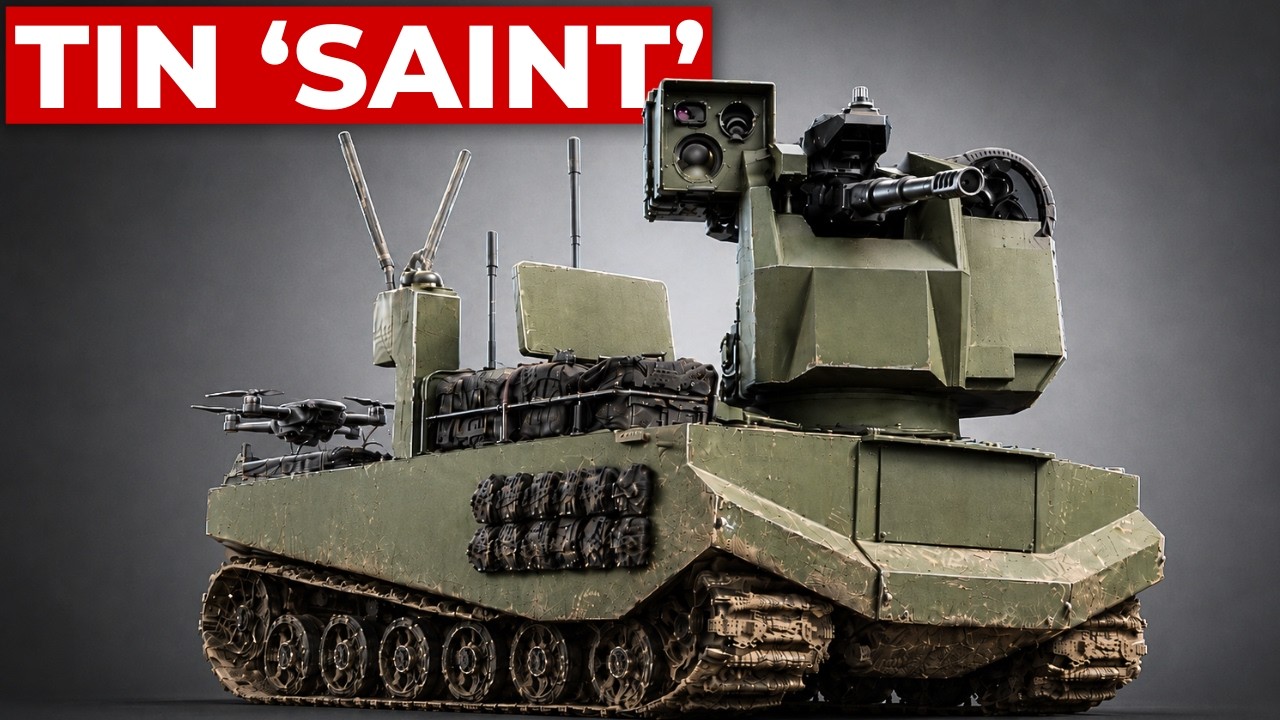
The company has a phrase for this, first unmanned contact. Send the robot into the place where the first shot will come from. Let the ambush spend itself on steel and circuitry. Keep the human being one field back, alive, deciding. This is not a laboratory idea. Germany paid for 30 of these vehicles and sent them to Ukraine, where they haul supplies, carry out the wounded, and scout the ground ahead.
Ukrainian crews have taken them into places a truck could never go, and a man should never have to. The feedback from that war flows straight back to Munich and into the next version. A loop of learning running at the speed of the fighting. For a long time, the serious people did not take machines like this seriously.
The great defense primes built platforms costing hundreds of millions, and a tracked box the size of a golf buggy did not look like the future of war. It looked like a toy, a gadget for a trade show. Real armies, the thinking went, were built on real steel crewed by real soldiers.
That condescension is worth remembering, because it is exactly the condescension the British generals of 1915 aimed at a water carrier built by a committee of sailors. If this deep dive into the machines rewriting British armor is holding you, take 1 second and subscribe. It costs nothing, and it keeps this kind of long-form military history being made.
Now, back to the record. The toy, it turned out, was not a toy. It was the answer to a question the tank could no longer answer on its own. And the army that would grasp that first and build its whole future around it was not the one that invented the machine. It was the one that had invented the tank. Part three.
Here is the question that turns a clever German gadget into a British story. Why would the army that invented the tank be the one to bet its future on giving that tank a robot escort? The answer is that Britain has done this before, and it did it the same way both times. Not through a ministry issuing a grand plan, but through outsiders and amateurs solving a problem the establishment had declared unsolvable.
The Landships Committee was a naval body meddling in a land war. ARX Robotics is a startup of ex-officers meddling in a market owned by giants. In both cases, the machine came in from the edge, and in both cases, Britain’s instinct was the same. Do not just buy the machine, build it here.
In 2025, the company announced it would invest 45 million pounds in a new factory in the west of England. Not a warehouse for imported robots, but a production line with a mostly British supply chain, and one specific startling figure attached to it. That single plant is designed to build 1,800 uncrewed military vehicles a year.
Sit with that number. 1,800 a year from one factory in one country. Britain has fewer than 150 of its newest main battle tanks planned in total. The same nation is tooling up to turn out more than 10 times that many robots every year from a single site. That is not an upgrade to the old force. That is a different kind of army being built quietly in a field in England.
This is where the arithmetic finally turns over. Remember the sum the old world refused to believe? A thousand-pound drone destroying a twenty-million-pound tank and its four-man crew. For years, that trade run one way, against the expensive machine and the irreplaceable people inside it.
The uncrewed system is the first honest answer to it. Now, the cheap replaceable thing is the one sent into the drone’s line of sight. Now, when the cheap weapon strikes, it strikes steel and software that can be rebuilt by Friday, and the four skilled human beings are a field back watching a screen. The machine goes first now, and the sum finally runs the right way.
Why can the enemy not simply copy this? Some of it they can and have, but the deeper system is harder to steal than the machine. Building uncrewed mass at industrial scale needs an open supply chain of microchips and sensors and secure radios, a web of small companies free to fail and try again, and money that flows to founders instead of ministries.
It needs, in a word, the exact ecosystem that sanctions and central control have strangled on the other side of this war. Anyone can bolt a gun to a robot. Almost no one can build them at that scale and improve the design every single month. That is not a product. That is an industrial culture, and it is the one thing an autocracy cannot import.
If your family has served in the Royal Armoured Corps or in the Royal Engineers or in any of the regiments now learning to fight beside these machines, I would be glad to read about them below. The people who crewed British steel through the last century have a stake in what replaces it, and their memory belongs in this record, too.
There is one more reason Britain moved, and it is the oldest reason of all. The last great uncrewed revolution, the small aerial drone, is dominated by supply chains Britain does not control. Having missed the drone, the army was determined not to miss the ground robot. So, it did something the amateur tradition would recognize.
It reached for the best machine it could find, wherever it came from, even from the old enemy across the channel, and it set about making it British. 110 years ago, the outsiders were sailors. This time, they are German. The instinct, take the unwanted machine and make it the heart of the force, is exactly the same. Part four.
For a long time, this was an argument between enthusiasts and traditionalists, fought at conferences and in trade journals. Then the war in Ukraine turned it into a body of evidence that could not be waved away. The evidence is written in burned armor. According to Oryx, an open-source project that counts only the losses it can see in photographs and video, Russia has lost more than 4,000 tanks since it invaded.
Not disabled, not damaged, visually confirmed wrecked and abandoned. It is the largest destruction of tanks since the Second World War, and much of it was done not by other tanks, but by machines costing a few hundred or a few thousand pounds. The armored mass that was supposed to win the war became the easiest thing on the battlefield to find and to kill.
Britain felt this directly. 14 Challenger 2 tanks were sent to Ukraine. Machines with a near legendary reputation for protecting their crews. In more than 20 years of British service, not one had ever been lost to enemy fire. In the autumn of 2023, near the village of Robotyne in southern Ukraine, that record ended.
A Challenger 2 was hit and lost. The crew, it should be said, survived exactly as the tank was built to ensure, but the myth of the untouchable British tank did not survive with them. And the uncrewed machines that had once looked like toys were suddenly everywhere. In a single month, in March of 2026, Ukrainian forces recorded more than 9,000 missions carried out by ground robots.
A few months earlier, that figure had been a fraction of the size. The line on the graph was not climbing. It was going vertical, which brings us at last to the general in the title of this film and to what he really said. In June of 2026, General Sir Rolley Walker, the head of the British Army, stood up at a defense conference in London and told the audience that in future, no crewed ground vehicle should ever deploy without a supporting array of uncrewed ones.
He did not quite say that no British tank would ever fight again without a robot. That sharper line is mine, not his. But it is a fair distillation, because a year earlier he had put the same idea in colder terms. He described the thousand to one exchange that was bleeding modern armies. An entire tank and its trained crew traded away for a drone a teenager could buy and fly after a few days.
Someone not even reading the same map. And he asked in effect why we would ever send our vehicles into that again without protection, without a layer of expendable machines around them, when we would never send a soldier out without a rifle, a radio, and a helmet. Read carefully. That is a confession.
The most senior soldier in Britain saying in public that the crude machine can no longer be sent forward alone. The realization ran through the whole force. The people building the machine said it too, more plainly, because they had less reason to be diplomatic. David Roberts, who runs ARX in Britain, put the case in the language of an accountant rather than a general.
Uncrewed systems, he said, deliver serious battlefield value at a lower cost than the crude platforms they protect. The soldier is the expensive, irreplaceable part. Everything else, increasingly, is a consumable. This is the hardest part of the admission, the right and wrong of it. The old faith was right that armor still matters.
It was right that firepower and protection still decide fights, that the tank’s gun is still fearsome. What it was wrong about was one thing only. It was wrong that the crude machine could still be the thing that goes first. That single error, small on paper, is the difference between the last century of war and the next one.
That operator in the dugout reaching for words that no longer fit was watching the answer to Walker’s question crawl across his screen. He had simply seen it before the doctrine caught up. Part five. So, we come back to the question under the whole story. What was that empty assault in the dugout really the end of? It was not the end of the tank.
Let that be said plainly, because the honest historian owes it. The tank still carries a gun nothing else on the ground can match. Challenger 3, Britain’s newest, is coming into service, late and troubled and delayed, but coming. Armor is not finished. What is finished is armor’s solitude.
The tank will fight on for decades yet. It will simply never again be asked to walk into the dark by itself. For a hundred years, the deal was this. You put four brave human beings inside a steel box, and you sent the box toward the guns, and their skill and their courage were the sharp end of the army. The new deal inverts it.
The skill and the courage move one field back to a screen. And the sharp end becomes something a single British factory turns out 1,800 at a time, year after year. Their metric was the crew. The new metric is the machine that spares the crew. We should be honest about the limits, too.
These robots are not clever. Most are driven by a human hand over a radio link, and that link can be jammed, and a jammed robot is a dead weight in a field. The autonomy is coming, but it is not here. And there is an irony Britain will have to live with. The machine at the heart of its sovereign future was designed by three officers of the German army in Munich, a city that twice in the last century sat on the other side of a British war.
The old enemy builds the new shield. History has a longer memory and a stranger sense of humor than any of us, but strip the irony away, and what remains is something worth respect. Not a conquest, an adaptation. Mark Whitfield and his fellow founders built the thing they wish they had carried as young officers.
And a British army that once mocked a water carrier built by sailors had the wit to see what it was. The engineers who will build it in a field in England, the crews in Ukraine who trust their lives to it tonight, the General Rowley Walker who stood up and admitted out loud that the old way was over, they are all doing the same unglamorous decent work, keeping the human being alive one more field back.
This was never really a story about a robot from Munich. It was a story about 100 years of armor finally learning that it could no longer go into the dark alone. The machine goes first now. And the four human beings it protects get to come home. That is the whole argument, and it is enough. If you want the next chapter, the story of the drones that hunt those tanks from above, it is coming. Stay with the record.