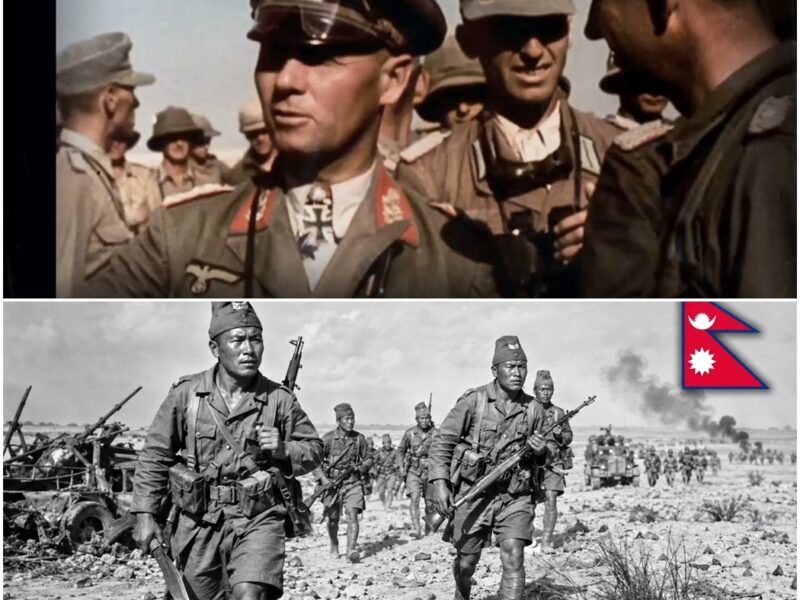
Why Rommel Feared the Gurkhas More Than Any Other Soldier D
In the autumn of 1941, a German intelligence officer sat down to write a field report about an enemy unit that had just torn through a fortified position in North Africa. He was not a man given to sentiment. He had filed dozens of such reports about British Tommies, about Australian diggers, about South African infantry.
He had described them all with the detached precision of a professional. But this report was different. He crossed out his first sentence twice. Then he wrote something that would be quoted in Wehrmacht briefings for the remainder of the war. He wrote, “These are not soldiers in any sense we understand.
They are something older, something we have no doctrine for.” He was writing about the Gurkhas, and Erwin Rommel, the Desert Fox himself, the general who had outmaneuvered entire armies and reduced Allied commanders to nervous breakdowns, had already reached the same conclusion. Privately, according to his own aide, he had said something that stunned the men around him.
He said that of every enemy he had faced in this war, the one that concerned him most was not the American with his abundance of material, not the Russian with his indifference to death, not even the battle-hardened British infantryman he had respected since France. It was the small, quiet soldiers from the hills of Nepal. Men who had served the British Crown for over a century.
Men who barely spoke above a murmur before a battle, who polished their curved knives in silence, and who once committed to an assault, could not, in any practical sense of the word, be stopped. This is the story of why the most celebrated field commander of the Second World War feared the Gurkhas more than any other soldier on Earth.
But to understand that fear, we must first understand what the Gurkhas actually were. The story most people know, the story of Gurkhas as exotic colonial curiosities, as mascots of empire, is not the story that German officers told each other in hushed tones. It begins in 1815 with a war that the British East India Company had expected to win comfortably and found to its considerable embarrassment that it could not.
The hill men of Nepal stopped the expansion of one of the most powerful military organizations in Asia. General David Ochterlony, who commanded the British forces in that campaign, wrote that the Gurkha soldiers possessed a quality that could not be manufactured by training. A natural ferocity combined with an equally natural discipline, a combination he had never encountered in any other fighting force.
The peace that followed produced an arrangement. Young Nepalese men from certain hill tribes, the Magar, the Gurung, the Rai, the Limbu, could volunteer to serve in special British battalions under British officers, while Nepal maintained its independence. Over 130 years, that arrangement built something extraordinary.
By 1939, there were 10 Gurkha rifle regiments in the British Indian Army. When the Second World War began, those regiments expanded to more than 40 battalions, eventually involving over 250,000 Gurkha soldiers. They fought in every major theater where the British were engaged, North Africa, Italy, Greece, the Middle East, Malaya, Burma.
They earned 26 Victoria Crosses between 1939 and 1945, and through all of it, they maintained a reputation that transcended the ordinary vocabulary of military excellence. But numbers do not explain the fear. To understand the fear, you must understand the Gurkha as a fighter, not as a statistic, but as a physical, psychological, and tactical reality that German soldiers encountered in the field and never quite recovered from.
The weapon that defined the Gurkha in German imagination and in German nightmares was not a rifle. It was a knife, the kukri, roughly 18 inches long, curved in a distinctive downward arc, weighted toward the tip so that a single downward stroke carried enormous force. It had been the tool and the weapon of the Nepalese hill people for centuries before the first Gurkha ever enlisted in a British regiment.
Every Gurkha soldier carried one, maintained with the same care they gave their boots and their rifles. A German NCO captured in Italy in 1944 described it in his prisoner of war statement as almost surgical, the kind of edge you would expect from a surgeon’s instrument, not a combat weapon. The Kukri’s reputation preceded it.
By the time Gurkha units arrived in North Africa in 1941, German soldiers in Rommel’s Africa Corps had already heard stories passed along in the informal networks by which soldiers share information about enemies. Stories about night raids, stories about sentries found dead at their posts without a sound having been raised, stories about the particular silence with which a Gurkha assault began, and the particular ferocity with which it ended.
A German private from the 90th Light Infantry Division who survived the war and gave testimony in a 1952 British military history project described what it felt like to be assigned to a sector where Gurkha units were known to be operating. You did not sleep. You could not sleep. Not because of noise, it was the silence that was worst.
You knew they could come through the wire without a sound, and that you would not hear them until it was too late. Every man in our platoon was afraid, not of dying in battle, of being found in the morning. This was the psychological dimension of Gurkha warfare that German commanders found so difficult to counter.
They had doctrine for artillery, they had doctrine for armor, they had doctrine for enemy infantry assaults in daylight at distance with supporting fire. They had no doctrine for soldiers who appeared to regard the darkness as their natural element, who moved through terrain that other units considered impassable, and who conducted close-quarters combat with a calm efficiency that defied the conventional understanding of what men were capable of under fire.
Rommel was too intelligent a commander not to recognize this. He had built his entire reputation on understanding the psychological dimension of warfare, but the Gurkhas represented something that even his tactical genius could not straightforwardly neutralize. They were, in the bluntest possible terms, better at the kind of warfare that exploited psychological terror than his own men were.
The first major encounter between Rommel’s forces and Gurkha units came in the brutal fighting around Tobruk in 1941 and 42. The 2nd King Edward the 7th’s Own Gurkha Rifles, the Sirmoor Rifles, and the 1st Battalion of the 9th Gurkha Rifles were among the units committed to the Tobruk garrison. When Rommel’s forces began their siege, they expected to deal with the mixed Allied garrison in the same way they had dealt with fortified positions in Greece and Yugoslavia.
Sustained pressure, artillery preparation, armor-led assault. It had worked before. It would not work at Tobruk. The garrison held for 241 days. During that time, Gurkha units were used repeatedly for night patrols and raids into the German lines. The kind of aggressive, close-quarters operations that most infantry units found extremely costly.
The Gurkhas conducted these operations not merely willingly, but with what their British officers described in after-action reports as an almost competitive enthusiasm. They returned from night raids into German positions carrying weapons, documents, and occasionally prisoners having navigated minefields and wire obstacles in darkness.
German after-action reports from the same period described the raids in terms that reveal genuine unease. “Enemy infiltration units demonstrated exceptional ability to penetrate defensive positions without detection. Method of approach unknown. Casualties inflicted at close range before alarm could be raised.
” A German officer of the 21st Panzer Division, Major Wilhelm Ritter, wrote in his diary during the Tobruk siege, “The Indian troops opposite us are not like the others. They come at night, and they leave nothing. Three men from 3rd Company found this morning. No one heard anything. The phrase “no one heard anything” appears with remarkable frequency in German accounts of encounters with Gurkha units.
It reflected a genuine tactical reality. Gurkha soldiers were trained from the beginning of their service in what British military doctrine called silent movement, the ability to cross difficult terrain at night without producing the sounds that normally betray infantry movement.
Equipment was tied down or removed. Boots were sometimes removed entirely on approaches. Communication was conducted by hand signals and touch. The result was an assault capability that German sentries, trained to listen for the sounds of enemy approach, found almost impossible to detect until physical contact was already being made.
Rommel himself addressed this in a memorandum circulated to his senior commanders in the spring of 1942. The document, recovered by British intelligence after the fall of Tunisia in 1943, is a remarkable piece of evidence. In it, Rommel acknowledged that standard defensive procedures were insufficient against the Indian mountain troops with curved blades, as he described them, and ordered that Gurkha-facing sectors should have doubled sentries with a minimum of two men per position.
He further ordered that wire obstacles in those sectors should be enhanced with tin cans and other noise-making devices, a measure that spoke volumes about the depth of the problem his commanders were facing. The most tactically sophisticated field army in the world was attaching tin cans to its wire because it could not reliably hear Gurkha soldiers approaching.
But the Gurkhas were not merely night fighters. They were complete soldiers capable of conventional daytime fighting, of holding defensive positions under sustained artillery fire, of maneuvering under armor threat. The battles in Italy demonstrated this comprehensively. The Italian campaign was, in many respects, the defining theater for Gurkha performance in the Second World War.
The terrain, mountain passes, river The fortified hilltop positions, suited the Gurkha soldiers particular strengths. They were hillmen. Their lungs and legs were conditioned by altitude in a way that low land soldiers could not replicate regardless of training. And their willingness to take routes that conventional military thinking deemed impractical, steep cliff faces, narrow goat tracks, ravines that sappers said could not be negotiated in combat order, gave British commanders an asset of extraordinary value. The battle for the Casino position in the winter and spring of 1944 stands as one of the most costly engagements of the Italian campaign. The German defenders, principally the elite first Fallschirmjäger division, the paratroopers who had made their reputation in Crete and Russia, had turned the Casino position into a fortress of almost medieval impregnability. Successive Allied assaults by New Zealand, Indian, and American units had failed to dislodge them. The 4th Indian Infantry Division, which included Gurkha
battalions, was committed to the 3rd and 4th battles. The Gurkhas found routes up the massif the German defenders had considered unwalkable. They moved at night carrying weapons and equipment up cliff faces that required hands and feet simultaneously. They appeared in positions that veteran German paratroopers, men who had parachuted into contested airspace, who had taken Crete house by house, had assessed as secured by terrain alone.
Oberstleutnant Karl Beisfeniger, commanding a regiment of the 1st Fallschirmjäger division at Casino, wrote after the war, “We thought the cliffs protected our left flank. They did not. The Gurkhas climbed what we had said was unclimable. When they appeared at the top, we understood that we had been wrong about what men could do.
” The aftermath of those night assaults produced a crisis in German defensive planning that went beyond the tactical. It was a crisis of assumption. The entire structure of German defensive planning in the Italian mountains rested on calculations about what terrain could and could not be crossed.
The Gurkhas had invalidated those calculations. And once that happened, every defensive position in the Italian peninsula had to be reconsidered because the enemy might appear anywhere. One German prisoner, a sergeant of the 71st Infantry Division, put it directly in his debriefing. With the British, you knew where they would come from. You could prepare.
With the Gurkhas, you prepared everywhere, and that meant you could defend nowhere properly. They broke our thinking. They broke our thinking. It is, in its way, the most devastating military assessment one soldier can make of another. Not that the enemy was stronger, not that they had better weapons or more men, but that they had broken the cognitive framework within which defense was organized.
Rommel, had he read that sergeant’s statement, would have recognized it immediately. It was precisely what he had always tried to do to his own enemies. The Gurkhas had done it to his army. They had turned his own weapon against him. Let us now follow one man through this war because the abstract statistics and tactical assessments only tell part of the story.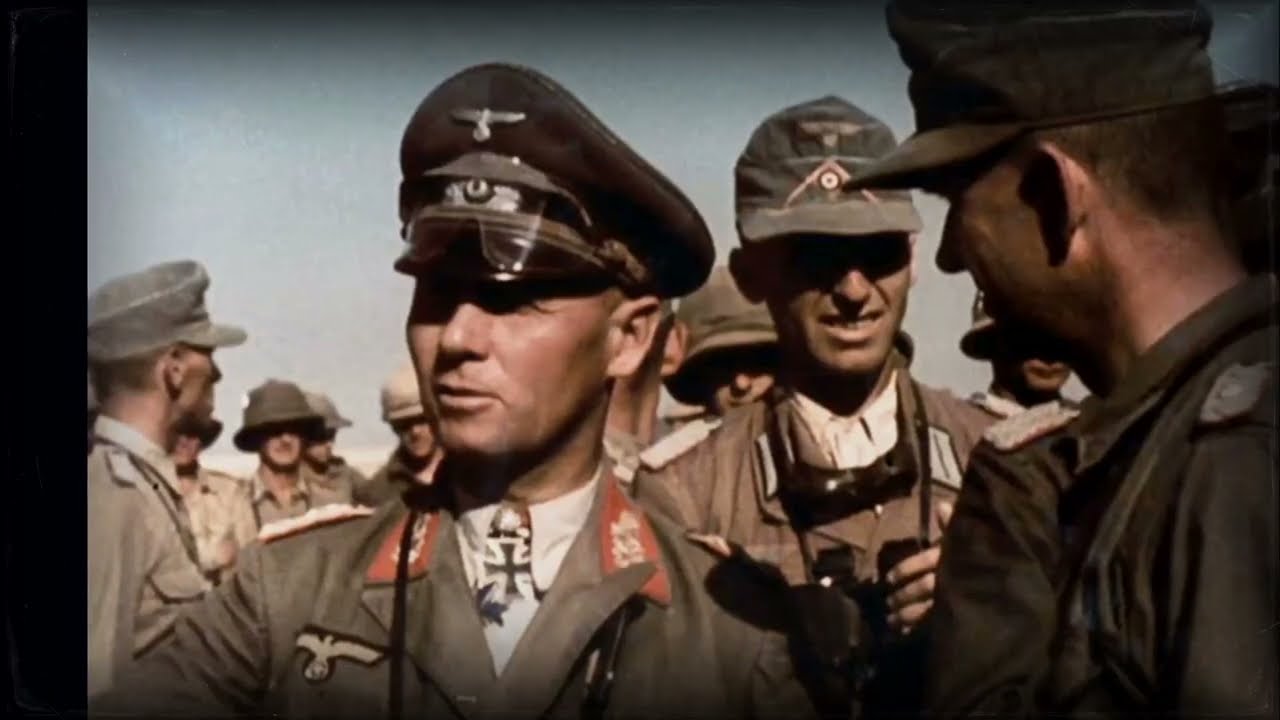
Rifleman Ganj Lama was born in the Sikkim Hills in 1922 and enlisted in the 7th Gurkha Rifles in 1942 at the age of roughly 20. He was not, by conventional measurement, physically imposing. He stood approximately 5 ft 3 in tall. He weighed perhaps 9 stone fully equipped. He had grown up in subsistence farming at altitude and had the lungs and the legs that came from that life.
He had enlisted, as most Gurkha soldiers did, out of a combination of economic necessity, family tradition, and genuine appetite for the soldier’s life. His grandfather had served. His uncle had served. It was simply what men of his background did. In June of 1944 in Burma, near the town of Ningthoukhong, during the battle for Imphal, a battle that would determine whether Japan could push through into India, Ganj Lama did something that the War Office citation described in the careful, measured language of official documentation, and which requires a moment to absorb in full. Japanese forces had broken through the perimeter and were advancing with tanks. Gurkha anti-tank weapons had been largely destroyed or suppressed. Ganju Lama, despite having his left hand shattered by shrapnel and his right arm partially disabled by a separate wound, crawled forward alone under direct fire. Crawled, not ran, dragging himself across open ground swept by machine gun and tank fire to within 30 yards of the
leading Japanese tank. He fired his P8 anti-tank projector one-handed. He destroyed the tank. Then he crawled forward further and destroyed a second, then a third. With two serious wounds, one hand essentially non-functional, he had single-handedly halted a Japanese armored advance that threatened to break the entire perimeter.
He was awarded the Victoria Cross. He survived the war, returned to Sikkim, and lived into old age, but in the summer of 1944, he had embodied something that military historians have struggled to name precisely. A quality that goes beyond courage in the ordinary sense, beyond training, beyond the famous Gurkha fighting spirit that British officers had been writing about for a hundred years.
It was perhaps the quality that Rommel’s intelligence officer had been reaching for when he wrote that these soldiers were something older, something that modern industrial warfare had assumed it had made obsolete. It had not made it obsolete. It had merely failed to encounter it until the hills of Nepal sent it south.
Burma was the theater in which Gurkha capability reached its fullest expression. The Japanese Imperial Army had conquered Malaya and Singapore with a speed that shocked the entire Allied establishment. It had fought with a discipline and a willingness to accept casualties that made even German commanders pause. Against the Japanese in the jungles of Burma, the Gurkhas met an enemy who did not flinch, who did not surrender, and who had their own traditions of close quarters combat.
A Japanese staff officer, Major Fujiwara, captured in Burma in 1944 and interviewed by British intelligence, said, “We had been told the British could not fight in the jungle. This was true of many British units. It was not true of the Gurkhas. They were the only enemy we encountered who seemed comfortable where we were comfortable. They moved like us.
They thought like us. We respected them in the way soldiers respect an equal.” The critical engagement took place near Kohima in April and May of 1944, the battle historians would later call the Stalingrad of the East, the point at which the Japanese tide in Asia definitively turned. The 14th Army, commanded by General William Slim, one of the most gifted commanders Britain produced in the entire war, had positioned Gurkha units at critical points throughout the defensive and counteroffensive operations around Kohima and Imphal. What followed was weeks of fighting at distances so close that grenades were thrown back before they could explode, that men grappled with each other in flood- ed slit trenches, that positions changed hands multiple times in 24 hours. In this environment, where all the advantages of firepower and technology are reduced to near nothing and the quality of the individual soldier is everything, the Gurkhas performed in a way that Slim would later describe as the finest
infantry fighting he had witnessed in 40 years of military experience. He wrote in his memoirs that the Gurkhas possessed a collective steadiness under extreme conditions that he had never seen equaled. They did not panic. When surprised, they regrouped. When surrounded, they fought outwards.
And they did all of this with a consistency across all Gurkha battalions committed to the Burma campaign that suggested the quality was cultural and deep, not accidental. There is, in all of this, a story about the British Army that deserves to be told directly because the Gurkha achievement was also a British institutional achievement.
British officers assigned to Gurkha regiments were required to learn Nepali. They trained with their men, ate with them, and the best of them came to understand the hill culture in a way that produced genuine mutual respect rather than colonial condescension. Men like Lieutenant Colonel Derek Horsford at Cassino, or Brigadier Harold Briggs in Burma, whose jungle fighting tactics became doctrinal for the entire 14th Army.
They were professionals who had devoted careers to understanding their soldiers and who trusted those soldiers in return with a completeness that the best combat units always require. The Wehrmacht’s foreign armies section noted it in a 1943 report on British Imperial performance in North Africa. The Indian mountain troops demonstrate a level of unit cohesion under fire that exceeds that of comparable German formations.
The relationship between British officers and Nepalese soldiers appears to be characterized by genuine mutual confidence rather than the mechanical compliance that characterizes most Allied colonial military relationships. Rommel’s fear then was not simply fear of the Kukri or fear of the night fighter. It was fear of something more fundamental.
A fighting force that combined the specific martial gifts of the Gurkha soldier, the altitude conditioning, the comfort with darkness and difficult terrain, the close quarters skill, the psychological steadiness under extreme violence, with the institutional excellence of the British Army’s regimental system at its best.
The combination was, in his assessment, more dangerous than any other infantry he faced. He expressed this assessment explicitly. His chief of staff, General Lieutenant Fritz Bayerlein, recalled after the war that Rommel had made a point of reviewing the order of battle of British units facing his army and paying particular attention to the presence of Gurkha battalions.
“He took them seriously in a way he did not always take British units seriously,” Bayerlein said in a 1956 interview. “He said once that if he had to attack a position held by Gurkhas, he would want twice the men he would need against anyone else. Not because they had better weapons, because they would not stop.
They would not stop. In the logic of modern warfare, which is ultimately a logic of cost and calculation, of determining at what point the cost of continuing an engagement exceeds the value of the objective, the Gurkha soldier represented an anomaly. He had arrived at a calculation that stopped at a different point than the calculation made by most soldiers.
The point at which a Gurkha stopped was not tactical disadvantage, not encirclement, not the death of officers, not running out of ammunition. The stories suggest that the point at which a Gurkha stopped was when there was nothing left to fight, or when he himself was incapable of continuing. 26 Victoria Crosses between 1939 and 1945, more than any comparable formation in the British Order of Battle.
More than 32,000 Gurkha soldiers killed or wounded. Every front where British forces were engaged, every position British commanders most needed held. And yet in the popular memory of the Second World War, in film, in television, in the casual history that most people absorb, the Gurkhas occupy a curiously peripheral position.
The men that Rommel feared above all others appear, if they appear at all, as a footnote. What Rommel understood, and what the popular memory has largely failed to reckon with, is that the British capacity to fight the Second World War was inseparable from the contributions of men who came from outside England, outside Britain, outside Europe.
Men who fought, in many cases, with a distinction that their more celebrated British counterparts could not match. In 1945, as the war in Europe was ending, and the war in Asia was in its final, terrible phase, a German general sat in a prisoner of war facility in Egypt and was interviewed by a British Army historian about his experiences facing British Imperial forces.
The historian asked him, at the end of a long session, which enemy he had found most formidable. He did not hesitate. He said, “The small men from Nepal. I never met one who was afraid of anything. I never met one who stopped.” He paused. Then he added something that the historian noted verbatim because it struck him as the most honest assessment he had heard from any German officer in months of interviews.
“We should have taken them more seriously sooner. We knew what they were capable of. We had the reports that there is something in the European military mind that cannot quite what those reports say until it has seen it for itself. By the time we believed the reports, it was too late to do anything about what we believed.
By the time we believed the reports, it was too late. Rommel believed the reports. He had always been a general who believed what the evidence showed him even when it was uncomfortable. He believed the reports about the Gurkhas and he adjusted his tactics accordingly and he added tin cans to his wire and he doubled his sentries and he told his staff that of all the enemies he faced, this was the one that concerned him most.
It was the right assessment. In the cold arithmetic of military history, it was the correct and professionally honest answer. And somewhere in the mountains of Nepal, in the villages that had been sending their sons to fight under the British flag since 1815, the sons and grandsons of those soldiers were still going, still enlisting, still training, still polishing their curved knives.
The hills that made them have not changed. Neither have they.