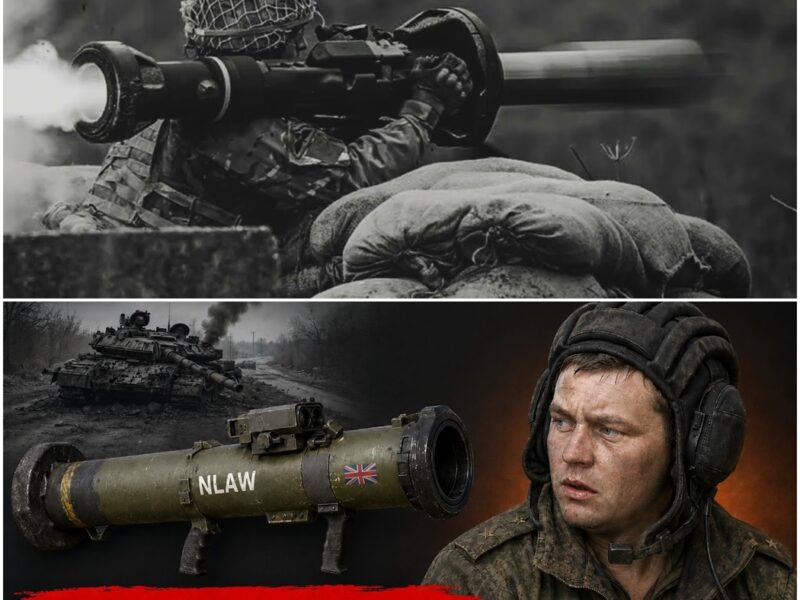
Why Russian Tank Crews Couldn’t Grasp How Ukraine Stopped Them With A British Tube They Threw Away D
Irpin, 12 March, 2022. A western suburb of Kyiv, a town the world had not heard of 2 weeks earlier. A Ukrainian soldier stands beside the wreckage of a Russian armored vehicle. He gives his name only as Victor. He is holding a spent metal tube, about a meter long, light enough to carry on one shoulder. It has already been used.
It will never be used again. By design, it was always going to be thrown away. He speaks to a reporter from Agence France-Presse. His sentences short. His grammar is the grammar of a man who has not slept in days. This one was shot from this beautiful thing, and I want to say a big thank you to our British comrades helping us.
Pause on that sentence. He is not thanking Britain for a treaty. He is not thanking Britain for a speech. He is thanking Britain for a tube, a throwaway tube. A tube engineered to be discarded after a single firing, and yet expensive enough to be a serious piece of western industrial output, and yet cheap enough that thousands of them could be flown into Kyiv on a handful of transport aircraft.
This is not a story about an anti-tank missile. It is a story about why a piece of throwaway engineering designed in Sweden, built in Belfast, and pre-positioned in Ukraine by a British defense secretary who took a political risk, broke the doctrine of an army that had planned to be inside Kyiv within 10 days.
The argument of this video is simple. Russia’s assumption in February 2022 was that armored speed could overrun a defended European capital. That assumption was wrong. The proof of it is sitting on a road outside Hostomel. The proof of it is sitting in the wreckage on Vokzalna Street in Bucha. The proof of it is sitting on a stretch of highway outside Brovary, where a Russian regimental colonel was killed during the ambush of his own armored column.
But before any of that proof, there is the tube in Victor’s hand. Its designation will come later. For now, the soldiers using it call it by its initials, four letters, a British shorthand. They have been trained on it for weeks. Some of them for years. And as Victor stood beside the destroyed Russian vehicle in Irpin, a Russian armored column to the north had begun to break up under fire.
A column that would, at its longest, stretch to 40 miles along the road from Belarus. The largest mechanized column moved against a European capital since the end of the Second World War. Here is the contradiction this video is going to walk through. The vehicle Victor’s Brigade destroyed cost roughly 50 to 100 times more than the tube used to destroy it.
The vehicle was the product of decades of doctrine. The tube was the product of a single narrow design decision. And the vehicle, in many cases, never saw the tube coming. One operator, one launcher, one destroyed Russian armored vehicle in Irpin. One thank you in English to Britain. The story is what made that thank you possible.
Now, to make sense of why a disposable British tube broke this particular invasion, you have to understand what the Russian planners thought they were doing on 24 February 2022, and you have to understand it on their terms, not yours. The Russian General Staff did not draft a stupid plan. They drafted a plan that was internally consistent with the doctrine they had inherited, the army they had built, and the experience they had earned in Crimea in 2014, in the Donbas after that, in Syria from 2015 onwards. Inside that frame, the plan was rational. The doctrine is Soviet in origin, refined for the post-Cold War era. It treats war as a contest of speed and shock. You assemble overwhelming armored force on a narrow axis. You break through. You drive deep, fast into the operational rear of the defender. You collapse the political center before the defender can mobilize. You do not stop. You do not wait for infantry to clear the woods on your flanks. You move. The
Royal United Services Institute, in its preliminary analysis of the war, made a striking observation. Russian operational security in the run-up to the invasion was so successful that on the northern axis going into Kiev, the invading force achieved a force ratio of roughly 12 to 1 over Ukrainian regulars in the area. 12 to 1.
That is the kind of advantage that in the textbooks Russian officers had grown up reading guarantees the breakthrough. Now consider it from inside their frame. You have 12 to 1 local superiority. You have hundreds of tanks on the northern axis alone. You have airborne forces ready to seize an airport on the western edge of the capital, 20 km from the city center.
You have helicopters carrying paratroopers across the border. You have predetermined refueling points. You have, in the very first hours, a column already rolling south through Chernobyl. Their model worked on paper before any shot was fired. Now layer in their recent combat experience. In Crimea, Russian armor had walked in unopposed.
The capture of the peninsula in 2014 was a textbook fait accompli, completed before any defender could organize. In the Donbas, Ukrainian forces had been ground down by Russian and proxy artillery, not by infantry with anti-tank weapons. The set piece battles around Ilovaisk and Debaltseve had been decided by indirect fires, not by precision-guided shoulder-fired munitions.
In Syria, the opposition’s tank-killing capability had been improvised and limited. TOW missiles in the hands of rebel groups had killed Syrian army armor at standoff range, but never in numbers sufficient to overturn a campaign. The model said, “Speed wins.” The data said, “Speed wins.” The reasoning was not absurd.
There were also the seasonal facts. February in northern Ukraine is the end of winter. The rasputitsa, the spring mud season, was about to begin. The fields were either still frozen or about to become impassable. That meant heavy armored columns had to move on roads, single file down forest tracks, through villages, past tree lines.
And here a second piece of doctrine clicked into place. Russian armored formations went in light on dismounted infantry. The mechanized infantry of a battalion tactical group was, in theory, supposed to ride in armored personnel carriers behind the tanks. In practice, on the key of approaches, the infantry component was thin and was kept thinner still by the speed of the advance.
There was no time in this plan to dismount and sweep the woods on either side of every road. The Russian assumption was therefore not one assumption, but a stack of them. That the breakthrough would be fast. That the airport at Hostomel would function as an air bridge into the western suburbs of Kyiv.
That Ukrainian resistance would be brittle. That a four-day operation, perhaps a 10-day operation at the outside, would deliver the capital. That a force of overwhelming local mass would punch through any defender, regular or territorial, who tried to stand in its way. This stack rested on one further idea that has to be said out loud because it is the lever the entire war moved against.
The Russians assumed that the man on the side of the road, the territorial defense soldier in a tree line outside Bucha, the marine outside Hostomel could not, in practical terms, kill a Russian tank. Their model worked until it didn’t. Its designation was the next generation light anti-tank weapon. In British service, the main battle tank and light anti-armor weapon.
In Swedish service, Robot 57. Soldiers and journalists called it by its initials, four letters, pronounced one at a time, NLAW. It was a Swedish design. Saab Bofors Dynamics began work on it in the late 1990s as a private venture. The British defense procurement agency was looking for a replacement for an older shoulder-fired anti-tank system and put the requirement out to tender in 1997.
Five years later, in May 2002, the British Ministry of Defense selected Saab’s design over a rival entry from Matra British Aerospace Dynamics. The Anglo-Swedish memorandum of understanding was signed in June of that year. The demonstration and manufacture contract was worth 419 million pounds. The system entered British Army service in 2009.
Final assembly was done in Belfast, Northern Ireland by Thales Air Defense in partnership with around 14 British subcontractors. So, when two decades later, a Ukrainian soldier in Irpin called the launcher a beautiful thing and thanked his British comrades, he was thanking a Belfast production line and the Swedish engineers who had drawn the system on a board in the late 1990s.
Now, the specifications, each one paired with what it actually meant to the soldier carrying it. It weighed 12.5 kg. One soldier could carry it comfortably to a window, to a tree line, to a rooftop, to a basement. It was 1 m long. It fit in the boot of a civilian car. Ukrainian Territorial Defense Units in the first hours of the invasion were moving them around the suburbs of Kyiv in private vehicles.
Its combat range was 20 to 800 m. That is short, deliberately short. It meant the engagement happened in close country, on roads through villages, exactly where a doctrine of fast armored columns would put the targets. It was a soft launch weapon. The motor ignited only after the missile cleared the tube.
This meant it could be fired from inside a confined space, a bedroom, a church doorway, a basement window. The soldier did not need to step out into the street and give his position away. The warhead was approximately 150 mm. The fuse had two selectable modes, direct attack for soft targets and buildings, and critically overfly top attack.
In top attack mode, the missile flew about a meter above the line of sight and pitched downward at the moment of overflight, striking the thinnest armor on any tank ever built, the top of the turret. The guidance system was the part that broke the Russian model. It was called predicted line of sight. The operator tracked the target for around 3 seconds before firing.
The launcher computed the target’s velocity and direction. After launch, the missile flew the predicted path. No infrared seeker, no radio link, no laser, nothing for the tank’s protection system to detect. The launcher did not even need to maintain a lock after the missile had left the tube.
Fire, drop the tube, move. And once it was fired, the tube was thrown away. By design, the operator could not reload it. There were no spare missiles in a separate box. One soldier, one tube, one shot, one tank. The next engagement required a new tube. This was the Anglo-Swedish answer to the threat of mass armor. Not one expensive launcher reloaded carefully under fire, thousands of cheap tubes distributed widely, fired once, then dropped.
The launcher was disposable, the lesson was not. The first combat use happened almost the moment the Russian columns crossed the border on 24 February 2022. A Russian airborne assault paratroopers from the 31st Guards Air Assault Brigade and elements of the 45th Spetsnaz Brigade dropped onto Antonov Airport at Hostomel by helicopter.
They had around 34 helicopters. The plan was to hold the runway for the second wave, the airlifted heavy follow-on from Russia. They were met by the 4th Rapid Reaction Brigade of the Ukrainian National Guard, known as Rubizh, and the Omega Special Unit. The defenders held the field long enough that when Russian ground forces broke through at Ivankiv and reached the airport the following day, the runway was no longer usable for the planned airbridge.
The Russians took the airport. They did not get the airbridge they had planned the entire offensive around. Two days later, on 27 February, a different Russian column was rolling south. It belonged to elements of the 36th Combined Arms Army and the 64th Separate Motor Rifle Brigade.
The column entered Bucha. It tried to push through Vokzalna Street, a narrow residential road, on its way toward Irpin and then Kyiv. It got several hours into that movement before Ukrainian forces stopped it. When it was over, satellite imagery and footage published by Bucha’s mayor, Anatoliy Fedoruk, showed a column of roughly 100 armored vehicles ended on a single residential street.
Tanks, personnel carriers, trucks. The largest tactical Russian defeat of the first week of the war on one road between rows of suburban houses. The kills were attributed by Ukrainian sources to a mix of artillery, mines, and shoulder-fired anti-tank weapons. The NLAW was on that street. This was the first proof in the open that the Russian model was wrong.
Not the only proof. There would be more. The convoy from Belarus would soon stretch to 40 miles. Its commanders had not yet realized what waited around Brovary, where one of their colonels would die at the head of his own column. Subscribe for more deep engineering analysis like this on the doctrine and the decisions that decided this war.
Now, to the deeper system. Why could Britain field this? And why could Russia not copy it? The answer is industrial, and it is doctrinal, and the two cannot be separated. Britain, working with Sweden, made a choice in the late 1990s that ran against the grain of every Cold War armored procurement plan.
The choice was simple. Do not put the expensive part in the launcher. Put the expensive part in the missile. Make the launcher disposable. Make it cheap enough to give to a soldier who is trained for a few days, and small enough to distribute to thousands of those soldiers at once. This is the money number.
The entire argument of this video hinges on it. The British Ministry of Defense, in its own imagery captions describing the system, has put the unit price at 30,000 to 40,000 dollars per NLAW. Some analysts, citing earlier British Army figures, give an estimate of around 20,000 pounds.
Either way, the order of magnitude is the same. A single shoulder-fired Anglo-Swedish NLAW cost the British taxpayer somewhere in the range of $30,000 to $40,000. A Russian T-72B3, the most common main battle tank in the units that crossed into Ukraine in February 2022, cost between $1 million and $2 million to build.
A T-80U, a slightly more capable variant, cost more. A T-90M, the most advanced and the rarest tank Russia put on the Kyiv approaches, cost, by export estimates, around $3 to $4 million. Pause on that comparison. $30,000 to $40,000 against $1 to $4 million. The cost ratio runs from roughly 50 to 1 to roughly 100 to 1.
State it again, because everything in this video rests on it. A throwaway British tube costing $30,000 to $40,000 killing a Russian tank costing up to 100 times that amount, fired by a soldier who had been trained on the system in days against a crew that had been trained on theirs for years. Russia could not copy this, and the reason is structural.
Russian armored doctrine is built on the idea of mass. Tanks were not a niche capability, they were the spine of the army. Procurement was centralized. Production was concentrated in two main factories. The institutional incentive ran in the opposite direction. More tanks, heavier tanks, bigger guns, thicker armor.
The opposite philosophy to make a tube and throw it away. A short sentence here. Russia could not be the country that built the NLAW. It had spent 50 years being the country the NLAW was designed to defeat. Now, the sacrifice. Because the British did not sell the NLAW to Ukraine. They gave it, and they gave it before the war began.
On 17 January 2022, 5 weeks before the invasion, the British Defense Secretary Ben Wallace stood up in the House of Commons. He told the House that the United Kingdom had taken the decision to supply Ukraine with light anti-armor defensive weapon systems. He stressed that the weapons were short-range and clearly defensive and that a small number of British personnel would deploy as trainers.
Overnight on the 17th and 18th, Royal Air Force C-17 transports began flying out of Royal Air Force Brize Norton. They had been ordered to detour around German airspace, which had refused overflight clearance for the cargo. They flew the longer route. By the 19th of January 2,000 NLAW’s had been unloaded in Kyiv and signed over to the Ukrainian armed forces.
The political risk in that decision is easy to miss in retrospect because the invasion did come. But in mid-January 2022, the invasion was not certain. The German federal government was publicly refusing to authorize lethal aid. The French president was still flying to Moscow to negotiate. Pre-positioning anti-tank weapons in Ukraine before a war that the Russian government was publicly denying it intended to start was a significant political decision.
It exposed the British government to the charge of escalation if the invasion did not happen and to the charge of provocation if it did. It split Britain from much of continental Europe on the question of how to deter Moscow. Wallace took the call and he held it. The decision was not popular in Berlin. It was 5 weeks later the decision the men in Bucha and Hostomel and Irpin would thank Britain for by name on camera with a spent tube in their hand.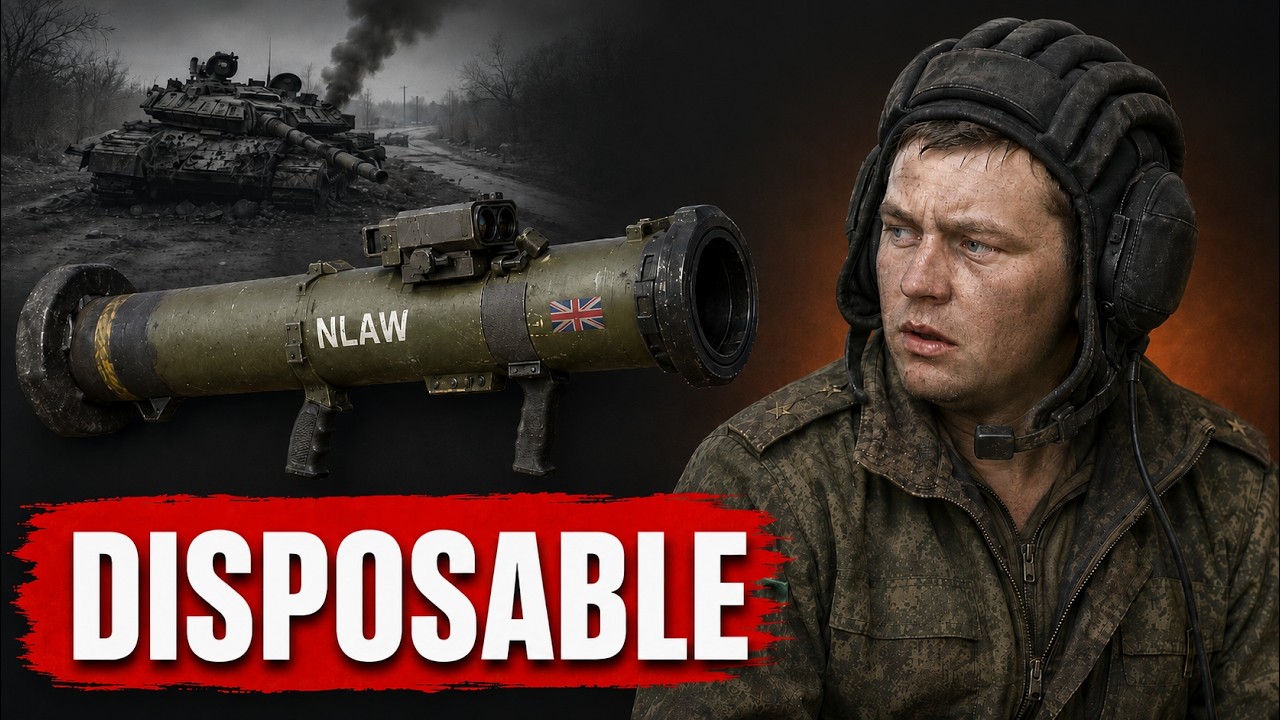
By 9th March 2022, Wallace told the Commons the cumulative figure had reached 3,615 NLAW’s delivered. By 16th March, in a statement to the Organization for Security and Cooperation in Europe, the British government put the figure at nearly 4,000. By the time the Russian withdrawal from northern Ukraine was complete in early April, the United Kingdom had committed in NLAW deliveries alone the largest tranche of any single anti-tank weapon system supplied to Ukraine in the opening phase of the war. The cost to Britain came in the back end. In December 2022, the Ministry of Defense signed a replenishment deal with Saab worth 229 million pounds with deliveries running from 2024 through 2026. The House of Commons Defense Committee warned in early 2023 that it could take roughly 10 years to fully replace the stocks gifted to Ukraine. Wallace himself acknowledged candidly that NLAW supply could not keep up with
Ukrainian demand. Britain had given away years of its own deterrent stock by the time the convoy outside Kyiv began to break up. The United Kingdom had committed roughly 2.3 billion pounds in military aid to Ukraine, more than any country except the United States. The Anglo-Swedish bet on a cheap tube taken 20 years before this war had now been paid out in full.
30,000 to 40,000 dollars per tank. The bill came due, Britain paid it. The Russians realized what was happening. They realized the wrong thing about it. By early March 2022, photographs began circulating of Russian tanks fitted with rough welded steel cages over the turrets. Russian crews and unit mechanics in the field were attempting to defeat top attack munitions by adding a slat roof.
The cages were improvised. They were sometimes called cope cages by Western observers, a phrase intended cruelly to describe a piece of metalwork that the crews fitting it knew on some level was inadequate to the threat. A Ukrainian anti-tank missile operator from the 128th Independent Mountain Assault Brigade, identified by his first name Anatoly, told the Ukrainian defense outlet Defense Express that the Russians were fixing makeshift metal cages to the top of their tanks.
His verdict was direct. This kind of protection proved to be totally ineffective against Javelin and NLAW attacks. No tank can withstand the Javelin attack. On the use case, Anatoly was specific. NLAW is great in close combat at ranges from 20 to 600 meters. It is therefore indispensable in close range situations such as urban combat.
On Russian morale, he was more direct still. The Russians, he said, were really scared off by these weapons and almost never advance when faced with a risk of being attacked because they knew too well that if his team fired at them, the missile would destroy the target. His NLAW training, he said, had lasted 4 days. Read that line again.
His training had lasted 4 days. A Ukrainian conscript could be put through enough familiarization in a working week to be effective against the most modern Russian armor on the field. The Russian counter response failed, and it failed in a particular pattern. The cages did not stop top attack warheads.
They added weight. They reduced visibility. They marked the tank as a target. They did not address the actual vulnerability, which was not the lack of a cage on the turret, but the architecture of the tank itself. Steven Zaloga of the Teal Group and one of the most cited Western specialists on Russian armor has explained this for years.
Russian main battle tanks like the T-72, T-80, and T-90 use a carousel autoloader at the base of the turret. The autoloader holds only about half of the tank’s main gun ammunition. The rest of the rounds sit in the crew compartment in racks around the fighting positions.
A penetrating top attack hit of the kind the NLAW and the Javelin were specifically designed to deliver has a high probability of igniting that ammunition. When it cooks off, the chain reaction blows the turret clean off the hull. Western tanks like the American Abrams and the German Leopard 2 store their ammunition behind blowout panels isolated from the crew so that a similar penetration vents the explosion upwards through the roof, and the crew has a chance to survive. Russian tanks do not.
This was not a flaw discovered in 2022. It was a known design trade-off, one Russian engineers had accepted in exchange for the autoloader’s faster rate of fire and the smaller silhouette of the tank. The NLAW did not invent the vulnerability. It exploited it. Here is where the right about wrong about pattern of the Russian planners becomes visible.
They were right that armored speed could break a defender who had no answer to it. They were right that 12 to 1 local superiority was a decisive ratio. In the doctrine they had inherited, they were right that holding Hostomel airport if they could open the air bridge would put an air mobile force on the western edge of Kyiv within days.
What they were wrong about was the tube. They were wrong about what 20 years of Anglo-Swedish disposable launcher design had done to the cost exchange ratio of armored warfare on a road. They were wrong about how many of those tubes had already been pre-positioned in Ukraine 5 weeks before the first shot.
They were wrong about how short a course a Ukrainian conscript needed before he could destroy a T-72B3 at 300 m from a basement window. The signature engagement happened outside Brovary on the eastern approaches to Kyiv on the 9th and 10th of March 2022. Elements of the 6th and the 239th Tank Regiments of the 90th Guards Tank Division drawn from the Central Military District Garrison at Chebarkul in the Urals advanced down Highway M01 toward the Kyiv Ring Road. They moved slowly.
They moved in column single file the way the doctrine and the highway dictated. They moved without dismounted infantry on the flanks with thermobaric TOS-1 rocket systems exposed near the head of the formation. The Russian column commanders had been ordered to push through to the eastern approaches of Kyiv.
The Russian column commanders had not been told that a Ukrainian artillery brigade had pre-registered every kilometer of the highway they were now driving down. At Skybyn, just north of Brovary, the Ukrainian ambush triggered. Artillery struck the head and the tail of the column simultaneously fixing the formation in place.
Anti-tank weapons engaged the vehicles trapped in between. Drone reconnaissance in real time fed corrections to the gunners. Among the dead was the commander of the 6th Tank Regiment, Colonel Andrey Zakharov from the Chebarkul garrison. The Ukrainian Ministry of Defense on 10th March issued a statement that read in part that the commander of the regiment, Colonel Zakharov, had been killed.
During the battle in the Brovary district, the battalion tactical group of the 6th Tank Regiment of the 90th Tank Division of the Central Command suffered significant losses. An intercepted Russian radio transmission, translated by Newsweek, was shorter and more direct. A lot of casualties, ambushed.
The commander of the column was killed. A Russian regimental leading a tank advance on a European capital lost at the head of his own column in an ambush triggered by Ukrainian artillery and anti-tank teams on a stretch of highway he had been ordered to take without proper infantry support. That is the picture. It is also the obituary of the assumption that opened this section.
There is one more thing this account needs, in honesty. The NLAW did not destroy every Russian armored vehicle around Kyiv. The Royal United Services Institute in its later analysis was explicit that the blunting of the Russian thrust on Kyiv was driven, above all, by the massed fires of two Ukrainian artillery brigades supported by anti-tank teams and drone reconnaissance.
A senior Ukrainian officer, speaking on 24th March, claimed that NLAWs accounted for between 30 and 40% of Russian tanks destroyed. That is a Ukrainian claim, not a confirmed catalog figure. The catalog figures from open-source tracking by the Oryx project of Russian armor lost in the first months of the war run into the hundreds across the northern axis.
Ukrainian losses were real, too. Armored vehicles, civilian buildings, soldiers and civilians in the fighting in Hostomel, Bucha, Irpin, and Brovary. The story is not bloodless. The point is that the architecture of the Russian failure was systemic, doctrinal, and visible in the wreckage of the column on Vokzalna Street and on the highway at Skybin. The launcher was disposable.
The lesson was not. return to Irpin, 12 March 2022. Victor with a spent launch tube in his hand, the Russian armored vehicle behind him still smoking. This one was shot from this beautiful thing. And I want to say a big thank you to our British comrades helping us. A beautiful thing. That is the phrase to hold on to.
Beautiful, because the soldier in front of the camera understood at street level what the planners in Moscow had not understood at the operational level. Beautiful, because the engineering had been narrowed and narrowed until it produced an object that could be used by a soldier with four days of training to destroy a vehicle that took years to build.
Honest limitations first before any verdict or the NLAW is not magic. Its range is 800 m. Beyond that range, the operator needs a different weapon. It is single use. After firing, the soldier has no further capacity until he gets another tube. It is heavy enough to slow a man over distance. It is dependent on re-supply. And re-supply as Ben Wallace admitted struggled to keep up with demand.
Against tanks with effective active protection systems and a competent dismounted infantry screen, the engagement is harder. Against an enemy that has learned, the calculus changes. But the verdict on the question this video asked can be given from settled fact alone. Russia had armored mass. Ukraine had a throwaway tube.
Russia had a 12 to 1 force ratio on the northern axis. Ukraine had a pre-positioned Anglo-Swedish stockpile that reached 3,615 NLAWs by 9th March. Russia had a 10-day plan to Kyiv. Ukraine had a Bucha residential street called Vokzalna where 100 armored vehicles ended. Russia’s assumption that armored speed could overrun a defended European capital was wrong.
The proof of it sits in three places. At Hostomel, where the air bridge never opened. At Bucha, on Vokzalna street, where the column of the 64th separate motor rifle brigade ended. At Brovary, on the highway at Skybin, where Colonel Andrei Zakharov did not return. On 29th March 2022, the Russian government announced the withdrawal of forces from the Kyiv and Chernihiv directions.
By 2nd April, Ukraine’s Ministry of Defense declared the whole of Kyiv Oblast free of Russian troops. By 6th April, the withdrawal was complete. The Battle of Kyiv was over. It is over. That is the point. A finished story. A closed arc. A doctrine tried and a doctrine broken. The argument resolved by the settled fact of the withdrawal and by the resting place of the convoy on roads it never finished traveling.
The launcher was disposable. The lesson was not. $40,000 against a regimental colonel and 100 armored vehicles on one residential street. That is the cost ratio that broke the doctrine. For the next chapter of this series, subscribe. There are more of these. More doctrines tested and broken.
More machines that turned out to matter more than their planners had assumed. To the soldiers in Hostomel and Bucha and Brovary, and to Victor and Ihor,