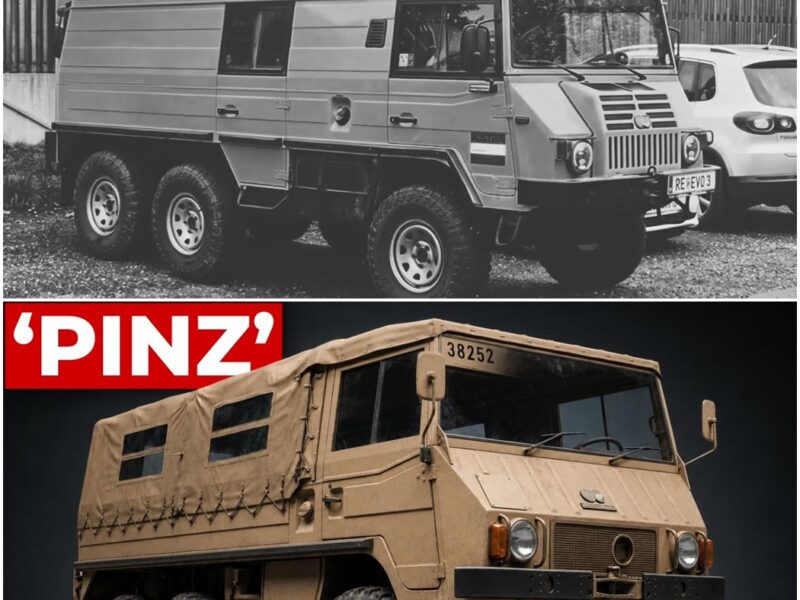
Why The SAS Abandoned British Vehicles For A ‘Borrowed’ Austrian Farm Truck To Fight Three Wars D
A company that built tractors and cattle trailers for Austrian dairy farmers produced a six-wheel truck so capable that America’s most secretive special forces unit chose it over every purpose-built military vehicle in the United States inventory. Not the Humvee, not the Land Rover, not the Unimog, a farm truck from the Austrian Alps.
Six wheels, no armor, an air-cooled engine borrowed from a civilian utility vehicle, a ground clearance system so unusual that most mechanics had never seen anything like it. Each wheel connected to the chassis through a set of gear hubs mounted above the axle center, allowing the entire drivetrain to sit higher than the wheels themselves.
The vehicle weighed less than 4 tons. It carried 14 soldiers, and it could climb a gradient so steep that a conventional military truck would tip backwards and roll. This is the vehicle that served on every continent except Antarctica. 29 nations bought it. American special operations teams drove it behind enemy lines in the Gulf War and into northern Iraq.
The British Army made it the backbone of its airborne artillery. The Swiss built their entire mountain defense network around it. And when the British Ministry of Defense tried to turn it into something it was never designed to be, an armored patrol vehicle for the roads of Helmand province, it became one of the most controversial vehicles in modern British military history.
The Steyr-Daimler-Puch factory complex in Graz, Austria, the mid-1960s. A company founded in 1864 as an arms manufacturer, its badge still showing the concentric circles of a rifle target, had spent the previous decade building a tiny four-wheeled utility vehicle called the Haflinger, named after a breed of Austrian mountain horse.
The Haflinger had proven that civilian engineering could solve military problems. Now the company wanted something bigger. Something with six wheels, a longer range, and enough payload to replace a small truck. The man they tasked with designing it was an engineer named Erich Ledwinka. That name matters. Erich Ledwinka was the son of Hans Ledwinka, one of the most important automotive engineers of the 20th century.
Hans Ledwinka had spent his career at Tatra, the Czech truck manufacturer, where he invented something called the backbone chassis. Instead of building a vehicle around two parallel rails like a ladder, Hans Ledwinka ran a single steel tube down the center of the vehicle and hung everything off it, engine, gearbox, suspension, differential housings, all mounted directly to one central spine.
It was lighter, stiffer, and far more resistant to twisting forces than anything else on the road. Ferdinand Porsche studied Hans Ledwinka’s design so closely that Porsche himself admitted the whenever he looked over his shoulder during the design process, he saw a Tatra staring back. Erich Ledwinka inherited every one of his father’s engineering instincts, and when Steyr-Daimler-Puch asked him to design a new all-terrain vehicle in the mid-1960s, he reached straight for his father’s central tube concept. But he added something his father had never combined with it at this scale, portal axles. To understand why the Pinzgauer could go where nothing else could, you need to understand what a portal axle does. In a conventional drivetrain, the axle runs straight from the differential to the wheel hub. The center of the axle is at the same height as the center of the wheel. This means the lowest point of the vehicle, the differential housing and the axle tubes, sits at wheel center height. Every rock, every ditch, every obstacle that reaches axle height can strike the drivetrain directly. A portal axle changes the geometry entirely.
Instead of connecting the axle to the center of the wheel, a portal axle uses a small gearbox mounted at each wheel hub to drop the wheel downward below the axle line. The differential and the axle tubes now sit above wheel center height. The entire underside of the vehicle rises without changing the wheel size, without raising the center of gravity, and without making the vehicle any taller than it needs to be.
The result is ground clearance that would normally require tires twice the diameter, achieved without the instability that giant tires create. Ledwinka combined this portal axle system with his father’s backbone chassis and an air-cooled 2.5 L inline four-cylinder engine producing around 87 brake horsepower.
The engine needed no radiator, no coolant hoses, no water pump. It could be submerged in 700 mm of water without stalling because there was nothing water could damage. Twin oil pumps ensured lubrication at any angle, meaning the vehicle could climb at 45° and the engine would not lose oil pressure. A five-speed manual gearbox fed through a two-speed transfer case with hydraulic differential locks on every axle, front, center, and rear.
Lock all three and the Pinzgauer became a six-wheel drive machine that could claw its way up a 100% gradient, limited only by tire grip. The first production Pinzgauer was presented on May 17th, 1971, rolling off the assembly line at the same Graz factory where Steyr-Daimler-Puch had been building the Haflinger for the previous decade.
The name came from the Pinzgau region of Salzburg, home to a famous breed of Austrian cattle known for their hardiness in mountain conditions. A farm vehicle named after livestock, designed by the son of a Czech truck engineer, built by a former arms manufacturer, nothing about its identity suggested a military future.
The Austrian army took delivery first, then Switzerland, which made the Pinzgauer the backbone of its mountain infantry and built its entire Alpine defense strategy around the vehicle’s ability to reach positions that nothing else could. Then Yugoslavia, which ordered nearly 4,000.
Malaysia purchased over 300 using the 716 as a gun tractor and the 718 as a mortar carrier. Malaysian soldiers nicknamed their Pinzgauers Piglet. By 1985, over 18,000 first generation Pinzgauers had been built, split between the four-wheel drive 710 variant and the six-wheel drive 712. They carried troops, towed artillery, served as ambulances, hauled radio equipment, and transported supplies across Alpine passes that would strand a conventional truck in minutes.
But the vehicle’s defining military chapter did not begin in the mountains of Austria or Switzerland. It began in the deserts of the American Southwest. Before we get into where the Pinzgauer actually fought and why one nation’s most elite soldiers chose it, if you are enjoying this deep dive into a vehicle most people have never heard of, hit subscribe.
It takes 1 second and it helps the channel cover more of these stories. In 1988, the United States Army’s 1st Special Forces Operational Detachment Delta began searching for a long-range patrol vehicle that could fit inside an MH-47 Chinook helicopter. Delta vehicle light enough to be airlifted, wide enough to mount heavy weapons and capable of crossing terrain that would destroy a Humvee.
They tested everything in the American military inventory. Nothing met the requirements. Then someone brought in a six-wheeled Austrian farm truck. Delta Force acquired approximately 20 Turbo Diesel 718M Pinzgauers and modified them with over 40 individual upgrades. Each vehicle received a turret ring for an M2 heavy machine gun or an M240B general purpose machine gun.
Satellite communications equipment was bolted to the rear. Smoke grenade launchers were fitted to the hull. Run-flat tires replaced the civilian rubber. An elevated tactic system allowed operators to assault hijacked aircraft directly from the vehicle’s roof. And critically, the entire vehicle, weapons and all, slid into the cargo bay of an MH-47 Chinook or an MH-53 Pave Low heavy lift helicopter with room to spare.
Delta used the Pinzgauer operationally during the 1991 Gulf War when American special operations teams deployed behind Iraqi lines to hunt Scud missile launchers in the western desert of Iraq. The Pinzgauer carried them across hundreds of kilometers of open ground where a single mechanical failure meant no rescue and no extraction.
The portal axles that Erich Ledwinka had designed for Alpine Meadows kept the drivetrain above the rocky desert floor. The air-cooled engine ran without overheating in temperatures that pushed conventional cooling systems past their limits. The six-wheel drive configuration spread the vehicle’s weight across enough contact patches to cross soft sand that would have buried a Humvee to its axles, not a purpose-built special operations vehicle, not a platform designed in a military research laboratory, an Austrian farm truck with a set of portal axles and a backbone chassis designed by the son of a Czech engineer who had spent his career building vehicles for cattle farmers. During the 2003 invasion of Iraq, Delta’s B Squadron, operating as part of Task Force 20, drove Pinzgauers into northern Iraq. The vehicles operated deep behind enemy lines in conditions that would have immobilized most wheeled platforms. The Pinzgauer fleet remained in Delta service until approximately 2008, when the retirement of the MH-53 Pave Low helicopter removed the aircraft that had been inserting and extracting them.
After 20 years of continuous special operations use, the Austrian farm truck was retired not because it failed, but because the helicopter that carried it was withdrawn from service first. While American special forces were driving Pinzgauers across the deserts of Iraq, the British Army had been running its own program to adopt the vehicle.
In November 1991, the Ministry of Defense issued an invitation to tender for a new truck utility medium heavy duty. The requirement called for a vehicle that could replace thousands of aging general service trucks across the British Army. The Pinzgauer competed against the Land Rover Defender and won. On July 28th, 1994, Steyr-Daimler-Puch announced a contract for 394 Pinzgauer 716M vehicles for the British Army.
A further 65 were ordered in January 1996. The fleet eventually grew to nearly 900 vehicles across both four-wheel drive and six-wheel drive variants. Their primary role was towing the L118 105 mm light gun, the standard field piece of the Royal Artillery’s airborne and air assault units.
16 Air Assault Brigade, the formation that worked most closely with British special forces, became the Pinzgauer’s principal operator. The first British Pinzgauers deployed operationally to the former Yugoslavia in June 1995, serving under United Nations command. There was a grim irony in their deployment. Yugoslavia had been one of the Pinzgauer’s largest customers, purchasing nearly 4,000 vehicles from Steyr-Daimler-Puch starting in 1971.
When the country collapsed into civil war, Serbian forces field modified some of those Pinzgauers with improvised armor plating and used them in combat. British soldiers driving Pinzgauers into the Balkans under a United Nations flag were operating the same vehicle that the forces they were deployed to contain were also driving.
The British vehicles proved reliable in the broken terrain, hauling guns and supplies across roads that had been shattered by years of fighting. By the early 2000s, the Pinzgauer was established across the British Army as a dependable workhorse for roles that required more capability than a Land Rover, but less bulk than a 4-ton truck.
Then came Afghanistan and with it a decision that would become one of the most controversial procurement failures in modern British military history. By 2006, British forces in Helmand province were taking casualties from improvised explosive devices at an alarming rate. The Snatch Land Rover, already condemned as fatally vulnerable, was being withdrawn.
The Ministry of Defense needed an armored patrol vehicle urgently. Rather than designing a new vehicle from scratch, they turned to the Pinzgauer chassis and asked BAE Systems, which had acquired the production rights, to build an armored body on top of it. The result was the Vector Protected Patrol Vehicle.
BAE developed the Vector in under 9 months under an urgent operational requirement. Approximately 166 to 180 vehicles were built, including 12 ambulance variants. All were delivered by the end of 2007. The first Vectors deployed to Helmand province in April 2007. The problems were immediate and catastrophic.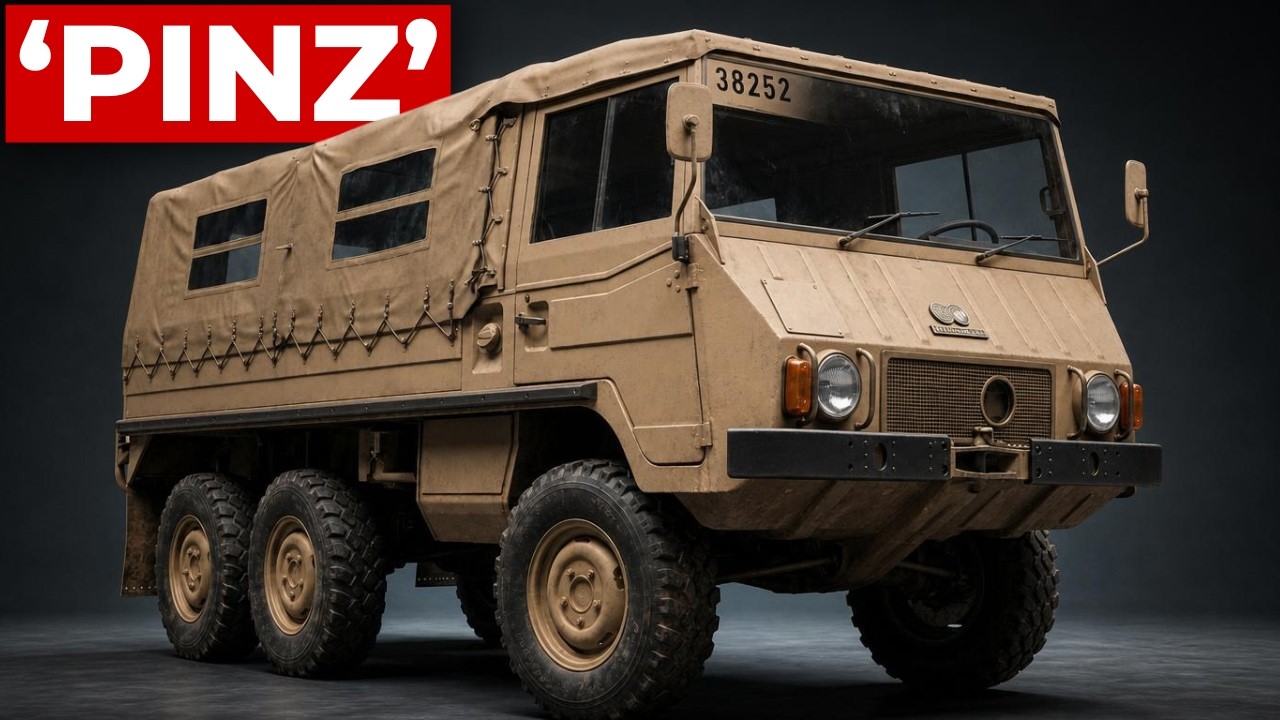
The Vector’s underbelly was flat, not V-shaped, not angled, not designed to deflect a blast outward, flat. When an improvised explosive device detonated beneath a Vector, the full force of the explosion drove straight upward through the floor and into the crew compartment. Worse, the driver and front passenger sat directly above the front wheels, the exact point where a buried device was most likely to detonate.
Engineers and explosive ordnance disposal specialist called this the cone of destruction. The Vector placed its crew directly inside it. British troops in Helmand gave the Vector a name. They called them coffins on wheels. On December 8th, 2007, Sergeant Lee Johnson of the 2nd Battalion, Yorkshire Regiment, was conducting operations to recapture the town of Musa Qala in Helmand Province.
Shortly before 10:10 hours local time, an explosive device detonated beneath his Pinzgauer Vector. Sergeant Johnson was killed. Another soldier in the same vehicle suffered serious injuries. Sergeant Johnson was later mentioned in dispatches for his service. Four days earlier, on December 4, Trooper Jack Sadler of the Honourable Artillery Company, serving with the 4th Regiment Royal Artillery’s 73th Special Observation Battery, as part of the Brigade Reconnaissance Force, was killed near the same area when his vehicle struck an explosive device. He was 21 years old. The official fatality notice did not specify the vehicle type. The Vector’s suspension and wheel hubs proved unreliable under the weight of the added armor. Vehicles broke down in the field. The chassis, designed to carry farmers across alpine meadows, was never engineered to bear the loads that mine-resistant armor demanded. Members of Parliament attacked the Ministry of Defense for the decision. In a Commons Defense Committee session on January 20, 2009, the debate on military vehicle design cited the Vector alongside the Snatch Land Rover as
examples of a disastrous pattern. The pattern of bolting armor plate onto flat-bottom civilian platforms and sending them into a war zone where shape charges were the primary threat. Defense Secretary John Hutton told the committee in April 2009 that mistakes were probably made and called the Vector the least successful of all the armored vehicles procured under the urgent operational requirement process.
On May 1, 2009, the Ministry of Defense confirmed that the Vector would be withdrawn from Afghanistan entirely, replaced by the Mastiff, the Ridgeback, and the Cougar, all of which featured the V-shaped hull that the Vector lacked. In 2016, the Ministry of Defense settled three claims from former service personnel who had been severely injured in Pinzgauer Vectors.
One Royal Marine of 42 Commando had been wounded in October 2008. Two other personnel were injured on August 3, 2009 when a Pinzgauer, serving as an ambulance, struck an improvised explosive device. The driver of the ambulance lost a leg above the knee. The settlement was reached without admission of liability.
The total compensation, including Armed Forces Compensation Scheme payments, reportedly exceeded 10 million pounds. Against this history, the Pinzgauer’s legacy splits into two completely separate stories. The unarmored vehicle remains one of the finest all-terrain platforms ever built. The armored Vector remains one of the worst procurement decisions of the Afghan War.
On paper, the Pinzgauer’s competitors looked stronger. The Mercedes-Benz Unimog had portal axles, too, paired with solid beam axles that gave it superior articulation over the most severe terrain and better stability on ice. The Unimog was the heavier, more industrial machine capable of hauling greater loads in worse conditions, but the Unimog required a Category C heavy vehicle license to drive.
The Pinzgauer did not. A soldier with a standard car license could drive a Pinzgauer off a ramp, through a ford, up a mountain pass, and into a fire position without any additional training. For airborne and air assault units that needed to deploy fast and light, that distinction was decisive.
The real reason portal axles suited special forces so precisely was a combination of factors that no single conventional design could replicate. High clearance meant the vehicle could straddle obstacles that would ground a conventional truck. The hub reduction gearing lowered the torque load on every component in the drivetrain, meaning axle shafts and differential gears lasted longer under stress.
And because the portal hubs dropped the wheels below the axle line instead of raising the body above it, the center of gravity stayed low for a given clearance height. A vehicle that could clear rocks like a lifted truck, but corner like a standard one. For operators driving at high speed across unfamiliar terrain in the dark, that stability was the difference between completing a mission and rolling the vehicle.
Against the Land Rover, the advantage was dimensional. The Pinzgauer carried more troops, more ammunition, and more equipment in a vehicle that still fit within the length and weight limits of helicopter under-slung loads. The portal axles gave it clearance that a Defender could not match without raising its center of gravity to dangerous levels.
The Land Rover was cheaper. It was easier to source parts for. But, in the specific role of airborne gun tractor and medium utility vehicle, the Pinzgauer offered capabilities that the Land Rover simply could not replicate. The vehicle that replaced the Pinzgauer in British special forces adjacent roles was the Supacat Jackal, a purpose-built high-mobility weapon platform designed from the ground for the kind of warfare that Afghanistan demanded.
The New Zealand SAS, which had also operated Pinzgauers as part of a 321-vehicle light operational vehicle fleet, replaced them from 2017 with the Supacat Extender. The British Army still holds a small number of Pinzgauers in limited service with an out-of-service date currently set for 2030. Today, surviving Pinzgauers have found a second life in the civilian world.
The overland expedition community prizes them as some of the most capable adventure vehicles ever made. Former Swiss Army 710 sell at auction for between 8,000 and 12,000 pounds. They appear in the most remote corners of the planet, from the Australian Outback to Patagonia to the floor of Canyon de Chelly in Arizona, where the Navajo Nation operates a fleet of Pinzgauers as tourist transport.
The vehicle even appeared in the 2011 film Thor as the research vehicle driven across the New Mexico desert. A farm truck from Graz hauling fictional scientists through a fictional landscape, 50 years after Erich Ledwinka first sketched its backbone chassis on a drawing board in Austria. And in Ukraine, in the middle of Europe’s largest ground war since 1945, donated British Pinzgauer vectors have appeared in service with Ukrainian forces.
At least three armored ambulance variants and eight armored personnel carriers were transferred from British stocks. The vehicle that was too vulnerable for Helmand is now carrying Ukrainian soldiers and casualties across a battlefield where any vehicle is better than no vehicle at all. A final chapter that nobody at the Graz factory ever imagined.
Consider what this vehicle was, an air-cooled farm truck with no armor, designed to carry cattle feed across the Austrian Alps. It weighed less than 4 tons. Its engine produced 87 horsepower. It was named after a breed of cow, and within 20 years of its first production run, it was carrying Delta Force operators behind enemy lines in Iraq, towing Royal Artillery guns into combat in the Balkans, and serving in 29 armies across six continents.
It was too light for mine warfare. It was too slow for highway convoys. It was too noisy for covert approach. Its fuel consumption was heavy. Its engine compartment was cramped and difficult to service. Its gearbox could be broken by rough handling. And when someone tried to make it into an armored vehicle, soldiers paid for that mistake with their lives and their limbs.
But across open terrain, across mountain passes, across river crossings and desert basins and alpine meadows and jungle tracks that would swallow a conventional vehicle whole, nothing in its weight class could follow where the Pinzgauer led. Not the Land Rover, not the Humvee, not any purpose-built military vehicle in any inventory in the world.
Erich Ledwinka took his father’s backbone chassis, added six wheels with portal axles, wrapped them around an air-cooled engine that had no radiator to puncture and no coolant to leak, and built a vehicle so far ahead of its competition that special forces on two continents abandoned their own military hardware to use it.
That is not the story of a farm truck. That is the story of what happens when an engineer solves the right problem and ignores every assumption about what a military vehicle is supposed to look like. Nations are still driving it. That is the only verdict that matters.