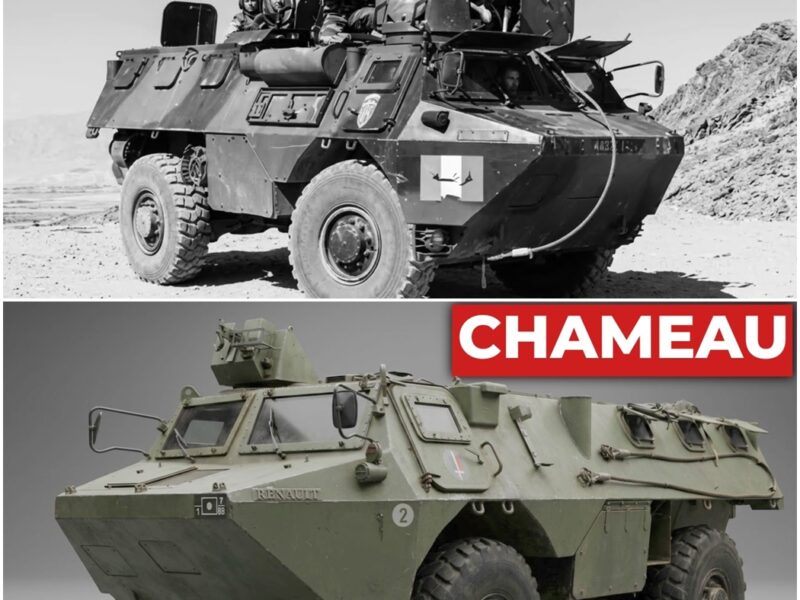
Why This ‘Cheap’ French Army Vehicle Armed 40 Nations While Britain’s Own APC Was Deemed Unsafe D
1976, the proving ground at Satory, just west of Versailles. A vehicle rolls off the assembly line and onto French military concrete for the first time. It is angular, blunt-nosed, and completely unremarkable. Four rubber wheels sit beneath a steel box that rises barely 2 m from the ground.
There is no turret, no cannon, no missile launcher. The armor is thin enough to stop a rifle round and not much else. A single machine gun sits on a pintle mount above the commander’s hatch, exposed to the sky. It looked ordinary. It looked disposable. The kind of vehicle a conscript might climb into once, survive a peacetime exercise, and never think about again.
French officers who inspected the first production models noted its simplicity with something between approval and suspicion. It used truck parts, truck engines, truck gearboxes. The hull was welded steel plate, not composite, not aluminum, not layered ceramic. It could swim, technically, propelled through water by two small jets mounted beneath the rear hull, but nobody expected it to win any races on land or in the river.
Nothing about this machine suggested that it would still be in production nearly 50 years later. Nothing about its plain steel hull hinted that it would fight wars on four continents, serve in more than 40 armies, absorb rocket-propelled grenades in the mountains of Afghanistan, carry French paratroopers into ambushes in the Sahel, take machine gun fire in Sarajevo without a single round penetrating its armor, cross the Iraqi desert at the head of an armored division, and ultimately be donated in the hundreds to a country fighting for its survival in Eastern Europe. It would be built more than 5,000 times. It would be configured in more than 30 variants. Soldiers who spent careers inside it would give it a nickname that said everything about what it was. They called it Le Chameau, the camel. The beast of burden that never stopped walking. Its designation was the VAB, the Véhicule de l’Avant Blindé, and it became the most produced, most deployed, and most combat-tested armored personnel carrier in French military history. To understand why the VAB existed, you need to understand the problem France faced
in the late 1960s. The French army was overstretched. Decolonization had redrawn the map of Africa and Southeast Asia, but France maintained military commitments across the francophone world that demanded rapid intervention capability. The Cold War added a second, equally pressing requirement.
If the Warsaw Pact invaded Western Europe, French mechanized infantry would need to cross rivers in Eastern France and Western Germany under fire, keep pace with tanks, and survive artillery fragments and small arms on a nuclear battlefield contaminated with fallout. The vehicles France had were not adequate.
Conscripts were still riding into exercises in lightly armored trucks with canvas roofs. The tracked AMX-VCI, a 1960s design, was expensive, slow to deploy by air, and consumed fuel at rates that made long-range expeditionary operations impractical. France needed something different, something fast, something cheap, something that could be manufactured in the thousands, flown into a crisis zone inside a transport aircraft, driven a thousand kilometers on its own fuel tanks, and maintained by conscript mechanics using truck parts they already knew. In 1970, Robert Galley, then the French Minister of Defense, launched the program. Two manufacturers competed. Panhard offered a 6×6 design. Saviem, a subsidiary of Renault, offered a 4×4. Both built prototypes. Trials ran through 1973 and into 1974. In May 1974, the Saviem prototype was declared the winner. The decision was deliberate and revealing. The French army chose simplicity over sophistication. Saviem’s
design used a maximum number of components drawn directly from the company’s commercial truck line. The engine was a Renault six-cylinder inline diesel, a unit already proven in thousands of heavy goods vehicles on French roads. The gearbox was a truck gearbox. The axles were truck axles. The tires were heavy-duty Michelin radials designed for cross-country commercial use.
This meant that any French army mechanic trained on Renault trucks could service the VAB without specialist instruction. It meant spare parts could be sourced from the civilian supply chain. It meant production could scale rapidly because the factory was already tooling for most of the components. The order was enormous, 4,000 vehicles for the French Army alone.
Production began at a rate of 30 to 40 units per month, a pace that would be sustained for years. The vehicle itself was a masterpiece of deliberate restraint. The hull was welded high hardness steel plate angled to deflect small arms fire and shell splinters. Protection stopped rifle caliber rounds, specifically 7.
62 mm ball ammunition and fragmentation from artillery bursts. It would not stop a heavy machine gun round. It would not stop an anti-tank missile. The designers knew this and they accepted it. The VAB was not built to fight tanks. It was built to deliver 10 infantrymen to the edge of a fight alive and ready.
The Renault MYD S062045 diesel engine, fitted from 1982 onward, produced 220 horsepower. This pushed the 13-ton vehicle to a top road speed of 92 km/h, a figure that made it one of the fastest armored personnel carriers in NATO. Range was 1,000 km on internal fuel, an extraordinary figure for its class.
A French VAB could drive from Paris to Berlin without refueling. In Africa, where French forces operated hundreds of kilometers from the nearest supply base, this range was not a luxury, it was survival. The vehicle was fully amphibious in its original configuration. Twin water jets mounted beneath the rear hull propelled it through rivers and coastal shallows at a speed of roughly 2 m/s.
This capability was specifically designed for crossing the rivers of Eastern France and Germany in the event of a Soviet advance, but it proved equally useful in the flooded terrain of West Africa and Southeast Asia. The base model carried a crew of two, a driver and a commander, plus 10 fully equipped infantrymen in the rear compartment.
Access was through armored double doors at the back. A pintle mounted 12.7 mm heavy machine gun gave the commander a degree of suppressive fire capability, but the VAB was never intended to fight from its hull. Its job was to deliver soldiers and then get out of the way. What made the VAB exceptional was not any single capability, it was the platform’s modularity.
Over the following decades, the French military and export customers would configure the VAB into more than 30 distinct variants. The VAB VTT carried troops, the VAB PC served as a mobile command post, the VAB sanitaire evacuated casualties, the VAB Mephisto carried four ready-to-fire HOT anti-tank guided missiles, the VAB T20 13 mounted 20 mm auto cannon in a turret recovered from older vehicles, the VAB Atlas served as an artillery observation platform.
There were mortar carriers, engineer vehicles, electronic warfare platforms, NBC reconnaissance variants, and police crowd control models fitted with dozer blades. One hull, 30 missions. This was the genius of the design, a platform so deliberately simple that it could be reconfigured for almost anything. The French army used the 4×4 exclusively.
Export customers, seeking improved cross-country mobility and greater internal volume, predominantly selected the 6×6 configuration at roughly 10% greater cost. Both shared the same engine, the same armor package, and the same modular architecture. The difference was an additional axle, a longer hull, and a wider operational footprint.
Two vehicles built from the same philosophy, serving different doctrines across different continents. Now, before we get into where this vehicle actually fought, if you are enjoying this deep dive into Cold War era military engineering, hit subscribe. It takes a second, costs nothing, and helps the channel grow.
The VAB’s combat debut came in Africa, and it came early. In 1983, Libyan forces under Muammar Gaddafi invaded Chad, pushing south with armor, artillery, and combat aircraft in support of rebel factions. France responded with Operation Manta, deploying 3,500 troops to establish a defensive line along the 15th parallel, the so-called red line that separated Libyan-controlled northern Chad from the capital, N’Djamena, in the south.
It was the largest French military intervention in Africa since the Algerian War. VABs carried French infantry and Foreign Legion cavalry into positions across hundreds of kilometers of open desert and scrubland. Units of the 1st Foreign Cavalry Regiment, freshly equipped with the VAB alongside the AMX 10 RC and the Milan anti-tank missile system, deployed directly from the Central African Republic into Chadian territory.
The terrain was brutal. Temperatures exceeded 50° C on the open plain. Sand infiltrated every mechanical component. Roads, where they existed at all, were unpaved tracks carved into laterite and loose gravel. Supply lines stretched to the breaking point. The VAB absorbed all of it. Its truck-derived engine tolerated low-quality fuel, a critical advantage in a country where refined diesel was scarce, and what was available was often contaminated.
Its large Michelin tires maintained traction on soft sand, where lesser designs would have bogged down within meters. Its 1,000-km range meant convoys could cover enormous distances between refueling stops, a capability that proved decisive when French forces established forward positions hundreds of kilometers from the nearest logistics hub.
When Libya violated the ceasefire in 1986, France launched Operation Épervier, a follow-on intervention that would keep French forces in Chad for years. VABs remained the backbone of French ground mobility throughout, patrolling the red line, escorting convoys, and transporting infantry across some of the most inhospitable terrain on Earth.
The vehicle had proved something that peacetime exercises never could. In sustained expeditionary operations far from factories and depots, simplicity was not a weakness. It was the only thing that kept an army moving. In 1991, the VAB went to war on a continental scale. Operation Daguet, France’s contribution to the coalition that liberated Kuwait, deployed the division Daguet into the Iraqi desert with 376 VABs.
These vehicles formed the core of the division’s light armored brigades, operating alongside AMX-10 RC reconnaissance vehicles and VBL light armored cars. The division advanced into Iraqi territory as the western flank of the coalition ground assault, screening behind reconnaissance elements rather than leading direct armored charges.
During the 100-hour ground offensive, the division Daguet covered more than 300 km in the initial thrust. VAB availability rates held above 90% throughout the campaign, a figure that stunned logisticians accustomed to the maintenance burdens of tracked vehicles in desert conditions.
The Renault diesel engines ran without complaint in sustained desert heat. Wheeled mobility allowed sustained speeds of up to 90 km/h on hardened desert tracks that would have punished the running gear of any tracked carrier. French ground force casualties during the 100-hour campaign remained under a dozen combat-related, reflecting both the VAB’s tactical employment and its ability to keep crews alive under fire.
Losses were confined to a handful of vehicles damaged by small arms fire. No VAB was destroyed by Iraqi anti-tank weapons or artillery during the entire operation. The Balkans tested the VAB in a different way entirely. From 1992 onward, French VABs deployed to Bosnia and Herzegovina as part of the United Nations Protection Force.
In Sarajevo, VABs operated under constant sniper fire and mortar bombardment. On multiple occasions, vehicles were struck by 7.62 mm and higher caliber rounds. Not a single round penetrated the hull. The vehicle’s basic steel armor, dismissed by some as inadequate for modern threats, performed exactly as designed against the weapons most commonly encountered in urban peacekeeping operations.
On the 27th of May, 1995, the VAB’s presence in Sarajevo took on a different character entirely. Bosnian Serb soldiers disguised in French uniforms and blue helmets seized United Nations observation posts at both ends of the Vrbanja bridge, taking 12 French peacekeepers hostage. French President Jacques Chirac ordered an immediate counterattack.
Captain François Lecointre led a platoon of 30 French Marines, supported by 70 infantrymen and 13 armored personnel carriers, including VABs providing direct fire support in an assault to retake the bridge. What followed was the first French bayonet charge since the Korean War.
In a 32-minute firefight, French forces recaptured both observation posts, freed the hostages, and killed four Bosnian Serb soldiers. Two French soldiers died, 17 were wounded. The Bosnian Serb army never again attempted to seize a French-held position in Sarajevo. Afghanistan revealed both the VAB’s strengths and its limits.
By 2008, 600 French VABs were deployed on external operations. 400 of them in Afghanistan with the International Security Assistance Force. On the 18th of August, 2008, a French column from the 8th Marine Infantry Parachute Regiment entered the Uzbin Valley east of Kabul on a reconnaissance patrol. The column was led by the platoon designated Carmen 2, riding in four VABs at an altitude of 1,750 m.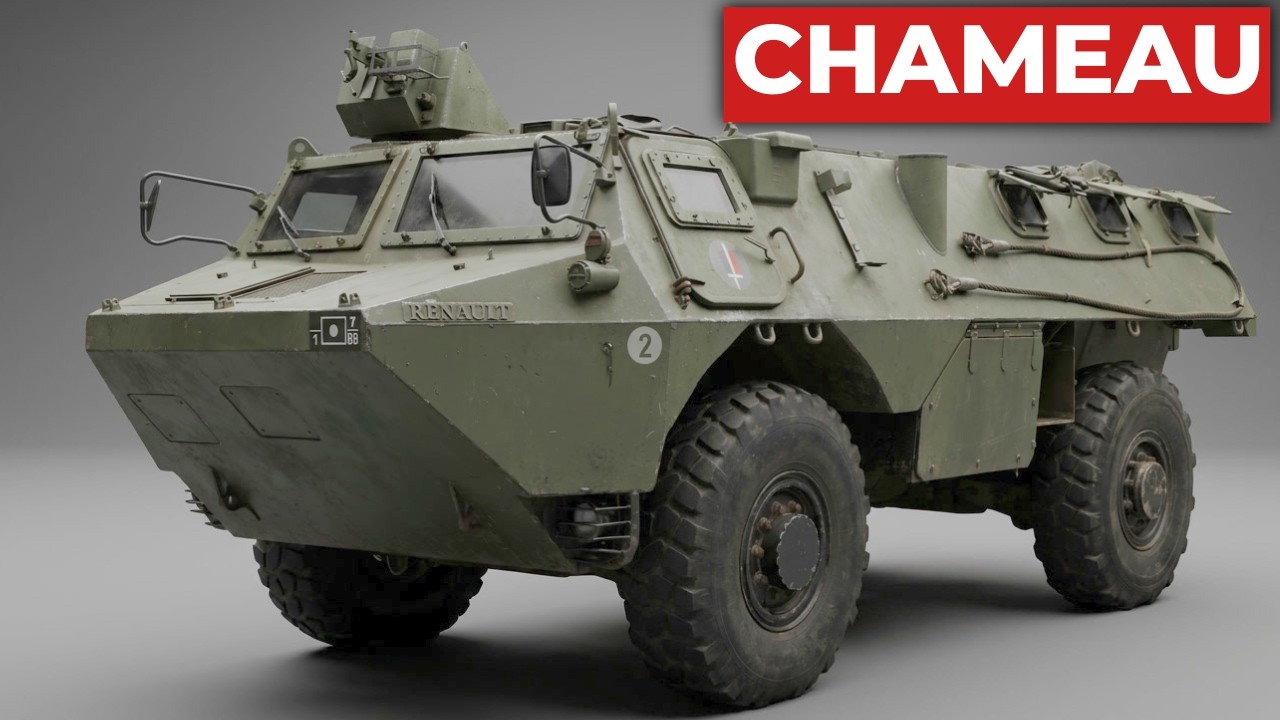
The road ended. The paratroopers dismounted and advanced on foot into a mountain pass. What followed was the deadliest single day for French forces since the 1983 Beirut barracks bombing. Taliban fighters, numbering over 100, opened fire from prepared positions on both sides of the valley. Reinforcements swelled the insurgent force to an estimated 400.
10 French soldiers were killed, 21 were wounded. One of the four VABs was struck directly by a rocket-propelled grenade. The crew inside survived without injury. The hull held, but one soldier manning the exposed rooftop machine gun of another VAB was killed when the road beneath his vehicle collapsed, rolling the carrier down the hillside and crushing him beneath its weight.
The Us pin ambush forced a reckoning. The VAB’s basic armor could stop rifle rounds and survive an RPG strike, but the exposed machine gun position was a death trap. Within months, the French military began equipping VABs with Kongsberg Protector Remote Weapon Stations, allowing gunners to operate from inside the vehicle.
Ceramic add-on armor tiles were bolted to the hulls of deployed vehicles. These upgrades, known collectively as the VAB Valorise program, added roughly 2 tons to the vehicle’s weight, which eliminated its amphibious capability, but dramatically improved crew survivability. By July 2011, 56 French VABs had been hit in external operations.
22 were destroyed, but the vehicle’s design, particularly the hull shape and wheel placement that deflected blast energy away from the crew compartment, consistently minimized casualties. Soldiers survived strikes that would have killed the occupants of flat-bottomed vehicles. In January 2013, the VAB deployed to its most recent major African campaign, Operation Serval.
France’s rapid intervention against jihadist forces advancing on Bamako, the capital of Mali, put VABs at the tip of the spear once again. Combined arms battle groups built around infantry battalions riding in VABs advanced north alongside AMX 10 RC armored cars, covering vast distances across the Saharan fringe.
The VAB’s 1,000 km range proved essential once again. Resupply in northern Mali was measured not in hours, but in days, and the ability to move without constant dependence on fuel convoys gave French commanders operational reach that the insurgents could not match. The operation transitioned into Operation Barkhane in 2014, a long-term counter-terrorism deployment stretching across five Sahelian nations that kept VABs in continuous combat operations for nearly a decade.
By 2017, VABs were a permanent fixture of French forward-operating bases from Tessalit to Gao. Beyond French service, the VAB compiled a remarkable foreign combat record. Morocco acquired over 400 VABs in multiple variants, including VCI-2C fire support vehicles and Mephisto anti-tank missile carriers, and deployed them extensively during the Western Sahara conflict against Polisario Front guerrillas.
Moroccan VABs operated in sustained desert warfare far from established supply lines, precisely the environment the vehicle had been designed for. Indonesian VABs saw combat during the May 1998 Jakarta riots, and the 2003 to 2004 military offensive in Aceh province, where they were used in both urban security and jungle counterinsurgency operations.
In Lebanon, 95 VABs delivered between 1981 and 1984 served through the civil war with several vehicles falling into the hands of the Shia Amal movement after the army’s predominantly Shia 6th Infantry Brigade defected in February 1984. Indonesian forces later deployed VABs again as part of the Garuda contingent with the United Nations Interim Force in Lebanon beginning in 2007.
The VAB’s closest competitors reveal why the French design endured where others did not. The American M113, the most produced armored personnel carrier in history, was a tracked vehicle. It offered comparable troop capacity and could mount heavier weapon systems, but its tracks demanded constant maintenance, consumed fuel at far higher rates, and limited the vehicle’s road speed.
The M113 could not drive itself 1,000 km to a crisis zone. It had to be transported. The Soviet BTR-60, 70, and 80 series offered a direct wheeled comparison, but these 8×8 vehicles were significantly larger, heavier, and more complex. Their amphibious capability was comparable, but their engines were less reliable in sustained desert operations, and their armor offered only marginal improvements over the VAB despite significantly higher weight.
The German Transportpanzer Fuchs was perhaps the closest equivalent in NATO, a 6×6 amphibious personnel carrier with truck derived components. The Fuchs shared the VAB’s philosophy of deliberate simplicity, but the Fuchs was heavier, more expensive, and produced in far smaller numbers. Germany built roughly 1,000 Fuchs vehicles.
France built 5,000 VABs. The doctrinal difference was revealing. France designed the VAB not as a fighting vehicle, but as a delivery vehicle. The infantry were the weapon. The VAB was the envelope. This philosophy, brutally simple, allowed France to project ground forces across Africa, the Middle East, and Central Asia with a logistical footprint that heavier, more sophisticated vehicles could never match.
A VAB could be loaded into a C-130 Hercules transport aircraft and flown to a crisis zone within hours. Its truck parts could be sourced locally in Francophone Africa, where Renault commercial vehicles were ubiquitous. Its fuel consumption was modest enough to sustain long-range patrols in terrain where every liter had to be trucked or flown in.
By 2019, the VAB had been exported to more than 40 nations. France itself operated approximately 3,900 vehicles in 35 different configurations. Production had continued in various forms for nearly four decades, making it one of the longest continuous production runs of any armored vehicle in Western military history. The replacement program began under the French Army’s Scorpion modernization initiative.
The Véhicule Blindé Multi-rôles Griffin, a 6×6 platform in the 24-ton class, was designed to succeed the VAB with dramatically improved protection, a digital battlefield management system, and modular mission kits. The French Army plans to acquire 1,872 Griffins to replace its fleet of 2,700 VABs still in service.
Deliveries began in 2019 with over 500 delivered by the end of 2023, but the VAB is not finished. Surplus French vehicles are being donated to Ukraine in significant quantities. By late 2024, 284 VABs had been delivered to Ukrainian forces, where they serve with airborne and mechanized brigades in high-intensity combat against Russian forces.
Ukrainian after-action reports have noted the vehicle’s strong cross-country capability in the country’s soft, waterlogged soil. At least 30 VABs have been visually confirmed destroyed in Ukrainian service. With 13 more damaged and abandoned. Even in the most demanding conventional war in Europe since 1945, the old camel keeps walking.
Meanwhile, Arquus, the successor company to Renault Trucks Defense, continues to market the VAB Mark 3, a thoroughly modernized 6×6 variant with STANAG Level 4 mine protection, a choice of 340 or 370 horsepower engines, and compatibility with remote weapon stations ranging from 12.7 mm machine guns to 90 mm cannons.
Saudi Arabia, Tunisia, and Armenia have all acquired or ordered VAB Mark variants. The platform refuses to die. 1976, the proving ground at Satory, a vehicle rolls off the line. It is boxy, plain, and utterly without glamour. It has no composite armor, no active protection system, no thermal imaging sight, no battlefield management network.
It cannot defeat a modern anti-tank missile. It cannot survive a direct hit from a heavy-caliber auto-cannon. Its basic steel hull would not pass the protection standards demanded by any Western army designing a vehicle today. And yet, it fought in the deserts of Chad, where heat and sand destroyed more sophisticated machines in weeks.
It crossed the Iraqi desert at the head of an armored division and maintained 90% availability when tracked vehicles around it broke down. It absorbed machine gun fire in the shattered streets of Sarajevo for 3 years without a single round penetrating its hull. It survived rocket-propelled grenades in the mountains of Afghanistan and kept its crews alive.
It carried French marines into a bayonet charge on a bridge in Bosnia and brought most of them back. It patrolled the Sahel for a decade under conditions that would age any vehicle a generation. It fights today in the muddy fields of Eastern Ukraine. 5,000 built, 30 variants, more than 40 nations, four continents, nearly 50 years.
The engineers at Saviem did not build a revolutionary machine. They built a truck that could take a bullet, cross a river, and carry 10 soldiers to the fight. They built it so simply that a conscript could fix it. So cheaply that a ministry could buy it by the thousand and so reliably that armies on four continents still depend on it half a century later.
The VAB was never the best armored vehicle in any category. It was never the fastest, the toughest, the most heavily armored, or the most technologically advanced. It was French. It was simple. And it worked everywhere it went.