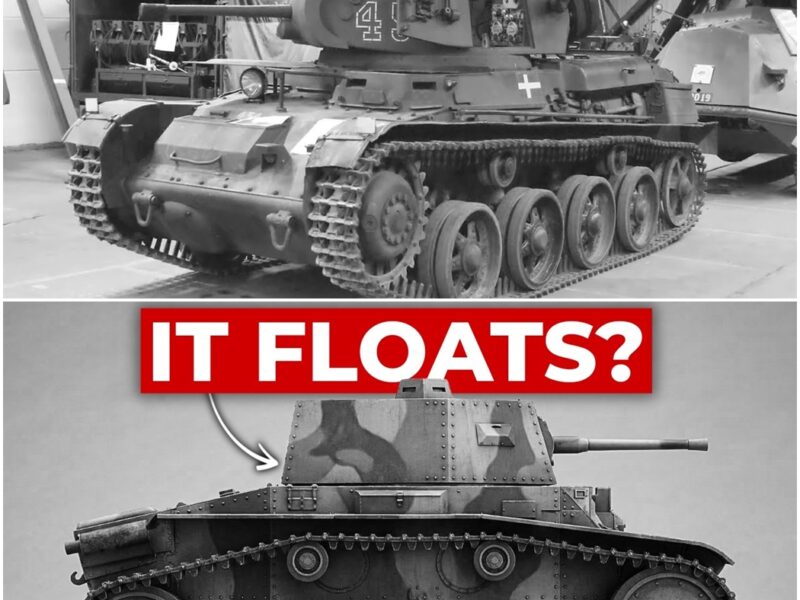
Why This ‘Failed’ British Tank Was Rejected By Seven Nations Before Changing D-Day D
1938 A Hungarian weapons testing ground on Haros Island south of Budapest. Military officials from seven nations have now seen the same demonstration. A light tank bolted to oversized pontoons lumbers into the Danube. It floats, barely. It paddles across at walking pace, wallowing and unstable, then clanks ashore trailing water.
Every delegation reaches the same conclusion. Interesting concept. Unacceptable execution. The Strausler V4 is rejected by Hungary, Britain, Italy, the Soviet Union, Poland, the Netherlands, and Japan. Seven countries, seven refusals. Its designer, a Hungarian-born British citizen named Nicholas Strausler, watches a decade of amphibious tank development collapse.
He does not give up. He goes back to his workshop and rethinks the entire problem from scratch. Six years later, his reinvented solution puts 30-ton Sherman tanks into the English Channel under their own power, swimming toward the beaches of Normandy. The problem Strausler was trying to solve had haunted military planners since the First World War.
Beaches are killing grounds. Infantry crossing open sand under machine-gun fire suffer catastrophic losses. Tanks can suppress those guns, but tanks cannot cross water. Every amphibious landing in history faced the same gap. The minutes between the infantry hitting the beach and heavy armor arriving by landing craft.
In those minutes, men died in enormous numbers. By the 1930s, several nations were attempting amphibious tanks. The Soviets mass-produced the T-37A, the world’s first amphibious tank built in large numbers, with roughly 2,500 rolling off production lines between 1933 and 1936. It weighed just 3.2 tons, carried a single 7.
62 mm machine gun, and had armor between 3 and 9 mm thick. Machine-gun rounds went straight through it. The Japanese built the Type 2 Ka-Mi, a well-designed amphibious light tank using detachable steel pontoons. It swam well, but weighed only 12.5 tons with pontoons, carried a 37-mm gun, and had 6 to 13 mm of armor.
Neither vehicle could survive contact with serious opposition. Strausler’s V4, developed under contract with Hungary’s Manfred Weiss Corporation, was more capable than either. The final version weighed approximately 12 tons, carried a 40-mm Bofors-derived anti-tank gun, and had frontal armor of 26 mm. It could reach 40 to 50 km/h on roads and 8 km/h in water.
The amphibious system used detachable pontoons bolted to the hull and a removable propeller. According to Hungarian trial records, it could even tow a 3-ton barge while afloat, but the pontoons doubled the vehicle’s width, making it impossible to transport by rail or launch from standard landing craft.
The suspension, a unique Strausler design using rocking arms with torsion springs, transmitted so much vibration that crews could not aim the gun while moving. The silhouette was too tall. The armor angles were poor. And the mechanicals were unreliable. When Hungary pitted the V4 against the Swedish Landsverk L-60 in June of 1938, the Swedish design won decisively.
It became the Toldi light tank. The rejected V4 was stripped of its weapons and used as a tractor at the test site until Soviet forces captured it during the siege of Budapest in 1944. The V4 taught Strausler a fundamental lesson. A purpose-built amphibious tank meant compromises everywhere.
Thin armor, light weapons, complex bolt-on flotation, restricted transport options. Every nation that tested it found a better alternative for each individual role. The tank that tried to do everything did nothing well enough. So, Strausler abandoned the entire concept of a special amphibious tank. Instead, he asked a different question.
What if you could make an existing tank swim? His answer came from earlier work designing collapsible floats for Vickers-Armstrong in the late 1920s. Those external floats worked, but each was roughly the size of the tank itself. Far too wide for practical deployment. Around 1934, Strausler attacked the problem from what he called an entirely new angle.
By 1940, he had devised something elegant. A folding waterproof canvas screen attached directly to the tank’s hull that formed a temporary boat-shaped enclosure around the vehicle. The canvas displaced enough water to float the tank. According to accounts from the Tank Museum at Bovington, Strausler reportedly demonstrated the principle to Winston Churchill by placing a brick inside a canvas bucket and floating it in a paddling pool.
In June of 1941, the first Duplex Drive trial took place at Brent Reservoir in North London using a 7-ton Tetrarch light tank fitted with the screen. General Sir Alan Brooke, Commander-in-Chief of Home Forces, witnessed the test and became an immediate supporter. Successful sea trials followed at Langstone Harbour near Portsmouth.
In December of 1941, the system worked like this. A continuous mild steel platform was welded around the tank at mudguard level, forming a waterproof base. The canvas screen, supported by horizontal metal hoops, folded and expanded like an accordion. 36 vertical rubber tubes, inflated by compressed air, held the screen rigid, each exerting roughly 600 lb of upward pressure.
Twin brass propellers, 28 in in diameter, were driven by a crown wheel gear attached to the tank’s rear idler wheel, drawing power through the tracks themselves. The tank commander stood exposed on a raised platform behind the turret, steering with a large tiller. Crew members sat on deck outside the tank, pressing their backs against the canvas to prevent waves from collapsing it inward.
Freeboard was approximately 3 ft. 3 ft of canvas between a 30-ton tank and the English Channel. The DD Sherman achieved roughly four knots in water. Screen erection took about 15 minutes. Collapse took seconds. And here was the transformation that made the V4’s failure worthwhile. Once ashore with its screen dropped, a DD Sherman was simply a standard Sherman tank.
75-mm gun, up to 76-mm of armor, full combat capability, no compromises. Production was substantial. British workshops converted 293 Sherman IIIs and 400 Sherman Vs. American factories converted approximately 350 M4A1s. Total Sherman DD production reached roughly 1,043 tanks. An additional 625 Valentine DD tanks were built exclusively for training.
Now, before we see how these performed in combat, if you’re enjoying this deep dive into British engineering, hit subscribe. It takes a second, costs nothing, and helps the channel grow. Right, let’s get into the beaches. The man who turned the DD tank from engineering curiosity into a battlefield weapon was Major General Sir Percy Hobart, nicknamed Hobo, a pioneering tank theorist who had trained both the Desert Rats and the 11th Armoured Division.
Hobart was forced into retirement by conservative superiors and was serving as a lance corporal in the Home Guard when Churchill personally recalled him to active duty. In March of 1943, Hobart took command of the 79th Armoured Division with orders to develop specialized armor for the invasion of Europe.
DD tanks came under his authority in April of that year. He trained 10 regiments across three nations for DD operations. June 6th, 1944. The plan called for roughly 280 DD Shermans to launch 5,000 yd from the Normandy coast and swim to shore ahead of the infantry. DD tanks were designed for waves up to 1 ft high.
On D-Day, waves reached 6 ft. At Sword Beach, the 13th/18th Royal Hussars executed the textbook operation. 34 tanks launched at the full planned distance of 5,000 yd. 31 reached the beach after an hour-long swim, touching down 5 minutes before H-hour, ahead of the infantry. Lance Corporal Patrick Hennessey later described sitting on deck, feet below sea level, expecting any wave to flood them, then feeling the tracks meet the sand and rising out of the water.
Within a minute of dropping their screen, they fired their first shot. At Juno Beach, the Canadian First Hussars launched 29 tanks at varying distances. Seven sank. 21 reached the beach. The commander of the Winnipeg Rifles later stated the surviving squadron literally made possible the overwhelming of the defenses.
At Utah Beach, the American 70th Tank Battalion launched from roughly 1,000 yd after rough seas forced LCTs closer than planned. 27 of 28 tanks reached shore. Utah recorded the lightest casualties of any D-Day beach. At Gold Beach, the 4th/7th Royal Dragoon Guards refused to launch in the heavy seas and landed their tanks directly from LCTs.
The Sherwood Rangers launched late from approximately 700 yd. Eight tanks were lost. Lieutenant Stuart Hills of the Sherwood Rangers captured the experience perfectly, saying that being a sailor in a tank was taking patriotism too far. Then, there was Omaha. The 741st Tank Battalion launched 29 DD Shermans at roughly 5,000 6,000 yd from shore in ferocious seas.
All 16 tanks of C Company sank. 13 of B Company’s 16 went down. Only two DD tanks reached the beach under their own power. 33 crew members were killed. The 743rd Tank Battalion made the opposite decision. Their commander and the Navy officer agreed the seas were too rough. Not a single DD tank was launched. LCTs carried all 32 directly to the beach.
By mid-morning, more than 40 Shermans were operational and proved critical in suppressing German positions. The contrast between beaches where DD tanks arrived and Omaha, where most sank, defined the human cost of the technology’s limits. Omaha suffered roughly 2,500 casualties. The British and Canadian beaches, supported by swimming armor, suffered far fewer.
No other nation fielded anything comparable. The American LVT was faster in water at 12 km/h and was produced in staggering numbers, over 18,000 units, but it was a transport with roughly 25 mm of armor and an open-topped turret. It could not fight as a tank. The Japanese Ka-Mi had excellent hydrodynamics, but only 182 were ever built, and they carried a gun already obsolete by 1944.
Soviet amphibious tanks were fast, but as German observers noted, weak as tin cans. Only the DD Sherman delivered real medium tank firepower, 75 mm of gun and over 50 mm of armor directly from the waterline. DD tanks continued operating after Normandy. They supported Operation Dragoon in Southern France in August of 1944.
They crossed the Western Scheldt in October, including the longest recorded DD swim of 7 mi. They crossed the Rhine in Operation Plunder in March of 1945. Straussler’s flotation screen concept persisted on lighter vehicles for decades afterward, used on the American M2 Bradley, the British FV432, and the Swedish Stridsvagn 103. Straussler himself continued inventing until his death in London on June 3rd, 1966 at age 75.
He received a Royal Commission award for the DD flotation system. His unpublished designs for a main battle tank with an auto-loading 120 mm gun and built-in amphibious capability were discovered in the Bovington archives decades later. Never built because the War Office preferred conventional designs.
Picture that testing ground on Harris Island again. 1938. The V4 wallowing in the Danube, rejected by every army that saw it. Now, picture the English Channel, June 6th, 1944. 31 Sherman tanks of the 13th-18th Hussars rising from the waves at Sword Beach. Screens collapsing, guns firing within 60 seconds of touching sand.
The same engineer designed both. The difference was not talent. It was the insight that failure provides when you let it teach you. Nicholas Straussler did not build a better amphibious tank. He made the best tank in the Allied arsenal amphibious. That distinction, born from seven rejections, changed the course of the largest seaborn invasion in history.
British engineering did not just solve the problem, it redefined what the problem actually was.