Why This ‘Flat’ British Carrier Could Vanish Behind A Hedge Then Rise Twelve Feet To Kill D
1943, County Commercial Cars Workshop, Fleet, Hampshire. A man who builds truck conversion kits for a living has just finished something that does not look like it belongs on a battlefield. It does not look like it belongs anywhere. The vehicle is a flat steel box on tracks, barely waist-high.
Two men lie face-down inside it. And when a hydraulic pump activates, the entire front end of the machine rises into the air like the head of an insect, pushing a pair of Bren guns nearly 12 ft off the ground. The man who built it is Dennis James Tap. He patented this idea 6 years earlier.
The British Army told him to keep going. They called it the Praying Mantis. It would become the strangest armored vehicle Britain ever produced, and one of the most forward-thinking designs of the entire war. To understand why Tap built this machine, you need to understand what killed soldiers behind walls.
The problem was ancient and unsolved. Anytime a defender needed to fire over a wall, a hedgerow, or an embankment, he had to expose his head and shoulders above the obstacle. That exposure, even for a few seconds, was lethal. Tap knew this firsthand. He had served as a machine gunner in the British Army during World War I. In the trenches, raising your head above the parapet to fire meant offering it to a sniper on the other side.
At Gallipoli, the casualties from this exposure grew so severe that Lance Corporal William Beach invented the periscope rifle in May of 1915, allowing soldiers to aim and fire without lifting their heads above the trench line. But periscope rifles were fragile, inaccurate, and limited to one man at a time.
Captain Leslie Vickers of the Seaforth Highlanders wrote in 1917 that his men quickly learned it was unhealthy to put their heads above the parapet any more than necessary. The fundamental problem remained. If you wanted to deliver concentrated fire over an obstacle, somebody had to be exposed. Suppressive fire from a Vickers gun required a crew of three men, all visible above the parapet.
A Lewis gun needed at least two. The more firepower you wanted over the wall, the more men you lost getting it there. After the war, Tap and his brother Percy went into the transport business, hauling meat from Smithfield Market. Finding standard trucks too small, they converted a vehicle to a twin rear axle design that could carry 2 tons.
That mechanical talent led them to found County Commercial Cars Limited in 1929, converting Ford trucks from two-axle to three-axle configurations. Ford eventually adopted their kits for factory production. Tap was an engineer by instinct, not training. And the idea he had carried since the trenches, a machine that could raise weapons over cover without exposing anyone, never left him.
In 1937, he filed a patent for an elevating armored fighting vehicle. The concept was simple. A tracked carrier would drive up behind a wall or hedgerow. A hydraulic system would then raise the weapons above the obstacle. The crew would fire from behind the cover, protected by both the obstacle and the vehicle’s own armor. When finished, the weapons would lower, and the vehicle would withdraw, never having shown more than a gun turret above the wall.
No nation on Earth had anything like it. Tap built his first prototype on a custom chassis with Carden Loyd suspension, thin tracks, and four road wheels. It carried a single crewman. Shortly after the outbreak of World War II in September 1939, he demonstrated it to the War Office. According to the Tank Museum’s official account, the War Office rejected the single crew design because it asked too much of one person, but they saw enough promise to authorize a second prototype with two crewmen.
This was critical. In 1940, with the German invasion of Britain appearing imminent under Operation Sealion, the War Office was entertaining every unconventional idea it could find. Britain had abandoned over 400 tanks and 2,400 heavy guns at Dunkirk. Only 167 anti-tank guns remained in the entire country.
Ammunition was so scarce that regulations forbade wasting a single round on training. In this climate of desperation, Tap’s strange machine got a second chance. The second prototype appeared in 1943, built on the chassis of the Universal Carrier. This was a natural choice. The Universal Carrier was the most produced armored fighting vehicle in history, with roughly 113,000 manufactured across Britain, Canada, Australia, and New Zealand.
It was proven, reliable, and available. Tap kept the carrier’s Ford flathead V8 engine, a 3.9 L unit producing 85 brake horsepower. He kept the distinctive track-bending steering system, which warped the tracks laterally for gentle turns instead of braking them. Everything else, he replaced. The new superstructure had three components, each named after parts of the insect it resembled.
The control chamber was a long armored box where both crew members, driver and gunner, lay face-down with their heads toward the front. At their feet sat the hydraulic system. Above the control chamber was the head, a section that could pivot independently up and down for fine elevation adjustments. On top of the head sat the helmet, a small rotating turret housing .
303 caliber Bren light machine guns mounted side by side, plus a small grappling gun. From the enemy’s perspective, the helmet presented a target not much larger than a man’s head. The hydraulic system could elevate the entire control chamber to roughly 55°, pushing the helmet turret to a maximum height of 11 and 1/2 ft, or 3.
48 m, above the ground. When fully lowered, the Mantis sat low enough to hide behind tall grass. According to one detailed account, the vehicle weighed 5.2 long tons and could reach 25 mph on road. It could drive in any position, fully lowered, partially raised, or at maximum extension.
The original design also called for the control chamber to traverse left and right, giving the gunner a wider firing arc. Whether this lateral movement functioned on the final prototype is unclear from surviving records. Picture the experience from the crew’s perspective. You’re lying face-down in a sealed metal box roughly the width of a coffin.
You cannot see outside except through small vision slits. The Ford V8 engine rumbles directly below you. When the hydraulic pump engages, the entire box you’re lying in tilts upward, pressing your body weight backward toward your feet. At full elevation, you’re angled at 55°, head up, feet down, swaying with every movement of the tracks beneath you.
Your job is to aim and fire two Bren guns at targets you can barely see while the whole structure pitches and rolls. The Mantis demanded that its crew fight gravity, nausea, and the enemy simultaneously. Now, before we get into what happened during trials, if you’re enjoying this deep dive into British engineering, hit subscribe.
It takes a second, costs nothing, and helps the channel grow. Right, let us get back to the Mantis. The trials were a disaster. The Tank Museum’s official summary states plainly that the design proved impractical. The controls were difficult to use, and the motion made the crews ill. The specific problems were devastating.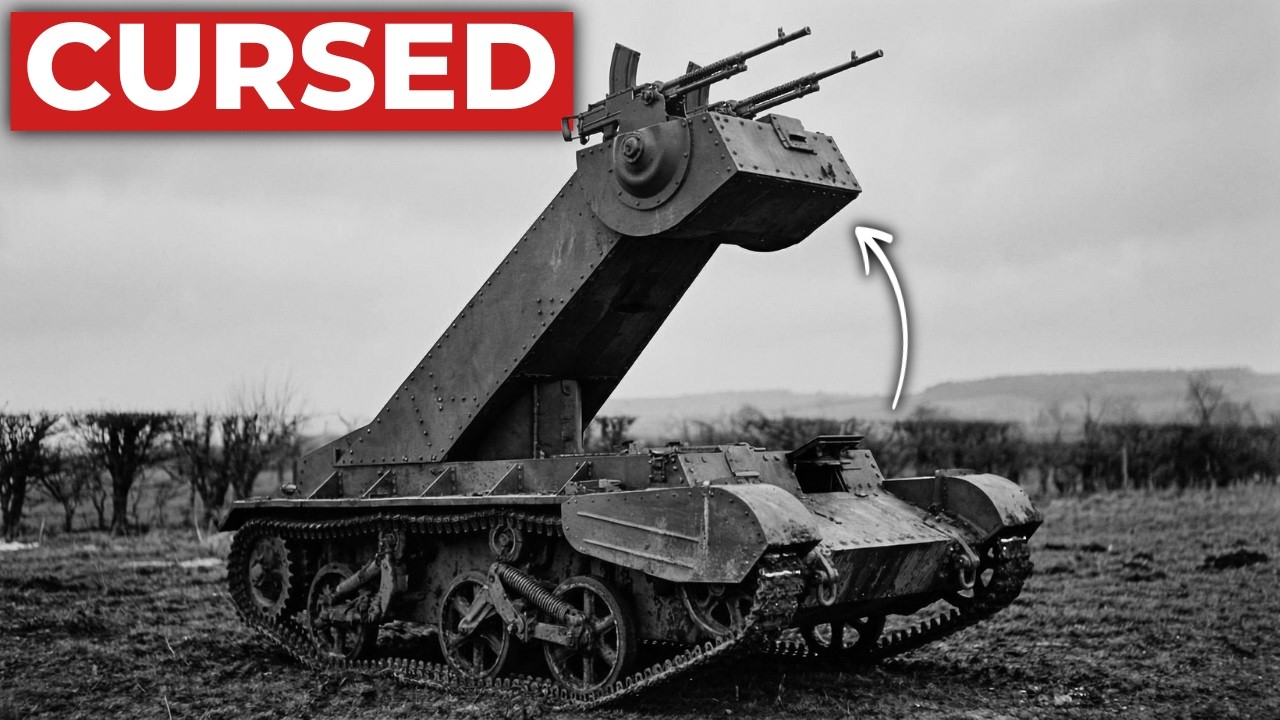
Motion sickness was the primary failure. Lying face-down inside a narrow steel box while it swayed and bounced across rough terrain was physiologically unbearable. Multiple accounts from crew members described severe nausea. The elevated compartment amplified every bump and vibration from the tracks below, swinging the crew through arcs that the human inner ear simply could not tolerate.
No amount of training or acclimatization solved this. Control difficulty compounded the problem. Operating driving controls, elevation mechanisms, and weapons while lying prone demanded unnatural body positions. Even with two crew members splitting the workload, the arrangement was too awkward for sustained use. The first prototype had already proven that one man could not manage everything.
The second proved that two men in this configuration could not manage it either. Armor protection was minimal. With only 6 to 9 mm of steel, the Mantis could stop small arms fire and shrapnel, but nothing heavier. If caught in the open without an obstacle to shelter behind, the vehicle and its crew were exposed.
The project was officially abandoned in 1944. By a brutal coincidence, the exact tactical problem the Praying Mantis was built to solve erupted in Normandy that same summer. The bocage, the hedgerow country of northern France, consisted of massive earthen embankments averaging 4 ft high, but reaching up to 15 ft, topped with centuries-old hedges and tangled root systems.
Norman farmers had packed rocks into these banks for generations, creating walls that were half earth, half living fortification. Each field was enclosed on all sides, rarely more than 300 ft across, turning the countryside into a maze of natural fortresses. The Germans had occupied this terrain for 4 years and knew every sight line.
They dug fighting positions directly into the embankments, pre-registered their mortars on every field opening, and turned each hedgerow gap into a kill zone. General Omar Bradley called it the damnedest country he had ever seen. Allied infantry trying to fire over these embankments took catastrophic losses.
Every time a soldier raised his rifle above the hedgerow, he became a target. American casualties in the bocage fighting around Saint-Lô reached an estimated 40,000 for a gain of barely 20 miles. Infantry rifle companies averaged 60% casualties among enlisted men, and 68% among officers. The solution that eventually worked was nothing like the Mantis.
Sergeant Curtis Culin Jr. of the 102nd Cavalry Reconnaissance Squadron welded scrap metal from German beach obstacles into cutting blades on a Sherman tank’s bow. These Rhino tanks sliced through hedgerows rather than trying to rise above them. General Bradley held the device a secret until Operation Cobra on July 25th, 1944, for maximum surprise.
The British equivalent, called Prongs, was fitted to Churchill tanks during Operation Bluecoat. The Mantis never reached Normandy. No evidence exists that it was considered for the campaign, but the hedgerow nightmare validated the exact problem Tap had identified 7 years earlier. Firing over obstacles without exposing the crew was not a theoretical concern.
It was a life-and-death tactical challenge that cost tens of thousands of casualties. The Praying Mantis failed as a vehicle, but Tap’s core idea, separating the weapon from the hull to fire from behind cover proved remarkably durable. According to Tank Encyclopedia, Tapp’s concept of raising weapons above cover without exposing the vehicle would later be employed by various armored vehicles.
The most direct descendant was the FV1620 Humber Hornet, developed in the 1950s. Built on the Humber Pig armored truck chassis, it mounted two Malkara anti-tank guided missiles on a hydraulically operated retractable boom. The boom stayed lowered during movement. When a target appeared, it raised for firing.
Once the missile launched, the boom dropped again, reducing the vehicle silhouette. This was Tapp’s concept applied to guided missiles. Around 250 were produced, and the Malkara carried a 26 kg warhead, the largest ever fitted to an anti-tank guided missile. The Soviet Union arrived at the same principle independently.
The BRDM-2 reconnaissance vehicle spawned multiple variants with retractable missile launchers. The 9P148 mounted five Spandrel anti-tank missiles on a rail that lowered flush during travel and raised for combat. Over 4,000 were built, serving more than 40 countries. No German or American vehicle of the 1940s attempted anything comparable to the Mantis concept.
The Germans addressed the defilade firing problem through conventional hold-down tactics, reversing tanks into prepared positions where only the turret showed above a ridge. This required pre-planned positions and offered no ability to fire over vertical obstacles like walls. The standard German approach to hedgerow fighting in Normandy was to dig into the embankment itself, not to rise above it.
The Americans relied on overwhelming firepower and numbers, eventually solving the hedgerow problem by cutting through obstacles rather than firing over them. Neither nation attempted a vehicle that could elevate its weapons independently of its hull. Tapp’s approach was unique, and it stayed unique for over a decade until the Humber Hornet proved the principle could work with guided missiles instead of machine guns.
The first Praying Mantis prototype was scrapped. The second survives at the Tank Museum in Bovington, Dorset. The Tank Museum considers it the strangest vehicle in their collection, and it regularly draws crowds who cannot quite believe what they are looking at. Its hydraulic pivoting mechanism still functions after eight decades, a testament to the build quality of County Commercial Cars engineering, even when the tactical concept itself could not work.
Visitors can see the narrow vision slits, the cramped prone positions where the crew once lay, and the twin Bren mountings in the tiny helmet turret. The museum featured it in Tank Chats number 13, presented by the late David Fletcher, their legendary historian. A comment preserved on Tank Encyclopedia from a former County Commercial Cars employee provides a rare personal connection.
The commenter wrote that he had worked for the company and met Mr. Ernest Tapp shortly before Tapp died, around 1964, and was amazed to later see footage of the vehicle’s development testing. Tapp spent his final decades building tractors. County Commercial Cars produced over 30,000 of them before manufacturing ended in 1995.
Modern armored vehicles have finally achieved what Tapp envisioned in 1937. Remote weapon stations across NATO armies allow crews to fire without any exposure at all. The Israeli Namer infantry fighting vehicle demonstrated a Spike missile pod that erects from and lowers flush into the turret roof. The Canadian Coyote reconnaissance vehicle carries a 10-m telescoping sensor mast that rises above cover while the hull stays hidden.
These systems accomplish through electronics and automation what Tapp tried to achieve through hydraulics and steel. They proved the concept was right. The technology of 1943 was not ready to deliver it. The Praying Mantis sits in Bovington today. Its control chamber still capable of that insectoid rise. It looks absurd.
Every visitor who sees it for the first time thinks the same thing the War Office officials thought in 1939, that cannot possibly work. They were right about the vehicle, but they were wrong about the idea. Ernest James Tapp, a butcher’s son turned truck engineer turned inventor, looked at the deadliest problem in positional warfare and designed a solution that was decades ahead of what any other nation attempted. The hydraulics still work.
The concept still works. The only thing that failed was the century. British engineering did not always produce weapons that reached the battlefield, but it produced ideas that reached the future. The Praying Mantis is proof.