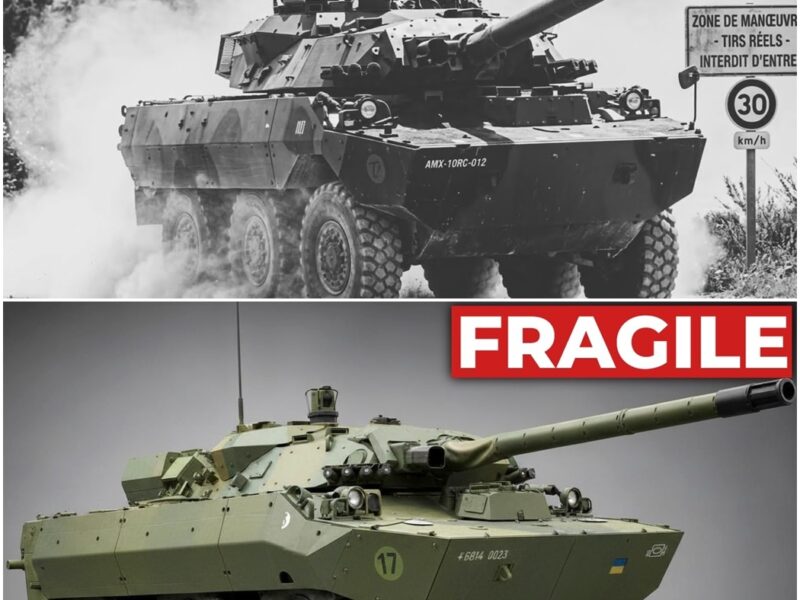
Why This ‘Fragile’ French Armoured Car Carried A Tank Gun Into Five Wars And Is Still Fighting D
1979, the Cavalry School at Saumur, western France. A vehicle rolls through the gates of the Second Hussar Regiment on six black wheels. Low to the ground, its hull a pale gray slab of welded aluminum. Mounted on top is a turret carrying a 105-mm cannon, the same caliber found on main battle tanks three times its weight.
The entire machine weighs just under 16 tons. A Leopard 1 weighs over 40. An American M60 weighs more than 50. This thing is built from aluminum, a metal associated with drink cans and aircraft skin, not with surviving tank fire. Its frontal armor can stop a 23-mm round. Its sides can stop rifle bullets, nothing more.
It looks like a mistake. It looks like someone bolted a tank turret onto a vehicle that has no business carrying one. The gun is too big, the armor is too thin, the wheels are too exposed. French cavalry officers inspect it, and half of them see a death trap. The other half see the fastest, longest-range gun platform in western Europe. Both are right.
Over the next four decades, this vehicle will deploy to the deserts of Chad, the sand seas of Iraq, the mountains of Afghanistan, the scrublands of the Sahel, and the trenches of eastern Ukraine. It will fight in five wars on three continents. It will destroy tanks, scatter infantry, and survive engagements that should have killed every crew inside it.
It will also burn when commanders forget what it is and use it as something it was never designed to be. Its designation is the AMX-10RC. The letters stand for roue canon, wheels and gun. It is the most controversial armored car France has ever built. And 46 years after it first rolled out of the factory, it is still fighting.
To understand why France built a 16-ton aluminum car with a tank gun, you need to understand how France thinks about armored warfare. Since the 1920s, the French army has maintained a cavalry reconnaissance tradition unlike any other in NATO. Where the Americans built heavy tanks and the British fielded a mix of tracked scouts and armored personnel carriers, France committed to a philosophy that sounds reckless on paper.
Build it light, build it fast, give it a big gun, and trust the crew to stay alive through speed, not steel. The Panhard EBR, an eight-wheeled armored car from the 1950s, was the vehicle that defined this doctrine for a generation. It carried a 75 mm gun on a chassis that could reach 105 km/h on road.
It served across French Africa, in Indochina, and in Algeria. By the late 1960s, it was obsolete, and the French army needed a replacement that could do everything the EBR had done, but with a gun powerful enough to threaten modern tanks. Development began in September 1970 at the Atelier de Construction at Issy-les-Moulineaux, the same state arsenal that had built the AMX-13 light tank.
The new vehicle shared automotive components with the AMX-10 P infantry fighting vehicle, but the mission was entirely different. This was not a troop carrier. This was a wheeled tank destroyer built for reconnaissance regiments, designed to find the enemy, hit him hard with a single shot, and disappear before he could fire back.
The first prototype was completed in June 1971. Testing ran for 5 years. The gun selected was the GIAT 105 mm F2, a medium-pressure rifled cannon firing proprietary French ammunition. The armor-piercing round used a fin-stabilized sabot penetrator with a muzzle velocity of roughly 1,400 m/s. It could defeat a NATO heavy tank target at 2,200 m.
The high-explosive anti-tank round left the barrel at around 1,000 m/s. 38 rounds were carried, 12 of them ready in the turret. A coaxial 7.62 mm machine gun provided close defense. The fire control system included a laser rangefinder and could acquire a target in under 6 seconds.
The hull and turret were welded aluminum throughout. This was the decision that would define the vehicle forever. Aluminum saved weight. It made the AMX-10 RC light enough to fit inside a C-130 transport aircraft. It gave the vehicle a top road speed of 85 km/h and a range of 800 km on internal fuel, figures that no tracked reconnaissance vehicle in NATO could match.
It also made the vehicle amphibious in its original configuration, capable of swimming across rivers using twin rear water jets at just over 7 km/h. But aluminum meant the crew was protected against rifle caliber rounds and artillery splinters, nothing heavier. No cannon fire, no anti-tank missiles, no mines.
Every deployment would be a bet that the crew’s speed and the commander’s judgment would keep them alive. The gun could kill a tank, the armor could not survive being seen by one. The crew consisted of four men. The driver sat low in the front left of the hull. The commander, gunner, and loader occupied the turret.
The turret was cramped. The gun was manually loaded, and the loader worked in a space barely wide enough to handle a 13 kg round under combat stress. There was no autoloader, no blowout ammunition compartment, and no separation between the crew and the stored rounds. If the hull was breached and the ammunition ignited, everyone inside would die.
This was not a theoretical risk. It was a design reality that every crew accepted the moment they climbed inside. One feature set the AMX 10 RC apart from every rival. Its Messier hydropneumatic suspension allowed the driver to raise or lower the hull, adjusting ground clearance from as little as 20 cm to as much as 60.
The vehicle could tilt forward, backward, or to either side. In a static firing position, the crew could lower the hull behind a ridge, expose only the turret, fire, and reverse away. It was a sniper’s platform designed for a machine that weighed less than a loaded truck. 337 were ordered for the French Army.
Production vehicles were delivered from 1979 through 1982 with turrets built at Tarbes and final assembly at Roanne. Export orders went to Morocco, which bought 108, and Qatar, which received 12 from French Army stocks. Total production reached roughly 460 vehicles. Now, before we get into where this vehicle actually fought, if you are enjoying this deep dive into modern armored vehicle design, hit subscribe.
It takes a second, costs nothing, and helps this channel grow. The AMX-10RC saw combat for the first time in Chad in 1983 during Operation Manta. France deployed roughly 10 vehicles to hold a defensive line across the desert against a Libyan and rebel advance from the north.
The 105-mm gun made it the most powerful combat vehicle France had ever committed to sub-Saharan Africa. In that theater, it fought no major armored engagements. It did not need to. Its presence alone deterred Libyan tanks from crossing the line. The vehicle proved it could survive weeks of sustained desert operations on minimal logistics, exactly the kind of war France designed it for.
Eight years later, it proved something far more dramatic. In February 1991 during Operation Daguet, France deployed roughly 96 AMX-10RCs with the 6th Light Armored Division to the far western flank of the coalition advance into Iraq. The vehicles had been fitted with bolt-on high hardness steel plates over the glacis, infrared jammers, smoke dischargers, and thermal sights taken from retired AMX-30 tanks.
The division’s mission was to screen the left flank of the American 18th Airborne Corps and neutralize the Iraqi 45th Infantry Division. The result was total. French cavalry regiments, including the 1st Spahis and the 1st Foreign Cavalry Regiment, advanced across the desert at speeds the Iraqis could not match.
The AMX-10RCs operated exactly as their designers intended, screening ahead of the heavier AMX-30 tanks, identifying Iraqi positions with thermal sights, engaging bunkers and entrenched vehicles with 105-mm high explosive, and calling in artillery on anything too heavily armored to kill directly.
The division captured the As Salman airfield, took roughly 3,000 prisoners, and destroyed or captured more than 20 Iraqi tanks and armored vehicles. French vehicle losses from enemy action during that engagement was zero. Not one AMX-10RC was knocked out. Not one was disabled. French casualties from enemy fire across the entire offensive numbered in the low single digits.
The AMX-10RC had fought its first major war and come through without a scratch. Two important facts temper this record. The French sector was deliberately positioned away from Iraqi T-72 tanks, which could have destroyed the AMX-10RC at any range. And the Iraqi forces had been devastated by weeks of air strikes and were surrendering en masse.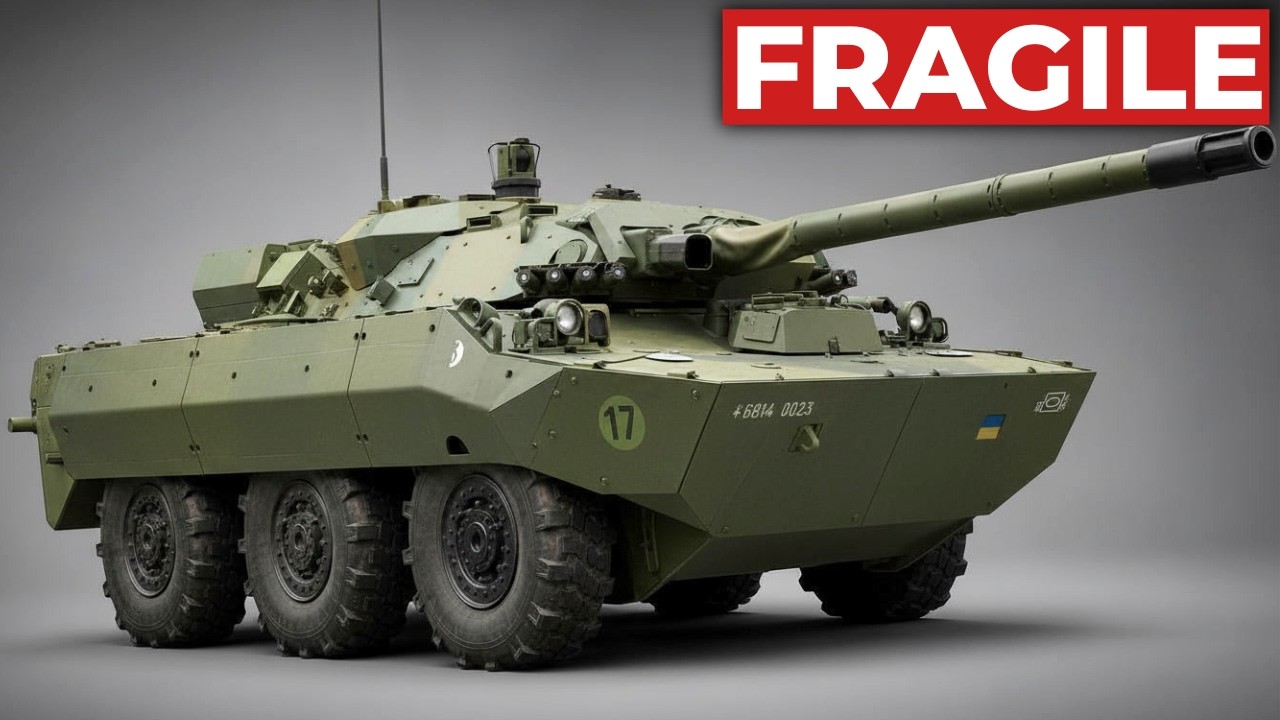
The Gulf War validated the vehicle within its own doctrine. It did not prove it could survive a fight against competent armor. Over the next two decades, the AMX-10RC deployed to Kosovo as part of KFOR, to Ivory Coast under Operation Licorne, and to Afghanistan under the NATO banner. In Afghanistan, vehicle served in the Kapisa and Surobi provinces with French battle groups from roughly 2008 to 2012.
At the Battle of Alasay in March 2009, three AMX-10RCs provided direct fire support to French mountain infantry and Afghan soldiers engaging insurgent positions at 600 m and enabling the infantry to close. At least one vehicle was hit by an IED during the Afghan deployment. The thin aluminum floor offered little protection against buried charges, a warning of what was to come.
Mali became the vehicle’s longest sustained combat deployment. In January 2013, France launched Operation Serval to halt a jihadist advance toward Bamako. Roughly 25 AMX-10RCs deployed, some driven overland more than 1,000 km from forward bases in Ivory Coast and Chad.
The vehicles conducted deep desert raids across the Sahel, exploiting their enormous range and speed to strike insurgent positions before withdrawing. The 105-mm gun proved devastating against infantry and light vehicles at ranges exceeding 2,000 m. But on the 8th of February 2013, a French driver was killed when his vehicle struck a mine near Gao.
The aluminum belly had failed again. Under Operation Barkhane, which replaced Serval in 2014, AMX-10RCs, fitted with the SEPAR mine protection kit, continued deep desert patrols along the Mali-Niger border. The SEPAR kit added armored plates beneath the hull and around the crew compartment, pushing the vehicle’s weight to roughly 22 tons and eliminating its amphibious capability entirely.
It was a trade that no one in the Sahel regretted. The vehicles operated in temperatures exceeding 50° C in sand that clogged filters and abraded every moving surface for nearly a decade of continuous combat operations until France withdrew in 2022. The AMX-10RC had proven everything its designers promised about mobility and firepower.
It had also proven everything its critics feared about protection. Then came Ukraine. On the 4th of January, 2023, President Macron announced that France would donate AMX-10RCs to Ukraine. It was a politically significant decision. The AMX-10RC became the first Western armored vehicle with a tank caliber gun pledged to Kyiv, a move that helped pressure Germany into releasing Leopard 2 tanks weeks later.
France shipped an initial batch of 14 vehicles in February. Ukrainian and open-source trackers converge on a total of 38 delivered to the 37th Separate Marine Brigade. Ukrainian crews trained for roughly a month at the French Cavalry School in Saumur, the same base where the first vehicles had arrived 44 years earlier. Then, they went to war.
The first weeks were catastrophic. In early June, 2023, during the counteroffensive near Velyka Novosilka in southern Donetsk, junior commanders placed the AMX-10RCs at the front of assault columns, driving them across minefields and into pre-registered artillery kill zones. They were being used as tanks.
They were not tanks. The battalion commander, a 34-year-old major known by the call sign Spartanets, described what happened to reporters in July 2023. A shell exploded next to one vehicle. Fragments pierced the aluminum hull and detonated the ammunition stored inside. The crew of four were killed instantly. They never had a chance.
Within days, the open-source tracking group Oryx confirmed four vehicles destroyed, two abandoned, and one captured. The captured vehicle was later displayed in Moscow and, according to reports, sent onward to a museum in Pyongyang. The AMX 10 RC had become a symbol not of Western superiority, but of what happens when a reconnaissance car is sent to do a tank’s job.
Then the 37th Marines adapted. By September 2023, Ukrainian crews had pulled the vehicles away from the front line and reinvented their role entirely. Using the vehicle’s precise day and night optics, its laser rangefinder, and tablet-based ballistic software, crews began firing from prepared positions at ranges exceeding a mile.
They would stop, fire one or two rounds, and relocate before counter-battery fire arrived. The high elevation of the 105-mm gun allowed crews to arc shells at targets up to 7 km away, effectively turning the vehicle into improvised self-propelled artillery. The vehicle’s thermal sights, originally designed for Cold War reconnaissance, proved exceptionally effective for identifying infantry and vehicle targets at long range.
Crews began coordinating with drone operators, who would spot targets, relay coordinates, and then film the impact for damage assessment. The AMX 10 RC had entered a kind of warfare its 1970s designers never imagined, serving as the ground element in a drone-artillery kill chain that belonged to the 21st century. Along the Dnipro River near Kherson from late 2023, AMX 10 RCs operated as night predators, striking Russian positions on the left bank using those same thermal sights.
They would move into firing positions after dark, engage targets across the river, and withdraw before dawn. By late 2024, vehicles were fitted with electronic warfare jammers to counter the FPV drone threat that had come to dominate every sector of the front. The jammers were not part of the original French design. Ukrainian technicians bolted them on in field workshops, adapting a Cold War vehicle to a battlefield where a $500 drone could kill a 16-ton armored car.
A well-drilled crew could fire roughly one round every 6 seconds and displace before counter-battery fire arrived. The 105-mm ammunition was also a logistical advantage. It was lighter, cheaper, and less contested than the 155-mm shells that every artillery battery on the front was burning through faster than factories could produce them.
Ukraine’s former defense minister, Oleksii Reznikov, after test-driving one of the vehicles in April 2023, described it as the sniper rifle on fast wheels. That phrase captured exactly what the vehicle became once its crew stopped treating it as an assault platform and started treating it as a mobile gun.
Of the 38 vehicles delivered, the large majority remain in service. The Oryx confirmed loss count stands at seven. For a vehicle that was written off by military commentators in June 2023, that is a remarkable survival rate, earned not through armor, but through doctrine. The AMX-10RC was never the only wheeled vehicle in the world carrying a big gun.
The Italian Centauro, an eight-wheeled platform weighing 25 tons, carries a stabilized 105-mm gun with heavier armor on every surface. The South African Rooikat, also eight-wheeled, weighs 28 tons and can reach 120 km per hour. The American Stryker MGS mounted a 105-mm gun on a Stryker chassis, but was widely judged cramped, unreliable, and was retired from service.
The Chinese ZTL-11, roughly 23 tons with a fully stabilized 105-mm gun, is the most modern iteration of the concept, entering service around 2011. Every one of these rivals is heavier. Everyone carries thicker armor. The Centauro’s gun is stabilized, meaning it can fire accurately on the move. The AMX-10RC’s gun is not.
The ZTL-11 has a computerized fire control system, a generation newer than anything fitted to the French vehicle. The Rooikat can outrun it by 35 km/h on open road. Against all of them, the AMX-10RC is the lightest and the least protected. It is also the only one that has fought in five wars across four decades, on three continents, and is still in combat today.
France is now replacing it with the EBRC Jaguar under the Scorpion modernization program. The Jaguar abandons the 105-mm cannon entirely. In its place sits a 40-mm case telescoped auto cannon firing at 200 rounds per minute, backed by two Akheron MP anti-tank missiles. At 25 tons, the Jaguar is nearly 10 tons heavier than the original AMX-10RC.
Its hull is taller, built around a crew survivability cell designed to withstand mines, and protected to STANAG level four against 14.5-mm armor-piercing rounds and 155-mm shell fragments. France plans roughly 300 Jaguars by 2035. The first operational unit, the first foreign cavalry regiment, converted from the AMX-10RCR to the Jaguar in 2022, closing a chapter that had begun at the same regiment four decades earlier.
The AMX-10RC is being retired from French service through the mid to late 2020s, with donations to Ukraine accelerating the drawdown. 19 79, Saumur, France. A vehicle with six wheels and a tank gun rolls through the gates of a cavalry regiment, and half the officers who see it think it will get its crews killed.
They were not entirely wrong. The aluminum armor cannot stop a cannon round. The gun is not stabilized for firing on the move. The floor offers minimal protection against mines. In Ukraine, fragments from a single nearby shell pierced the hull and killed four men in their seats. And yet, it worked. It worked in the Chadian desert where it deterred Libyan armor without firing a shot.
It worked in Iraq where it helped destroy an entire Iraqi division and came home without a single vehicle lost. It worked in Afghanistan where it provided direct fire support to infantry fighting in mountain valleys. It worked in Mali where it conducted thousand kilometer raids across the Sahel on its own fuel and it worked in Ukraine where crews who learned to respect its limits turned it into the most precise mobile gun on the southern front.
46 were built. They served with four nations across five conflicts. The vehicle that critics called fragile outlasted the Striker MGS, outlasted the ERC-90 and is still firing rounds in a war that has destroyed thousands of heavier better protected machines. The AMX-10RC was never a tank.
It was never meant to be. It was a gun on wheels built for crews smart enough to shoot first and leave before the enemy could answer. 46 years later, that is still exactly what it does.