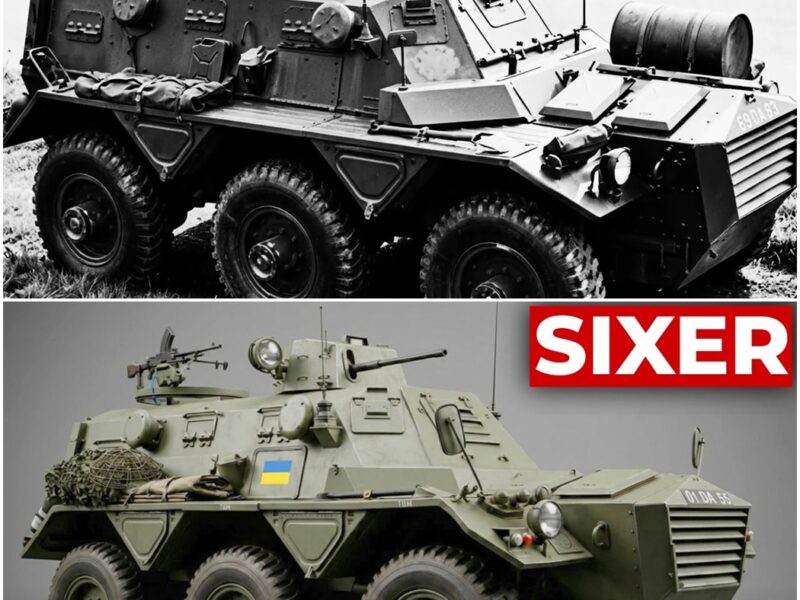
Why This ‘Obsolete’ British Armored Truck Fought Insurgents on Three Continents for 30 Years D
1952, the Alvis factory, Holyhead Road, Coventry. A machine rolls off the production line that looks like nothing any soldier has asked for. It is enormous, nearly 8 ft wide, over 8 ft tall, riding on six rubber tires that belong on a commercial lorry, not a battlefield. Its hull is a slab-sided steel box with the aerodynamic profile of a garden shed.
There is no main gun, no turret worth the name, just a single machine gun perched on the roof like an afterthought, and a pair of steel doors at the back that open onto a compartment barely large enough for 10 men sitting knee to knee. It looked obsolete the day it was built. Senior officers called it underpowered, armor specialists called it underprotected.
Tank crews refused to take it seriously. On paper, it was a stopgap, a vehicle rushed into production before its own design had been properly finished to fight a jungle war that most of the British public had already forgotten. That stopgap would go on to crush a communist insurgency in the jungles of Malaya, patrol the burning streets of Aden, deter an Iraqi invasion of Kuwait, fight its way through the Borneo jungle, and become the most recognizable armored vehicle on the deadliest streets of Northern Ireland for more than a decade. It would be exported to over 15 nations across three continents. It would serve in wars its designers never imagined, on terrain it was never built for, against weapons that should have destroyed it, and it would refuse to leave service for more than 30 years. Its designation was the FV603 Saracen, and it was the armored truck that held Britain’s crumbling empire together. To understand why the Saracen existed, you need to understand the problem Britain faced in 1947. The war was over, the empire was not.
From Malaya to Kenya, from Palestine to Aden, British forces were scattered across a dozen territories that were rapidly becoming ungovernable. The army needed vehicles that could move troops safely through hostile territory, protect them from ambush, and operate for months without the logistical tail of a full armored division.
The existing fleet was a disaster. Wartime half-tracks were worn out, armored cars were designed for reconnaissance, not troop transport, and there was nothing in the British inventory that could carry a full infantry section under armor to a contact point, drop them off, and get out. Nothing. The Fighting Vehicles Research and Development Establishment at Chertsey began work on a new family of six-wheeled armored vehicles in 1947.
The project was designated FV600, and the family would share a common hull, drivetrain, and suspension to simplify production and logistics. The lead designer at Alvis Limited was Willy Dunn, a Coventry engineer whose team would ultimately produce four vehicles from the single chassis. The star of the family was supposed to be the FV 601 Saladin, a six-wheeled armored car armed with a 76 mm gun.
The Saracen, the troop carrier, was the supporting act. It was supposed to come second. Then, Malaya happened. In June 1948, communist guerrillas launched a full-scale insurgency across the Malayan Peninsula. British troops were being ambushed on jungle roads, killed in rubber plantations, and pinned down in villages with no armored transport to move them safely.
The army needed an armored personnel carrier immediately, not in 5 years, not after the Saladin was finished. Now. The Saracen was yanked ahead of the Saladin in the production queue. Alvis was ordered to get it into service as fast as physically possible. The Saladin program was handed to Crossley Motors in Manchester and pushed back by years.
Two Saracen prototypes were shipped directly to Malaya for field trials in 1951 before the vehicle had even been fully tested. Production vehicles began rolling off the Coventry line in December 1952. Development was so compressed that prototypes and production vehicles were being built side by side on the same factory floor.
The design itself was driven by one strange specific requirement. The Saracen had to be no wider than 8 ft because it needed to fit between the rows of rubber trees on Malayan plantations. That single constraint shaped the entire vehicle. Willy Dunn placed the engine at the front, a Rolls-Royce B80 Mark 6A, an eight-cylinder petrol unit producing 160 brake horsepower.
It was smooth, reliable, and desperately thirsty. Behind the engine sat the driver and commander, and behind them the troop compartment, accessed through twin doors at the rear. The layout was reversed from the Saladin, which mounted its engine at the back to make room for a central gun turret.
Both vehicles shared the same six-wheel drive system with independent suspension on all wheels. The same pre-selector gearbox and hundreds of common parts, but they were opposite machines built from the same skeleton. The Saracen weighed roughly 11 tons fully loaded. Its armor was all welded steel, 8 to 16 mm thick, enough to stop rifle rounds and shell splinters, but nothing heavier.
A single Browning machine gun sat in a small turret on the roof, the same turret used on the Ferret Scout Car, and a Bren gun could be mounted on a ring at the rear. It carried a crew of two, the driver and commander, plus eight to 10 infantry, depending on how tightly they were packed. On a good road, it could reach 45 mph.
Off-road, it was adequate but never exceptional, lacking the low ground pressure of a tracked vehicle and offering no central tire inflation system. It had no nuclear, biological, or chemical protection, no night vision, no amphibious capability beyond a deep fording kit that was rarely fitted. It was, in every measurable way, a steel box on wheels designed to get soldiers from one place to another without being killed on the way. It was not glamorous.
It was not advanced. And it was exactly what the British Army needed. The base Saracen was only the beginning. The same hull was adapted into a family of specialist variants that multiplied its usefulness across the army. The FV604 was an armored command vehicle fitted with additional radios and map tables.
The FV610 was a taller, wider, turretless command post designed for Royal Artillery Battery Headquarters, with enough internal space for officers to stand upright and work over charts while under fire. The FV611 was an armored ambulance capable of carrying stretcher casualties under the same protection that shielded infantry.
And the Salamander, built on the same automotive components, was an airfield crash rescue tender for the Royal Air Force with 125 produced between them. These variants meant that a single Alvis chassis could equip an entire brigade support echelon, and every mechanic in the formation already knew how to fix it.
Now, before the combat record of the Saracen is laid out in full, if this deep dive into Cold War British engineering is the kind of content you value, hit subscribe. It takes a second, costs nothing, and helps this channel continue producing these films. The Saracen arrived in Malaya at the worst possible moment and performed exactly as required.
From 1952 onward, Saracens carried infantry sections through ambush-prone roads and deep into rubber plantations where communist guerrillas of the Malayan Races Liberation Army had been operating with near impunity. The vehicle’s deliberately narrow hull fit between plantation rows that would have stopped anything wider.
Its armored sides absorbed the rifle fire and shotgun blasts that had been killing soldiers in open trucks. When Saracens hit mines, the six-wheel configuration meant the vehicle could lose two wheels and keep moving, dragging its crew to safety on the remaining four. Armored car regiments operating in Malaya used Saracens as the troop carrying element of combined patrols, four Saracens supporting a troop of Ferret Scout Cars or Saladin armored cars.
The routine was punishing. Crews lived inside the vehicles for days at a time, moving through humidity that rotted canvas and rusted steel within weeks. On laterite roads that turned to red soup in the monsoon season, engines overheated constantly. The front-mounted Rolls-Royce, cooled by a system designed for the English climate, struggled in tropical air that rarely dropped below 30° C.
Alvis responded with the Mark III variant, which introduced a reverse-flow cooling system specifically engineered for hot climates, buying the engine just enough margin to keep running. They were workhorses, not war winners, but their contribution to the Briggs Plan, the strategy of isolating guerrillas from the civilian population through protected resettlement and aggressive patrolling, was fundamental.
Soldiers who had watched friends die in open trucks on ambush roads stopped dying. The insurgency was declared over in 1960. The Saracen had fought in every year of it. Before the jungle war was fully finished, the Saracen was already being called somewhere else. In July 1961, Iraq’s leader Abd al-Karim Qasim threatened to annex newly independent Kuwait.
Britain launched Operation Vantage, deploying a reinforced brigade group to Kuwait within days. Saracens joined the deterrent force that assembled on the Mutla Ridge in summer temperatures exceeding 50° C. The Rolls-Royce petrol engine, already known for running hot, suffered in the extreme conditions, but the force held. Iraq backed down.
The Saracen had helped prevent a war simply by being there. Then came Borneo. During the confrontation with Indonesia from 1962 to 1966, Saracens served alongside Saladins and Ferrets in Sarawak and Sabah, carrying troops through jungle tracks and coastal roads where Indonesian raiders crossed the border. Units including the 5th Royal Tank Regiment and the Queen’s Royal Irish Hussars operated mixed armored troops using the Saracen’s carrying capacity to move infantry quickly between contact points in terrain that swallowed lighter vehicles whole. It was not a glamorous deployment. It rarely made the newspapers, but the Saracen was there doing the same job it had done in Malaya, moving soldiers safely through hostile ground. Then came Aden. The Aden emergency from 1963 to 1967 was one of the ugliest episodes in Britain’s retreat from empire. Nationalist insurgents of the National Liberation Front and the Front for the Liberation of Occupied South Yemen waged a guerrilla campaign in the streets of
Aden, the alleyways of Sheikh Othman, and the tight urban blocks of the Crater District. Saracens of armored squadrons including the Queen’s Dragoon Guards patrolled alongside Saladin’s and Ferrets, absorbing grenade attacks and small arms fire in a conflict that grew more bitter by the month.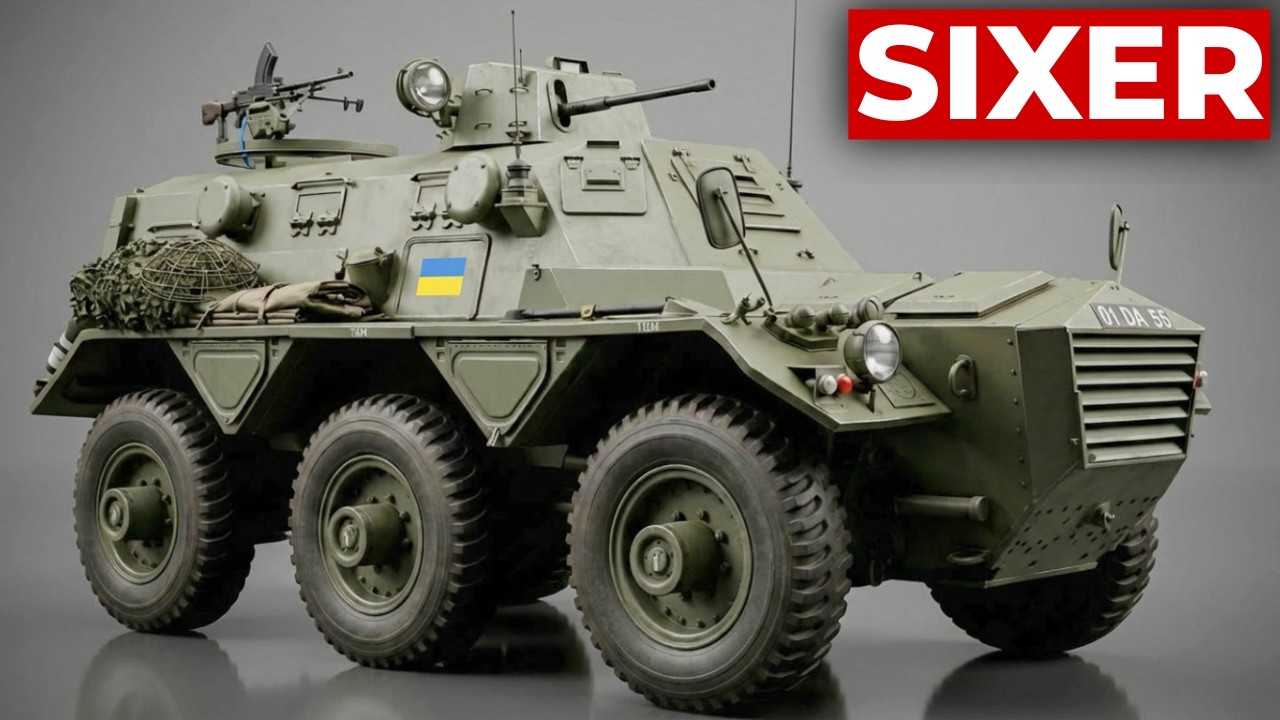
The defining moment came in June 1967. Aden armed police mutinied on the 20th, killing 17 British soldiers including eight from a transport unit caught in an ambush by their own supposed allies. The Crater District fell out of British control entirely. For 2 weeks, no British soldier entered Crater.
Then, on the 3rd of July, Lieutenant Colonel Colin Mitchell led the 1st Battalion Argyle and Sutherland Highlanders back in. The operation was code-named Stirling Castle. Mitchell’s men advanced into Crater behind Saracen armored vehicles. The steel hulls of the carriers providing the only cover on streets where snipers controlled every rooftop.
15 regimental pipers played Scotland the Brave in the regimental charge, Money Musk, as the column moved forward. The reoccupation was nearly bloodless. One local was killed. Mitchell established his headquarters in the Chartered Bank building, renamed it Stirling Castle, and held Crater until the final British withdrawal in November 1967.
The press called him Mad Mitch. The Saracen had carried his men into the last battle of the British Empire. But the deployment that made the Saracen truly iconic was Northern Ireland. From 1969 onward, with the launch of Operation Banner, Saracens became the defining image of the Troubles. They were everywhere.
On the Falls Road and the Shankill in the Bogside and the Markets, outside police stations and at vehicle checkpoints. Soldiers called them sixes. For the civilians of Belfast and Londonderry, the sight of a Saracen grinding down their street meant that something bad was about to happen or already had. Some of the vehicles deployed had originally been built as Mark III export models intended for Libya before being diverted to Northern Ireland, a detail that said everything about how quickly the British Army had been caught short by a crisis on its own doorstep. The daily routine was grinding. Saracens carried four-man patrols to their drop-off points, waited in side streets as mobile cover, while soldiers moved on foot, and then extracted them at the end of the shift. They ferried arrest teams during early morning raids. They blocked junctions during riots, their steel hulls absorbing paving stones, bottles, and petrol bombs. At night, their engines idled at permanent vehicle checkpoints on the arterial roads between Catholic and Protestant
neighborhoods. The crews watching for car bombs through armored glass that offered no peripheral vision and no depth perception. During the Falls curfew of July 1970, a three-day security operation in the Lower Falls area of Belfast, Saracens were at the center of the operation. Charles O’Neill, a 36-year-old Catholic former serviceman, was struck and killed by a Saracen on the Falls Road during the initial rioting.
He was the first of four civilians killed by the army during the operation on the 30th of January 1972, the day that became known as Bloody Sunday. Soldiers of the 1st Battalion Parachute Regiment deployed into the Bogside aboard Saracen and Humber Pig armored vehicles to carry out an arrest operation.
The events that followed, 13 civilians shot dead, a 14th mortally wounded, defined the Troubles for a generation. The Saville Inquiry, published in 2010, concluded that the shootings were unjustified and unjustifiable. The Saracen paid a price in Northern Ireland as well. On the 9th of October 1975, a Saracen was destroyed by a Provisional IRA culvert bomb near Crossmaglen, killing Corporal Edward Gleeson.
According to author Toby Harnden, that single attack prompted the army to abandon routine road movement across South Armagh entirely, switching to helicopter resupply for all permanent bases. The deadliest single Saracen loss came on the 19th of May 1981 during the hunger strike crisis.
Five soldiers, Private John King, Private Michael Bagshaw, Lance Corporal Paul Bulman, Private Andrew Gavin, and their Royal Corps of Transport driver Private Grenville Winston were killed when the IRA’s South Armagh Brigade detonated a 1,000-lb culvert landmine under their Saracen on Chancellor’s Road near Newry.
The blast tore a 25-ft crater in the road and threw the 11-ton vehicle into the air, scattering wreckage over 300-yd radius. Every man inside was killed instantly. Northern Ireland Saracens were progressively upgraded. The Mark V and Mark VI variants receiving additional armor plate, crew harnesses, seat belts, and internal padding.
In at least one documented case, a retrofitted Saracen of the First Royal Tank Regiment survived a culvert bomb near Armagh with its harnessed crew uninjured, but the added weight strained the aging Rolls-Royce engine, and mechanical failures increased. By the mid-1980s, the Saxon armored patrol vehicle and the Humber Pig had taken over most internal security duties.
The Saracens war in Northern Ireland was finally over. Beyond British service, the Saracen acquired a darker legacy abroad. South Africa purchased 280 Saracens between 1953 and 1956. Four of those vehicles were present at the Sharpeville massacre on the 21st of March 1960, when police opened fire on a crowd of unarmed protesters, killing 69 people.
Eyewitness accounts describe police officers standing on Saracen roofs firing into the crowd. The vehicle became an international symbol of apartheid enforcement and a rallying point for the British arms embargo campaign. South African Saracens were not retired from the armored corps until 1991.
Nigerian federal forces used Saracens during the Biafran War from 1967 to 1970. In Lebanon, around 18 Saracens originally delivered to the Lebanese army ended up in the hands of the Shia Amal militia and saw combat during the civil war. Other operators included Jordan, which took 120 vehicles, Indonesia with 55, Australia with 30, Sri Lanka with 67, Kuwait, the United Arab Emirates, Thailand, Sudan, and Brunei.
Several surplus Saracens were purchased by American police departments, including Tulsa and San Francisco, for use by SWAT units. On paper, the Saracen should not have survived as long as it did. The American M113, an aluminum-hulled tracked carrier fielded from 1960, was lighter, fully amphibious, carried a heavier .
50 caliber machine gun, and was produced in quantities exceeding 80,000. It was, by every modern metric, a superior vehicle. The Soviet BTR-152 and later BTR-60 offered comparable or greater firepower on eight-wheeled platforms with higher road speeds, but the Saracen was not competing on metrics. It was competing on practicality.
The M113 required tracked vehicle maintenance, chewed up roads, and terrified civilian populations. The BTR-60 had a notoriously poor troop exit, a single rear hatch that turned every dismount into a bottleneck. The Saracen drove on tires, which meant it could patrol city streets without destroying them. It had wide rear doors that allowed rapid dismount.
It could be maintained by regimental fitters with basic tools, and it could operate continuously for days without the crew exhaustion that tracked vehicles imposed through vibration and noise. In the colonial policing role, in the counterinsurgency fight, on the streets of Belfast, those practical advantages mattered more than any specification on paper.
The Saracen was replaced in the mechanized infantry role by the tracked FV432 from 1963. The FV432 was a proper Cold War fighting vehicle, heavier, better armored, and designed for the plains of northern Germany, where NATO expected to fight the Soviet Union. But it was also tracked, which meant it tore up roads, needed constant maintenance, and was completely unsuitable for patrolling civilian neighborhoods.
For the counterinsurgency and internal security missions that consumed most of Britain’s actual military effort in the 1960s and 70s, the wheeled Saracen remained in use long after the army had officially moved on. The Saxon, a four-wheeled armored patrol vehicle built by GKN Sankey, finally took over the internal security role from the mid-1980s.
It was cheaper to run and offered comparable protection, but veterans who had served in both vehicles noted that the Saxon lacked the Saracen’s imposing physical presence, the sheer bulk that made crowds think twice before closing in. The last Saracens in mainstream British service were withdrawn around 1983.
The very last operational use was by the Saracen troop of 28 Squadron, Queen’s Own Gurkha Transport Regiment in Hong Kong, which was not disbanded until early 1993. 41 years after the first production vehicle left the Coventry factory, a Saracen was still carrying soldiers on operational duties.
In total, 1,838 Saracens were built by Alvis in Coventry between 1952 and 1972. Survivors are common in museums and private collections, including the Tank Museum at Bovington, where examples of both the base carrier and the FV610 command variant are preserved. On the private market, Saracens have sold for as little as £8,000, making them among the most affordable Cold War armored vehicles a collector can own.
They have appeared in films, including 633 Squadron and Judge Dredd, in the television series The Avengers, and in the IRA folk song My Little Armalite, where the Saracen is named as the vehicle the singer vows to fight. 1952, the Alvis factory, Holyhead Road, Coventry. A steel box on six tires rolls off the production line and into a world that has already decided it is not good enough. It was underpowered.
It was underprotected. It had no amphibious capability, no night vision equipment, no nuclear or chemical defense. Its petrol engine drank fuel and caught fire more easily than any diesel. Its armor would not stop anything heavier than a rifle round. By the standards of modern armored vehicle design, it was obsolete before the first one was delivered and yet it worked.
It worked in the rubber plantations of Malaya, where its narrow hull threaded between trees that stopped everything else. It worked on the scorching ridgeline of Mutlah, where its presence alone stopped an invasion. It worked in the burning alleyways of Crater, where it carried Mad Mitch’s Highlanders into the last Imperial battle.
It worked on the Falls Road and in the Bogside, where it absorbed stones and bullets and bombs for more than a decade. It worked in the hands of 15 nations on three continents, in wars that lasted longer than the vehicle was ever designed to fight. The Saracen was never the best armored vehicle in any category.
It was never the fastest, the toughest, or the most heavily armed. It was the one that showed up, took the punishment, and kept moving. It was built not for the war that generals planned, but for the wars that actually happened. The small, ugly, grinding conflicts at the edges of empire, where survival mattered more than firepower and reliability mattered more than reputation. 1,838 were built.
Some are still running. That is not luck. That is Coventry engineering built for the wars nobody wanted to fight.