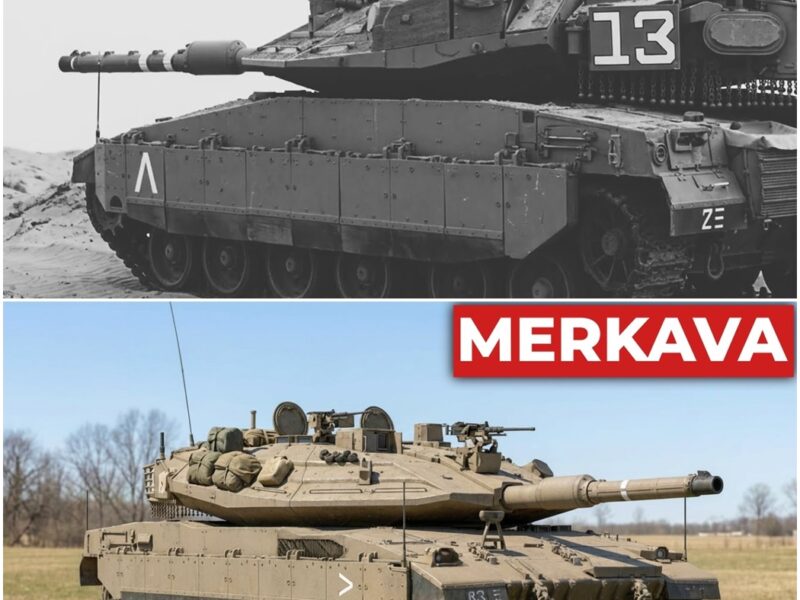
Why This ‘Overbuilt’ Israeli Tank Was Designed To Bring Its Crew Home When Every Other Tank Failed D
1973, the Sinai Peninsula, Egypt. Along a desert ridge barely 20 km east of the Suez Canal, a column of Israeli tanks advances into a morning that has turned wrong in every direction. The men inside are trained. They are experienced. They have fought in this desert before. None of that matters.
The missiles come from nowhere. Wire-guided, Soviet-built, fired by Egyptian soldiers who had crossed the canal 2 days earlier in the largest amphibious assault the Middle East had ever seen. The anti-tank rockets punch through the steel of Israeli tanks that were supposed to be superior. Tanks catch fire. Hatches blow open.
Men try to climb out of machines that are burning around them. By the fifth day of the war, 300 of the 900 Israeli tanks committed to the Sinai front had been destroyed. By the third day alone, the Israel Defense Forces had lost 40% of their entire armored fleet. More than 1,000 tanks were destroyed or put out of action across both fronts before the fighting stopped.
The death toll among tank crews was catastrophic, and every armored commander in Israel reached the same conclusion at the same moment. The tank was failing the man. Not every nation draws the same lesson from the same disaster. The Soviet Union had always accepted that tank crews were expendable.
The Germans had built for firepower and reach. The Americans had built for speed and strategic mobility. Israel, a nation of fewer than 4 million people in 1973, could not afford any of those answers. Every trained tank crewman who died represented years of investment that could not be replaced. Every family that received a knock on the door narrowed the margin between survival and extinction.
One man decided to build something different. His name was Major General Israel Tal. His soldiers called him Talik. He had fought the British as a young man in the Jewish underground, then fought alongside them as a machine gunner in North Africa and Italy in the Second World War. He had commanded armor in 1956, in 1967, and had held the southern front in the worst days of 1973.
He had watched Israeli tank crews die inside machines that were never designed to bring them home, and when the war ended, he was given a mandate that no tank designer in history had received in quite the same form. Build a tank where the man is at the center, and everything else is arranged around him.
Every other nation on Earth put the engine at the rear, the crew in the middle, and the main gun at the front. The engine sat behind the fighting compartment because that was where engines belonged. That was how tanks had worked for 60 years. Tal inverted the entire logic. His tank would place the engine at the front using the mass of the power pack as an additional shield for the crew behind it.
The fighting compartment would sit deep inside the vehicle, protected by armor on every face, and by the engine block itself absorbing the first impact of any frontal hit. The rear of the tank, where most designs place the engine, would instead become an exit, a door, a way out. No tank in active service had ever given its crew a rear escape hatch.
The logic seemed obvious once stated. If the tank is on fire, if the crew needs to get out, if a wounded man needs to be evacuated, the only safe direction is backward, away from the enemy, shielded by the hull. Every other tank in the world forced its crew to climb upward through the turret into the open air, into the line of fire, in full view of whoever had just shot them.
Tal’s tank would let them walk out through the back. The ammunition was placed low in the hull in fire-resistant containers, positioned away from the crew and designed to reduce the risk of a catastrophic detonation tearing the vehicle apart from the inside. The armor was modular, meaning damaged sections could be replaced in the field.
The interior was lined with spall protection to catch the fragments that conventional armor missed. Every single design decision, without exception, pointed in the same direction. The crew would come home. The first prototype was completed in 1974. The definitive production model was ready by 1977.
In 1979, the tank entered service with the Israel Defense Forces under the name Merkava, the Hebrew word for chariot. It was unlike anything any army had ever built. It looked unusual. The front was strange. The silhouette was wrong by every convention that armored vehicle designers had accepted since the First World War. It worked.
In June 1982, Israeli forces crossed into Lebanon and the Merkava went to war for the first time. In the Bekaa Valley, Israeli Merkavas clashed with Syrian armor including Soviet T-72s. The front engine absorbed hits that would have penetrated directly into the crew compartment of a conventionally designed tank.
In the opening engagements, not one crew member was killed inside a Merkava. The vehicle that had looked wrong on paper proved right in the only test that mattered. But 1982 was only the first examination. The real test would come 24 years later. August 1986. That sentence is wrong and the error matters. August 2006, Southern Lebanon.
A column of 24 Merkava Mark IV tanks from the 401st Brigade advances through a steep valley called Wadi Saluki during the final days of the Second Lebanon War. Hezbollah had spent years preparing for this moment. The valley walls were covered with pre-positioned firing points. The ambush was waiting before the first tank rolled in. 11 of 24 tanks were hit.
Missiles, rocket-propelled grenades, anti-tank rounds from weapons that were a generation more advanced than anything Israeli armor had faced in 1973. The Kornet laser-guided missile, capable of defeating reactive armor with a tandem warhead, punched through vehicles that were supposed to be protected against it. Eight tank crewmen were killed.
The battle was a shock and yet not one of those 24 tanks was destroyed outright. 11 were hit. Eight crew members died. That number is not small. But the defenders of that position had fired enough anti-tank missiles to expect far greater carnage. An equivalent ambush on tanks without the Merkava’s crew protection features would, by the assessment of analysts studying the engagement afterward, have killed perhaps 50 men.
The tank had done what it was designed to do. It had not made the crew invincible. It had made the crew harder to kill. The men who survived Wadi Saluki did so in part because the Merkava placed their bodies further from the point of impact than any other tank in service.
The driver sat forward next to the engine. The other three crewmen sat behind him deep inside the vehicle. When missiles struck the front and sides, the geometry of the machine was working in their favor. Israel drew the lesson immediately. The Mark IV had entered service in 2004 with a 1,500 horsepower engine, a 120 mm smoothbore gun, and modular composite armor across every surface.
The vehicle weighed approximately 65 tons. It was the fastest and most capable Merkava yet built, but it was not enough. What it needed was a shield that moved. Rafael Advanced Defense Systems had been developing an active protection system, a technology designed to intercept incoming projectiles before they reached the tank at all.
The system was called Trophy. It used four flat panel radar antennas mounted on the hull to create a 360° detection field around the vehicle. When an incoming missile or rocket-propelled grenade was detected, the system classified the threat, calculated the intercept point, rotated a launcher, and fired a directed blast of metal fragments that destroyed or deflected the incoming round before it reached the armor.
The entire sequence took less than 100 milliseconds. Trophy was integrated into the Merkava Mark IV beginning in 2009. The first brigade was fully equipped by 2011. The system was declared operational following live-fire evaluation against real anti-tank rounds. Then, it waited for war. On March 1st, 2011, a Trophy-equipped Merkava near the Gaza border detected an incoming anti-tank projectile and destroyed it in flight.
No crew member was scratched. No tank was damaged. It was the first time in military history that a hard-kill active protection system had successfully intercepted a real anti-tank weapon fired in actual combat. Not a test. Not a simulation. A real engagement against a real threat with real men inside the vehicle.
It worked again in 2012, and again, and again, when Israeli ground forces entered Gaza in Operation Protective Edge in the summer of 2014. Trophy-equipped Merkava Mark IVs performed more than a dozen confirmed interceptions of anti-tank missiles, including the Cornet rounds that had killed men in 2006.
The system destroyed rocket-propelled grenades fired from point-blank range in urban streets. It intercepted missiles coming from rooftops and alleyways. In several cases, the threat was eliminated so quickly that the crew inside never knew they had been targeted until they reviewed the system logs afterward.
No Israeli tank was lost in the 2014 campaign. The IDF reported that Trophy-equipped tanks intercepted every anti-tank missile fired against them. It was not magic. It was engineering applied with a specific intention: bring the crew home. If you’re watching this far and finding value in this deep dive into armored warfare and military engineering, subscribe now.
It takes 1 second and it costs nothing, and it helps this channel continue producing detailed analysis on the machines and the men behind modern armor. Now, the next evolution. Research into what would become the Barak began in 2015. Formal development started in 2018. The project drew directly from the 401st Brigade’s accumulated combat experience, from the lessons of Wadi Saluki, from the Trophy intercepts in 2014, and from a parallel Israeli program called Carmel that explored what a next-generation fighting vehicle built around artificial intelligence and autonomous systems might look like. The designers faced a specific problem. A tank’s greatest vulnerability is no longer its armor. A tank’s greatest vulnerability is what the crew cannot see. Hezbollah in 2006 had positioned themselves before the Israelis arrived. They knew where the tanks were going before the tanks got there. In Gaza, fighters had used commercial drones to observe Israeli movements and identify approaches.
In the years between 2014 and 2023, every adversary Israel faced had developed sophisticated methods of watching armored vehicles move through terrain, identifying their blind spots, and directing fire at the angles the crew could not observe. The Barak’s answer was to give the crew eyes in every direction simultaneously.
The Elbit Iron Vision System is derived from helmet-mounted display technology developed for fighter aircraft. A pilot in a modern jet can look through the fuselage of his aircraft and see what is behind him because cameras feed real-time imagery to his visor in every direction. Iron Vision brings that capability into a tank.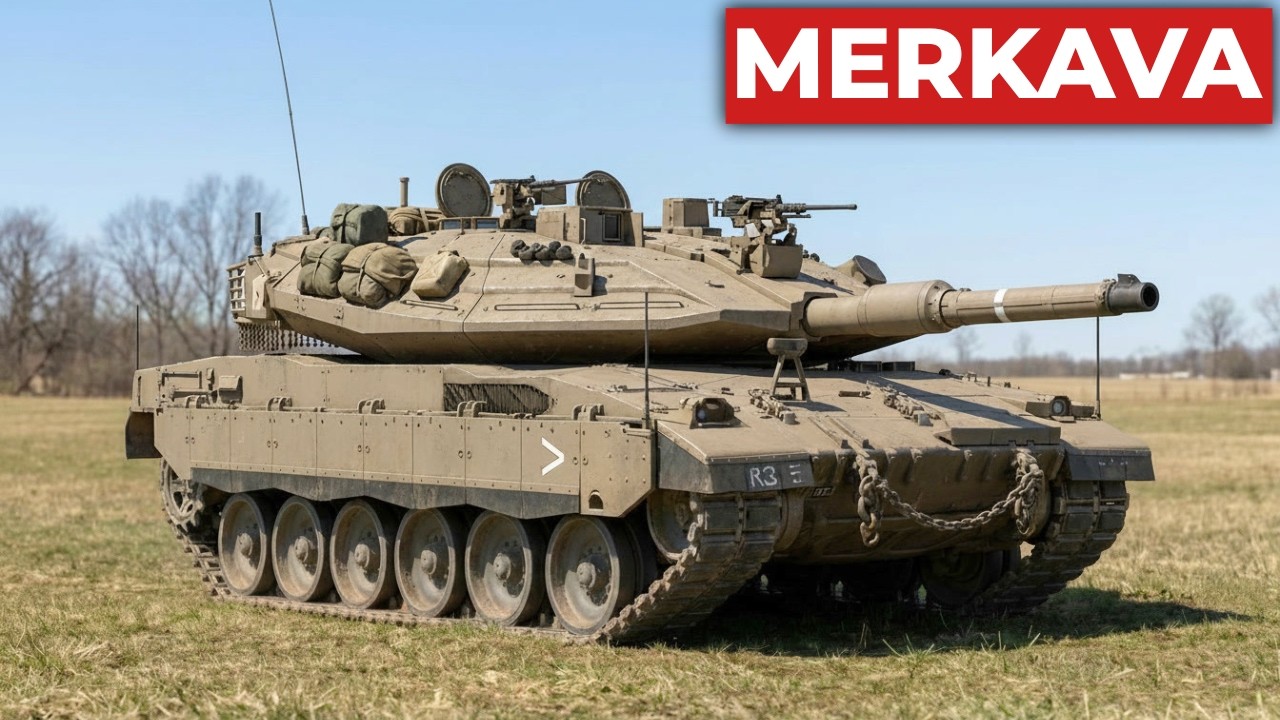
A Barak crewman wearing the helmet can look at the floor of the tank and see the terrain beneath the vehicle. He can look at the rear wall and see what is behind him. He can fight with the hatches sealed, never exposing himself above the turret while maintaining full 360° situational awareness as though the armor around him were transparent.
Paired with Iron Vision is an artificial intelligence targeting system. The Barak’s computers process sensor data from cameras, radar, and thermal systems continuously, identifying and classifying potential threats before the crew would normally detect them, and presenting the most dangerous targets for the commander’s attention in priority order.
The crew does not need to search. The machine tells them where to look. The Barak was officially unveiled on September 19th, 2023. Defense Minister Yoav Gallant called it an extraordinary leap forward. The event was deliberately timed to coincide with the 50th anniversary of the Yom Kippur War. The tank that Israel Tal had started building in the wreckage of that disaster was presenting its fifth generation exactly half a century later.
Three weeks after the unveiling, the war began. October 7th, 2023, southern Israel. Hamas launched the largest attack on Israeli soil since 1973. Along the Gaza fence, armored vehicles were targeted immediately. Anti-tank missiles, rocket-propelled grenades, and quadcopter drones carrying shape charges were deployed against Israeli armor in coordinated attacks.
In the chaos of that morning, several Merkava tanks were hit, damaged, and in some cases temporarily captured near the fence line before Israeli forces could respond. When the Israel Defense Forces entered Gaza in force in late October, the Merkavas went with them, and the fighting that followed was unlike anything armored doctrine had prepared for in the previous generation.
Urban combat in dense residential terrain. Buildings on every side, threats from rooftops, basements, and tunnels, anti-tank missiles fired from ranges of 10 m, improvised explosive devices buried under rubble, quadcopter drones diving into open hatches, magnetic charges placed on hulls by fighters who had approached on foot while the crew was stationary.
Every weapon system that Trophy was designed to defeat was present. So were a dozen categories of threat that Trophy was not designed to defeat. The system performed. In verified engagements, Trophy intercepted missiles fired from inside buildings at ranges that would have been impossible for a human crewman to respond to.
The radar detected threats and destroyed them in milliseconds. Crewmen who reviewed engagement logs after operations found interceptions they had never felt, never heard, never knew had happened until the data showed them. But the campaign also demonstrated the limits of any machine. In November 2024, imagery emerged showing the first destroyed Merkava Barak.
A massive improvised explosive device had detonated beneath the vehicle. The blast came from below, through the underbelly, at an angle that Trophy’s systems could not engage. Three of the four crew members were killed. The commander, the gunner, and the loader. The driver, seated forward beside the engine at the front of the vehicle, survived.
The front engine had done what it was always designed to do. Even in destruction, the geometry of the machine had saved one life that a conventional tank layout might not have saved. The crewman sitting closest to the engine, shielded by its mass from the forward face of the blast, was the one who came home.
Israel Tal died on September 8th, 2010 in Rehovot. He never saw the Barak. He never saw Trophy intercept its first missile in combat. He never saw the active protection system he had campaigned for during the final years of his life become the most important defensive innovation in armored warfare in half a century.
But the philosophy he encoded into the first Merkava prototype in 1974 was still present in every system decision made when the Barak was designed 40 years later. The man in the center, everything else arranged around him. Compare this against any other tank built in the same era.
The American M1A2 Abrams is exceptional. It carries depleted uranium armor that no other nation has fielded in a production tank. Its turbine engine gives it extraordinary acceleration and cross-country performance. But when an Abrams is penetrated, the crew climbs upward through the turret into the open. The first Trophy systems the United States Army installed went on to Abrams tanks using Israeli technology to solve a problem that Abrams was not originally designed around.
The German Leopard 2A7 is one of the finest tanks in the world by every conventional metric. Accurate gun, excellent fire control, wide adoption across NATO. It was not built with an active protection system as standard. Germany adopted Trophy for its own Leopard fleet following a formal contract in late 2024, nearly 15 years after Israel had fielded it in combat.
The Russian T-14 Armata features an unmanned turret and a crew capsule that is theoretically capable of high protection levels. As of 2026, it has not been committed to sustained combat in significant numbers. Its protective qualities remain largely theoretical. The Merkava’s protection record is not theoretical.
It is documented engagement by engagement across four decades of war. How many Merkavas have been built is not a number the Israeli government publishes. Independent analysts place the total across all marks above 2,000 vehicles. The 401st Brigade received the first Barak tanks in the autumn of 2023, delivered to the 52nd Battalion just weeks before the war began.
The IDF has ordered approximately 300 Barak variants. In August 2025, Israel approved a $1.5 billion armored vehicle acceleration program to expand production further. The tank is not exported in its complete form. Israel has maintained this restriction for decades, protecting the technology at the cost of the revenue that export sales would generate.
Subsystems have reached foreign militaries. Trophy is now mounted on American Abrams tanks, German Leopards, and British Challenger 3s. The philosophy that Israel Tal encoded into a prototype 50 years ago now protects the crews of armored vehicles in three of the largest NATO armies. He was never asked for credit. He asked only that the crew come home.
October 7th, 2023, a tank driver named Ido Somach was near Route 232 when a missile struck his Merkava from the rear. The commander and the gunner were killed. He was alone inside a burning vehicle, unable to reach help, uncertain whether fighters were outside waiting to capture him.
He made the decision that he would not be taken. He loaded the main gun himself, moved to the loader’s position, aimed at the cupola, and waited. He killed at least one attacker. He drove the tank out. The driver survived. The man closest to the front engine survived. October 7 also, a gunner whose name has not been fully published, designated in reports as E, returned from rescuing a stranded vehicle and took a missile hit at close range. The round struck the rear.
Had it struck the center of the hull, his assessment was direct, they would have been killed. The blast knocked the loader toward the rear exit hatch, the door at the back of the machine that no other tank had ever provided. All four crew members survived, some with severe burns. In November 2024, the driver of the first destroyed Barak survived because he was seated beside the engine. Three separate incidents.
Three separate wars. Three crew members who survived because the machine put something solid between them and the thing that was trying to kill them. 1973, the Sinai Desert, 300 tanks destroyed in five days, crews burning inside machines that gave them no way out. The Merkava Barak is not the fastest tank in the world. It is not the lightest.
It cannot be air-transported by most aircraft. Its front engine layout trades conventional automotive efficiency for protection geometry that engineers elsewhere in the world still regard as unorthodox. It is not unstoppable. November 2024 proved that. Three men died inside the most advanced version of the tank ever built, but the average number of crewmen killed per tank penetrated fell from two in 1973 to 1.5 in 1982 to 1 in 2006.
Each generation of the machine reduced the cost of being hit. Each generation brought the crew closer to home. Israel Tal built a tank around an idea that most nations never prioritized. The vehicle can be replaced. The man cannot. 50 years of combat that history across four marks of the same machine in wars that tested every assumption the designers made have produced a single consistent finding. The idea was right.
The crew came home. That is not a coincidence. That is what happens when you build the machine around the man from the very first bolt.