Why This ‘Primitive’ British Tractor Truck Fed Every Soldier From North Africa to Normandy D
January 1942, the Ford Motor Company plant, Dagenham, Essex. On the muddy southern bank of the Tempame’s Eststerie, a truck rolls off the assembly line. It is not elegant. It is not powerful. It is cab forward, flat-faced, built on the same factory floor that 12 months earlier was still stamping out Fords and tractors for English farms.
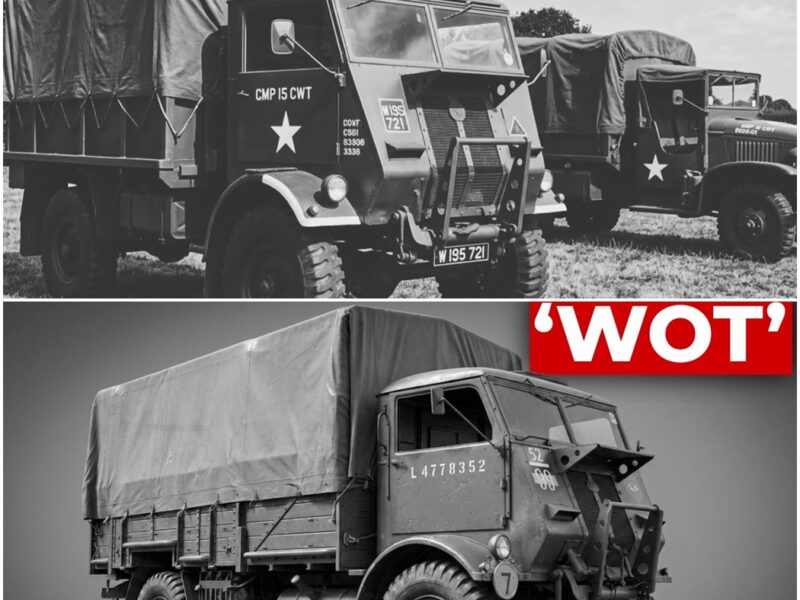
Its engine is an 85 horsepower side valve V8, the same motor found in pre-war civilian saloon cars. Its bodywork is plain timber bolted to a steel frame. Its cab is cramped, drafty, and fitted with a hatch in the roof. Not for ventilation, but for mounting a machine gun. It looked agricultural. It looked like something that belonged in a field, not on a battlefield.
And yet, over the next 3 and 1/2 years, vehicles exactly like this one would haul ammunition, fuel, food, and every category of military supply across North Africa, through the mountains of Italy, across the beaches of Normandy, and into the shattered cities of Germany. Nearly 30,000 would be built.
They would form the backbone of the Royal Army Service Corps supply chain in every major British theater of the war and remain in military service for two decades after the last shot was fired. Its designation was the Fordson W6 and it was the truck that kept the British army moving when nothing else could be built fast enough.
To understand why the W6 existed, you need to understand the crisis Britain faced in 1939. The British army did not have enough trucks. It was that simple and that dangerous. Years of peaceime austerity had left the military with an aging fleet of transport vehicles spread across dozens of incompatible civilian types.
Different engines, different parts, different maintenance requirements. When the War Office began calculating what a modern mechanized army actually needed to move itself, feed itself, and fight, the numbers were staggering. There was no time to design a purpose-built military truck from scratch. The solution was faster and crudder.
Take what British industry already builds, militarize it, put it into production immediately. Bedford offered militarized versions of its commercial lorries. So did Austin, Morris and Commer, and so did Ford of Britain, operating under the Fordson brand at Dagenham. Now Fordson was a name most people associated with tractors.
The brand had originated with Henry Ford and Sons Tractor Company, and by the late 1930s, Ford tractors represented roughly 95% of all tractor production in the United Kingdom. But Fordon also built commercial trucks and vans. The Dagenham plant was not just a tractor factory. It was a full-scale vehicle manufacturing complex purpose-built on the temp’s eststerie with its own deep water port for bulk deliveries of steel and coal.
When the war office came looking for trucks, Fordson did not start from nothing. The company took its existing civilian truck designs and re-engineered them for military service. The result was the WOT family. Wot stood for war office truck. Five variants were built. The WOT1, a 6×4 chassis used mainly by the RAF for crash tenders and fuel tankers.
The WOT2, a light 1500 weightight 4×2, the most numerous of the family with roughly 60,000 produced. The WOT3, a 3000 weightight RAF workhorse, the WOT8, a 3000 weightight 4×4 gun tractor that saw action in North Africa. and the WOT6, the 3-tonon 4×4 general service cargo truck.
The largest and most capable of the family and the subject of this film. The vehicle itself was a masterpiece of practical simplicity. The engine was Ford’s flathead side valve V8, 3,621 cm, producing 85 brake horsepower at 3,800 revolutions per minute. It was not powerful. It was not efficient, but it was already in mass production.
It tolerated lowgrade fuel without complaint. and every Ford mechanic in the British Army already knew how to strip it, rebuild it, and keep it running with minimal tools. The gearbox was a four-speed manual mated to a two-speed transfer case that gave the driver high and low range, plus the option to disengage the front axle entirely and run in rear wheel drive to save fuel and reduce wear on paved roads.
The cab was a forward control layout, meaning the driver sat directly above the engine. This pushed the cargo bed further back, maximizing load space on a wheelbase of 43 1/2 in. Unladen, the truck weighed roughly 8,700 lb. It could carry 3 tons of cargo, its fuel tank held 35 imperial gallons, giving a range of approximately 280 mi.
Though fuel consumption was heavy, somewhere around 8 m per gallon. Top speed was roughly 40 to 45 mph, more than enough for a supply truck. The suspension was simple semi-elliptic leaf springs front and rear. The brakes were mechanical. The electrics were 12vt. Nothing about the WOT6 was sophisticated.
Everything about it could be built fast, repaired fast, and understood by any soldier with basic mechanical training. And that was the point. Now, before we get into where this truck actually served, if you are enjoying this deep dive into wartime British logistics, hit subscribe. It takes a second, costs nothing, and it helps the channel cover subjects that most military history channels never touch.
By June of 1940, the Dagenham plant was producing approximately 130 military vehicles per day. Not all were WOT6s. The factory built every variant in the WOT family alongside civilian contract work, but the pace was relentless. Between 1939 and 1945, Ford of Britain produced some 355,000 military vehicles. The WOT6 alone accounted for nearly 30,000 of that total.
They went everywhere the British Army went. In North Africa, WOT6s carried ammunition and rations forward to the fighting divisions of the 8th Army across hundreds of miles of open desert. The Royal Army Service Corps organized its supply chain in echelons. Forward supply points fed the fighting brigades. Rear depot fed the forward points and between them convoys of three-tonon trucks ran ceaselessly day and night across flat featureless terrain where a single broken down vehicle meant stranded cargo and a gap in the chain that could cost men their lives. The WOT6 was not a desert specialist. It was a 4×4, not a 6×6, and it lacked the cross-country agility of some American designs, but it could carry three tons on roads and hardpacked tracks. And its simple V8 ran reliably in temperatures that climbed above 50° C in conditions that destroyed more complex engines. Sand fouled air filters, heat warped gaskets, dust ground bearings to nothing. The flathead V8 was crude
enough to tolerate all of it. In the desert, reliability was not a luxury. It was survival. In Italy, the challenges were entirely different. narrow mountain roads, mud so deep it swallowed wheels to the axle, rain that turned supply routes into rivers, bridges that could barely support a loaded truck and sometimes collapsed under one.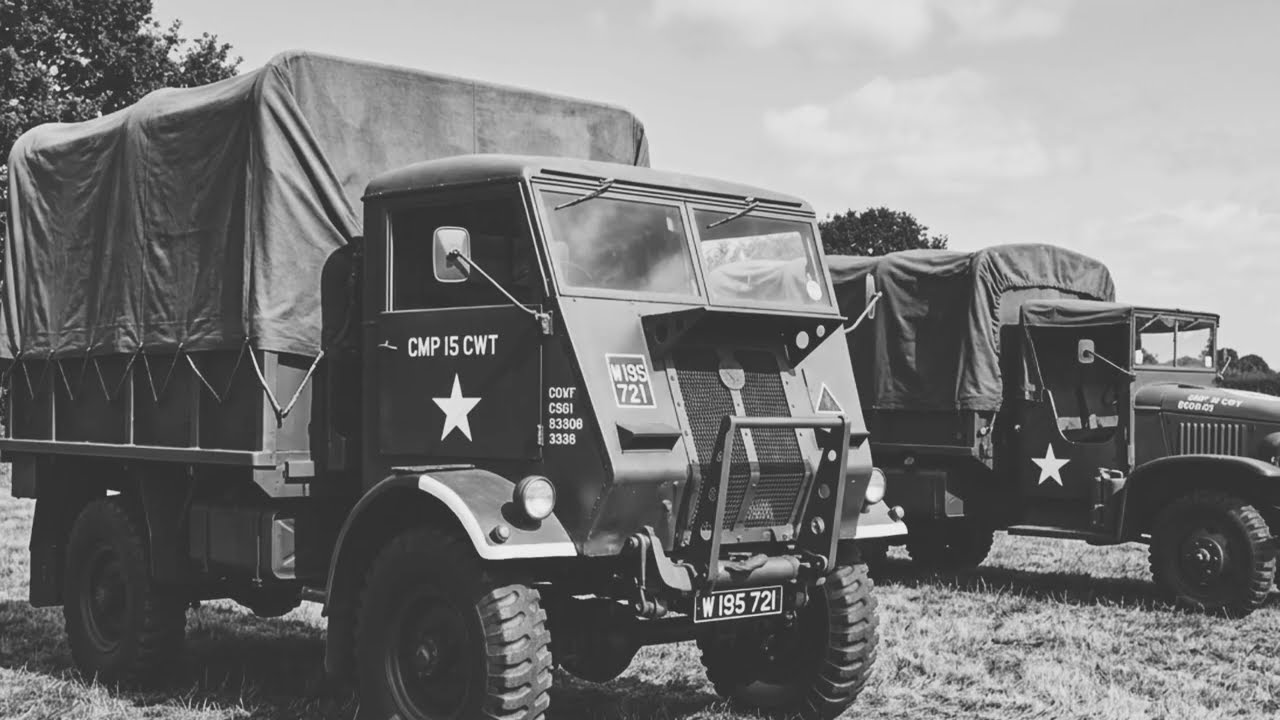
The Italian campaign was a logistician’s nightmare, a war fought uphill in winter through terrain that seemed designed to stop wheeled vehicles entirely. The WOT6 was not light, but its four-wheel drive kept it moving on gradients and surfaces that stranded two-wheel drive trucks. Its wheelbase and turning circle made it manageable on hairpin mountain roads that would have been impossible for larger American 6x6s.
Royal Army Service Corps convoys of WOT6s fed the advance up the Italian peninsula, hauling supplies through terrain that turned logistics into an engineering problem as much as a military one. Every round fired at Monte Casino. Every ration eaten at Anio had to arrive on the back of a truck. The WOT6 was one of the trucks that delivered.
In northwest Europe, from June of 1944 onward, the WOT6 became part of the vast supply machine that sustained the British Second Army from the Normandy beaches to the German border. The RAC operated field maintenance centers and beach group supply chains that funneled everything from rifle ammunition to tinned rations inland from the coast.
Trucks were the connective tissue. Without them, the fighting units starved. The WOT6 was one of the vehicles that ensured they did not. Photographs from the period confirm WOT6s serving with the Seventh Armored Division, the Desert Rats, as far forward as Hamburg in 1945. Others served with the 50th North Umbrean Division’s Royal Artillery Headquarters in Holland in 1944.
They were not frontline assault vehicles. They were the reason frontline assault vehicles had fuel in their tanks and shells in their racks. One variant deserves particular attention. An air portable version of the WOT6 was built with a cab roof that could be unbolted and removed, reducing the vehicle’s height enough to fit inside a general aircraft Hamlcar heavy glider, a 3-tonon cargo truck designed to fly into battle alongside airborne forces.
The image alone captures the desperation and ingenuity of British wartime engineering. And the Wot family had one more contribution that almost no one remembers. The closely related WOT8, the 300 weightight 4×4, was supplied to the Soviet Union under the Atlantic Charter. 868 were dispatched. Only 731 arrived.
The rest lost to Yubot in the Arctic convoys. Those that reached the Eastern Front were converted by the Red Army into launch platforms for Kusha rockets, a British Ford truck built in Essex, firing Soviet rockets at German positions on the Eastern Front. War produces ironies that novelist would dare invent.
After the war, the WOT6 did not disappear. British forces continued operating them into the late 1950s, and some remained in service until the early 1960s. They served in Hong Kong, Malaya, and Korea. The Danish army acquired surplus WOT6s and kept them running until 1974, more than three decades after they had rolled off the line at Dagenham.
On paper, the WOT6 was outclassed. The Bedford QL was Britain’s other main 3-tonon 4×4, and it was a more refined truck. Over 52,000 were built, and the QL is generally regarded by historians as the superior off-road design, purpose-engineered for military cross-country work, where the WOT6 was adapted from a commercial platform.
The Bedford was lighter, better suspended, and more agile on broken ground. Then there were the Americans, the GMCC CKW. The famous Jimmy was a 2 and a half ton 6×6 with three driven axles, a more powerful engine, and vastly superior cross-country mobility. Over 560,000 were built, more than any other American military vehicle except the Jeep.
The Studebaker US6, built in nearly 220,000 units, served the same role and was supplied in enormous quantities to the Soviet Union under lend lease. Against these machines, the WOT6 looked exactly like what its critics called it, agricultural. underpowered, primitive. But the WOT6 had three advantages that no specification sheet could measure.
First, it was domestic. Every WT6 was built in Essex, not shipped across the Atlantic in a convoy vulnerable to Ubot in the darkest years of the war when shipping losses were catastrophic. A truck you could build on your own soil was worth more than a better truck sitting at the bottom of the ocean.
Second, it was simple. One engine powered the entire WOT family. One set of parts, one training program, one repair manual. In a war fought as much in the workshop as on the battlefield, that simplicity saved time, saved parts, and saved lives. Third, it was available. Not the best truck, not the fastest, not the most capable off-road, but it was there in numbers when Britain needed it most.
Most WOT6s were scrapped in the years after the war. Surplus military trucks flooded the civilian market, were driven until they wore out, and then disappeared. Relatively few survive today. Those that do are in private hands, painstakingly restored by enthusiasts who understand that this truck, more than most, has earned its place in history.
The Bedford RL replaced the WOT6 and the QL in the 1950s, and the Fordson name eventually faded from military procurement entirely. The truck that kept the British supply chain alive became one of the most forgotten vehicles of the war. And here is the irony that matters. The same Ford Flathead V8 that powered the WOT6 through the deserts of Libya and the lanes of Normandy became after the war the favorite engine of American hot rodders.
A humble agricultural mass-produced motor that was never designed for glory. It just worked everywhere it was asked to work for as long as it was needed. January 1942 Dagenham Essex. A truck rolls off the line. It is not fast. It is not refined. It has a farm engine, a timber body, and a face only a quartermaster could love.
It was underpowered. It drank fuel. It had no sophistication whatsoever. And yet, it worked in the sand of North Africa, in the mountains of Italy, on the cratered roads of Normandy, in the frozen supply depots of postwar Korea. Nearly 30,000 were built, some served for over 30 years.
Not because they were the best trucks in the war, but because they were the trucks that were there. That is not glamour. That is not engineering brilliance. That is British logistics.