Why This ‘Primitive’ Soviet Scout Car Hunted Nuclear Fallout on NATO’s Border for 30 Years D
1957, the Molotov GAZ plant, Gorky, Soviet Union. A low, boat-shaped hull rolls off the final assembly line on four oversized tires. Its welded steel body still bare and unpainted. Workers in heavy coats guide it down a frozen ramp toward a line of waiting transporters. It weighs barely 5 and 1/2 tons.
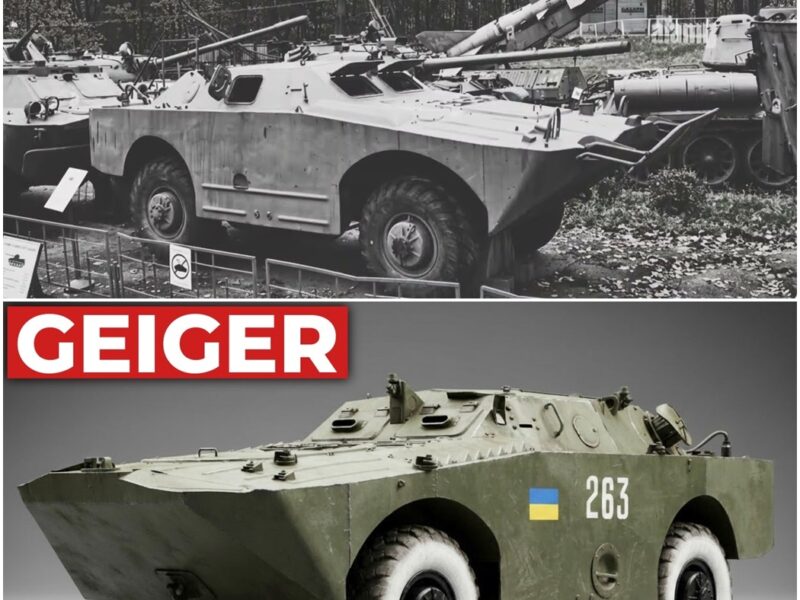
Its armor is 10 mm thick at the front, thinner than a kitchen knife is long, and drops to 7 mm at the sides. It carries no turret. Its earliest versions carry no weapons at all. The crew of three climbs in and out through hatches on the roof because the designers did not bother to fit side doors. From the front, it looks like a boat that someone forgot to leave in the water.
From the side, it looks like a steel coffin set on wheels too large for its body. It looked absurd. It looked like something a competent infantryman could put a rifle round through from 200 m. Western military attachés who first observed it during Soviet parades dismissed it almost immediately. Too thin, too light, too simple.
A vehicle already obsolete the day it entered service. That thin, light, simple vehicle would go on to serve in more than 40 nations across four continents, fight in at least six major wars, carry nuclear battlefield sensors along the most dangerous border in human history, spawn an entire family of anti-tank missile carriers that paralyzed NATO armored doctrine for a generation, and remain in active military service for more than 50 years after the last one left the factory floor.
Approximately 10,000 were built in under a decade. Some sources claim the number exceeded 11,500. Its designation was the BRDM-1, the Bronirovannaya Razvedyvatelnaya Dozornaya Mashina, armored reconnaissance patrol vehicle. It was the first purpose-built amphibious scout car the Soviet Union ever mass-produced, and it changed the way the Red Army watched the world.
To understand why the BRDM-1 existed, you need to understand the problem the Soviet Army faced in the mid-1950s. The Red Army had just deployed a revolutionary new generation of amphibious armor, The PT-76 light tank, introduced in August 1952, could swim across rivers under its own power and was designed to lead fast-moving reconnaissance operations deep behind NATO lines in the event of a European war.
But, the PT-76 had no equivalent partner. The aging BA-64 armored car, a relic of 1942, was too small, too slow, and critically, it could not swim. Soviet doctrine demanded that reconnaissance units move at the speed of the armored advance, cross water obstacles without waiting for engineers, and report back to divisional command in real time.
Every river between the Elbe and the Rhine was a potential choke point. Every canal and marsh was a delay that could cost an offensive its momentum. In late 1954, the Soviet Ministry of Defense ordered the A. Dedkov OKB Design Bureau to solve the problem. The project was placed under designer V.K.
Rubtsov, a man whose name rarely appears in Western histories, but whose work would equip half the armies of the developing world for four decades. Rubtsov’s brief was conservative. Build an amphibious variant of the existing BTR-40 wheeled personnel carrier. But, as the design progressed through 1955, it evolved into something entirely different.
The vehicle shed its troop-carrying role and became a dedicated reconnaissance machine built from the hull up for one operational concept, watching the enemy without being caught. The vehicle was renamed to reflect its new identity, BRDM, armored reconnaissance patrol vehicle. The first prototype was completed in February 1956, a remarkably short development timeline by any standard.
Detailed trials were conducted in the Black Sea region, testing the vehicle’s amphibious performance in open water, coastal surf, and river currents. It passed. The Soviet Army accepted the BRDM into service in 1957, and production began the same year at the Molotov GAZ plant in Gorky. It would continue without interruption until 1966, by which time approximately 10,000 vehicles had rolled off the line.
The hull was welded steel, shaped like a boat at the front with a sharply pointed nose that sloped upward toward the crew compartment at the center of the vehicle. The boat shape was deliberate. It maximized buoyancy in water and deflected waves during river crossings. Maximum armor thickness was 10 mm at the frontal arc. The sides offered 7 mm.
This was never intended to stop cannon rounds, anti-tank rifle fire, or heavy machine gun burst at close range. It was intended to keep out shell fragments, small arms fire, and shrapnel long enough for the crew to observe, report, and withdraw before the enemy could bring heavier weapons to bear.
The philosophy was speed and information, not protection and firepower. The engine was a GAZ-40PB six-cylinder inline gasoline unit producing 90 horsepower at 3,400 revolutions per minute. This power plant was derived from a Second World War era American Dodge truck engine, a lineage that Soviet engineers rarely acknowledged publicly, but that gave the vehicle an unexpected advantage.
The engine was mechanically straightforward, tolerant of low-quality fuel, and repairable with basic hand tools by crews with minimal technical training. It drove through a manual gearbox with four forward gears and one reverse connected through a single dry plate clutch. On paved roads, the BRDM-1 could reach speeds between 80 and 90 km/h, giving it a genuine speed advantage over most armored vehicles of its era and many of the vehicles designed to replace it decades later. Its operational range on a single fuel load of 150 L was 750 km on roads. That is the distance from Moscow to Minsk on one tank of gasoline. For a vehicle weighing under 6 tons, that range was extraordinary. But the BRDM-1’s most distinctive engineering feature was invisible until the crew needed it. Between the two main axles, concealed beneath the hull floor, sat four chain-driven auxiliary wheels, two on each side. These belly wheels could be lowered by the driver from inside the vehicle to create a temporary eight-wheel configuration.
With the belly wheels deployed, the vehicle could crawl across trenches up to 1.2 m wide, cross broken terrain, and soft ground that would immobilize a conventional four-wheel vehicle, and negotiate obstacles that would require heavier machines to detour or wait for engineering support. No other mass-produced combat vehicle in the world carried anything like this system.
It was a uniquely Soviet solution. Crude in concept, but devastatingly effective in practice. The belly wheels reduced top speed to a crawl, roughly 5 to 8 km/h, but they allowed the BRDM-1 to go places its weight class had no business reaching. The vehicle was fully amphibious without any preparation beyond what the crew could accomplish in minutes.
Before entering water, the crew raised a trim vane at the front of the hull to deflect waves, activated bilge pumps, and engaged a rear-mounted water jet powered by a four-bladed internal propeller driven off the main engine. The BRDM-1 could swim at 9 km/h and had a waterborne range of 120 km. It could cross a river in darkness, in sub-zero temperatures, without a bridge, without engineers, and without stopping.
For Soviet planners envisioning a massive armored thrust across the North German Plain, where dozens of rivers and canals stood between the inner German border and the Rhine, this capability was not a luxury. It was the entire point. The first production model, the BRDM-1 Model 1957, had an open-topped crew compartment.
Only a handful were built before the design was revised. The Model 1958 introduced a closed roof with two large hatches, becoming the most common production variant. The Model 1959 added a single 7.62 mm SGMB medium machine gun on a pintle mount at the front of the roof. The Model 1960 expanded armament to three pintle mounts, one at the front and one on each side of the superstructure.
Though mounting machine guns in all three positions simultaneously was rarely practiced in the field, later production runs replaced the 7.62 mm front gun with either a 12.7 mm DShK heavy machine gun or a 14.5 mm KPV heavy machine gun, giving the vehicle genuine capability against light armored targets and low-flying aircraft.
But firepower was never the point. The BRDM-1 was designed to see, to cross, to report, and to survive long enough to do it again the next night. The tire pressure regulation system fitted as standard allowed the driver to adjust pressure in all four tires from inside the vehicle while moving.
Lowering pressure increased the contact patch on soft ground. Raising it restored speed on pavement. This system, which Western armies would not widely adopt for decades, meant a BRDM-1 crew could transition from frozen highway to muddy forest trail to riverbank without stopping. And then the Soviets turned it into something far more dangerous than a scout car.
Now, before we get into where the BRDM-1 actually fought and what it became on the battlefield, if you are enjoying this deep dive into Cold War military engineering, hit subscribe. It costs nothing, takes a second, and helps the channel grow. The BRDM-1’s hull proved so mechanically adaptable that the Soviet military rapidly developed a family of specialized variants, each more lethal or more strategically significant than the last.
The first was the BRDM-rkh, a radiological and chemical reconnaissance vehicle. This variant was fitted with KZO-2 flag dispensers mounted in rectangular packs at the rear of the hull, along with a DP dosimeter for measuring radiation intensity, and a PChR-54 semi-automatic chemical detection device for identifying battlefield chemical agents.
The BRDM-rkh was designed for one specific nightmare scenario, nuclear war on the plains of Central Europe. Crews in these vehicles would drive forward into contaminated zones after a nuclear or chemical strike, systematically mapping the boundaries of the fallout, planting colored marker flags at measured intervals to warn following units of radiation levels, and reporting contamination data back to divisional and army level command so that advancing formations could route around the worst of the poisoned ground.
These vehicles patrolled the inner German border throughout the Cold War, exercising regularly with Warsaw Pact forces, ready to be the first vehicles into the atomic wasteland if the unthinkable ever happened. Poland fielded the BRDM- rkh as part of its dedicated NBC reconnaissance units. East Germany maintained its own fleet.
The irony was as sharp as it was grim. The standard BRDM-1 had no NBC protection system of any kind, no filtration, no overpressure capability, no sealed hatches. The crews who were expected to drive into a nuclear blast zone and measure radiation levels had absolutely no protection from the very contamination they were trained to detect.
The second transformation was far more lethal. The 2P27 variant stripped out the rear crew compartment entirely and replaced it with a rebuilt superstructure housing a 2K16 launcher armed with three 3M6 Shmel anti-tank guided missiles, known to NATO as the AT-1 Snapper. The operational concept was elegant. When the vehicle reached a firing position, the armored launcher rose from inside the compartment, exposing the three missiles.
The operator guided each missile to its target using manual command to line of sight control, steering it via a wire trailing behind the missile back to the vehicle. After firing, the launcher retracted, the missiles disappeared behind the armor, and the vehicle could relocate before the enemy identified the firing position.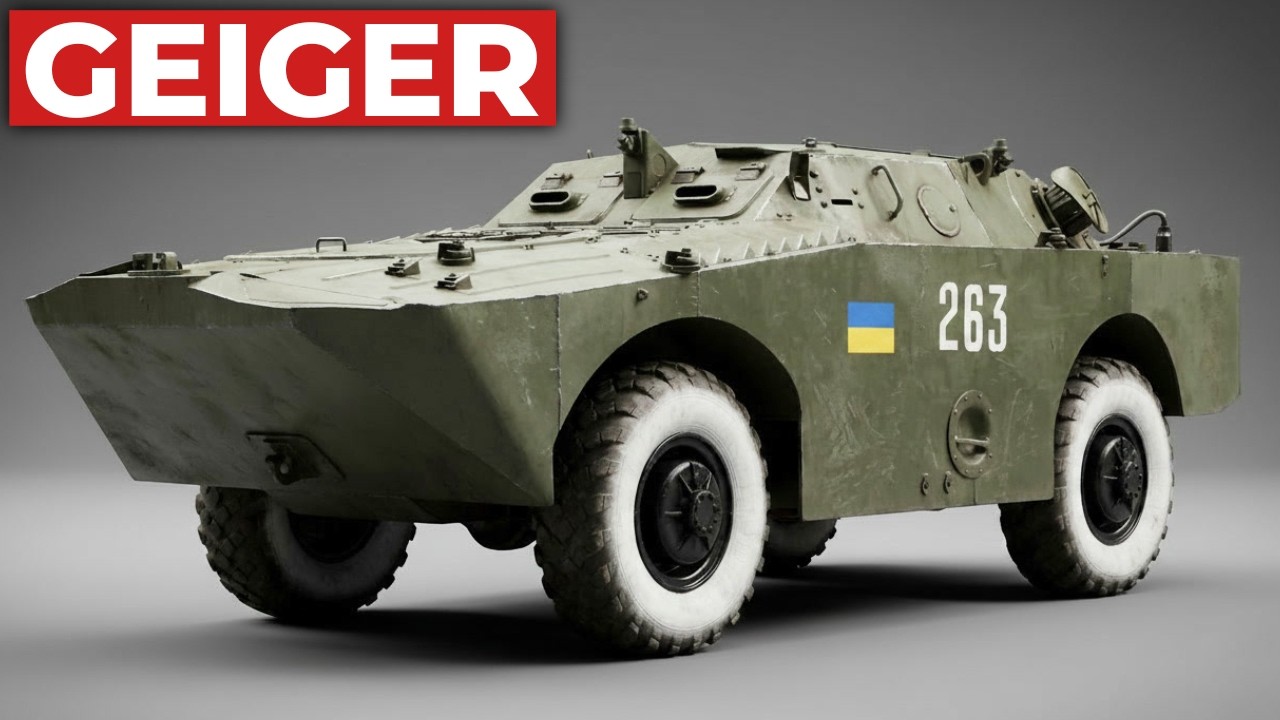
For the first time in history, a vehicle weighing less than 6 tons could reliably destroy a main battle tank at ranges well beyond a tank gun’s effective engagement distance. The concept was refined with the 2P32 variant, which carried four 9M11 Falanga missiles, NATO designation AT-2 Swatter, and then perfected with the 9P110, which mounted six 9M14 Malyutka missiles, the weapon NATO called the AT-3 Sagger.
The Sagger would become one of the most consequential anti-tank weapons of the 20th century, responsible for hundreds of tank kills across multiple wars on three continents, and the BRDM-1 was its first wheeled launch platform. The BRDM-1U was a command variant, distinguished externally by four whip antennas compared to the single antenna on the standard vehicle.
It carried additional R-112 radio sets and was used by reconnaissance company and battalion commanders to coordinate the movements of scout car platoons operating across wide frontages. East Germany produced its own modified variant of the Sagger carrier, designated the 9P111, which added additional headlight protection and rear-mounted fuel canister brackets to extend range during extended border patrols.
The BRDM-1 saw its first combat in June 1967 during the Six-Day War. Egypt and Syria had received substantial deliveries of Soviet equipment throughout the 1960s, and both nations deployed the BRDM-1 in its designed role, pushing reconnaissance patrols ahead of their main armored formations in the Sinai Peninsula and along the volcanic ridgelines of the Golan Heights.
Egyptian reconnaissance units operating BRDM-1s screened the forward edge of the Egyptian defensive positions in the Sinai attempting to provide early warning of Israeli armored thrusts. The war lasted six days. It did not go well for the Arab armies. The Israeli Air Force destroyed the Egyptian Air Force on the ground within hours of the war’s opening, and Israeli armored columns under commanders including Major General Israel Tal drove through Egyptian positions in the Sinai with devastating speed. Israeli forces destroyed or captured significant quantities of Soviet-supplied equipment during the advance, including multiple BRDM-1s. Some captured vehicles were evaluated by Israeli military intelligence officers at testing facilities and subsequently pressed into limited service by the Israel Defense Forces themselves six years later, the BRDM-1 returned to the same battlefields under far more dramatic circumstances. On October 6th, 1973, the holy day of Yom Kippur, Egyptian and Syrian forces launched a coordinated surprise attack against
Israel on two fronts simultaneously. Egyptian forces crossed the Suez Canal in force and advanced into the Sinai Peninsula. Syrian armor, supported by approximately 1,100 T-54 and T-55 tanks, swept onto the Golan Heights. BRDM-1 scout cars operated ahead of both the Egyptian and Syrian main armored thrusts, performing the reconnaissance screening role they had been designed for 15 years earlier, identifying Israeli defensive positions, probing for gaps in the line, and reporting back to divisional headquarters. But, it was the anti-tank variants that made the deepest impact. Egyptian forces deployed the 9P110 Sagger carrier and infantry teams equipped with man-portable Sagger systems in coordinated anti-armor ambushes along the Suez Canal. In the opening days of the war, Sagger missiles devastated Israeli tank formations attempting to counterattack the Egyptian bridgehead. Israeli Centurion and Patton tanks, advancing without adequate infantry support, were struck at ranges the tank crews could not effectively return fire
against. The missile that caused this carnage had first been mounted on a BRDM-1 chassis a decade earlier. On the Golan Heights, the fighting was even more desperate. Syrian reconnaissance elements, including BRDM-1s, probed ahead of the main armored that struck the Israeli defensive line held by the severely outnumbered Barak Armored Brigade under Colonel Yitzhak Ben-Shoham.
Ben-Shoham was killed during the fighting. The Israelis held the Golan by the narrowest of margins, and only after reserve formations under Brigadier General Rafael Eitan arrived to stabilize the line. Across Africa, the BRDM-1 fought an entirely different kind of war. Angola received approximately 120 vehicles during the 1970s supplied by the Soviet Union as part of its military aid to the MPLA government during the Angolan Civil War.
These vehicles operated alongside Cuban expeditionary forces who eventually numbered over 40,000 personnel, South African mechanized battle groups equipped with Eland 90 armored cars and Ratel infantry fighting vehicles, and Cold War proxy fighters from half a dozen nations. The vehicles proved durable in the harsh Angolan bush where maintenance was primitive and spare parts arrived irregularly by Soviet freighter.
Angolan BRDM-1s remained in service well into the 2000s, more than four decades after the production lines in Gorky had gone cold. Mozambique received over 50 vehicles in the late 1970s and still had approximately 30 in service decades later. Ethiopia acquired 50 in 1977 during the Ogaden War against Somalia.
Cuba took delivery of 50 in 1966. Indonesia received 10 in 1963 from the triple canopy jungles of Southeast Asia to the sand seas of the western desert to the volcanic highlands of East Africa, the BRDM-1 fought in conflicts its designers in Gorky never imagined. Iraq operated a combined fleet of approximately 1,300 BRDM-1s and BRDM-2s, though exact numbers remain disputed between sources.
Iraqi vehicles saw action during the grinding eight-year Iran-Iraq War through the 1980s and again during the Gulf War of 1991. By the time the second conflict ended, most had been destroyed by coalition air power, captured, or scrapped. The Warsaw Pact deployments were equally vast and strategically far more significant.
Poland was the most prolific European operator, receiving more than 800 vehicles starting in the early 1960s, including the standard reconnaissance model, the 2P27 and 9P110 anti-tank missile carriers, and the BRDM-RKH chemical reconnaissance variant. Polish reconnaissance units, organized within the Ludowe Wojsko Polskie, used the BRDM-1 as their primary scout car for over a decade until it was gradually replaced by the BRDM-2 in the 1970s.
East Germany designated its standard vehicles the SPW 40P for unarmed models and SPW 40PA for armed variants, fitting them with larger infrared headlights suited to the long nights of northern European winter patrolling. Czechoslovakia, Bulgaria, Romania, and Albania all operated the vehicle in front-line reconnaissance roles.
Hungary took the concept further than any other Warsaw Pact nation. Unable to obtain sufficient BRDM-1s from Soviet production, which was stretched thin supplying dozens of client states simultaneously, Hungary used the Soviet vehicle as the basis for an entirely domestically designed scout car, the D-442 FUG, known by its Czechoslovak designation OT-65.
The Hungarian Army had been left without a wheeled scout 1945 after the Soviets promised deliveries of BR-64s that never arrived, and the gap had become operationally intolerable. The FUG used a hull designed by the Danube Shipyard to maximize buoyancy during river crossings, producing a more angular shape than the BRDM-1’s boat-like form.
It fitted two water jets instead of one, used a Hungarian-built Csepel six-cylinder diesel engine instead of the Soviet gasoline unit, and added a feature the Soviet designers had never considered necessary, a round escape hatch in the floor. It was, in effect, the BRDM-1 concept reimagined by engineers who admired the idea but refused to accept the compromises.
On paper, the BRDM-2, introduced into Soviet Army service on May 22nd, 1962, looked superior in almost every measurable respect. It carried a turret-mounted 14.5 mm KPVT heavy machine gun with a coaxial 7.62 mm PKT, providing 360° traverse so the gunner no longer had to expose himself to fire. Its 140 horsepower engine gave it a top speed of 100 km/h.
It had an integrated NBC protection system with filtration and overpressure. It had infrared night vision for the driver and commander. By the mid-1960s, the BRDM-2 had systematically replaced the BRDM-1 in Soviet front-line reconnaissance battalions. Production of the older vehicle ceased entirely in 1966. On paper, the BRDM-1 was finished.
In practice, the BRDM-1 refused to disappear. Third world operators who could not afford the BRDM-2 kept the older vehicle running for decades. Nations that received BRDM-1s as military aid in the 1960s were still operating them in the 1990s. The vehicle’s mechanical simplicity, the very quality Western analysts had dismissed as primitive, became its greatest survival advantage in the harshest environments on Earth.
The gasoline engine derived from an American Dodge truck could be maintained by conscript crews with minimal training and repaired with hand tools. The hull, with no turret ring to maintain, no complex optics to calibrate, and no filtration systems to replace, required almost nothing in specialized support in the forests of Central Africa, in the deserts of the Horn, and in the bush of Southern Angola, where spare parts arrived by mule and technical manuals existed only in Russian, the BRDM-1 simply kept running when more modern vehicles sat idle. The BRDM-1 also left a doctrinal legacy that outlived the vehicle itself by decades. The concept of mounting anti-tank guided missiles on a light fast amphibious wheeled chassis, first proven operationally on the 2P27, 2P32, and 9P110 variants, became a foundational element of Soviet and Warsaw Pact anti-armor doctrine throughout the Cold War. The BRDM-2 inherited this missile-carrying role directly, serving as the chassis for
successive generations of Saga, Spandrel, and later anti-tank missile systems. Every wheeled anti-tank guided missile carrier in the Russian military inventory today traces its conceptual and mechanical lineage directly back to the BRDM-1 variants that first proved the idea could work.
Today, fewer than 600 BRDM-1s are believed to remain in the reserves of a handful of nations, mostly in sub-Saharan Africa. Most are rusting in open storage yards from Luanda to Maputo to Addis Ababa. A few sit in military museums across Eastern Europe. Their belly wheels permanently lowered for visitors who have no idea what they are looking at.
The vehicle that once patrolled the inner German border in the dead of a January night, its crew scanning the darkness with infrared driving lights for signs of NATO movement, ready to drive into a nuclear wasteland and measure the radiation that would kill them, has largely vanished from the world’s active armies.
1957, the Molotov GAZ plant, Gorky, Soviet Union. A low boat-shaped hull rolls off the assembly line on four oversized tires, 10 mm of welded steel, no turret, no doors, no NBC protection. Four hidden belly wheels concealed beneath the floor that nobody outside the design bureau has ever seen before. A crew of three who enter and exit through hatches in the roof like submariners climbing into a vessel that has no business being on land. It had no night vision.
It had no chemical filters. It had no turret traverse. Its crew had to open a hatch and stand exposed in the open air to fire the single machine gun it carried. Western defense analysts examined it and saw a vehicle already obsolete before it had completed its first year of service. And yet it worked.
It worked in the burning sands of the Sinai, where it screened ahead of Egyptian armored columns rolling toward the Suez Canal. It worked on the volcanic rock of the Golan Heights, where Syrian scouts probed Israeli defenses before the largest tank battle since Kursk. It worked in the red laterite mud of Angola, where Cuban and Angolan crews drove it through bush warfare that lasted 27 years.
It worked in the frozen mud along the inner German border, where Warsaw Pact crews sat in darkened vehicles through winter nights watching for the war that never came. It carried nuclear sensors into contaminated zones where no other vehicle was expected to go. It carried Sagger missiles that burned through the frontal armor of tanks costing 50 times its own price.
It swam across rivers that stopped heavier, newer, more expensive vehicles dead on the bank. 10,000 were built. More than 40 nations operated them. Some were still running half a century after the last one left the factory. The BRDM-1 was not fast enough, not armored enough, not armed enough, and not modern enough.
It was Soviet, and it saw everything that mattered for 30 years.