Why This ‘Unknown’ Singapore 8×8 Is One Of The Most Protected Vehicles On Earth D
2009, a factory floor in Singapore, not far from the Jurong Industrial Waterfront. A vehicle rolls out from the production hall of ST Engineering Land Systems, eight huge wheels, a low angular hull, steel plates angled sharply downward in a double V beneath the belly. It looks heavy. It looks serious.
It looks like something a small nation built when it decided it could never afford to lose a single soldier. The men watching it that day did not cheer. They studied it. Officers from the Singapore Armed Forces walked around it, checked the hatches, inspected the armor seams. Singapore is a city state of fewer than six million people.
It has no strategic depth, no mountains to fall back to, no rivers wide enough to slow an enemy for more than a day. When Singapore sends its infantry into a fight, every vehicle, every seat, every bolt of steel around those soldiers has to be the best available. There is no margin for mediocrity.
There is no room for compromise. The vehicle those officers were inspecting that day was the first generation of a family that would spend the next 15 years evolving into something extraordinary. It would swim across open water. It would survive blast loads that would tear other armored vehicles in half.
It would enter a competition against the most powerful military on Earth and come within a single evaluator’s decision of winning. It would be seized by China’s customs apparatus in one of the most audacious geopolitical provocations of the 21st century. And when Singapore’s engineers finally finished their work, the platform they created carried more protection, more firepower, and more electronic intelligence than almost anything else on eight wheels anywhere on the planet.
Its name is the TX, and the story of how a city with no army tradition built one of the world’s most advanced fighting vehicles is a story almost nobody outside the defense world has heard. To understand why the Terra exists, you need to understand what Singapore is. The island republic sits at the southern tip of the Malay Peninsula, roughly 34x 27 mi in total area. It is smaller than many cities.
It has no natural resources. It is surrounded by much larger neighbors. When Singapore gained independence in 1965, its first prime minister, Lie Kuan Yu, understood with absolute clarity that a small nation without military power is simply an invitation. What followed was the construction of a professional defense force built on an Israeli model of universal conscription and technological superiority to compensate for numbers.
The philosophy driving the Singapore armed forces shortened to SAF was simple. Singapore could never match its neighbors soldier for soldier, but it could field soldiers who were better equipped, betterworked, and better protected. Technology was not a luxury. It was a survival strategy. For decades, the SAF relied on older armored vehicles, including the American-designed V200 Commando, an 8-W wheeled APC that had served well, but was rapidly becoming obsolete by the 1990s.
Singapore needed something new, something designed not for the Cold War battlefields of Europe, but for the dense jungles, urban streets, and coastal waters of Southeast Asia. something that could be shipped rapidly, maintained in a tropical climate, and survive modern threats, including mines, rocket propelled grenades, and anti-tankg guided missiles.
The SAF turned to ST Kinetics, the land systems division of Singapore Technologies Engineering, one of the largest defense and technology companies in Asia. ST Engineering had been built up deliberately by Singapore’s government, as a domestic defense industrial capability. It was not a vanity project. It was strategic insurance.
If Singapore depended entirely on foreign suppliers for its military hardware, then foreign governments could cut off that supply at a politically inconvenient moment. Better to build it yourself. Working with the Irish engineering firm Timony Technology, a company with deep expertise in heavy vehicle suspension and chassis design, ST Kinetics began developing a new generation of 8×8 wheeled armored fighting vehicle.
The 8×8 configuration, eight wheels driving on eight wheels, was chosen deliberately. It offered the strategic mobility of a wheeled vehicle over roads and rough terrain. It could be carried by standard military transport aircraft and loaded onto commercial shipping. Unlike a tracked vehicle, it did not chew through its running gear in a matter of hundreds of miles.
It could sustain high road speeds for long distances. And critically for Singapore’s island geography and its training deployments across the region, it could be made to swim. The first prototype designated AV81 and later marketed as the TX was shown publicly at DSEI in London in 2001. The design was immediately striking.
The hull was not the box-shaped silhouette of older armored personnel carriers. It was angled. The front plates were sloped to deflect blast and projectile energy. Beneath the crew and troop compartment, the designers had incorporated what they called a double Vhull configuration. A lower V-shaped belly plate was designed to absorb and deflect the initial energy of a mine or improvised explosive device detonating beneath the vehicle.
Above it, a second V-shaped inner hull protected the crew compartment, creating a double layer of blast management that went far beyond anything comparable on wheeled vehicles of the era. The baseline TX hull could withstand a detonation equivalent to 12 kg of TNT directly beneath the vehicle. That is not survivable in most of the world’s wheeled armored personnel carriers.
By 2009, the SAF had committed to acquiring at least 135 TX infantry carrier vehicles to replace its aging fleet. The second battalion of the Singapore Infantry Regiment was the first unit to convert to motorized infantry operations using the new vehicle. Those early vehicles, which defense analysts now refer to as the TX1, weighed approximately 24 tons at gross vehicle weight and were propelled on road by a diesel engine delivering around 450 horsepower.
Their top speed on road exceeded 80 km per hour. In water, twin water jets drove them at approximately 10 km per hour. Fully amphibious, carrying a crew of 2 + 11 dismounted soldiers. The TX1 was competent. It was well protected for its weight class. It was genuinely amphibious. And it gave ST Engineering a foundation to build something considerably more ambitious.
The second generation vehicle unveiled at DSi in September 2015 pushed every performance parameter further. The TX 2 increased gross vehicle weight to 30 tons. The engine was upgraded to a Caterpillar C9.3A cer delivering 600 horsepower. The hull retained the double Vine protection architecture but with enhanced composite armor appliques.
The amphibious system was redesigned replacing water jets with twin rear propellers capable of driving the heavier vehicle through water at over 6 knots. rated to survive seaate 4 conditions, meaning open ocean swells in the range of one to two and a half meters. 11 surveillance cameras mixing day, low light, and thermal imaging allowed the crew to drive the vehicle and assess threats with all hatches fully closed.
It was the TX 2 that put ST Engineering on the global map. The United States Marine Corps had been searching for a replacement for its decades old amphibious assault vehicle, a tracked swimming machine that had been in service since the 1970s. The new program was called the amphibious combat vehicle.
Two finalists were selected in November 2015 from a competitive field. One was BAE Systems offering a vehicle derived from the Italian Avico SuperAV. The other was Science Applications International Corporation known as SIC partnered with ST Kinetics offering a version of the TX 2. The contract value for the engineering and manufacturing development phase was substantial.
SIC and ST Kinetics received 121 million $543,000 for 16 prototype vehicles. They were competing for a program that would eventually equip the entire Marine Corps amphibious force. For a Singaporean company, it was an extraordinary position to occupy. The competition ran through 2016, 2017, and into 2018.
Both vehicles were tested intensively. Both swam off the California coast. Both were subjected to blast trials, ballistic testing, troop loading evaluations, and sustained reliability assessments. On the 19th of June 2018, the Marine Corps announced its decision. BAE Systems and the SuperAV had won.
SIC and ST Kinetics had lost. The stated reasons were a combination of technical evaluation scores and best value cost analysis. BAE’s vehicle could carry 13 embarked Marines, matching the full strength of a Marine rifle squad as it was then structured. The TX2 carried 11. It was a margin of two seats, and it cost ST Kinetics, the largest military vehicle contract ever competed for by a Singaporean firm.
SIC stated publicly that it was disappointed. ST Engineering had come within reach of the most coveted wheeled vehicle program on Earth and had not quite closed the distance, but the engineers in Singapore had not been standing still while the American competition played out. At Eurosetry in Paris in June 2016, ST Kinetics unveiled a scale model of a third generation vehicle.
It was larger, it was heavier, it was more heavily armed, and it represented a fundamental philosophical decision about the direction of the TX program. If you’re enjoying this deep dive into one of the most underrated armored vehicle programs in modern defense history, hit subscribe. It costs nothing, takes a single second, and it helps this channel continue producing this kind of in-depth coverage.
The TX 3, to give it its full name, pushed gross vehicle weight to 35 tons. Payload capacity reached 12,000 kg. The engine was upgraded to a Caterpillar C13, delivering 711 horsepower and 2,700 new m of torque. driving through a Caterpillar CX 31 transmission providing six forward and one reverse gear.
Road speed exceeded 88 km per hour. Road range exceeded 520 km. The suspension was an 8-wheel independent system using double wishbones with hydrors, allowing ride height adjustment for wading and improved crossount performance. The tires featured run flat inserts and a central tire inflation system, allowing the crew to adjust pressure from inside the vehicle to optimize traction on sand, mud, or rock.
The turning circle, enabled by all-wheel steering, was 14.3 m wallto-wall, tight for a vehicle of this size. Simon Wilkins, Timy’s business development director, was direct at the 2016 launch about the single most important design decision embedded in those weight figures. The TX 3, he confirmed, was not amphibious.
At 35 tons, the vehicle simply could not be made to float in any operationally useful configuration. The water jets and propellers of the earlier variants were gone. The vehicle offered inland forwarding capability to a depth of 1.8 m, but it could not cross open water under its own power.
This was a trade, and to understand the trade, you need to understand what Singapore was buying in return. The 35tonon weight class opened space for a protection architecture that the lighter swimming variants could never carry. The TX 3 retained the double V hull blast protection system from its predecessors, still capable of defeating large mine and IED detonations beneath the vehicle.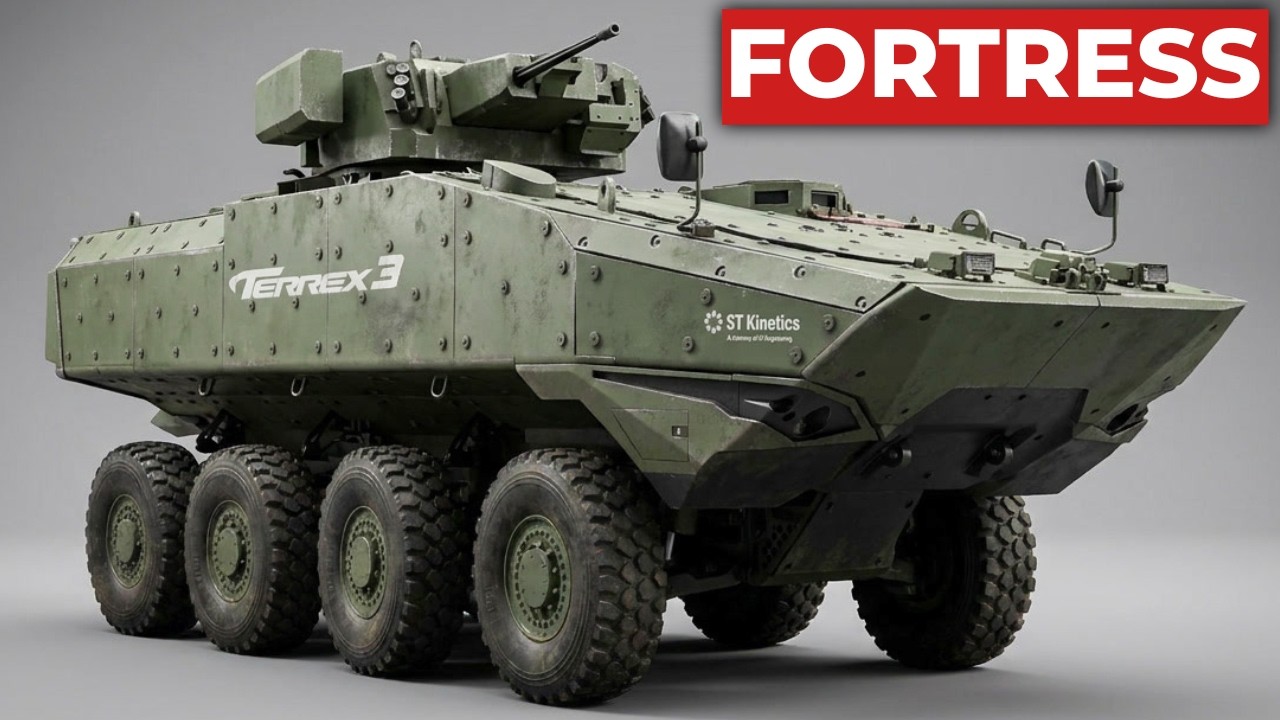
But the additional weight allowance permitted the integration of a layered protection system that went far beyond passive armor alone. At Eurosetry 2016, the TX 3 was shown fitted with the Iron Fist light configuration active protection system developed by imi systems of Israel. Subsequently absorbed into the Elbit systems group.
The Iron Fist light configuration is a hard kill active protection system. It works by mounting radar arrays around the vehicle’s hull to detect incoming threats, ranging from rocket propelled grenades to anti-tankg guided missiles in the instant after they are fired. When the radar detects a threat within lethal range, the system fires a small interceptor grenade from one of its launchers.
The interceptor detonates adjacent to the incoming projectile, disrupting or destroying it before it reaches the vehicle’s armor. The system operates faster than human reaction time. It does not require the crew to see the threat to identify it or to respond to it. The vehicle defends itself.
This combination, passive double V hull, composite applique armor panels, and a radar triggered hard kill active protection system. placed the TX 3 in a category of protection that most wheeled vehicles in the world cannot enter. The heaviest wheeled infantry fighting vehicles of comparable size, such as the German Dutch boxer, may surpass the TX 3 and ballistic protection at the frontal arc, but very few wheeled platforms anywhere integrate all three protection layers simultaneously within a deployable road mobile package. The fire support architecture matched the protection investment for the Australian competition which designated the TX 3 variant as Sentinel 2. ST Kinetics fitted the vehicle with the Elbit MT30 turret. The MT30 which stands for manned turret 30 is a twoperson stabilized fighting compartment designed to function equally in manned or unmanned configuration. Its main armament was the Northre Grumman Mark 44 Bushmaster 230 mm dual feed autoc cannon capable of
switching between ammunition natures in a single trigger pull. The gun was designed with an upgrade path to the 40mm caliber futurep proofing the platform against evolving armor threats. A 7.62 mm coaxial machine gun sat beside the main cannon. A twin launcher for the Raphael Spike LR anti-tank guided missile with a range of approximately 4 km was integrated to provide the crew with a standoff tank killing capability.
Eight smoke grenade launchers arranged in two banks of four allowed the crew to instantly generate a concealing screen around the vehicle. The gunner and commander each operated independently stabilized panoramic day and nightight thermal sites enabling what military planners call hunter killer capability in which the commander acquires and designates a new target while the gunner simultaneously engages the previous one.
The electronics architecture woven through the vehicle was equally advanced. Battle management systems allowed the TX 3 to share positional data, threat assessments, and fire control information with other vehicles and headquarters elements in real time. The surveillance camera suite gave the crew a full allround picture of the battle space from inside closed hatches.
Laser warning receivers detected when the vehicle was being illuminated by a targeting system, alerting the crew before a missile was fired. This is a combat vehicle designed not merely to carry soldiers to a fight, but to participate in it autonomously, to protect itself without human intervention, and to share intelligence across aworked force in real time.
for a wheeled platform that represents a generational advance over what existed in the early 2000s. The Australian competition known as Land 400 Phase 2 was the TX 3’s single export attempt. Australia was seeking a new combat reconnaissance vehicle to replace its aging ASLV8x8 fleet with a requirement for up to 225 vehicles.
The Sentinel 2, as the TX 3 was designated in the Australian configuration, was one of several contenders that included the Rhin Metal Boxer combat reconnaissance vehicle and the BAE Systems Patriot AMV35 at the 2016 down select Sentinel 2 was eliminated. Australian defense analysts and trade publications were specific about the primary reason.
The Australian requirement included a Stanag 4569 ballistic protection standard at level six, meaning the vehicle had to withstand large caliber heavy machine gun fire at close range across the full frontal arc. Assessment of the Sentinel 2 indicated it reached level four, defeating 14.5 mm armor-piercing rounds at 200 m, but could not achieve the level six standard without major redesign that would have required removing the manned turret.
The Australian Army shortlisted the Boxer CRV and the AMV35 and in August 2018 finalized a contract with Ryan Metal Defense Australia. Valued at 4.28 billion Australian dollars for 211 boxer combat reconnaissance vehicles. The TX 3 had not been fast enough or protected enough for Australia’s specific requirements.
It had however demonstrated something remarkable. a defense company from a city state of 6 million people had built a vehicle sophisticated enough to compete seriously against the established giants of European armored vehicle design. The broader TK story had also by this point acquired a dimension that had nothing to do with vehicle specifications.
On the 23rd of November 2016, a container ship operated by American President Lines, the APL Qatar arrived at the Quai Chung container terminal in Hong Kong. In its hold were nine Singapore Armed Forces TX infantry carrier vehicles together with associated equipment being shipped home to Singapore after training exercises in Taiwan under a long-standing bilateral arrangement called Exercise Starlight.
The arrangement had been in place since 1975. Singaporean soldiers trained in Taiwan regularly. The vehicles were transported commercially on the return journey. Hong Kong customs officials boarded the vessel and detained the vehicles. China’s government lodged a formal diplomatic protest.
the one China principle was invoked. Beijing’s position was that Singapore’s military training cooperation with Taiwan was politically unacceptable and that the transit of military equipment through Hong Kong from Taiwan constituted a violation of that principle. The vehicles were moved from the dock to an indoor facility on the 6th of December.
Singapore’s response was measured but firm. Defense Minister Ninggh stated that the vehicles were being transported legally and were entitled to sovereign immunity as military equipment. Foreign Minister Vivien Balakrishnan engaged his Chinese counterpart. Prime Minister Lee Xien Lung wrote directly to Hong Kong’s chief executive Lung Chunying.
Singapore did not alter its position on Taiwan, did not cancel exercise Starlight, and did not acknowledge that any principle had been violated. The vehicles remained in Hong Kong for more than 2 months. On the 24th of January 2017, Hong Kong authorities announced that the vehicles would be released.
They arrived back in Singapore on the 30th of January. The legal aftermath extended further. In 2019, the shipping company APPPL was fined 90,000 Hong Kong dollars by Hong Kong courts and the ship captain Panchuan was fined $9,000 Hong Kong dollars with a 3-month suspended sentence for breaching Hong Kong’s import and export ordinance.
The episode was read by defense analysts across the region as a direct pressure campaign. China had demonstrated that commercial shipping routes through Hong Kong could be used as leverage against Singapore’s security relationships. Singapore had demonstrated that it would not modify its defense posture in response to that pressure.
The detained vehicles were the TX one, not the TX 3. But the incident placed the entire TX program and Singapore’s defense strategy at the center of one of the sharpest geopolitical confrontations in Southeast Asia in a generation. Through all of this, ST Engineering continued developing the TX family. The limitations exposed in the Australian competition were not ignored.
The Stann level four ceiling, the loss of the Marine Corps contract on capacity grounds, the weight versus amphibiousness trade-off, all of these fed into the engineering work that followed. In March 2025, Singapore’s Defense Minister Ang announced that the SAF would acquire a new generation of infantry fighting vehicle.
It was to be designated the Titan. The vehicle was based on the Traxx S5 platform, the latest evolution of the TX Hull, incorporating a hybrid electric drive system that reduced acoustic and thermal signatures, a turret mounting a 30 mm cannon with anti- drone ammunition capability, and a full active protection system integration.
The contract was finalized in December 2025 with deliveries scheduled to begin from 2028. The Titan represented the synthesis of everything the TX program had learned since 2001. It was amphibious, retaining the swim capability that the TX 3 had traded away. It met higher ballistic protection standards than its predecessor.
Its hybrid drive system gave it capabilities in both thermal stealth and fuel economy that no previous variant had possessed. Singapore’s soldiers would ride into battle in a vehicle that the island’s own engineers had designed. refined across five generations and tailored precisely to the threats and geography of the Southeast Asian region.
Now return to the factory floor in 2009. The vehicle rolls out. The officers study it. They say nothing. Singapore has no margin for sentiment. What they were looking at was not impressive in the way that a main battle tank is impressive. It did not project mass or menace at first glance.
It was a wheeled box, angled and gray, with a relatively modest armament for its size. Officers who had spent careers studying European armored fighting vehicles might have found it competent but unremarkable. They would have been wrong. The TX program across its generations produced a family of vehicles that competed against Germany’s boxer and lost on protection level alone came within two passenger seats of winning the world’s most valuable amphibious vehicle contract.
survived a Chinese geopolitical seizure and returned to service without Singapore conceding a single policy point and culminated in a next generation fighting vehicle carrying active protection systems, hybrid electric propulsion, and anti- drone armorament ordered into full production for the 21st century SAF. The TX 3 itself never entered production.
No export customer ordered it. Australia chose Germany’s boxer. The Marine Corps chose Italy’s Super AV. By the metrics of commercial success, the TX 3 was a vehicle that lost every competition it entered. But that is not the measure that matters in Singapore. The measure that matters is whether Singapore’s soldiers have at this moment access to fighting vehicles that can protect them, carry them, network them into a combined arms battle, and bring them home.
On that measure, the TX program delivered. The Titan that ST Engineering is now building for the SAF is not an import. It is not a licensed copy of a European design. It is the product of 25 years of engineering development by a nation that decided in the 1960s that it could not afford to rely on anyone else.
Singapore is smaller than many cities. It has no strategic depth. Its army trains in other countries because there is not enough space at home. Its vehicles are shipped commercially because it has no military transport fleet large enough to move them independently. Its defense company lost the biggest armored vehicle contract in modern history by a margin of two seats.
And yet, the vehicle that rolls out of ST Engineering’s factory in 2028 will carry an active protection system that can defeat anti-tank missiles without crew input, a cannon capable of engaging drones and armored vehicles alike, a hybrid drive that reduces its signature below the thermal threshold of most targeting systems, and the same double V blast protection architecture that has kept Singapore’s soldiers alive through every exercise, every deployment, and every political provocation since 2009.
That is not fortune. That is what a small nation builds when it understands that there is no one else coming to help.