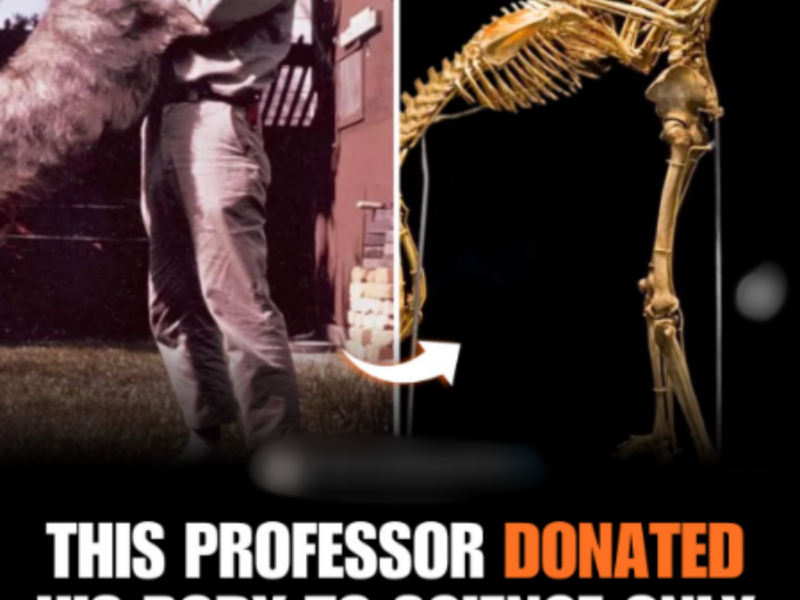
He Donated His Body to Science—But His One Final Wish Was to Rest Beside His Beloved Dog Forever
A Professor Donated His Body to Science—But Made One Heartwarming Final Request About His Dog
The Professor, the Monster, and the Dog Who Followed Him Into Eternity
There is a glass case in Washington, D.C., that can stop a person cold.
At first, it does not look like a place where a mystery should end. It is not hidden deep in a forest. It is not buried beneath old field notes, muddy footprint casts, or the half-whispered testimony of frightened hikers who swore they saw something enormous moving between the trees. It is not in the Pacific Northwest, where fog hangs low over cedar forests and where the American imagination has long placed one of its strangest legends.
It is inside the Smithsonian’s National Museum of Natural History.
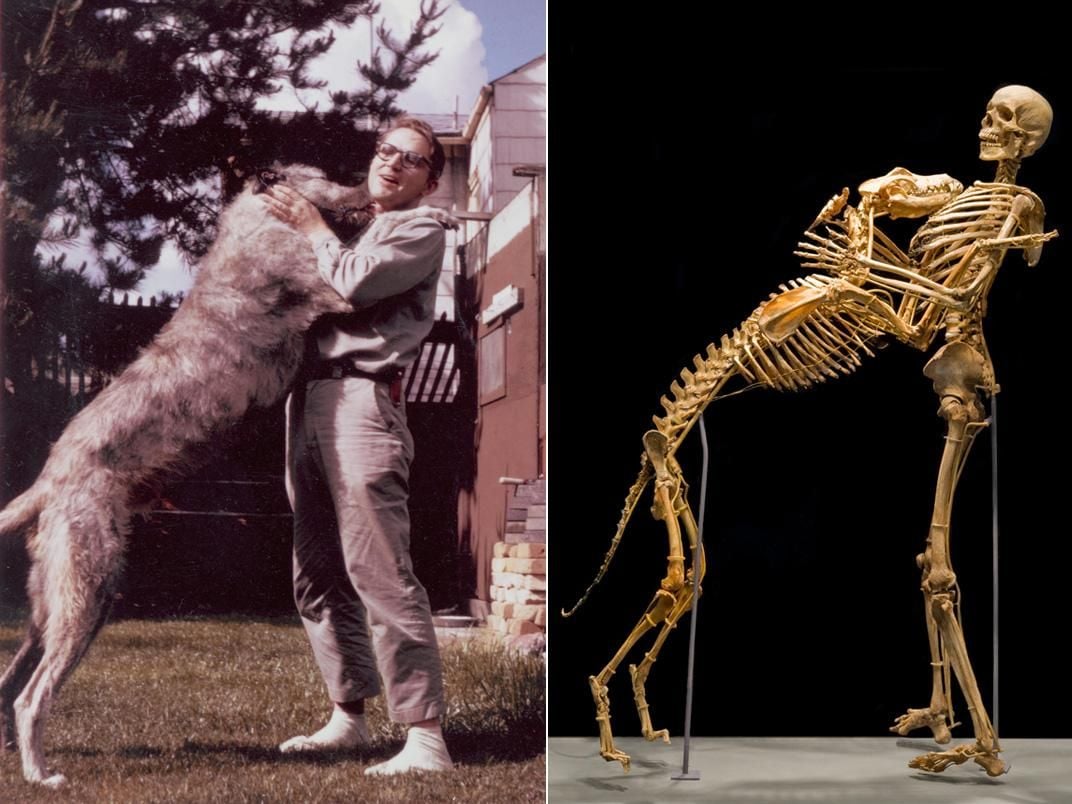
There, in a quiet educational space, the bones of a man and a dog remain together.
The man is Grover Sanders Krantz, an anthropologist, professor, author, skeptic, believer, rebel, and one of the most controversial academics ever to stake his professional reputation on the possibility that Bigfoot was real. The dog is Clyde, his beloved Irish wolfhound.
Their skeletons are not arranged as specimens stripped of feeling. They are posed in a way that seems almost impossibly tender. Clyde’s long-boned frame rests close to Krantz, and Krantz appears to hold him in an embrace. It is scientific. It is educational. It is anatomical.
And yet, for many visitors, it feels like something else entirely.
A love story.

Not the kind Hollywood usually sells. Not the kind wrapped in violins and candlelight. This is a stranger, quieter kind of love story — one told in bone. It is the story of a professor who spent decades chasing a creature most scientists dismissed as folklore, only to leave behind, in death, the one piece of evidence no skeptic could argue away: he loved his dog so fiercely that even death was not allowed to separate them.
Krantz donated his body to science, but he gave the Smithsonian a condition. His remains had to stay with his dogs. Smithsonian Magazine reported that when he offered his body for educational use, he made clear there was “one catch”: his dogs had to remain with him.
That detail has traveled across the internet for years because it feels almost too moving to be true. A professor hunts Bigfoot for thirty years, dies without proving the creature exists, gives his bones to science, and asks only that his loyal wolfhound be placed beside him.
But the deeper story is more complicated, more suspenseful, and more human than the viral version suggests.
Grover Krantz was not merely an eccentric man with an unusual final wish. He was a trained physical anthropologist who taught for decades at Washington State University. He studied human evolution, primate anatomy, fossil reconstruction, skeletal structure, and the origins of language. The Smithsonian’s archival record describes him as a leading authority in hominoid evolution and an expert on primate bone structure. It also notes that he was among the first established researchers to approach the question of Bigfoot, or Sasquatch, from a scientific perspective.
That is where the trouble began.

Because in American science, there are questions that can make a career.
And there are questions that can haunt one.
For Krantz, Bigfoot became both.
He did not invent the legend. Long before television documentaries and supermarket tabloids turned Bigfoot into a pop-culture mascot, stories of large, humanlike beings existed in Indigenous traditions and regional folklore. Across the Pacific Northwest, people had told stories for generations about something strange moving through the forests. Loggers spoke of footprints. Hunters described figures too tall to be bears, too upright to be apes, and too fast to be human. Families claimed to hear screams at night that did not sound like coyotes, wolves, or anything they had known.
Most scientists ignored it.
Krantz did not.
That decision changed the way the world saw him.
To his supporters, he was brave. He was one of the rare academics willing to ask whether a ridiculed subject deserved disciplined investigation. To his critics, he was reckless. He gave oxygen to myth. He blurred the line between science and obsession. Smithsonian Magazine described his cryptozoological work as serious, public, and professionally damaging, noting that he risked his career and reputation on a topic many considered a joke.
Krantz understood the danger. He was no fool wandering blindly into the woods with a flashlight and a campfire story. He knew what his colleagues said. He knew the raised eyebrows, the jokes in hallways, the polite silences at academic gatherings. He knew that to be associated with Bigfoot was to invite mockery.
But he also knew something else.
Science, at its best, does not begin with certainty.

It begins with a question.
And Krantz had a question he could not put down: What if the tracks were not all hoaxes? What if every witness was not lying? What if buried beneath the exaggerations, pranksters, misidentifications, and campfire nonsense, there remained a biological possibility worth examining?
To Krantz, Bigfoot was not a magical beast. He imagined it as a large, bipedal primate — perhaps six to eight feet tall and weighing hundreds of pounds. In interviews and writings, he tried to describe the creature not as a ghost of the woods but as a possible animal, flesh and bone, subject to anatomy, evolution, habitat, diet, and reproduction. Smithsonian Magazine noted that Krantz believed such a creature might weigh 600 to 800 pounds and stand six to eight feet tall.
That belief made him famous.
It also made him a target.
For more than thirty years, Krantz drove across the American West chasing reports that most professors would not touch. If a farmer found an enormous footprint in soft earth, Krantz wanted to see it. If a logger claimed something had crossed a remote road at dawn, Krantz listened. If plaster casts of strange tracks appeared in a rural town, he examined them with the seriousness other scholars reserved for fossilized skulls.
He was searching for the one thing that could end the argument.
A body.
Not another footprint. Not another blurry photograph. Not another trembling eyewitness. A body, a bone, a piece of undeniable physical evidence that could be examined, tested, cataloged, measured, challenged, and either accepted or rejected.
Krantz knew the rules. Extraordinary claims did not survive on excitement. They needed proof.
And Bigfoot had a problem.
It had stories. It had tracks. It had sightings. It had believers. It had skeptics. It had a powerful place in American folklore.
But it did not have a body.
That absence became the wall Krantz could not climb.

The deeper he went, the more the mystery seemed to tighten around him. If such a creature existed, why had no hunter shot one? Why had no hiker found a skull? Why had no road crew discovered bones? Why had no clear photograph settled the matter? How could an animal so large move through a continent that had been mapped, logged, hunted, filmed, and fenced?
Krantz had answers, or at least theories. Remote terrain. Low population numbers. Possible intelligence. Nocturnal movement. Bodies lost to wilderness scavengers and weather. He argued, he calculated, he compared anatomy.
But the scientific mainstream remained unmoved.
Without physical proof, Bigfoot stayed outside the gates.
And Krantz stayed with it.
That is the part of his life that makes his story so compelling to Americans: he was not simply chasing a monster. He was fighting the cost of curiosity. He was testing how far a respectable person can follow an unpopular idea before respectability begins to crack.
In American culture, we claim to love rebels. We celebrate the lone investigator, the dissenting expert, the outsider who sees what the crowd cannot. But in real life, rebellion is rarely romantic. It is lonely. It is professionally expensive. It can turn a brilliant scholar into a punchline.
Krantz lived that contradiction.
He was a professor with academic credentials and a man whose name became inseparable from Bigfoot. He published books on human evolution and other scholarly subjects, but the public often remembered the Sasquatch. Smithsonian Magazine reported that Krantz published ten books, including several on anthropology and five on Bigfoot.
Imagine the tension of that life.
In one room, he was teaching students how to read bone. How to understand pelvis, skull, femur, jaw. How a skeleton can reveal sex, age, ancestry, injury, disease, labor, and death. In another room — sometimes the same room — he was defending the possibility of an enormous undocumented primate walking through North American forests.
One side of him belonged to the academy.
The other side walked into the trees.
His critics saw contradiction. Krantz saw continuity. To him, bones, footprints, and bodies told stories. A skeleton could identify a person centuries after death. A fossil could reveal a vanished species. A footprint, if genuine, could point to an animal that had not yet been accepted.

This was his logic.
Not everyone accepted it.
But he followed it anyway.
Born on November 5, 1931, in Salt Lake City, Utah, Krantz entered the world far from the national stage he would one day occupy in such an unusual way. The Smithsonian archives note that he was born to Swedish immigrants and spent his childhood in Salt Lake City and Rockford, Illinois. He began college at the University of Utah, served in the United States Air Force, and later earned bachelor’s and master’s degrees in anthropology from the University of California, Berkeley. In 1970, he earned a doctorate in physical anthropology from the University of Minnesota.
Those details matter because they complicate the caricature.
Krantz was not a backwoods crank shouting about monsters. He was educated in serious institutions. He became a professor at Washington State University in Pullman, where he taught from 1968 to 1998. His expertise included hominoid evolution, primate bone structure, and the reconstruction and casting of hominid fossils.
That is what made the Bigfoot question so explosive.
When a casual believer claims to have seen a creature in the woods, the world shrugs. When a trained anthropologist says the question deserves study, the world leans in — and the academy stiffens.
Krantz did not only believe; he tried to build an argument.
He studied footprint casts. He considered muscle structure, stride length, weight distribution, and evolutionary ancestry. He proposed that if Sasquatch existed, it might descend from Gigantopithecus, an extinct giant ape from Asia. Smithsonian Magazine summarized that theory, explaining that Krantz believed Bigfoot could have descended from an ancient Asian ape and migrated across the Bering Land Bridge during periods of lower sea level.
It was a bold idea.
To many scientists, too bold.
The burden of proof remained crushing. A footprint can be faked. A witness can be mistaken. A sound in the night can become whatever fear imagines. A shadow between trees can grow in memory. A blurry film can be debated forever.
Krantz knew that.
That is one reason his story feels tragic. He did not spend his life unaware of skepticism. He lived inside it. He understood why scientists doubted him. In fact, Smithsonian Magazine quoted him acknowledging that the scientific community wanted definitive proof — a body or part of one — before accepting Sasquatch.
There is something almost haunting about that.
A man who made his name studying bones spent decades searching for bones that never appeared.
Then, in the end, his own bones became the evidence people came to see.
Not evidence of Bigfoot.
Evidence of devotion.
Evidence of a life lived with strange courage.
Evidence of a bond with a dog that survived the body itself.
Clyde was not a footnote in Krantz’s life. Clyde was a presence. An Irish wolfhound is a striking animal under any circumstances — tall, rough-coated, dignified, gentle, and built like something from an old legend. Beside Krantz, Clyde must have seemed less like a pet than a companion on equal terms: large enough to command attention, gentle enough to become family.
For people who have never loved a dog that deeply, Krantz’s final request may seem odd.
For those who have, it makes immediate sense.
There are dogs who do not merely live in a house. They change the weather inside it. They learn the rhythm of footsteps. They know when grief enters the room before a word is spoken. They become witnesses to the private versions of ourselves that no colleague, student, critic, or admirer ever sees.
A dog does not care if a journal rejects your paper.
A dog does not care if your colleagues laugh.
A dog does not care if the world thinks your life’s obsession is foolish.
Clyde, we can imagine, did not care whether Bigfoot was real.
Clyde was there.
That may be why the final image of Krantz and Clyde is so powerful. After all the controversy, after the books, after the arguments, after the fieldwork, after the ridicule, after the unresolved mystery, the public is left not with a monster but with a man holding his dog.
In the years before his death, Krantz faced the one certainty no theory can outrun. He had pancreatic cancer. The Smithsonian archives state that after his battle with the disease, he died on February 14, 2002. His remains were sent to the University of Tennessee’s Anthropology Research Facility, where scientists conducted skeletal research of forensic value, before his bones were sent to the Smithsonian for educational use.
That path from body to skeleton may sound unsettling. But for Krantz, it was consistent with everything he had taught. He understood the scientific value of remains. He knew that bones are not merely leftovers of a life. They are records.
A healed fracture can tell of an old accident. Tooth wear can speak of diet. Joint degeneration can reveal labor. A skull can help identify ancestry and age. A femur can help estimate stature. The dead, in the hands of forensic anthropology, can speak.
Krantz had spent his career teaching people how to listen.
So when death approached, he chose to keep teaching.
Smithsonian Magazine reported that Krantz told Smithsonian anthropologist David Hunt he had been a teacher all his life and might as well continue after death by donating his body. But then came the condition: his dogs had to remain with him.
That condition transforms the story.
Plenty of people donate their bodies to science. It is generous, practical, and often deeply meaningful. But Krantz’s request was not only scientific. It was personal. It said: use me, study me, display me, let students learn from me — but do not strip my humanity away.
Keep my dogs with me.
Especially Clyde.
It was a sentence that refused to let science become cold.
In 2009, Smithsonian Magazine wrote that Krantz’s skeleton and Clyde’s were placed on display in the exhibition “Written in Bone,” where visitors could see them as an example of how body donations serve education. The same report described the skeletons as appearing in a loving embrace.
The display later became part of the museum’s educational space, where Krantz and Clyde continued to confront visitors with a rare combination of science and tenderness. Smithsonian Magazine described the skeletons as enclosed in a glass case, with Krantz holding Clyde’s articulated bones in what looked like a warm embrace.
A warm embrace.
Those words are difficult to forget.
Because a skeleton is supposed to be the opposite of warmth. It is what remains after warmth has left. It is structure without breath, form without heartbeat. Yet in that case, viewers saw affection. They saw loyalty. They saw the echo of touch.
That is the shock of the display.
It makes the dead seem less distant.
It makes science feel intimate.
It makes a person ask: What will remain of me when the arguments are over? What will people remember? My work? My mistakes? My strange beliefs? My enemies? My credentials? My love?
For Grover Krantz, the answer became all of it.
His legacy cannot be separated cleanly into respectable and ridiculous, scientific and sentimental, brilliant and strange. He was all those things at once. He was a man of credentials who chased a legend. He was a professor who accepted ridicule rather than abandon a question. He was a body donor who insisted on remaining with his dogs. He was a scientist whose final display moves people not because it proves an academic theory, but because it reveals the emotional truth beneath a complicated life.
In the American imagination, Bigfoot often represents the unknown — the possibility that something wild still exists beyond the reach of highways, satellites, and certainty. It is a creature of margins. It lives where maps blur, where trees swallow sound, where the modern world feels less complete than it pretends to be.
Perhaps that is why Krantz could never leave it alone.
He came from a discipline that studies origins, bones, extinct relatives, ancient migrations, and the deep past of humanity. Anthropology is, in many ways, the science of asking what kind of creatures we are and where we came from. Bigfoot, if real, would have rewritten a small but astonishing part of that story.
That possibility was enough to hold him.
But the unanswered question also consumed public memory of him. For many, the name Grover Krantz leads first to Bigfoot, then to the Smithsonian display. The order is telling. America loves an eccentric. It loves an obsession. It loves a mystery that refuses to die.
Yet the more one studies Krantz, the more the monster becomes only one doorway into the man.
He wrote. He taught. He argued. He researched. His papers at the Smithsonian’s National Anthropological Archives are organized into correspondence, writings, research, professional activities, Sasquatch materials, teaching files, biographical records, sound recordings, and electronic records — a broad archive that suggests not a one-note crank, but a restless mind moving across subjects for decades.
And then there were the dogs.
Clyde, Icky, Yahoo, and Leica — the names alone soften the edges of the legend. Smithsonian Magazine noted that in addition to Clyde, Krantz had preserved the bones of three other dogs: Icky, Yahoo, and Leica.
That fact may seem unusual, even startling. But it also tells us something essential. Krantz did not see death as disappearance. He saw remains as meaningful. To preserve bones was not, for him, macabre. It was a way of honoring form, history, relationship, and memory.
A scientist of skeletons loved creatures whose skeletons he could not bear to lose.
There is a profound symmetry in that.
For decades, he searched for evidence of an animal that would not leave bones behind. In his personal life, he made sure the animals he loved did leave bones behind — and that those bones stayed with him.
The public display of Krantz and Clyde raises uncomfortable questions. Should human remains be displayed? Does educational value outweigh the unease of seeing a real person’s skeleton? What does consent mean after death? In Krantz’s case, the central ethical point is clear: he asked for this. He wanted his remains used for education. He understood the work. He had spent his life inside the science of bones.
But many visitors are still surprised by their own reaction.
They do not simply learn anatomy. They feel something.
Parents pause with children. Teenagers who came to see dinosaurs or forensic exhibits find themselves quiet. Dog owners look longer than they expected. People who may not know a thing about hominoid evolution understand immediately what the display says.
He did not want to be alone.
That is not a scientific conclusion.
It is a human one.
And it is why the story continues to spread.
The viral version usually compresses Krantz into a single sentence: a professor donated his body to science on the condition that his bones remain next to his dog’s. It is a perfect internet story because it is short, surprising, and emotionally complete. But the full life behind that sentence is far richer.
Krantz was not simply sentimental. He was stubborn.
Not simply loving. Controversial.
Not simply a Bigfoot believer. A scientist trained to ask hard questions about bodies, bones, and origins.
Not simply a professor. A man who seemed willing to be misunderstood.
That willingness may be the key to him.
Most people fear ridicule. Academics especially know the power of reputation. Careers are built on credibility, and credibility can be fragile. One strange obsession, one unpopular theory, one public misstep, and the serious rooms begin closing their doors.
Krantz walked into that risk.
Did he go too far? Many scientists would say yes. They would argue that he gave too much weight to weak evidence, that he allowed fascination to outrun proof, that he attached his name to a claim that never met the standards of his own discipline.
They may be right.
But there is another question.
What if a person can be wrong about one thing and still reveal something valuable by the way he pursues it?
Krantz did not prove Bigfoot existed. That must be said plainly. No accepted physical evidence has settled the matter. The mainstream scientific position remains skeptical because the decisive proof Krantz himself acknowledged as necessary has not emerged.
Yet failure to prove a claim is not the same as a meaningless life.
Krantz’s story endures because he lived at the edge of certainty. He reminds us that curiosity can be noble and dangerous at the same time. He shows how a serious mind can become attached to an unlikely possibility. He demonstrates the thin line between persistence and obsession.
And then, just when the story seems destined to be about a man and a monster, Clyde enters the frame.
The dog changes everything.
Because Clyde pulls the story out of argument and returns it to feeling.
You do not have to believe in Bigfoot to understand a man who loved his dog.
You do not have to agree with Krantz’s theories to be moved by his final request.
You do not have to know anthropology to stand before those bones and feel the strange ache of companionship preserved beyond death.
That is the genius of the display, whether intended or not. It refuses to let the viewer reduce Krantz to his most controversial idea. It says: here is the whole person, or at least one more piece of him. Here is the scholar. Here is the believer. Here is the teacher. Here is the man who wanted his dog.
The museum label may not need to endorse Bigfoot. The bones say something else.
They say loyalty is real.
They say love leaves evidence.
They say companionship can become part of a scientific record.
In the end, Grover Krantz never brought the world the body he spent so long seeking. He never produced the skull, the jawbone, the tissue sample, the undeniable remains that would force the textbooks to change. The creature he pursued remained in the fog — part legend, part possibility, part cultural mirror.
But Krantz did give science a body.
His own.
And he gave the public an image more haunting than any footprint in wet soil.
A man and his dog, together forever in bone.
That image has a way of overturning expectations. We begin with Bigfoot, expecting a strange tale of obsession. We end with Clyde, confronted by something gentler and more devastating. The monster story becomes a love story. The controversial scientist becomes a teacher after death. The skeleton becomes not a symbol of loss, but of keeping faith.
Perhaps that is why Americans keep returning to stories like this. We are a nation fascinated by the unknown, but we are also a nation afraid of being forgotten. We chase mysteries, build careers, defend ideas, lose arguments, make enemies, love imperfectly, and hope that when everything is stripped down, something true will remain.
For Grover Krantz, something did.
Not proof of Bigfoot.
Not universal acceptance.
Not a clean reputation.
But Clyde.
And maybe that was the one certainty he trusted most.
In life, Krantz searched forests for signs that something enormous had passed through and left its mark.
In death, he left his own mark behind: a professor’s skeleton beside the bones of his faithful dog, still teaching, still provoking, still asking visitors to look closer.
The mystery he could not solve remains out there, somewhere between folklore and science.
But the lesson he left in the glass case is unmistakable.
Some bonds do not end when the body does.