Inside the Deadly “Paper Drug” Crisis: How a Dangerous Cocktail Is Spreading Through Prisons and Killing Inmates
Inside the Deadly “Paper Drug” Crisis: How a Dangerous Cocktail Is Spreading Through Prisons and Killing Inmates
The Paper Death Trap: Inside the Silent Killer Decimating America’s Prisons

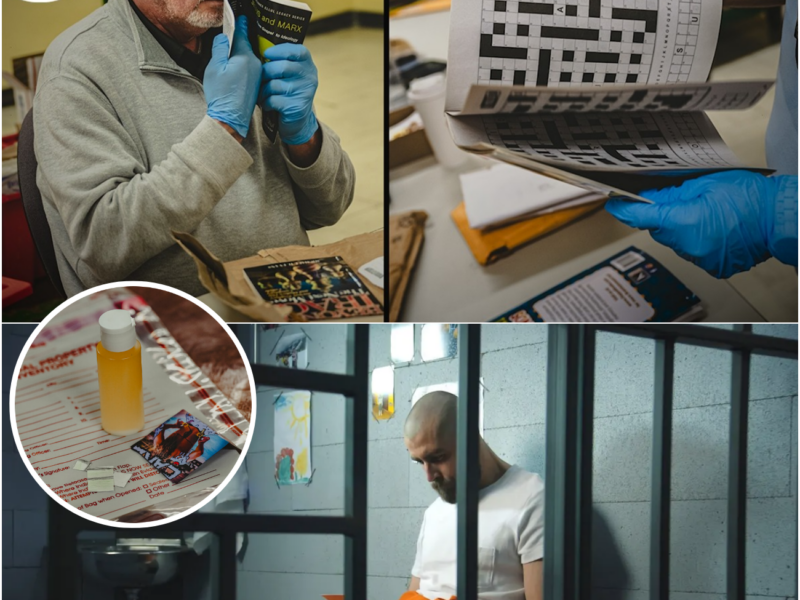
In the sterile, echoing hallways of America’s most secure correctional facilities, a new, invisible terror is unfolding. It arrives not in a package, a visitor’s pocket, or a smuggled drone drop, but through the mail—disguised as innocent birthday cards, legal correspondence, or children’s drawings. This is the era of the “drug-soaked sheet,” a lethal cocktail of synthetic chemicals infused into ordinary stationery that has become the most dangerous contraband to ever breach the walls of a prison. It is a silent killer, turning paper into a deadly narcotic delivery system that is claiming lives at an alarming, unprecedented rate.
For the families of those incarcerated, the mail is often the only remaining tether to the outside world. But today, that tether is being weaponized. Synthetic cannabinoids, fentanyl, and potent analogues are dissolved into solvents and soaked into standard printer paper. Once dried, the paper bears no smell, no texture, and no visual sign of contamination. It is a Trojan horse delivered by the postal service, slipping past standard security protocols and ending up in the hands of the most vulnerable.
The consequences are catastrophic. Inmates, desperate for escape or suffering from the crushing weight of dependency, consume the paper—often by tearing it into tiny, dosable squares to be smoked or ingested. A single letter can be cut into hundreds of individual “consumption units,” each a potential death sentence. The potency of these modern synthetic compounds is so high that a fragment no larger than a postage stamp can induce seizures, respiratory failure, or a fatal overdose. The prison system is facing an existential crisis: how do you secure a facility when the very medium of communication has been transformed into a lethal weapon?

The Economics of Extinction: Why Paper?
The rise of drug-soaked paper is not an accident of circumstance; it is a calculated evolution of the illicit market. In the harsh ecosystem of the American prison system, the scarcity of drugs creates a hyper-inflated economy. A standard strip of paper, bought for pennies on the street, can command hundreds of dollars once it clears the perimeter of a correctional facility.
Because traditional detection methods—such as canine units or basic X-ray screening—are often unable to identify liquid chemical compounds invisible to the naked eye, this method has become the “gold standard” for smuggling syndicates. Correctional facilities are currently engaged in an arms race against highly organized criminal networks that leverage the same supply chains that feed the broader opioid crisis.

The Pathological Impact: The “Zombie” Crisis
The health hazards associated with these substances are uniquely devastating. Unlike traditional narcotics, synthetic cannabinoids (often marketed as “Spice” or “K2”) are not regulated for purity. The chemicals sprayed onto the paper are often volatile, inconsistent, and incredibly potent.
When an inmate consumes these materials, the reaction is often sudden and violent. Reports from facilities across the United States detail inmates becoming unresponsive, suffering from extreme agitation, hallucinating, or succumbing to “zombie-like” states. The medical response is often complicated by the fact that the specific chemical makeup of the drug is unknown, leaving prison medical staff to treat symptoms in the dark.
Security in the Age of Digital Contraband
The infiltration of these substances has forced a radical change in prison operations. Many facilities have moved toward “mail-only” policies, where incoming physical mail is scanned, and the inmate receives only a digital copy or a photocopy, while the original is destroyed. While this strategy aims to mitigate the flow of contraband, it has also sparked a debate over the rights of inmates to receive physical items from their families.

The human cost is profound. For many, the loss of physical letters—the weight of paper held by a loved one—represents the final stripping away of humanity within the system. Yet, as the death toll rises, administrators argue that these draconian measures are the only way to prevent the next preventable death.
The Future: A Technological Reckoning
As we look to the coming years, the battle against drug-soaked paper is shifting toward high-tech detection. University research teams and defense contractors are racing to develop handheld mass spectrometry devices capable of sniffing out microscopic traces of synthetic narcotics on any surface.

If these tools become standard, we may see a decline in the effectiveness of the “paper tactic.” However, the history of illicit trade suggests that for every barrier erected, a new, more ingenious method of concealment will emerge. The cycle of addiction and supply will continue, and the battle will likely move to new frontiers, such as the tampering with laundry services, food shipments, or even the ventilation systems of high-security wings.