Katie Porter Responds to Viral Video Controversy, Points to Campaign Staffer in Tom Steyer Orbit as Leak Investigation Emerges
Katie Porter Responds to Viral Video Controversy, Points to Campaign Staffer in Tom Steyer Orbit as Leak Investigation Emerges
Katie Porter Campaign in Turmoil: Leaked Video, Blame Shifts, and the Battle for California
In the high-stakes arena of California politics, image is everything—and one misstep can derail even the most carefully constructed campaign. For former U.S. Representative Katie Porter, the fallout from a leaked video of her yelling at a staffer has cast a long, unflinching shadow over her gubernatorial bid. What began as an isolated moment caught on camera in a Department of Energy video has snowballed into a political storm, drawing in billionaire rival Tom Steyer, sparking questions about internal campaign loyalty, and threatening to reshape the narrative of the race entirely.
The controversy centers on a short segment of footage obtained by POLITICO, depicting Porter telling an employee to “get out of my f–king shot” during a behind-the-scenes recording with then-Energy Secretary Jennifer Granholm in July 2021. At the time, the recording was part of a broader push by the Biden administration to promote electric vehicle investment, a project that involved coordination between congressional offices, administration staff, and media teams tasked with creating polished social content.
Porter, who formally represented Orange County, initially responded to the leak with a mea culpa, acknowledging that her behavior in the footage was “not good.” But the apology did little to stem the tide of political damage. In the highly competitive California governor’s race, where perception often outweighs policy proposals, the video quickly became a flashpoint, fueling narratives of harsh temperament and toxic staff management. For a candidate already fighting to distinguish herself in a crowded Democratic field, the repercussions were swift and severe.
A Rival Named in the Storm
As the video circulated online and in political circles, Porter sought to shift responsibility for its release. In interviews with CNN and other media outlets, she directly implicated Tom Steyer, a billionaire candidate and fellow Democrat, suggesting that someone within his campaign leaked the footage to damage her electoral prospects.
“I am confident that is the case,” Porter told CNN. “I’ve been told by many people it’s a Department of Energy video, it was only held by the Department of Energy, and people can follow the trail to who his campaign staffers are and understand what happened there.”
Newly uncovered documents, reported by the Los Angeles Times, appear to corroborate that individuals associated with Steyer’s campaign could have had access to the video. Kevin Liao, who is now frequently cited as Steyer’s campaign spokesman, was listed as an “expected participant” on a June 21, 2021 video call between Porter and Granholm. The memo described the call as a 20-minute Zoom discussion to promote electric vehicle investment, noting that Liao, then Granholm’s press secretary, helped coordinate the session and planned edits for social media distribution.
“This is a 20 minute recorded Zoom with Energy Secretary Jennifer Granholm to discuss the importance of investing in electric vehicles,” the memo read. “Kevin Liao, Granholm’s press secretary, reached out to set this up. His team will edit this video down into a 2–3 minute clip for social media. Secretary Granholm will have a whiteboard, as noted in the script.”
For Porter, the presence of Liao in the call provided grounds to suggest that the leak originated from Steyer’s camp. The implications were politically explosive: if a rival campaign had indeed circulated internal footage to tarnish her image, the stakes of the race were suddenly heightened, introducing questions of ethics, legality, and the thin line between political strategy and sabotage.
Denials and Counterclaims

Steyer’s campaign quickly pushed back against Porter’s assertions. In statements to The California Post, campaign spokespeople emphasized that Steyer had “nothing to do with that video,” and any involvement by Liao was purely logistical. Liao himself declined to comment directly, referring inquiries to another campaign colleague.
“This is an attempt from Katie Porter to deflect from her past mistakes,” the spokesperson told The Post. “Katie Porter only has one person to blame for her standing in the race, and it’s herself.”
The public denials did little to calm the media storm, as political observers and journalists analyzed both Porter’s statements and the trail of documents linking campaign staffers to the original recording. In a race where trust, character, and temperament are scrutinized by voters, the controversy added a layer of suspense that few campaigns could navigate unscathed.
The Role of Social Media and Public Perception
Beyond the political maneuvering, the incident highlighted the volatile power of social media in modern campaigning. Once the footage leaked, AI-generated content, memes, and satirical posts proliferated across Twitter, TikTok, and other platforms, magnifying the damage to Porter’s public image. Her campaign scrambled to counter the narrative, but the viral nature of digital content made control nearly impossible.
Porter’s team eventually attempted a form of damage control by incorporating the controversy into her messaging. In a bold move earlier this month, Porter released a campaign video featuring the same moment from the leaked footage, culminating with her turning to a crowd of supporters and joking, “Now could you guys please get out of my shot?” By reclaiming the moment and attempting to inject humor, Porter aimed to demonstrate accountability while softening the perceived severity of her behavior. However, political analysts debated the effectiveness of the strategy, noting that attempting to spin a viral scandal can sometimes reinforce negative impressions.

Polling Shifts and Electoral Consequences
At the same time, polling numbers reflected the tangible impact of the video leak. Porter, once a rising figure in Democratic politics, has seen her support slip. Recent surveys show Democrat Xavier Becerra leading the gubernatorial field with 19%, while Republican Steve Hilton and billionaire Democrat Tom Steyer tie at 17%. Republican Chad Bianco follows, and Porter has fallen to fifth place.
For Porter, the confluence of negative media coverage, social media amplification, and public scrutiny has created a challenging uphill battle. In a field where narrative control is critical, even minor missteps can reshape the electoral landscape. The leaked video, though brief, played into pre-existing concerns about her temperament, providing a potent storyline for opponents and media alike.
Behind the Scenes: Ethics, Staff Management, and Political Strategy
The incident also reignites a broader conversation about ethics, staff management, and the responsibilities of political leaders. While Porter’s outburst was directed at a single staffer during a recorded meeting, it raises questions about workplace culture in political offices and the impact of public perception on leadership credibility. Campaigns are, by design, high-pressure environments, yet moments of visible anger or harshness can have lasting effects on both internal morale and voter sentiment.
Moreover, the accusations against Steyer’s campaign introduce an additional ethical dimension. If a rival campaign were to circulate internal footage for political gain, it would touch on questions of privacy, fairness, and the lengths campaigns will go to influence the electorate. While Steyer’s team denies involvement, the mere suggestion of such tactics fuels speculation and contributes to the narrative of a cutthroat electoral environment.
The Politics of Blame and Responsibility
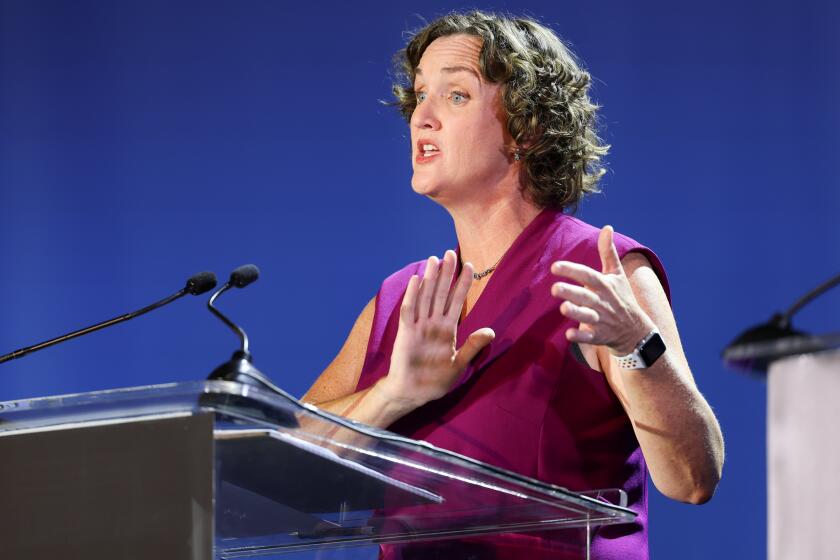
One of the most striking elements of the controversy is Porter’s attempt to redirect responsibility. In shifting the focus to Steyer, she highlights a fundamental dynamic in politics: the tension between personal accountability and strategic deflection. While rival campaigns and political analysts argue that Porter bears ultimate responsibility for her words and actions, her strategy reflects a common political instinct—identify an external source for the negative event, frame it as an orchestrated attack, and attempt to rally supporters around a narrative of unfair targeting.
Yet, this tactic carries risks. By publicly accusing a rival of wrongdoing, Porter exposes herself to counterclaims, legal scrutiny, and the potential for reputational harm if the accusation is disproven. The tension between deflecting blame and maintaining credibility is a delicate balancing act, one that can determine whether a campaign recovers or continues its downward trajectory.
Broader Implications for the California Race
The implications extend beyond Porter and Steyer. For voters, the episode underscores the importance of vetting candidates not only on policy positions but also on character, judgment, and temperament. In a state as politically diverse and media-savvy as California, voters are increasingly attentive to the personal and professional conduct of gubernatorial contenders. A leaked video, amplified by AI-generated content and rapid social media circulation, can transform a localized incident into a statewide issue almost instantaneously.
Political strategists note that the Porter-Steyer controversy may have ripple effects, influencing fundraising, volunteer recruitment, and coalition-building. Donors and party operatives are likely assessing whether Porter can withstand ongoing scrutiny, whether she can control her narrative, and how this incident may affect her electability relative to other candidates in the field.
A Lesson in Modern Campaign Vulnerability
The Porter leak exemplifies the vulnerabilities inherent in modern political campaigns. In an era of digital transparency, every word, gesture, and interaction is potentially recorded, edited, and distributed to an audience of millions. Candidates operate under constant observation, and the stakes for missteps are magnified.
Furthermore, the episode illustrates the intersection of personal behavior, media strategy, and political rivalry. The interplay between internal campaign dynamics, inter-campaign competition, and public perception creates a high-stakes environment where a single video clip can become a defining moment.
The Road Ahead for Porter
As the gubernatorial race continues, Porter faces a critical juncture. Her campaign must navigate the dual challenges of countering the narrative surrounding the leaked video while articulating a clear, compelling vision for California. The stakes are especially high as she competes in a crowded Democratic field against seasoned political figures and well-funded challengers like Steyer.
Strategically, Porter must decide whether to continue emphasizing external blame, reclaim the narrative through transparency and humor, or pivot entirely toward policy-driven messaging. Each path carries risks and potential rewards, but the underlying reality remains: voters have seen a glimpse of Porter’s temperament, and the interpretation of that glimpse may prove decisive in shaping electoral outcomes.
Conclusion: Politics, Perception, and the Power of a Video
The controversy surrounding Katie Porter’s leaked video encapsulates the perils of modern campaigning, where personal conduct, media scrutiny, and rival campaigns intersect in dramatic and unpredictable ways. For Porter, the fallout represents both a personal and political challenge, testing her ability to navigate accusations, manage public perception, and recover from a high-profile misstep.
Whether the accusations against Steyer hold water, whether Porter can rehabilitate her image, and whether voters prioritize policy over personality remain open questions. What is clear, however, is that in California politics, as in contemporary campaigns nationwide, one moment captured on camera can reverberate far beyond its original context, shaping narratives, influencing elections, and defining careers.
The drama is ongoing, the stakes are high, and the story is far from over. In the realm of politics, few events are truly contained; leaks, missteps, and strategic accusations have a way of reshaping the landscape, leaving candidates to confront both the consequences of their actions and the unpredictable machinations of their rivals. Katie Porter’s gubernatorial bid now sits at the nexus of these forces, a cautionary tale for anyone navigating the treacherous intersection of personal conduct and public scrutiny.