This 21-Year-Old Lost a Leg to Cancer—Then Completed 143 Marathons in 143 Days for Cancer Research
After Losing a Leg to Cancer at 21, He Ran 5,373 Kilometers by Completing a Marathon Every Day for 143 Days to Fund Cancer Research
The Marathon of the Human Spirit: The Unending Legacy of Terry Fox
There are certain individuals whose lives serve as a moral compass for the rest of humanity—people who, through sheer force of will, redefine the boundaries of what is possible. In the grand tapestry of North American history, few threads are as vibrant, as enduring, or as profoundly moving as that of Terry Fox. His life was short, spanning only twenty-two years, yet the path he carved across a continent has become an eternal thoroughfare for hope. To understand Terry Fox is not merely to understand a runner or a cancer survivor; it is to understand the absolute, unyielding capacity of the human spirit to turn personal tragedy into a universal victory.
The Crucible of Adversity
In 1977, at the age of eighteen, Terry Fox was a young man with the world at his feet. A student and athlete in British Columbia, his life was defined by the typical aspirations of youth. Then came the diagnosis: osteosarcoma, a devastating form of bone cancer. The medical reality was brutal—the amputation of his right leg above the knee.
For many, such a diagnosis would be the end of a narrative. It is the moment where the world shrinks, where dreams are folded away, and where the focus shifts entirely to the preservation of self. But Terry Fox possessed a different internal geometry. While lying in the hospital, surrounded by other patients—many of them children—suffering from the ravages of cancer, he saw something that shifted his purpose. He did not just see his own suffering; he saw the systemic failure of our collective effort to combat the disease. He saw the lack of funding, the lack of hope, and the desperate need for a champion.
He didn’t just survive his cancer; he chose to challenge the very nature of it.

The Marathon of Hope: A Vision of Defiance
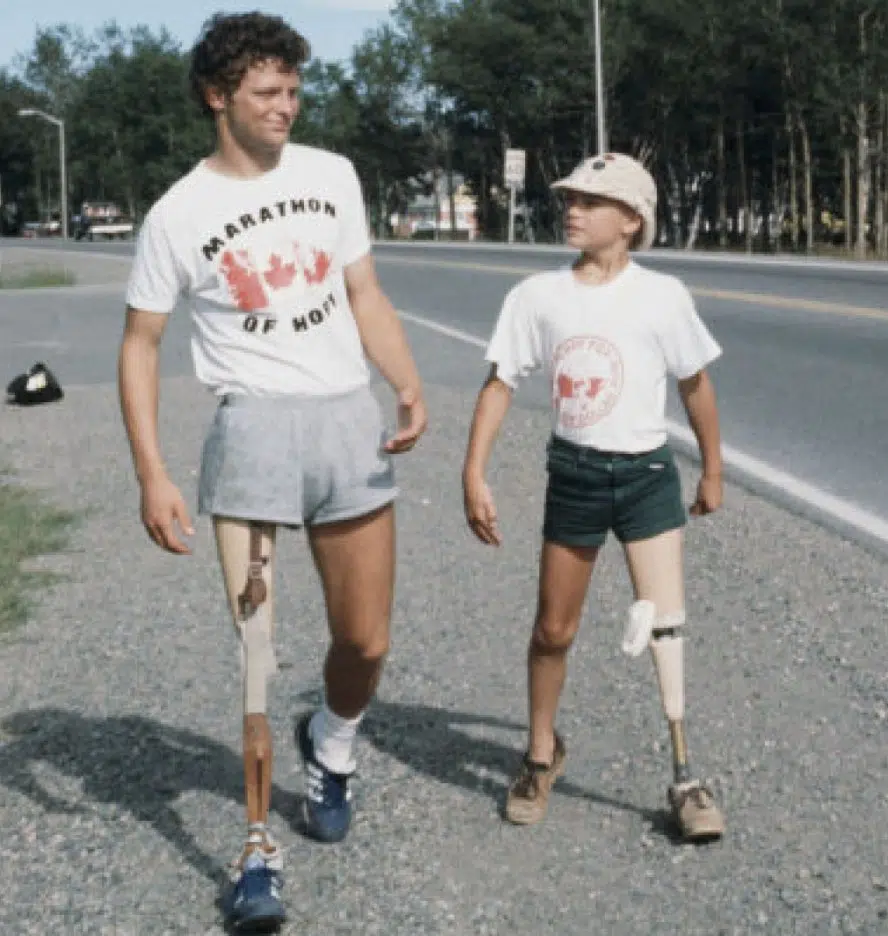
On April 12, 1980, Terry Fox stood on the shores of the Atlantic Ocean in Newfoundland. He dipped his artificial leg into the cold, churning waters—a symbolic gesture of connection between the start of his journey and his ultimate destination. He called it the “Marathon of Hope.” The premise was deceptively simple: to run a full marathon—42 kilometers (26.2 miles)—every single day until he reached the Pacific coast.
To comprehend the physical toll of this endeavor is nearly impossible for the average person. Terry did not run with the fluid grace of an Olympic athlete; his gait was a rhythmic, painful mechanical hop, a constant struggle against the friction of a prosthetic leg that was never designed for such extreme endurance. Every mile was a victory of mind over biology. Every day was an exercise in agony that he endured with a quiet, steely resolve.
For 143 days, Terry traversed the rugged, unpredictable Canadian landscape. He endured blistering heat, freezing rain, and the constant, throbbing ache of a body pushed far beyond its limits. Yet, he refused to stop. He became a traveling monument to the possibility of change. As he moved westward, the nation—and eventually the world—began to pay attention. He wasn’t running for fame; he was running to empty the pockets of apathy and fill the coffers of cancer research.
The American Connection: Shared Values of Grit and Grace
![Image] Terry Fox who 40 years ago, ran 3,339 miles across Canada before dying of cancer at the age of 21. : r/GetMotivated](https://i.redd.it/rdkwlttxw4h41.jpg)
While Terry Fox was Canadian, his story resonates with the profound depth of the American ethos. We are a people who have long celebrated the “self-made” individual, the rugged pioneer, and the underdog who defies the odds. Terry Fox embodies these archetypes, but he transcends them by adding a layer of profound, selfless altruism that characterizes the best of our shared North American values.
In America, we are often enamored with “the grind”—the idea that through hard work and relentless dedication, one can achieve anything. Terry Fox took the American concept of the grind and stripped away all vanity. There was no ego in his stride. There was no commercialism in his ambition. He was, quite literally, sacrificing his body to buy time for strangers he would never meet. He taught us that endurance is not just about moving forward; it is about why we are moving forward.
The Unfinished Mile
The tragedy of Terry Fox is that he never reached the Pacific. In September 1980, near Thunder Bay, Ontario, the cancer that had once taken his leg returned—this time in his lungs. He was forced to end his run, though it was the cancer that stopped him, never his spirit. He passed away the following June, just a month shy of his twenty-third birthday.
But to view his death as the end of the Marathon of Hope is to fundamentally misunderstand the nature of his contribution. Terry Fox did not fail. He succeeded in a way that rendered the physical completion of his route irrelevant. He succeeded in capturing the conscience of a continent. By the time he was forced off the road, he had raised millions of dollars, but more importantly, he had ignited a fire that would continue to burn long after he was gone.

A Legacy That Never Stops
Today, the Terry Fox Run is a global phenomenon. It is held in countries across the world, involving millions of participants who walk, run, or roll in his honor. The money raised has funded breakthroughs in cancer research that have saved countless lives. It is a rare thing for an individual’s legacy to be so tangibly beneficial to the future of humanity.
For American readers, Terry’s story serves as a perennial reminder of the power of one. We live in an era of massive, complex institutions—governments, corporations, and global organizations. It is easy to feel small, to feel that our individual contributions are like drops of water in an ocean. Terry Fox is the antidote to that cynicism. He proves that a single person, armed with nothing more than a vision and an indomitable will, can shift the trajectory of history.
The Lesson of the Footprint
Terry Fox famously said, “I’m not a dreamer, and I’m not saying this will initiate any kind of definitive answer or cure to cancer, but I believe in miracles. I have to.”
This was the core of his message: not that the world is perfect, but that it is perfectible. He understood that progress is not a straight line, but a series of small, agonizing steps taken in the face of impossible odds. He showed us that courage is not the absence of pain; it is the decision to keep moving in spite of it.
When we look at the path he left behind, we see more than just a route across a map. We see a blueprint for how to live. We see that our worth is not measured by how long we are here, but by the weight of the burdens we help others carry. He turned his personal “lost leg” into a gain for all of humanity. He transformed the silence of a hospital room into the roar of a movement that spans generations.
Conclusion: The Path Ahead
The story of Terry Fox is a mirror. When we read about his 143 days of relentless struggle, we are invited to examine our own lives. What are the “marathons” we have been avoiding? What are the causes we have been too comfortable to champion? What are the limits we have placed on ourselves that, like the limits imposed on a man with one leg, are perhaps not as absolute as we believe?
Terry Fox did not just leave footprints; he left a path that the world is still following. That path leads away from selfishness and toward collective healing. It leads away from resignation and toward the bold, defiant hope that, together, we can overcome even the most formidable obstacles.
As long as there are people who believe that one person can make a difference, the Marathon of Hope continues. It continues in every research laboratory, in every oncology ward, and in the heart of every person who decides to turn their own struggle into a source of strength. Terry Fox may have stopped running, but the momentum he created is stronger than ever. It is a reminder that while the road may be long and the weather unpredictable, the journey is worth every step.

We are all, in our own way, running a marathon of hope. We run for those who have gone before us, for those who are currently fighting, and for the generations yet to come. And in that shared journey, we find the true meaning of the human experience: the knowledge that we are never truly running alone.
How does the story of Terry Fox challenge your own perspective on what one person can accomplish in the face of overwhelming odds?