Amy Winehouse heard a 13-year-old girl sing. She built a record label for her. Nobody noticed.
When Amy Winehouse heard a 13-year-old girl sing, she did not call a manager. She founded a record label. She called it Lioness. She signed the girl herself. And what she built in the two years before she died was something that the music industry, which had spent years defining her as a problem, had not expected from her at all.
But to understand why Amy Winehouse started a record label, you need to understand something about her relationship with the music industry that the tabloid coverage never captured. Because the public image of Amy in the years after Back to Black, chaotic, self-destructive, ungovernable, was in important respects incomplete.
It was the image of someone falling apart. It was not the image of someone who had spent years paying close attention to how the business worked, who had formed considered opinions about what was wrong with it, and who had arrived at a specific plan for doing something better. Amy had been inside the music industry since she was 19 years old.
She had signed to Island Records after a single audition. She had spent the early years of her career under the management of 19 management, Simon Fuller’s company, the same organization that had managed the Spice Girls, before eventually parting ways with them in circumstances that said a great deal about what she valued and what she did not.
When her management company suggested she enter rehabilitation in 2006, she had fired them. She had turned the experience into rehab, one of the most successful singles of the decade, and signed to a new management arrangement on terms that gave her more control. The pattern of those decisions, the consistent prioritization of artistic autonomy over institutional compliance, the willingness to accept personal cost in exchange for professional independence, was not recklessness.
It was a coherent position held consistently over years by someone who understood exactly what she was doing and why. Amy had been inside the music industry since she was 19 years old. She had watched it from a position of proximity that most people who work in it never achieve, not as an executive or a producer or an ANR person, but as the artist at the center of the operation, the person whose music and whose life and whose commercial potential were the raw material from which everyone around her was building something. She had
watched contracts being negotiated and promotional campaigns being planned and decisions being made about her work that she had limited ability to influence. She had called the people making those decisions idiots in a national magazine when she was 20. She had been right and she had spent the years afterward thinking carefully about the structures that produced the idiocy.
The music industry had a specific relationship with artists that Amy understood from the inside. She had also observed it from the outside through the experiences of musicians she admired, through the history of the genre she had grown up inside. Jazz had a long and painful relationship with the major label system.
The artists who made the music that Amy loved most, Billy Holidayiday, Dina Washington, Sarah Vaughn, had often made it under arrangements that gave them little control and limited financial return on work that generated enormous value for the people who owned the recordings. The structural unfairness was not new. It was built into the industry’s foundations. Amy knew this history.
She had absorbed it alongside the music itself. The music industry had a specific relationship with artists that Amy understood from the inside. Record labels signed artists early when their negotiating position was weakest and locked them into arrangements that gave the label significant control over their output, their image, and the commercial exploitation of their work.
The label bore the financial risk of developing an artist, paying for recording, promotion, distribution, and recovered that investment through the recordings, taking a significant share of the revenue in perpetuity. For an artist who became successful, this meant that the work they had made when they were young and unknown continued to generate money for the people who had signed them on terms that had been set when the balance of power was entirely in the label’s favor.
Amy had seen this from every angle. She had seen what it looked like when an artist had no leverage. She had also seen by the time Back to Black made her one of the most commercially valuable musicians in the world. What it looked like when an artist had some. The difference between those two positions was the difference between accepting what you were given and having a say in what happened to your work.
Amy, who had always had very clear views about her work and very limited patience with people who did not understand those views, was interested in the second position. She was also interested in something more fundamental. She was interested in the model that Barry Gordy had built at Mottown Records in the late 1950s.
The idea that a record label could be something other than a corporation extracting value from artists. that it could be a community, a creative home, a place where the people making the music had a stake in the enterprise and were treated as collaborators rather than raw material. Mottown had produced some of the greatest music of the 20th century.
It had done so not in spite of its structure, but partly because of it, because the artists who recorded there were working inside a system that had been built by someone who understood what they needed. Amy was also inspired by two-tone records, the Coventrybased label founded by Jerry Dammers of the Specials in 1979, which had launched the SCA revival and produced a series of records that were both commercially successful and genuinely radical.
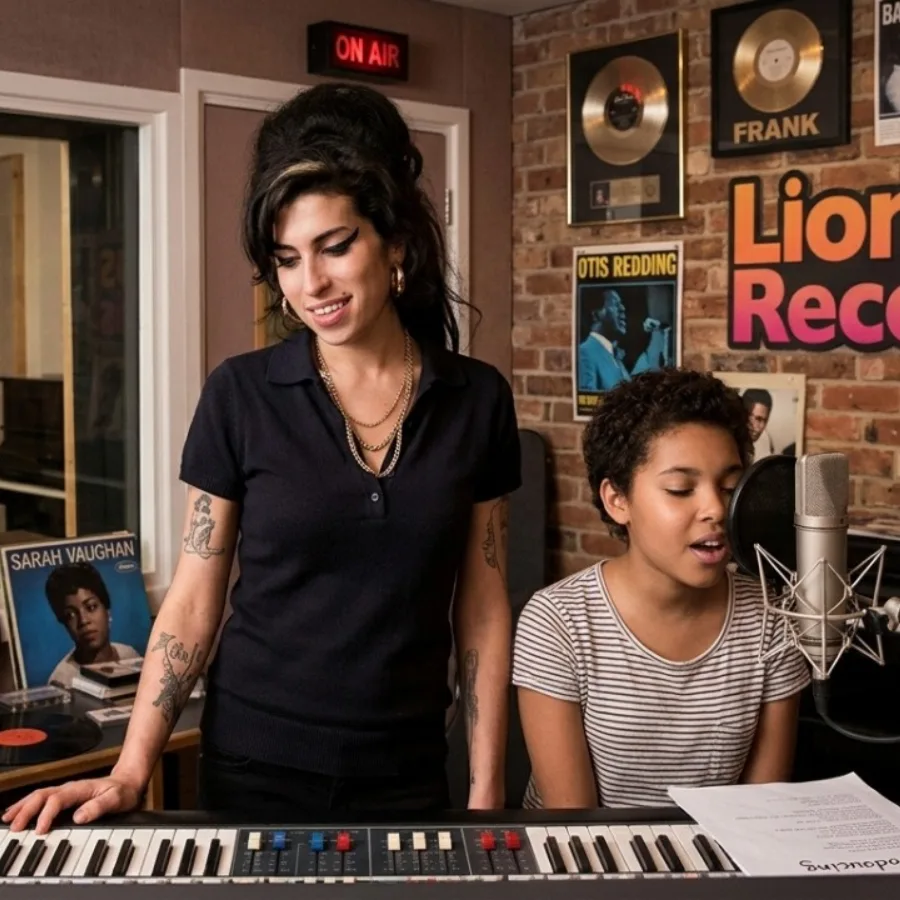
made by artists who had creative control and a genuine relationship with the label that had signed them. Two-tone had been small and specific and entirely itself. It had done what it did on its own terms without compromise and it had mattered. Amy wanted to build something like that. In 2009, she heard Dion Bramfield sing. Bramfield was 13 years old.
She was the goddaughter of Amy’s close friend and had grown up around Amy’s world in Camden, one of the children who existed in the orbit of Amy’s life during those years, familiar faces in the flat and at the kitchen table. When Amy heard her, the response was immediate and unambiguous. Bramfield had something real.
She was young and unformed and had none of the professional polish that the industry would eventually apply to her. But the fundamental material, the voice, the musicality, the quality that made certain performers different from other performers was already there. Amy did not think about it for very long. She founded Lioness Records.
The name was deliberate. The lioness is the hunter of the pride, the one who does the work, who provides, who protects the young. Amy chose the name herself. She later said it reflected what she was trying to do, to create something that protected the artists inside it, that gave them the support they needed without extracting from them what the major labels extracted.
She was not building a business in the conventional sense. She was building a home. The founding of Lionus Records happened while the tabloids were running their usual coverage of Amy Winehouse. The photographs, the speculation, the ongoing documentation of everything that was going wrong. The business was not news. The personal life was news.
And so a significant and revealing act, a woman who had been treated as a commodity by the music industry, deciding to build an alternative to the machinery that had treated her that way, went largely unnoticed, while the cameras focused on what they had always focused on. Bramfield had grown up listening to Amy. She had been in Amy’s world since she was small, the goddaughter of Amy’s friend, a fixture of the Camden flat, someone who knew Amy not as an icon, but as a person who made tea and was funny, and occasionally let a 13-year-old girl
sit in the corner of the room and watch what was happening. That intimacy was part of what Amy was protecting when she decided to sign her. She was not identifying a commercial opportunity. She was recognizing someone she knew and understood. Someone who needed the specific kind of support that Amy had not always received.
The support of someone who would not try to change her into something more marketable, who would give her the conditions she needed to find out who she was as an artist before the industry had a chance to tell her. Bramfield’s debut album, recorded under Amy’s supervision on the new label, was released in 2010. Amy co-wrote several of the songs.
She produced sessions. She was present in the studio with the directness and the musical seriousness that everyone who had worked with her described. The producer who had built the piano riff overnight, the collaborator who had made the DAP kings understand in minutes what kind of session they were in. She was not playing at running a label.
She was doing it with the same completeness that she brought to everything she cared about. The act of founding the label was itself a form of the thing Amy had always done. The refusal to accept other people’s terms when her own terms were available. She had refused to sand down her music when the industry suggested it was too unusual.
She had refused to become the person the tabloids were constructing. She had refused to go to rehabilitation when people told her she needed to and had eventually sought it on her own terms when she decided she was ready. The label was the same refusal in a different register. The industry had spent years telling Amy what she was and what she should do.
Lioness Records was Amy telling the industry what she was going to do instead. She also had larger plans. Lioness was not intended to be a vehicle for Dion Bramfield alone. Amy had spoken to people around her about the label’s potential, about the kind of artists she wanted to sign, the kind of music she wanted to put into the world, the vision she had for what a label run by a musician rather than a corporation might look like.
She wanted to sign acts that the major labels would not touch because they were too raw or too unusual or too honest. She wanted to give them the conditions in which they could make the thing they needed to make rather than the thing the market was expecting. She wanted, in other words, to build the structure that had not been built for her.
There is a particular irony in the timing. 2009, the year Amy founded Lioness Records, was also the year that the tabloid coverage of her was at its most relentless. The photographs of her outside the flat, the speculation about her health, the running commentary on everything that was wrong, all of it was happening simultaneously with the quiet, undocumented work of building a record label from scratch.
The cameras were pointed at the chaos. Nobody was pointing a camera at the woman sitting in a studio with a 13-year-old girl co-writing songs, building something. This is not unusual in the history of Amy Winehouse coverage. The things that were most true about her were consistently the things that received the least attention.
The music got attention when it won awards. The personal life got attention all the time. The business intelligence, the artistic seriousness, the genuine care for the people around her. These things existed in the gaps between the coverage, visible only to the people who were actually there. She did not get enough time.
She died in July 2011, 2 years after founding Lioness. The label continued after her death. Bramfield continued recording and releasing music under it, and the Amy Winehouse Foundation later established a music arm that carried the Lionist name. The estate that managed Amy’s legacy took over the label’s operations. It survived her in the way that the things she had built tended to survive her imperfectly, incompletely, in forms that were not quite what she had intended, but that carried something of the intention forward. The legacy of Lionus
Records is complicated in the way that the legacies of things that were started and not finished tend to be complicated. The label continued after Amy’s death, but under different stewardship with different priorities without the animating intelligence that had conceived it. Bramfield continued recording.
The Amy Winehouse music arm carried the name forward, but the specific vision Amy had articulated, the independent home for artists who were too raw or too honest for the major labels, the Mottown of its kind, the two-tone for a new generation, remained incomplete. Not abandoned, but not realized either. Unfinished in the same way that the third album was unfinished.
The Paisley Park collaboration was unfinished. The life itself was unfinished, a shape rather than a thing. What the label did accomplish in the two years Amy had to work on it was Deion Bramfield’s debut. That album existed because Amy heard a 13-year-old girl sing and decided immediately and without hesitation that the right response was to build the infrastructure to support her.
That was not the response of a person who had been broken by the industry. It was the response of a person who had been educated by it, who had learned from the inside what the industry got wrong and had decided to do something different. Wikipedia in its entry on Amy Winehouse lists her as a singer, songwriter, musician, and businesswoman.
That last word is there because she earned it because she looked at the industry that had made her and found it wanting and decided to build something better. She was 25 years old when she started. She had 2 years to work on it before she ran out of time. The music industry had spent years describing Amy Winehouse as ungovernable.
What it had actually encountered was someone who had looked carefully at the way the system worked and decided that the right response was not to be governed by it at all. She called it Lionus. She was always going to call it something like that. The name, like the songs, was entirely her own. The music industry spent years writing Amy Winehouse’s story as a tragedy, as the story of a talent consumed by its own excess, of a woman who could not be saved from herself.
That story is not wrong exactly, but it is incomplete in a specific and important way. It leaves out the person who was building something while the cameras documented the falling apart. It leaves out the woman who heard a 13-year-old girl sing and thought, “I need to build something that protects her.
” It leaves out the businesswoman, and she was always there in the contract she read carefully. In the management she fired when it stopped serving her, in the label she found it at 25 with Barry Gordy and Jerry Dammers in her head, and a 13-year-old girl’s voice in her ear. She just did not get enough time to show the world what she was building.