Amy Winehouse wrote Rehab in 5 minutes on a street. Here is exactly what happened.
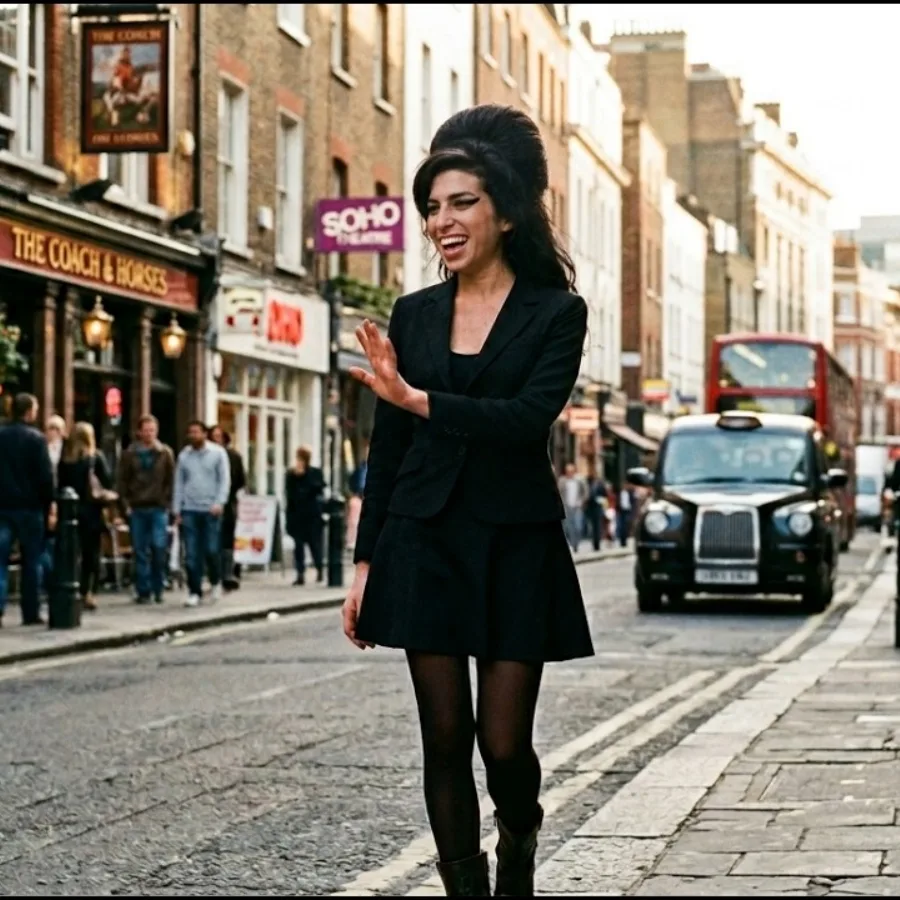
The most famous three words Amy Winehouse ever sang, no, no, no, were not written at a piano or in a studio. They were said on a street. She said them to Mark Ronson while walking in Soho, telling him a story, doing the talk to the hand gesture. He stopped walking. He said, “That’s a song.” She said she just made it up.
He said, “I know. That’s why it’s a song.” But to understand how rehab got written and what it meant that it got written the way it did, you need to go back about a year before that Soho Street to a moment that Amy herself described as being kind of messed up. Not in the way that the tabloids would eventually describe her as messed up.
Not the public version of that story, the private version, the version that happened in her flat in Camden on a day when the people who were supposed to be looking after her professional interests came to her home because they were worried about her. Her management team had arranged an intervention. The word feels clinical, but the reality was simpler and more human than that.
A group of people who knew Amy, who had a professional stake in her well-being and also in some cases a genuine personal concern, gathered in her flat to tell her that they thought she needed help, that the drinking had reached a level that they could no longer manage around, that there was a rehabilitation clinic that could help her, that they had arranged it, that they wanted her to go.
Amy called her father. She asked Mitch Winehouse directly whether he thought she needed to go. This was the question that mattered to her. Not what her management thought, not what the clinic could offer, not the professional assessment of the situation, what her father thought. Mitch said no. He said she did not need to go.
He then added almost as a qualification that she should probably give it a try. So, she went. She stayed for 15 minutes. She walked in, introduced herself, and explained to whoever was receiving her that she drank because she was in love and had messed up the relationship. Then she walked out. The explanation she had given, “I drink because I am in love and have screwed up the relationship,” was by Amy’s own account the truest thing she could have said at that moment.
She was in love with Blake Fielder Civil. The relationship was in its early stages of being complicated. the drinking was connected to the complication. These were the facts as she understood them, and she stated them plainly to a clinician she had just met, and then she left because she felt she had said what there was to say, and there did not seem to be any point in remaining.
She then fired her management company. This is the part of the rehab story that tends to get left out. The intervention and the 15-minute clinic visit are well documented. The firing of the management is less discussed, but it is essential to the story because it tells you something important about Amy’s relationship to the situation.
She was not passive. She was not a person who had been pushed into something she did not want and had gone along with it resentfully. She had gone, decided it was not for her, come back, and made a decision. The management company that had organized the intervention, Simon Fuller’s 19 management, the same company that had managed the Spice Girls, was no longer managing Amy Winehouse by the time Back to Black was in production.
A year or so later, she was in New York with Mark Ronson. They had been working together for about a week. The Back to Black sessions were underway. The Greenwich Village studio was where they were spending their days. The relationship between producer and artist was new enough that they were still learning each other.
On a particular afternoon, they had left the studio and were walking through Soho to find a birthday present for Amy’s boyfriend, a shirt specifically. They were walking and talking the way you do when you are new colleagues who were getting to know each other. And Amy started telling Ronson a story.
She told him about the intervention, about her management coming to her flat, about calling her father. She told it with the particular combination of self-awareness and humor that characterized everything she said about herself. Not with bitterness, not with self-pity, but with the slightly exasperated fondness of someone who was aware that the situation had been absurd, and was prepared to find the absurdity useful.
You know, I used to be kind of messed up, she said to Ronson. There was this time when I was drinking a lot and my family and my manager, these people came over to my house. They tried to make me go to rehab. And she said, I was like, “No, no, no.” And she did the hand gesture, the talk to the hand gesture, the flat palm extended outward, the dismissal made physical, the visual equivalent of the three words she had just said.
She did it while walking down a street in Soho in conversation as a casual illustration of what had happened. Ronson said afterward that he heard the rhythm before he heard the meaning. The words no, no, no, delivered in Amy’s voice with that specific cadence, short, declarative. The three beats equal and emphatic were a musical phrase before they were a lyric.
The talk to the hand gesture gave them a visual rhythm that reinforced the sonic one. He heard them and thought that is a hook. Not a hook in the calculated sense of something engineered to be memorable, but a hook in the real sense, something that catches, that holds, that does not let go. He turned to Amy and said, “We’ve got to write that down.” She was surprised.
She said she had just made it up. She said it was just something she said. He told her it did not matter that she had just made it up. In fact, the just made it up quality was precisely the point. The most honest things Amy said were always the ones she had not prepared in advance, had not constructed or arranged, had simply said because they were what was true.
The talk to the hand, no, no, no, was what was true. It was what had actually happened. It was the whole story compressed into three syllables. [snorts] She went home and wrote the song. This took, by her own account to the Daily Mail in a 2007 interview, 5 minutes, not 5 minutes as a round number or a modest way of describing a quick process.
5 minutes as the actual duration. She said she sang the hook out loud while walking with Ronson. I just sang it out loud. It was quite silly, really. and that when he asked who wrote it, she told him she just made it up, but that it was true. And he encouraged her to turn it into a song, which took her five minutes.
The song that came out of those 5 minutes begins with the scene as it actually happened. They tried to make me go to rehab. I said, “No, no, no.” The specificity is total. There’s no metaphor, no transformation of the real event into something more poetic. The management came over. They tried to make her go. She said no.
That is the first verse. The second verse adds the conversation with her father. Yes, I’ve been black, but when I come back, you’ll know no, which is the emotional complication, the acknowledgment that there is real difficulty underneath the refusal. That the no no is not simple defiance, but something more like a person who is not ready yet.
The third verse introduces Rey and Mr. Haway, Ray Charles and Donnie Hathaway, both artists who had struggled with addiction and made extraordinary music. Anyway, both invoked as evidence that she can work things out without a clinical intervention. The production decisions Ronson made around Amy’s vocal were, as with everything on Back to Black, built to serve what she had given him rather than to impose something on top of it.
The DAP Kings were the right band for rehab for the same reason they were the right band for the whole album. They played with the weight and the warmth and the slight roughness of musicians who had spent years in a tradition, who understood that the imperfection was the point, who were not trying to make everything precise.
Sharon Jones, who recorded with them regularly, had a voice with some of the same qualities as Amy’s. The directness, the refusal to be polished down into something more manageable. When the DAP kings heard rehab in the studio, they understood immediately what it needed from them. What it needed was joy. The lyric was about refusal, but the music needed to be about freedom.
The freedom of someone who had made a decision and was not apologizing for it. The horns that open the song announce something celebratory before the lyric announces something complicated. By the time Amy sings the first no, no, no. The listener has already been given a reason to be on her side. The original version Ronson heard in his head was a slow blues.
This is documented. He has spoken about it in interviews about the first instinct being something in the blues tradition, a slower and more melancholy version of the same lyric. But as he developed the production in the days after Amy gave him the song, the Mottown influence took over.
The horns and the rhythm and the dap king’s energy pushed it towards something more propulsive, more buoyant, more like the defiance sounded rather than the complexity underneath it. The song became the opposite of its lyric in terms of feeling. The words were about refusal, and the music was about joy. This was intentional.
Ronson understood that the song needed to be as fun to listen to as it was serious to hear properly. The three Grammy version of Rehab, Record of the Year, Song of the Year, Best Female Pop Vocal Performance, was a record that people drove to at high volume and sang along to and knew every word of before they had thought carefully about what any of those words actually meant.
That was the point, the Trojan horse principle. get people inside the song before they realize what the song is doing to them. The video music was shot in black and white in a style that referenced early 60s girl group videos. Amy in a beehive, Amy in a mod dress, Amy performing to camera with the directness and the humor of someone who is fully in on the joke.
She had by the time of the video shoot already become recognizable in the way that only happens when Back to Black has just come out and everything is accelerating. The beehive was now inseparable from the song. The eyeliner was now inseparable from the song. Amy Winehouse had become through the process of making and releasing this album and this single a complete image.
One of those artists whose visual presence is so specific that you can describe it to someone who has never seen them and they will still understand exactly what you mean. There is a particular irony that sits underneath the commercial success of rehab that becomes more visible with time. The song is about refusing to get help.
It became famous partly because Amy’s life, her public struggle, her eventual death gave the refusal a tragic dimension that the song itself does not contain. In 2006, when Rehab was released, it was funny and defiant and completely of a piece with who Amy was. By 2008, when it won record of the year, the Grammy audience was applauding a song about a decision that the person who made it had publicly come to regret making.
By 2011, the song had become inseparable from the story of what not getting help had eventually meant. This is not a criticism of the song. It is a recognition of the specific and unusual relationship that rehab has to Amy’s biography. The way it became more meaningful as the biography developed, not less. Most songs diminish with context. This one deepened.
The no no that was defiant in 2006 became something more complicated by 2011. Not wrong, not regrettable, but layered in ways that Amy could not have anticipated when she wrote it on a street in Soho in 5 minutes. The song reached number seven in the United Kingdom and number nine in the United States, her first top 10 hit in America.
It was the record that broke back to black worldwide, the entry point for the hundreds of millions of people who would subsequently discover the album and hear everything else. It was the signature song, the one that everyone knew, the one played at every karaoke night and every ‘9s and naughties themed evening and every funeral in every celebration that needed a song with attitude.
And it was written in five minutes on a street in Soho because a 23-year-old woman told a story with the talk to the hand gesture and a producer heard the music inside it before she did. Amy Winehouse went to rehabilitation for 15 minutes, fired her management and wrote a three Grammy song about the whole thing in the time it takes to make a cup of tea.
That was Amy Winehouse. Not the tabloid version, not the cautionary tale. the woman who took the worst moment of a difficult year and turned it into the most recognizable hook of the decade because that was how she processed things. Not by sitting with them, not by working through them carefully, but by opening her mouth on a street in Soho and saying exactly what had happened and letting the music be whatever the honesty required.