Russell Brand said when you love an addict, you wait for a phone call. His came July 23rd 2011.
Russell Brand wrote that when you love an addict, you spend your life waiting for a phone call. You hope it will be them saying they are ready to stop. You fear it will be someone else saying it is too late. He had been waiting for that call about Amy Winehouse for years. On July 23rd, 2011, it came. But to understand what Russell Brand and Amy Winehouse were to each other and what the essay he wrote the day after she died represents, you need to start where they started.
Not at a Grammy ceremony or a professional collaboration or a carefully managed press event. at a bar in Camden in the years before either of them had become what they were going to become when they were just two people from North London who were not quite present when you talk to them. Russell was already becoming recognizable when he first met Amy around 2003 or 2004.
Camden in those years was a specific kind of place. Not quite the tourist attraction it would later become, but a working neighborhood with a music scene that had produced the libertines and the clash before them and that continued to generate a particular kind of north London bohemian life.
The bars and the markets and the canal and the specific atmosphere of a place that had always attracted people who did not quite fit anywhere more conventional. All of it made Camden a natural home for people like Brand and Amy, who were each, in their different ways, emphatically themselves in a world that did not always know what to do with that.
The Camden that Brand and Amy moved through in those years was a small world. The same faces appeared at the same venues. The same conversations happened at the same bars. The libertines crowd and the comedy circuit crowd and the music industry periphery all over overlapped in ways that meant everyone knew everyone within a few degrees of connection.
Carl Barat knew Amy. Barat introduced Brand to Amy. Brand and Amy began to exist in the same social orbit. It was ordinary and accidental and in retrospect significant. Brand was already becoming recognizable when he first met Amy around 2003 or 2004. He was performing standup, developing the persona that would eventually make him one of the most famous comedians in Britain, the verbosity, the self- mythologizing, the charisma that was so large it occasionally tipped into self-parody.
He had also by that point been through rehabilitation for drug addiction. He had come out the other side. He was, as he described it himself, thirstily seeking less complicated women and barely reflecting on the world around him. Amy was described to him by Carl Barat, the libertine’s guitarist, who was part of the same Camden music scene that both of them moved through in those years.
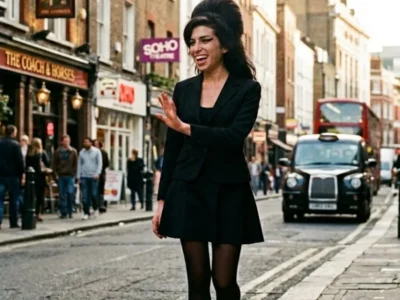
Barat told Brand that she was a jazz singer. Brand found this information bizarrely anomalous. jazz singer was not a category that the Camden bar scene of 2003 usually produced, and the girl he was looking at in the pink satin jacket did not particularly fit the image. She was shuffling around bars with mutual friends, most of whom were in indie bands, or were what Brand memorably called peripheral Camden figures with nailing their way through life on impotent charisma.

She was sweet and peculiar and most of all, in his word, vulnerable. He chatted to her anyway, and he noticed something that he did not fully register at the time, that he would only understand later in retrospect. She had about her what he described as the heir of elsewhere, the quality that all addicts share, he would write years later.
Regardless of the substance or the social status, they are not quite present when you talk to them. They communicate through a barely discernable but unignorable veil. They are looking through you to somewhere else they would rather be. Brand had worn that veil himself in the years before rehabilitation. He recognized it in Amy without knowing that he recognized it.
They were more alike than either of them understood in the pink satin jacket years. What changed for Brand was a concert. He saw Amy perform live with Paul Weller’s band at some point in the Frank era and experienced what he later described as the awe that envelops when witnessing a genius.
He wrote about it with the rhetorical extravagance that was always his mode. But underneath the performance of the pros was something genuine and specific. Her voice, he said, seemed not to come from her, but from somewhere beyond even Billy and Ella, from the font all greatness, a voice filled with such power and pain that it was at once entirely human, yet laced with the divine.
My ears, my mouth, my heart, and mind all instantly opened. He wrote, “Wine house. Winehouse. Winehouse.” He revised his assessment of the girl in the pink jacket. She was not just some hapless wannabe, yet another pissed-up knit who was never going to make it. Nor was she even a tenny shantus enjoying her 15 minutes. She was a [ __ ] genius.
And from that moment, he paid attention to her differently. She came on his television and radio shows. They remained connected through the Camden world they both moved in. And as Amy became famous, as the back to black years arrived and the tabloids arrived and everything that came with them, Brand watched from a proximity that was both personal and agonizing.
He understood what he was watching in a way that most of the people watching did not. He had been through the addiction and come out the other side, and he knew from the inside what the veil looked like, and what it cost to lift it, and why lifting it was harder than it appeared from the outside. Bran’s recovery had not been easy or linear.
He had documented it publicly in his standup, in his memoir, My Bookie Wook, in countless interviews with a cander that was unusual for a public figure, and that had made him in some circles the most visible recovering addict in Britain. He was not shy about what he had been through or what it had cost. He was also not shy about what had saved him.
He spoke about the 12step program with the evangelical enthusiasm of someone who had found something that worked and who believed that the reluctance to discuss it publicly was costing lives. This combination, the personal experience of addiction and recovery, the public platform, the willingness to speak about it directly meant that Brand occupied a unique position in relation to Amy’s story.
He was not an observer. He was not an industry figure who had watched from a professional distance. He was someone who had been where she was, who had found a way out of where she was, and who was watching her struggle with the specific anguish of someone who knows the exit exists and cannot make another person use it.
He understood why the public narrative frustrated him so deeply. The tabloids and the television programs and the comment sections were treating Amy’s addiction as a spectacle, as entertainment, as evidence of a character flaw or a poor decision or a failure of willpower. Brand knew with the specific authority of someone who had been an addict and had recovered that this framing was wrong in a way that was not just unfair, but dangerous.
Addiction was not a choice. It was not a character flaw. It was a disease. And the way the world was responding to Amy’s disease with cameras and headlines and the particular cruelty of public fascination was not helping her and might be making things worse. He had tried to articulate this while she was alive.
He had spoken publicly about addiction, about his own experience, about the gap between what the public thought addiction was and what it actually was from the inside. He had tried in the way that someone who has survived something tries to make the people who had not survived it understand what it felt like. He was not sure anyone was listening.
On July 24th, 2011, the day after Amy died, he sat down and wrote something. The essay he posted on his website that day titled Simply To Amy, is one of the most remarkable pieces of writing about addiction and loss that has been published in the 21st century. It is also, incidentally, one of the most honest and precise accounts of who Amy Winehouse actually was.
Not the tabloid version, not the Grammy version, but the person who had shuffled around Camden bars in a pink satin jacket and had a voice that came from the font of all greatness. He wrote about the phone call. He wrote, “When you love someone who suffers from the disease of addiction, you await the phone call. There will be a phone call.
The sincere hope is that the call will be from the addict themselves, telling you they’ve had enough, that they’re ready to stop, ready to try something new. Of course, though, you fear the other call, the sad, nocturnal chime from a friend or relative telling you, “It’s too late. She’s gone.” He had been waiting for one of those calls about Amy for years.
He had hoped with the specific hope of someone who knows what recovery looks like and believes it is possible that the call would be the first kind. He had feared with the specific fear of someone who also knows what the alternative looks like that it would be the second. On the morning of July 24th, he received the second. The essay did not stop at grief.
Brand had made a decision in the years since his own recovery that he was going to use his platform to say things about addiction that were not being said to argue publicly and with the full force of his ability with language that the way society treated addicts was wrong and needed to change. Amy’s death gave him an occasion to make that argument as directly and as forcefully as he had ever made it.
He wrote that we have lost a beautiful talented woman to the disease of addiction. He wrote that it is a disease and not a failure of character. He wrote about the futility of legal penalties for drug use. That you can’t arrest, prosecute or imprison the disease out of someone. He [snorts] wrote with the compassion of someone who had been there and the anger of someone who had watched the world respond to the thing he had been through with judgment rather than understanding.
The essay landed with a force that surprised even Brand. He was not the first person to write about addiction with compassion rather than judgment. And he was not the first person to argue that the legal and social response to drug dependency was counterproductive. But he was writing on the day after one of the most famous women in the world had died from it to an audience that was raw with grief and looking for something that made sense of what had happened.
His words met that grief with something that felt to the people who read them like the first honest account of the situation. He was also writing from a position of specific authority that nobody else who was writing about Amy that day could claim. The journalists writing her obituaries had known her professionally or had covered her or had observed her from the distance that most people observed famous people from.
Brand had known the veil. He had worn it himself. He had been the person in the bar who was not quite present, who was looking through conversations to somewhere else he would rather be. He knew from the inside what that felt like and what it cost and what it required to stop, and he was writing about it on the day that it had finally cost Amy everything.
The essay was read millions of times. It was shared across the internet in the days after Amy’s death with a velocity that suggested it had touched something real. That the people who loved Amy and were grieving her had found in Bran’s words an account of what had happened that felt more honest than the coverage in the newspapers.
[snorts] He had known her. He had understood what she was struggling with from the inside. and he had written about it with a clarity and a compassion that the tabloid press, which had covered Amy’s struggles for years without ever quite understanding them, had never managed to produce. A month later, at the 2011 MTV Video Music Awards, Brand delivered Amy’s eulogy from the stage.
He was the person they had chosen. Not an industry executive, not a chart topping collaborator, not a member of the recording academy, the man who had met her in a bar in Camden when both of them were barely holding on. He asked the audience to remember her for her music. He asked those in the audience who were struggling with addiction to seek help.
He said the only way to handle it is to not do it, to abstain. He was speaking from experience. He was speaking to anyone who needed to hear it. There is something important in the fact that Bran’s eulogy at the VAS was delivered by him and not from someone from the music industry. The Recording Academy had given Amy five Grammys.
Island Records had released her albums. The tabloids had documented her life for years. None of them were the right person to stand at that podium. Brand was the right person because he was the only person in that context who could speak about addiction from the inside who could say this is a disease not a failure and here is what that means.
He asked anyone in the audience who was struggling to seek help. He was speaking from experience. He was speaking to anyone who needed to hear it. The friendship between Russell Brand and Amy Winehouse was not the most documented relationship in her life. It was not the one that produced the most column inches or the most public drama.
It was the relationship of two people who had recognized the same thing in each other. the veil, the heir of elsewhere, the shared affliction, and who had moved through the same neighborhood and the same years with the same disease pulling them in different directions. Brand came out the other side. Amy did not.
He has spent the years since trying to understand why. Not to assign blame, not to construct a narrative, but because understanding it matters. Because the way the world treats people with addiction determines who survives it and who does not. And Amy, who had been treated by the world as a spectacle, had not survived. He wrote the essay in grief.
He also wrote it in the hope that something might change, that the next person who shuffled around Camden bars in pink satin jacket with the air of Elsewhere about them might be met with something other than cameras and headlines. that the next phone call might be the first