The ‘Forgotten’ Armoured Car That Fought Three African Wars And Overthrew Its Own Regime D
1967, a factory floor in Samora Correia, 40 km east of Lisbon, Portugal. A four-wheeled armored vehicle rolls off an assembly line for the first time. It is squat and angular, wrapped in welded steel plate no thicker than 12 mm. It looks unfinished. It looks cheap. It looks like something a small broke nation built because nobody else would sell them anything better, which is exactly what it was.
Officers who saw the first prototypes shrugged. European defense analysts ignored it entirely. NATO looked the other way. Even the Portuguese soldiers who would crew it were not entirely convinced. It looked like a minor footnote in the history of Cold War armored vehicles. It was anything but.
Over the next decade, this vehicle would fight in Angola, Guinea-Bissau, and Mozambique simultaneously. Three wars on three separate fronts across an entire continent. It would be exported to Peru, Lebanon, Libya, and the Philippines, where it fought guerrillas, militias, and armies. And then, on one morning in 1974, it would do something no armored vehicle had ever done before.
It would drive into the capital city of its own country, stop outside a government building, accept the surrender of the sitting prime minister, and carry him through streets lined with cheering civilians who were pressing carnations into its gun barrel. Its designation was the Bravia Chaimite 5200, and it was the only armored vehicle in history that ended the dictatorship that built it.
To understand why the Chaimite existed, you need to understand the position Portugal found itself in during the early 1960s. Portugal was a founding member of NATO. It had signed the treaty in 1949 along with Britain, France, and the United States. It sat on the alliance’s southern flank, controlling the Azores, a critical mid-Atlantic refueling point.
On paper, Portugal was a valued Western partner. In reality, Portugal was also the last colonial empire in Europe. It controlled Angola, Mozambique, and Guinea-Bissau, vast African territories it had no intention of relinquishing. And beginning in 1961, all three of those territories erupted simultaneously.
The Angolan War started on the 4th of February 1961. The Guinea-Bissau insurgency in January 1963. The Mozambique War opened on the 25th of September 1964. Portugal was fighting three separate counterinsurgency campaigns across thousands of miles with one of the weakest economies in Western Europe.
By the early 1970s, defense spending consumed roughly 40% of the national budget, and over 150,000 troops were deployed in Africa at any given time. The equipment those troops were fighting with was embarrassing. World War II era armored cars, half-tracks, light tanks that had been obsolete before the decade that produced them had even ended.
The inventory was a logistical nightmare. A patchwork of British, Canadian, French, and American designs, each requiring different spare parts, shipped across oceans to three different theaters. The obvious answer was to buy modern equipment from allies. The allies said no. The United States refused to supply vehicles outside NATO’s operational area.
The Netherlands cut off rifle exports in 1963. The United Nations Security Council passed resolutions calling on member states to stop arming Portugal for colonial war. Portugal was a NATO founder that could not buy NATO weapons. So, the Portuguese army decided to build their own. Major João Donas Botto was tasked with the project.
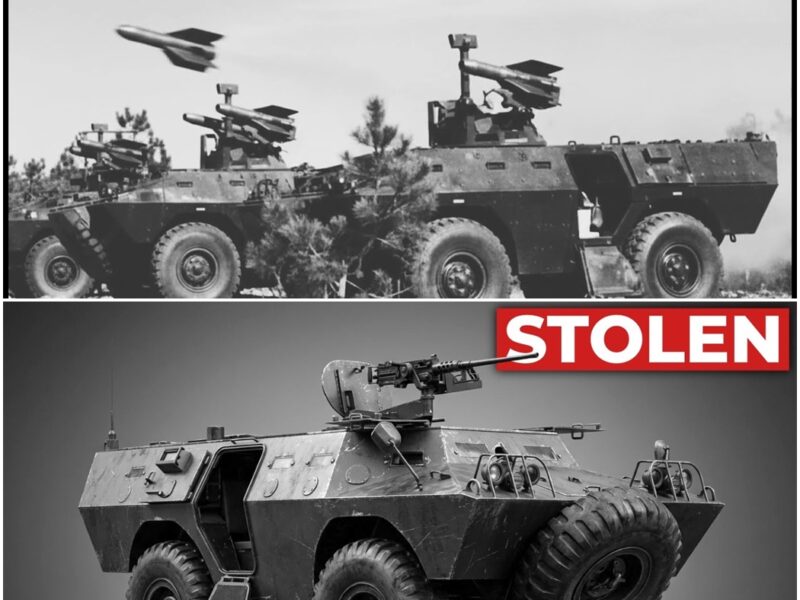
He traveled to the United States and made contact with two former employees of Cadillac Gage, the American firm that had just developed the V-100 Commando armored car for use in Vietnam. Those two employees stole technical blueprints and transferred them to Portugal. Both were subsequently prosecuted and convicted.
Donas Botto founded the company Bravia in March 1967 and established a production plant in Samora Correia, outside Lisbon. He named his vehicle Chaimite after the old Gaza Empire capital in Mozambique, where a Portuguese cavalry officer had captured the Mozambican king Gungunhana in December 1895, a name soaked in colonial mythology.
The irony of that choice would only become clear 7 years later. The Chaimite 5200 was a 4×4 armored personnel carrier, weighing approximately 7,300 kg in combat configuration. Its hull measured 5.6 m in length and 2.26 m in width, built from laser-welded ballistic steel plate. The standard power plant was a six-cylinder diesel, producing 155 horsepower, mated to an automatic transmission driving all four wheels through lockable differentials.
The range was the headline figure. From a 300 L fuel tank, the diesel Chaimite could travel 804 km without refueling. That figure dwarfed almost every contemporary. The French Panhard AML managed 600 km, the South African Eland 450, the British Ferret 306. In Africa, where patrol routes stretched for hundreds of kilometers between remote bases, range was not a luxury.
It was survival. The vehicle was fully amphibious, propelled through water by its own rotating wheels at nearly 5 km/h. In Guinea-Bissau’s river-threaded swamp terrain, this mattered enormously. Armor protection was rated to defeat standard rifle caliber fire and artillery fragments across the frontal arc.
The interior was lined with non-inflammable foam to reduce spalling when rounds struck the hull. The standard armament turret could be configured with twin 7.62 mm machine guns or a combination of one 12.7 mm heavy machine gun and one 7.62 mm weapon, traversing a full 360°. The crew consisted of commander, driver, and gunner, with seating for eight fully equipped infantry in the rear.
The first prototype was completed in 1966 at Military Engineering Workshops in Belém, Lisbon. The Portuguese army placed its first order of 28 vehicles in 1967, followed by 56 more in 1968. First production units reached troops in 1970. They went straight to the worst posting on the continent.
Now, before we get into where this vehicle actually fought and what it actually did, if you are finding value in this deep dive into overlooked military hardware, hit subscribe. It costs nothing. It takes a second, and it genuinely helps this channel grow. The first combat deployment was Guinea-Bissau. Portuguese Guinea was called Portugal’s Vietnam by the officers sent there, and not without reason.
The PAIGC insurgency, led by the Marxist theorist Amílcar Cabral, had seized control of roughly two-thirds of the country by the early 1970s. Its fighters were exceptionally well armed, supplied by the Soviet Union and Cuba with rocket-propelled grenades, heavy machine guns, and by 1973, surface-to-air missiles that neutralized Portuguese air cover.
The very first Chaimite prototype sent to Guinea for trials was destroyed by PAIGC insurgents using a rocket-propelled grenade. That was the opening statement. Production vehicles began arriving in January 1971, with approximately 18 units completed at that point. Crews learned quickly that Guinea was not Angola.
The dense jungle and river network stripped away the advantages of long range and road speed. Engagements happened at close quarters in terrain where the enemy could wait unseen at 10 m and fire before the turret could traverse. The Chaimite’s armor held against small arms fire and mine blasts, but crews took casualties to ambushes that would not have been possible on the open ground of Angola.
In Angola, the picture was different. The vast savanna and bush terrain suited the Chaimite’s strengths. Cavalry reconnaissance squadrons paired Chaimites with Panhard AML armored cars, the AML providing fire support with its 60 mm mortar, while the Chaimite carried the infantry.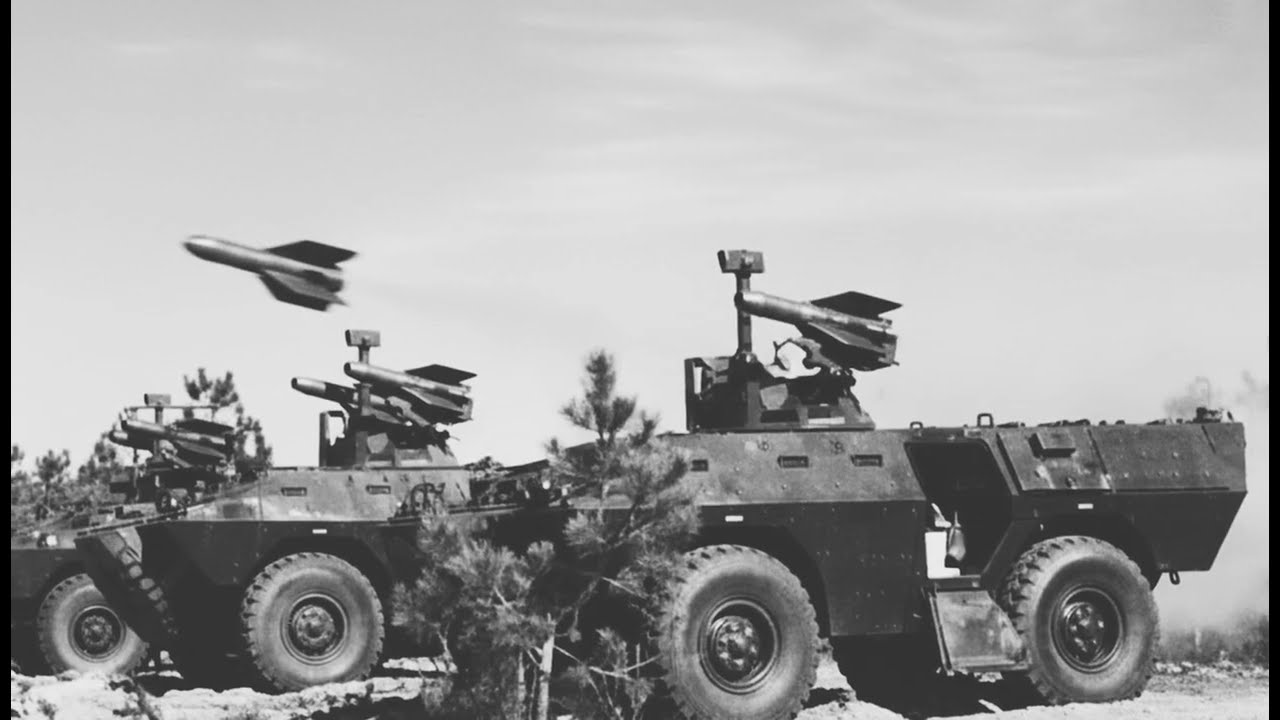
The combination gave Portuguese patrols a compact strike and maneuver package that worked across enormous distances. The 800 km range meant patrols could operate deep into contested territory without the vulnerability of fuel convoys. The locking differentials allowed the vehicle to push through soft ground and dry riverbeds that would stop a wheeled vehicle with a conventional drivetrain.
In Mozambique, FRELIMO operated through northern highland terrain, ambushing supply columns and attacking isolated garrisons. Chaimites escorted the convoys that kept remote outposts alive. They were not glamorous missions. They were grinding, repetitive, dangerous work in brutal heat, and the vehicles took it.
The hydraulic front winch, rated to 4,530 kg of pull, recovered vehicles that would otherwise have been abandoned. The run-flat combat tires allowed crews to drive out of ambush zones that would have left rubber-tired vehicles stranded. The Carnation Revolution arrived on the 25th of April 1974. Captain Fernando Salgueiro Maia, a cavalry officer who had served in Mozambique and Guinea, led approximately 240 men and 25 vehicles out of the cavalry school in Santarém before dawn.
Chaimites rolled through empty Lisbon streets in darkness. By early morning, they had surrounded the GNR barracks at the Largo do Carmo, where Prime Minister Marcelo Caetano had taken refuge. Caetano refused to surrender to a captain. He demanded general. By 7:00 in the evening, General António de Spínola arrived.
At approximately 7:30, a single Chaimite, known to its crew by the call sign Bula, drove into the Carmo courtyard. Caetano, his foreign minister, and his information minister climbed aboard. The vehicle drove them through 20 minutes of packed streets, crowds shouting victory in the night air, to the military command post at the First Engineer Regiment in Pontinha.
Somewhere along Rua do Carmo, a restaurant worker named Celeste Caeiro handed a carnation to a soldier sitting on top of a Chaimite who had asked her for a cigarette. He pushed the flower into his gun barrel. Others followed. The Carnation Revolution had its name. The vehicle built to defend a colonial empire had just ended one.
The Chaimite also went to war under different flags in the years that followed. Peru acquired 20 units beginning in 1971 for its naval infantry. From 1982 onwards, Peruvian marines deployed them in brutal counterinsurgency operations against Shining Path guerrillas in the Andean highlands, a conflict that ultimately claimed between 50,000 and 70,000 lives.
Lebanon ordered 30 vehicles in December 1972 for its internal security forces. When the civil war erupted in April 1975, those Chaimites were seized by Christian militias. In the Battle of the Hotels in October 1975, internal security forces Chaimite helped evacuate over 200 civilians trapped in downtown Beirut’s burning hotel district.
In 1981, Guardians of the Cedars militia Chaimites fought the Syrian army at the Battle of Zahle. Lebanon’s crews reported that the vehicle withstood not just rifle fire and mine blasts, but rocket-propelled grenade strikes in urban combat, a performance that exceeded its stated protection specification.
Libya ordered 60 vehicles, but canceled after Portugal established relations with Israel, leaving a handful of delivered examples eventually transferred to the Palestine Liberation Organization. One of those vehicles was captured by Israeli Defense Forces in the Bekaa Valley during the 1982 Lebanon War.
A single armored car had passed through Libyan, Palestinian, and Israeli hands. On paper, the Chaimite faced serious competition. The French Panhard AML, produced in vastly greater numbers and exported to over 40 nations, offered a 90-mm gun capable of defeating light armor at range. It was faster and more widely supported, but it carried no passengers.
It could not cross a river under its own power in all configurations. Its range was a third shorter. For a colonial counterinsurgency army that needed one vehicle to scout, to carry troops, to cross rivers, and to survive 3,000 km from the nearest major spare parts depot, the AML’s firepower advantage came with crippling tactical limitations.
The South African Eland, itself a license-built AML, faced the same trade-off. Like Portugal, South Africa was developing indigenous armored capability under international arms embargo pressure, and like the Chaimite, the Eland was born of isolation. It was a fine fighting vehicle. It was not a troop carrier.
The Cadillac Gage 5 100 Commando, the vehicle whose blueprints the Chaimite had been built from, was ultimately the closest comparison. Near-identical weight, similar dimensions, similar amphibious capability. Portugal separately purchased 15 genuine V-150 Commandos during the colonial war period, apparently without legal complications.
Bravia went bankrupt 1987. The vehicles outlasted the company by nearly three decades. In 1985, Portugal contracted Cadillac Gage itself to modernize the surviving fleet. The nation paid the company whose designs it had stolen 20 years earlier to maintain the vehicles built from those designs.
81 Chaimites remained in inventory as late as February 1992. They deployed to Bosnia under NATO peacekeeping operations and to Kosovo under KFOR. Portugal ordered the Austrian Panda 2 8×8 to replace them in 2005. The last operational Chaimites were retired in 2016, 49 years after the first production order.
Examples survive at the Museum of the Combatant at Fort of Good Success in Lisbon, and at the Military Museum of Elvas. In June 2019, a Chaimite was incorporated into a permanent monument to the events of the 25th of April 1974 in Póvoa de Varzim. A replica of the Beula was restored for the 50th anniversary celebrations in 2024.
Lebanese Internal Security Forces Chaimites, refurbished with Mercedes diesel engines by American contractors in 2006, deployed against Fatah al-Islam militants in Tripoli in May 2007. Some remain in service today. Return to Samora Correia 1967. A vehicle rolling off an assembly line that most of the world never noticed.
It was underpowered by the standards of the era’s best armored cars. Its armor was light. Its weapons were modest. Its manufacturer went bankrupt before the Cold War ended. Its own origins involved industrial espionage and a criminal prosecution in the United States. Its export record ran through some of the most violent corners of the 20th century, from the Peruvian highlands to the backstreets of Beirut, to a Palestinian encampment in Lebanon.
And yet it worked. In Angolan savanna and Mozambican highlands, in Guinea-Bissau swamps, in the alleys of Beirut, in the mountains of Peru, in the streets of Lisbon on the morning the dictatorship fell, the Chaimite was born from desperation, built by a country the world had decided to ignore.
It fought wars that nobody outside Africa was watching. It survived them all, outlasted its manufacturer, outlasted its wars, and outlasted the empire it was built to preserve. That is not luck. That is what happens when a nation with no other option decides to build something that simply cannot afford to fail.