Why Rommel’s Afrika Korps Couldn’t Break Free French Legionnaires Holding Bir Hakeim For 16 Days D
Rommel’s plan for the southern end of the Gazala line handed the job to a single Italian armored division as a side task on the way to Tobruk. The British had put the Free French there almost as an afterthought. The thin end of the line held by an army that Cairo still measured against the collapse of 1940.
One account has Rommel expecting the surrender inside a day. It held 16. What held it was not defiance and not luck. It was roughly 1,200 holes chipped into desert rock by legionnaires who considered digging beneath a fighting man. On the first morning of the assault, 31 Italian tanks burned in a ring around Bir Hakeim, a position with almost nothing standing above ground level.
A brigade with no tanks, no relief, and field guns designed in 1897 cost Panzer Army Afrika two weeks it could not spare. This is the audit of how. On the 14th of February, 1942, the first Free French Brigade under General Marie-Pierre Koenig relieved a British infantry brigade at the box. There was almost nothing there.
A dry well, the ruin of an Ottoman fort, an old camel corps post at the crossing of two Bedouin tracks. The position was a rough pentagon about 4 km by 5 sitting at the bottom of the Gazala line where the defenses thinned out and the minefields were expected to do most of the work. They were given 3 and 1/2 months.
They spent them digging. The legion’s trade before the war had not only been fighting, it had been construction, roads, bridges, forts across French North Africa. Most of it done with a pick, a shovel, and no machinery at all. Legionnaires had hated that work. They thought it was beneath a soldier.
Now they did it again in rock that turned picks blunt, in heat that ran over a hundred by day, and dropped to cold by night with the ghibli, the desert wind, filling every trench they opened. Who was in those holes changes what losing would mean. The core was the 13th Demi-Brigade de Légion Étrangère, and by 1942 that meant Spanish Republicans who had already lost one war, Poles, Jewish refugees, Germans who had left Germany.
In the Legion, an enlistment name was an identity rather than a nationality. Alongside them stood colonial battalions from Ubangi-Chari, Chad, and the Congo, and the Bataillon du Pacifique, volunteers from Tahiti and New Caledonia. Opposite them, in the German 90th Light Division, were about 2,000 German legionnaires pressed into service out of Vichy North Africa.
Former comrades. For part of the garrison, capture was not going to mean a prisoner of war camp. That was the official view of what they were worth, an afterthought at the thin end of the line. Their colonel, Dimitri Amilakhvari, is often quoted saying that foreigners had one way to repay France, by dying for her, though accounts differ on when he said it.
What nobody wrote down was the arithmetic underneath, how a position with no armor and no way out was supposed to survive one armored division, let alone whatever came after it. First, the ground. By the middle of May, the position was honeycombed, roughly 1,200 entrenchments, foxholes, gun pits, bunkers, and buried hides for vehicles and supplies.
The interior was divided into zones, each one a unit’s responsibility, with Koenig’s headquarters near the center at the crossroads. Almost none of it stood above the desert. Guns sat in deep pits with the lip at ankle height. Vehicles went underground. On the surface, it looked like a fortress.
It was the opposite of a fortress. A fortress is something you can see. Consider what that does to an air campaign. A dive bomber pilot needs an aiming point, a wall, a tower, a parked column, a shadow that says, “A man is here.” Bir Hakeim offered him a flat plane with holes in it.
Stukas came at the position more than 20 times, and the British official history describes the French works as so well built as to be almost invulnerable. What does a hundred aircraft do to a hole in the ground? Less than expected, and less every day, because a hole that survives one raid gets deepened before the next one arrives.
The northern face was dug by the battalion from Ubangi-Chari and the gunners from Chad and the Congo. In June, they would hold that low-rise under 60 aircraft at a time. There is no plaque in Paris carrying their battalion’s name, and around all of it set the part that has not been explained yet. Wire and 50,000 mines.
Then, the mines. 50,000 of them, anti-tank and anti-personnel, laid in V-shaped belts around the box. Begun by Indian troops before the French arrived, extended afterwards. The number is impressive. The number is not the point. A minefield is not a wall. Treated as a wall, it fails because armor will always find somewhere to breach it.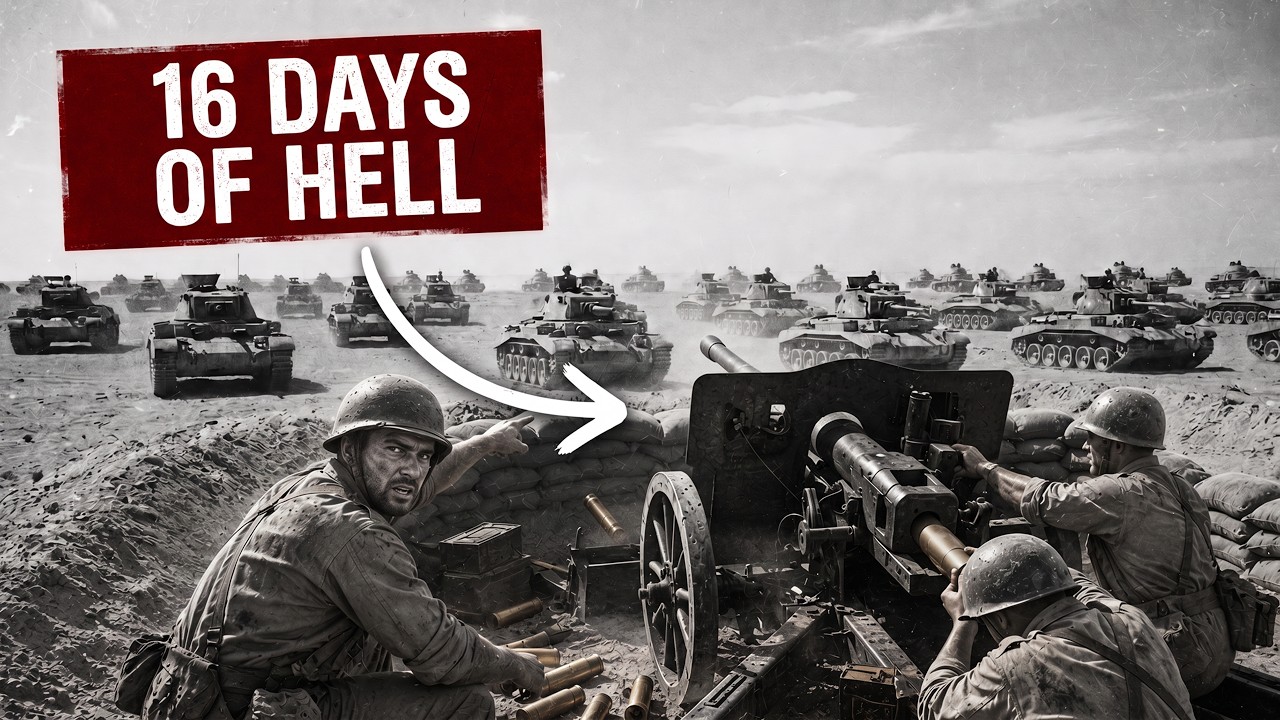
Treated as a funnel, it becomes something else, a way of deciding months in advance where the enemy will be standing at the moment he finally gets through. That is what the belts did. They did not seal the position. They chose the ground. Lanes ran through them, and those lanes were patrolled by 63 Bren carriers of the Legion’s third battalion, working in three squadrons, pushing north toward the neighboring box.
A lane is a matter of trust. It is safe because a man mapped it correctly in the dark and told the truth about it afterwards. And every crew that drove one was betting on that. The 27th of May, quarter past 8:00 in the morning, an Italian tank battalion of the Ariete division came at the wire in a charge.
It lost 31 tanks and a Semovente self-propelled gun in front of the position, 32 in some accounts. 10 tanks got through the mines. All 10 were destroyed at close range by the French 75s. 124 Italian casualties. The colonel of the tank regiment was pulled out of his wrecked machine and taken prisoner. The mines did not stop the attack.
They concentrated it. The guns finished it. That was the first morning. The next day the Desert Air Force came over in poor visibility, saw a ring of burnt-out Italian tanks, and bombed Bir Hakeim by mistake. Koenig sent men out to destroy the wrecks. The proof of their own success had turned into a marker pointing straight at them.
What made the funnel worth building was the third part. What was waiting at the end of it. Roughly two dozen field pieces, the counts differ between sources, of the Canon de 75 model 1897, a design that was 45 years old in 1942, on paper obsolete. With them a company of anti-tank guns, 47 and 25-mm anti-tank rifles and Bofors for the aircraft.
An old gun in the open is a target. An old gun in a pit on ground its crew has been surveying and registering for three and a half months, laid along a lane the enemy has been funneled into, does not need to be modern. It needs to be right the first time. The pit buys it one shot before the position is known. None of this was passive, which is the part the word siege hides.
Through the spring the brigade ran Jock columns, mobile raiding groups, out into the desert and kept running them after the ring closed. A detachment under Amilakhvari destroyed an Axis vehicle repair workshop. In his order of the day of the 15th of June, Koenig counted 154 Italian and 25 German prisoners taken on those sorties.
A garrison that keeps taking prisoners is not a garrison waiting to die. And on the night of the 7th of June in thick fog, an officer cadet named Bellec walked out through the German lines and back in again to bring the last convoy through. On the 2nd of June at half past 10:00 in the morning, two Italian officers came forward under a white flag and asked for the capitulation of the position.
Koenig refused. Then the weight came down. Artillery that outranged the French guns. Air attacks that did not stop. On the 8th, the Desert Air Force flew 478 sorties over the battle, a record, and the northern perimeter still buckled. An ammunition dump went up. On the 10th, 100 Stukas dropped something like 130 tons of bombs onto a position 4 km across.
So, how do you tell whether the holes actually worked? By counting. Across 16 days under all of that, the garrison lost 141 men killed out of a strength usually given as around 3,700. The returns vary. 3,600 in some, 4,000 in others. 141 under that. And Rommel with the position visibly failing, still would not send his tanks in.
He expected it to fall the following day and was not willing to lose armor in the minefields to make that happen sooner. 16 days in, the belts were still deciding what he could do. Inside on the 8th, the buried aid post was destroyed with wounded men in it. A detail that comes from Polynesian commemorative accounts rather than the official record.
By then, the mortar rounds were being counted out one at a time. On the 9th of June, Lieutenant Colonel Felix Broche, who had brought the Bataillon du Pacifique from the islands to the desert, was hit by a shell splinter in his post and died in his orderly’s arms. Koenig held the news back a day. That comes from Broche’s son recounting what Koenig told him afterwards, testimony rather than document, and the reasoning was plain enough.
Men who have just lost their commander do not break out well because the breakout was the only thing left. The system had done what it was built to do and none of it could leave with them. The holes stayed. So did the guns. On the night of the 10th, sappers went out to cut a corridor 200 m wide through the French mines.
They managed a narrow lane. The column moved 75 minutes late in the dark through a gap barely wider than a truck. Koenig went out at the head of it in a Ford driven by Susan Travers, an Englishwoman attached to the medical section. The guide had lost his way. The headquarters column was blown up three times on mines.
When the column jammed against German troops, Koenig ordered it to rush the line regardless of what was under foot. And in that fight, Le Maz, Ricogne, and Dewey were killed. Travers kept her foot down. Her car reached British lines with 11 bullet holes in it. By 7:00 that morning, around 2,700 men were out.
814 were taken prisoner. Hitler had ordered that captured German political refugees be killed. Rommel did not carry the order out. Churchill stopped calling them the Free French. After Bir Hakeim, they were the Fighting French. In Paris, the Viaduc de Passy was renamed Pont de Bir Hakeim and the metro station beside it took the name, too.
The renaming is usually dated to 1948. The public ceremony with de Gaulle and Koenig present was held on the 18th of June 1949. The sources do not quite agree. The plaque on the bridge says the brigade told the world that France had never stopped fighting. The dismissal made sense at the time. The box was flat, isolated, hard to relieve, and held by an army with two years of defeat behind it.
It was wrong anyway, and the cost of being wrong is measurable in days, in aircraft, in the tanks Rommel would not risk. This June the 13th demi-brigade, now at Larzac, marked the 84th anniversary, and its general told serving legionnaires to remain worthy of the men who held it. In Paris, a train crosses a bridge named after a dry well in Libya, past a plaque that names the brigade and not the battalion from Tahiti and New Caledonia, or the one from Ubangi-Chari.
If this is the kind of history you want more of, like the video and subscribe. And if your family has a connection to the 13th demi-brigade, to the Bataillon du Pacifique, to the March Battalion from Ubangi-Chari, or to the crews who served those 1897 guns, tell me about it in the comments.
And if a name belongs on that plaque, tell me whose.