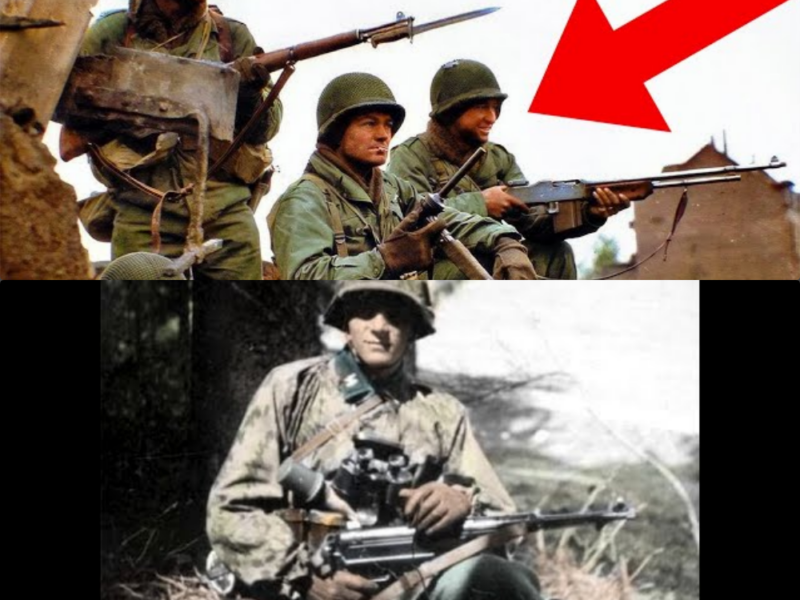
American SS Renegades – The George Washington Legion
The Twisted Reality of the George Washington Legion: American Traitors in the SS
The history books often tell us about the heroism of the Allied forces, but they rarely focus on the sinister handful of Americans who defected to the Third Reich. While rumors of a George Washington Legion have persisted for decades, the true story is even more unsettling. This was not a legion of thousands, but a collection of disillusioned, ideologically driven individuals who chose to serve in the German military, including the notorious SS.
Among them was a pilot who pulled off an audacious theft of an American warplane, flying it straight into enemy-occupied territory to offer his services to the Nazis. From radio propaganda roles to frontline reporting for the SS, these men were not just soldiers; they were pawns in a global psychological war. Their stories of treason, subsequent court-martials, and bizarre attempts to return to normal life after the smoke cleared are as gripping as they are repulsive. What drove these men to commit the ultimate betrayal against their own countrymen?
And how did one man manage to serve in the SS only to re-enlist in the United States military years later? Uncover the shocking, forgotten facts about these American renegades and the consequences of their actions. The full account is available now, and it is a piece of history that you simply cannot afford to miss. Check out the link in the comments for the full story.
In the annals of the Second World War, the narrative is often one of absolute clarity: the Allied forces standing against the tyranny of the Axis powers. However, history is rarely as black and white as we wish it to be. Beneath the surface of grand battles and strategic movements lie stories of moral ambiguity, confusion, and, in the most extreme cases, outright betrayal. One of the most persistent legends of the war concerns the “George Washington Legion,” a supposedly large unit of American soldiers who defected to the German SS to fight against their own country. While the name itself is largely a myth—a product of post-war thriller fiction rather than military reality—the underlying truth is far more unsettling: American citizens did, in fact, defect to the enemy, and some did indeed find their way into the ranks of the SS.

The Myth of the Legion
The concept of a “George Washington Legion” has been popularized by authors such as Jack Higgins, creating a mental image of a regimented battalion of Americans fighting for the Third Reich. History, however, dictates otherwise. The Germans, particularly the SS, were certainly opportunistic recruiters. They drew from the populations of occupied territories and even sought to capitalize on Allied prisoners of war, most notably through the British Free Corps. Yet, when it came to Americans, the numbers were not there to form a dedicated, battalion-sized unit. The sheer distance from the theater of war and the overwhelming loyalty of the vast majority of U.S. troops meant that such a large-scale defection was impossible.
However, the lack of a formal “legion” does not mean that the phenomenon of American treason was non-existent. Throughout the war, a small but notable number of Americans serving in the German military did appear. These men were often driven by a toxic combination of anti-communist sentiment, misplaced ideology, and, in some cases, personal opportunism.
The Anatomy of a Traitor: The Case of Martin James Monti
Perhaps the most spectacular example of an American turncoat is the story of Martin James Monti. Born in 1921 in Saint Louis, Monti was the son of a Swiss-Italian father and a mother of German ancestry. Like many of his contemporaries who eventually turned to the dark side, Monti was virulently anti-communist, an ideology that would eventually lead him to align with the Nazi regime.
Monti’s path to treason was unconventional and brazen. Enlisting in the U.S. Army Air Corps in 1942, he trained as a pilot, becoming qualified on formidable aircraft like the P-39 Airacobra and the P-38 Lightning. By 1944, he was a first lieutenant stationed at the 126th Replacement Depot in Karachi, then part of British India. It was here that Monti decided to abandon his oath of service.

In a move that defied logic and duty, Monti went absent without leave (AWOL). He hitched a ride on a transport plane to Cairo, then made his way through Tripoli, eventually reaching the Italian front. His goal was not to return to his unit, but to defect. Upon arriving at the airfield of the 354th Air Service Squadron near Naples, he saw an opportunity: a P-38 Lightning variant—an F5E—that required a test flight. Monti stole the aircraft and flew it directly into German-occupied Italy, landing in Milan on October 13, 1944. He had defected to the Axis, and he had handed them a perfectly intact piece of American military technology in the process.
Life as an SS Renegade
Once in German hands, Monti worked to convince his captors of his ideological purity. He was not immediately discarded; the Germans saw value in American defectors for the purposes of propaganda. Initially, Monti attempted to work in radio broadcasting alongside the infamous “Axis Sally” (Mildred Gillars), but he found little success in that arena.
His true “home” became the SS. Monti was inducted as an SS-Untersturmführer (second lieutenant) into the SS-Standarte Kurt Eggers, a special propaganda unit composed of war reporters and correspondents. This was not a safe desk job; these units were often sent to the front lines to document the war, and many paid for their service with their lives. During his time in the SS, Monti adopted his mother’s maiden name, “Viitoff,” to mask his identity.
His tenure in the unit was marked by the drafting of leaflets intended to demoralize Allied prisoners of war, urging them to abandon their fight against the German regime and join the struggle against the Soviet Union—a narrative he felt aligned with his own anti-communist views. He served in northern Italy until the final collapse of Nazi Germany in May 1945, eventually surrendering to U.S. forces while still wearing his SS officer’s uniform.
Justice and the Bizarre Aftermath
The conclusion of Monti’s story is perhaps the most shocking part of his life. After the war, he faced a court-martial for desertion and stealing an aircraft. In 1946, he was sentenced to 15 years in prison, but due to a series of bureaucratic oversights and the chaotic nature of the immediate post-war period, his service in the SS was largely overlooked during the sentencing phase.
In an act that defies belief, his prison sentence was suspended, and he was allowed to re-enlist in the U.S. Army Air Forces in 1947. He served as a private and had even been promoted to sergeant before his discharge in early 1948. It was only then—just moments after leaving the military for the second time—that the FBI caught up with him.
The gravity of his treason finally descended upon him. Indicted on 21 counts of treason under the name Martin Viitoff, he pleaded guilty in 1949 and was sentenced to 25 years in prison with a $10,000 fine. He served his time at Leavenworth, was paroled in 1960, and lived the remainder of his life in obscurity until his death in 2000.
Reflection on a Dark Chapter
The story of men like Martin Monti serves as a stark reminder that even in the most clearly defined moral struggles, the human element remains unpredictable and susceptible to corruption. While there was no legion of thousands, the few who chose to betray their country left a stain on the history of the American war effort. Their stories remain a cautionary tale about the dangers of unchecked ideological fervor and the ultimate, inevitable consequences of abandoning one’s core values in the face of tyranny. The George Washington Legion may have been a myth, but the betrayal it represented was very real.