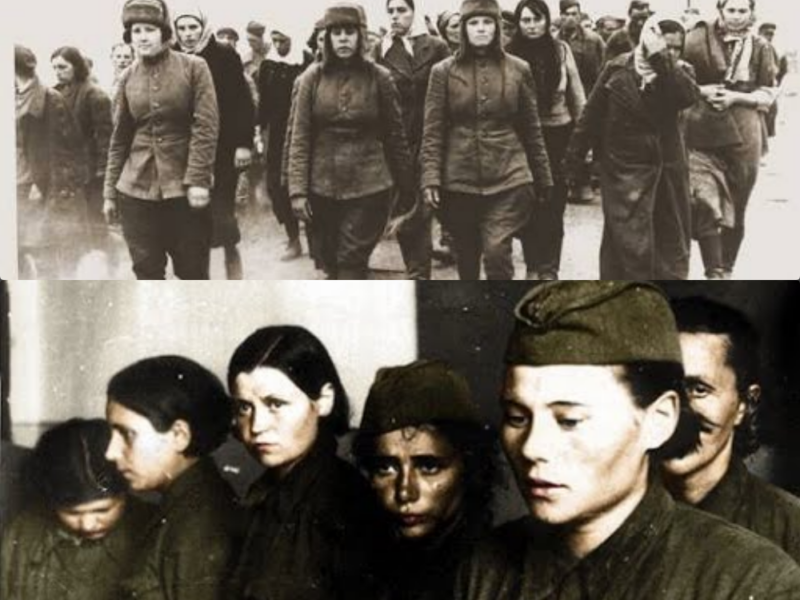
Captured Soviet Female Soldiers – How Did the Germans Treat Them?
The Forgotten Front: The Chilling Fate of Captured Soviet Female Soldiers
Picture a conflict where ideology dictates the value of a human life, even on the battlefield. On the Eastern Front, the German Wehrmacht found itself face-to-face with an adversary they refused to respect: female Red Army soldiers. Branded with derogatory slurs and viewed as a stain on military honor, these women were subjected to systematic execution, horrific assault, and imprisonment in the darkest corners of the Nazi camp system. While the regular German army wrestled with the concept of women in combat, the reality of their treatment was nothing short of criminal.
Field marshals issued direct orders to shoot women in uniform without trial, and thousands met their end at the hands of units who saw them as nothing more than pests to be cleared from the field. Those who survived the initial onslaught often faced a fate arguably worse: being handed over to the SS for concentration camp internment. This was a war of annihilation, and for Soviet women, the front lines were a death sentence.
How did these women manage to serve in roles like snipers, pilots, and anti-aircraft gunners despite the threat of such terrifying reprisals? And what does their story tell us about the extreme nature of the war between Nazi Germany and the Soviet Union? We are peeling back the curtain on this dark historical reality. Click the link in the comments to read the full report and witness the untold history of the women who fought on the front lines against the odds.
When the German Wehrmacht launched Operation Barbarossa on June 22, 1941, they stepped into a conflict unlike any they had encountered in Poland, France, or the Low Countries. The Eastern Front was not merely a territorial struggle; it was a total war of annihilation driven by opposing ideologies—National Socialism and Soviet Communism. Among the many clashes of this campaign, one development particularly disgusted and unsettled the German military: the presence of female combatants in the Red Army.
To the German soldier, indoctrinated with Nazi propaganda that denigrated the Soviet population as “sub-human” and viewed women’s roles through a rigidly traditional lens, the sight of a Soviet woman in uniform was incomprehensible. While the German army would eventually be forced to conscript women for auxiliary and non-front-line roles to manage manpower shortages, the front line remained, in their eyes, a strictly masculine space. The Soviet Union, however, operated on the premise of gender equality in the defense of the motherland. Women served as nurses, but they also manned anti-aircraft batteries, flew fighter and bomber missions, and, most famously, served as snipers who struck terror into the hearts of their enemies.

This defiance of gender roles in the military triggered a visceral, hateful reaction from the German forces. They referred to female Red Army soldiers as “flintenweiber”—a derogatory term loosely translating to “rifle broads”—and viewed them as the embodiment of everything wrong with the communist system. As the invasion progressed and large numbers of these women were captured, they were rarely granted the treatment afforded to prisoners of war (POWs) under international conventions. Instead, they were frequently treated as partisans or degenerates and targeted for immediate execution.
The systemic nature of this abuse was evidenced by the official orders issued by high-ranking German commanders. On June 29, 1941, only a week into the invasion, Field Marshal Günther von Kluge ordered that “women in uniform are to be shot.” While this specific order was later rescinded, the sentiment remained deeply embedded. In October 1941, Field Marshal Fedor von Bock and other commanders issued similar instructions, asserting that women soldiers were to be executed immediately upon capture. These were not the isolated actions of rogue soldiers, but the explicit directives of a military machine operating under the belief that these women were essentially outside the protection of international law.
Reports from the field confirm that these orders were executed with grim efficiency. One infantry division reported the execution of thirty female Soviet soldiers shortly after their capture. For those who were not executed on the spot, the situation was often even more harrowing. Many were subjected to horrific sexual assault before their deaths. Those who were taken prisoner were rarely kept in standard POW camps—which were themselves death traps where millions of male Soviet prisoners perished from starvation and abuse—but were instead handed over to the SS. These women were sent to concentration camps, most notably Ravensbrück, the largest concentration camp for women, or to Auschwitz-Birkenau. It is estimated that around 18,000 Soviet female POWs passed through the gates of Ravensbrück alone.
The psychological impact of these realities led many Soviet female soldiers to a desperate choice: suicide. Facing the prospect of torture, sexual violence, or death in a concentration camp, many chose to end their own lives if capture became imminent. This cycle of violence and the disregard for the basic humanity of these women serve as a grim reminder of the extremity of the Eastern Front. It was a war where propaganda fueled a hatred so deep that it reached out to strike down those who dared to defy traditional military norms.

The story of the Soviet female soldier is a testament to the courage of those who fought, but it is also a somber reflection on the brutality of the Nazi regime. While history has celebrated the exploits of the “Night Witches” and the legendary snipers, the quiet, horrific fate of those who were captured remains a vital piece of the narrative. By examining these accounts, we gain a clearer understanding of how the war on the Eastern Front eroded the boundaries of civilization and forced combatants to face choices that no human being should ever have to confront.
As we look back at the Second World War, the fate of these women stands as a stark indicator of how totalitarian ideologies can strip away the protections of war and replace them with institutionalized cruelty. The regular German army’s role in these executions and abuses underscores the extent to which the dehumanization of the enemy had permeated all levels of their military command. The soldiers, who viewed themselves as disciplined professionals, were in fact participants in a massive, systemic failure of moral duty.
To understand the Eastern Front fully, we must recognize that the war was not just about territory or the fate of nations; it was about the collision of irreconcilable worldviews that resulted in the most extreme suffering. The Soviet women who went to the front lines knew the risks, yet they stepped forward to defend their homeland. Their bravery in the face of an enemy that viewed them not just as combatants, but as moral outcasts, is a chapter of history that deserves to be remembered with gravity and respect.
The legacy of these women is defined by their immense contribution to the war effort and their tragic sacrifice. With nearly one million Soviet women serving during the war, their presence was a defining feature of the conflict. The fact that almost 200,000 of them were decorated, with 89 receiving the title “Hero of the Soviet Union,” speaks to their extraordinary heroism. However, for those captured, the recognition of their service was replaced by the cold, brutal hand of their captors.
Today, as we analyze the records and testimonies left behind, we see the true face of the Eastern Front. We see a war where the lines between combatant and non-combatant were blurred by hatred, and where the treatment of prisoners was dictated by the darkest impulses of the regime. The story of captured Soviet female soldiers is one of the most painful, yet necessary, stories to recount. It forces us to confront the reality of how quickly humanity can be discarded in the heat of ideological warfare, and it ensures that the sacrifices of these women are not lost to the silence of history.
In exploring this narrative, we see that the treatment of captured female soldiers was consistent with the wider policy of “Vernichtungskrieg” (war of annihilation) pursued by Germany in the East. This was not a side effect of the conflict; it was central to its execution. The targeting of women was an attempt to degrade the Soviet military spirit and enforce a vision of society that the Nazi Party sought to impose across all conquered territories.
Ultimately, the plight of these women underscores the fundamental differences in how the war was prosecuted in the East versus the West. In the West, soldiers were generally treated as prisoners; in the East, they were viewed as ideological foes to be exterminated. The women of the Red Army found themselves at the center of this distinction, bearing the brunt of a regime that could not accept them as soldiers, as women, or as human beings. Their memory stands as a reminder of the atrocities that can occur when the forces of intolerance are given free rein, and it serves as a powerful call to remain vigilant in our own time.
By examining the specific fate of these soldiers, we honor their struggle and ensure that their voices, which were silenced by the brutality of their captors, are heard by future generations. We must continue to peel back the layers of history, uncovering the uncomfortable truths that have been buried by time, to better understand the fragility of the peace we enjoy today. The stories of these women remain a vital, if tragic, part of our global heritage, reminding us of the cost of freedom and the devastating price paid by those who were at the forefront of the fight against tyranny.
In closing, the systematic abuse and execution of captured Soviet female soldiers remain one of the most disturbing aspects of the Second World War. Their story challenges our perception of the conflict, moving beyond the grand strategies and battles to the individual experiences of those who were caught in the gears of total war. It is a story of extreme courage pitted against extreme hate, and in the end, it is a story that requires our attention and our continued remembrance.