Hitler Promoted 12 Field Marshals in One Day — What Happened to Them?
Hitler Promoted 12 Field Marshals in One Day: The Shocking Fates of the Nazi Elite
Behind the glittering pomp and circumstance of Nazi Germany’s finest hour in the summer of 1940 lies one of the most chilling and dark historical narratives of the Second World War. On July 19, Adolf Hitler gathered his most senior commanders inside the historic Croll Opera House to bestow upon twelve generals the ultimate military honor of Field Marshal, alongside Hermann Goring’s unprecedented elevation to Reich Marshal.
It was meant to be an unbreakable seal of loyalty and a permanent monument to German invincibility after the stunning defeat of France. Instead, it marked the exact high-water mark before a catastrophic fall that would see the highest echelons of the German military machine tear itself completely apart from the inside out.
From brutal executions by Allied gallows and desperate cyanide suicides on fleeing roads to mysterious medical releases and shocking post-war acquittals, the fates of these twelve commanders exposed the rotten, crumbling core of Hitler’s inner circle. Uncover the untold aftermath of how betrayal, war crimes, and poetic justice caught up with Hitler’s chosen elite. Check out the full post in the comments section to read the complete story.
The summer of 1940 marked the undisputed zenith of Nazi Germany’s military expansion and territorial conquest across Europe. Following the astonishingly rapid defeat of Poland in the autumn of 1939, followed swiftly by the invasions of Denmark and Norway in the spring, the German Wehrmacht achieved what many military analysts considered unthinkable. In a ferocious six-week campaign, German armored divisions overran the Netherlands, Belgium, and France—a nation widely regarded at the time as possessing the strongest and most formidable army on the European continent. Eager to immortalize this staggering triumph and project an aura of invincible hegemony, Adolf Hitler decided to stage a victory celebration of unprecedented theatrical scale. On July 19, 1940, the Nazi dictator summoned his senior military commanders to the Croll Opera House in Berlin, the historic building that had served as the seat of the German parliament since the infamous Reichstag fire of 1933.
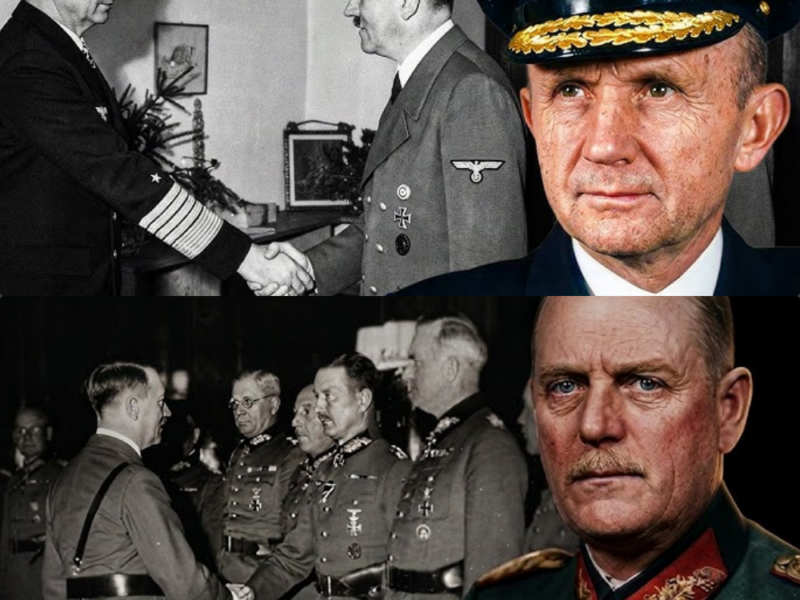
What unfolded inside the Croll Opera House that afternoon was less a standard military briefing and more a carefully choreographed political pageant. Following a lengthy address celebrating the martial prowess of the armed forces, Hitler called his senior generals forward one by one to present them with ornately decorated batons symbolizing the highest rank attainable in the German military: Field Marshal. Newsreels captured the grandiose scenes for domestic consumption, showing rows of decorated senior officers standing at attention as Hitler moved down the line. Beyond the immense prestige attached to the promotion, the rank carried substantial material privileges. A German Field Marshal received an annual tax-free salary of 36,000 Reichsmarks and was granted lifetime active-duty status, exempt from formal retirement. The rank itself held deep historical reverence within German military culture, having been abolished following the defeat of 1918 and only recently resurrected under Hitler’s aggressive rearmament program. By elevating twelve commanders to Field Marshal in a single afternoon, Hitler sought to reward their battlefield successes while tightly binding their ambitions to his regime, asserting absolute control over an aristocratic officer class whose traditional independence and skepticism toward the Nazi party he had never fully trusted.
When the curtain fell on the ceremony, twelve officers who had walked into the hall as generals departed as Field Marshals. The army contingent comprised prominent commanders such as Walther von Brauchitsch, Fedor von Bock, Wilhelm Keitel, Günther von Kluge, Wilhelm Ritter von Leeb, Wilhelm List, Walter von Reichenau, Gerd von Rundstedt, and Erwin von Witzleben. Joining them from the Luftwaffe were Albert Kesselring, Erhard Milch, and Hugo Sperrle. Standing even higher above them all was Hermann Göring, who was raised that very same day to a uniquely created rank—Reichsmarschall of the Greater German Empire—placing him above every other officer in the armed forces and cementing his status as Hitler’s designated political successor. The ceremony was meticulously designed to project an image of an elite, unified military aristocracy leading Europe into a glorious new epoch. Yet, history would reveal that this grand spectacle was not the dawn of a permanent golden age, but rather the glittering high-water mark before an inevitable, catastrophic fall. Furthermore, the selection of men standing on that stage offered deep insight into the specific brand of military compliance Hitler demanded, as well as the ostracization awaiting those who dared exhibit moral hesitation.
The unraveling of Hitler’s newly minted elite occurred gradually over the subsequent five years of relentless total war, turning the Croll Opera House stage into a haunting prelude to disgrace, execution, and ruin. Wilhelm Keitel, who occupied the highest position on paper as Chief of the Armed Forces High Command (OKW), demonstrated an unswerving, servile loyalty to Hitler until the bitter end. Keitel routinely affixed his signature to criminal orders that stripped legal protections from prisoners of war and civilians across occupied territories, enabling horrific atrocities. As the Reich collapsed in absolute ruin, it was Keitel who signed Germany’s unconditional surrender documents in Berlin on May 8, 1945. His defense at the postwar International Military Tribunal in Nuremberg—claiming he was merely following superior orders—was firmly rejected by the Allied judges. Keitel was convicted on all four counts of war crimes and crimes against humanity, meeting his end on the gallows at Nuremberg prison on October 16, 1946.
In stark contrast, Erwin von Witzleben traversed the exact opposite path, moving from the pinnacle of military honors into active resistance against the Nazi regime. Disgusted by Hitler’s reckless strategic blunders and moral depravity, von Witzleben became a central architect of the July 20, 1944 bomb plot aimed at assassinating the dictator and overthrowing the government. Had the conspiracy succeeded, von Witzleben was slated to assume the role of Commander-in-Chief of the armed forces. When the assassination attempt failed, von Witzleben was swiftly arrested, stripped of his military rank, and ignominiously expelled from the army so that he could be subjected to the humiliating theatrical show trials presided over by Judge Roland Freisler at the Nazi People’s Court. Condemned for treason, von Witzleben was brutally executed at Plötzensee prison in Berlin on August 8, 1944. Thus, within a span of two years, two of the twelve Field Marshals appointed in 1940 met violent ends at opposite sides of the ideological spectrum—one hanged by Allied victors for serving Hitler, and the other hanged on Hitler’s direct orders for trying to destroy him.
Other members of the elite cohort never survived long enough to face any formal postwar judicial reckoning. Walter von Reichenau, one of the most politically radicalized and fiercely committed ideological commanders in the East, led the Sixth Army during the invasion of the Soviet Union. In late 1941, he issued a notorious directive to his troops—subsequently known as the severity order—that explicitly bound the army to participate in genocidal atrocities behind the front lines. However, in January 1942, after running through extreme winter cold during field inspections, von Reichenau suffered a massive stroke. Arrangements were made to evacuate him to Germany for emergency medical treatment, but he suffered another fatal stroke aboard the aircraft on January 17, 1942, dying mid-flight. Fedor von Bock survived considerably longer but met an equally violent demise. Having commanded an army group during the initial Soviet invasion before falling out of favor and being dismissed by Hitler in 1942, von Bock spent the remainder of the war sidelined in forced retirement. On May 3, 1945, with Nazi Germany collapsing days away from final surrender, a low-flying Royal New Zealand Air Force fighter strafed his civilian car on a road in northern Germany. Von Bock’s wife and daughter were killed instantly, and the retired Field Marshal succumbed to his severe wounds the following day, earning the grim distinction of being the only one of the twelve to be killed directly by Allied enemy fire.
Internal paranoia and professional disgrace claimed other commanders before external justice could intervene. Günther von Kluge had possessed advance knowledge of the July 20 bomb plot, offering quiet encouragement to the conspirators without ever fully committing his active support. When the coup collapsed, his hesitant stance left him dangerously exposed. By August 1944, as German armies in France crumbled under the Allied onslaught in the Falaise Pocket, a deeply suspicious Hitler relieved von Kluge of his command on August 17 and ordered him to report to Berlin for questioning, fearing he was negotiating with the Western Allies. Realizing that arrest and execution awaited him, von Kluge never made it to Berlin. On August 19, 1944, while traveling along a road near Metz, he committed suicide by biting down on a cyanide capsule. In a final, desperate letter addressed to Hitler, he professed his unwavering loyalty and insisted he had always done his duty, marking a pathetic end for a commander trapped between his allegiance to an insane dictator and the collapse of his armies.
As the smoke cleared across Europe in 1945, five of the original twelve Field Marshals lived to face trial before Allied military tribunals, providing a fascinating study in postwar international justice. Albert Kesselring, who had commanded Axis forces in Italy, faced grave war crimes charges, most notably orchestrating the brutal reprisal execution of more than 300 Italian civilians at the Ardeatine Caves outside Rome in March 1944—slaughtered in retaliation for a partisan bomb attack, despite the victims having had no connection to the bombing. In 1947, a British military court in Venice sentenced Kesselring to death. However, due to intense political lobbying and shifting Cold War dynamics, his sentence was commuted to life imprisonment, and in October 1952, he was released on compassionate grounds due to failing health, ultimately living a free man until his death in 1960. Wilhelm List found himself as the primary defendant in the high-profile Hostages Trial at Nuremberg, prosecuted for overseeing brutal scorched-earth reprisal policies across occupied southeastern Europe. Sentenced to life imprisonment in 1948, List shared Kesselring’s fate, being released in December 1952 for medical reasons and surviving until 1971. Erhard Milch, who had managed German wartime aircraft production for the Luftwaffe, was convicted at a dedicated Nuremberg military tribunal in 1947 for his widespread exploitation of brutal slave labor, earning a life sentence that was subsequently reduced to fifteen years before his release in 1954. Meanwhile, Wilhelm Ritter von Leeb and Hugo Sperrle faced trial together in the High Command Trial, the final proceedings of the Nuremberg process. Leeb was convicted of passing on criminal orders but sentenced merely to time already served, allowing him to walk out of the courtroom a free man, while Sperrle—whom Hitler had dismissed in 1944 following the failure to stop the Allied landings in Normandy—was acquitted of all charges due to insufficient evidence. Within a decade of these historic verdicts, every single surviving defendant was a free citizen once more.

Two final members of the 1940 cohort managed to avoid formal courtrooms entirely due to intervening deaths. Walther von Brauchitsch, who had served as the Commander-in-Chief of the Army during the triumphant 1940 ceremony and stood at the pinnacle of military prestige, fell victim to Hitler’s scapegoating following the catastrophic failure of the drive on Moscow in December 1941. Blamed entirely for the military setback, Brauchitsch was unceremoniously dismissed and lived out the war in obscurity. Arrested by Allied forces in May 1945, he was held in British custody awaiting trial for war crimes, but cheated the courtroom gallows by dying of illness in a Hamburg military hospital on October 18, 1948. Gerd von Rundstedt experienced a turbulent career marked by chronic dismissals and subsequent recalls by Hitler, becoming legendary for his cyclical relationship with the dictator. Having also chaired the disgraceful Court of Military Honor that expelled Erwin von Witzleben and other July 20 plotters from the army so they could face execution, von Rundstedt was captured by Allied forces in 1945 and faced impending war crimes indictments. However, due to his advanced age and severely failing health, legal proceedings against him were permanently dropped. Released from custody in 1949, von Rundstedt lived quietly until his death in 1953, never having to answer for his command responsibilities in a court of law.
Significantly, the grand ceremony of July 19, 1940, also highlighted those whom Hitler deliberately chose to exclude from the highest honors. One prominent general conspicuously absent from the promotion lists was Johannes Blaskowitz. Placed in charge of the German occupation army in Poland immediately following the 1939 invasion, Blaskowitz had displayed rare moral conscience by repeatedly drafting formal, detailed memoranda cataloging the horrific atrocities, mass executions, and brutal mistreatment inflicted upon Polish and Jewish civilians by SS and police units. Blaskowitz warned the military high command that these unbridled acts of terror were actively strengthening local partisan resistance, destroying Germany’s international reputation, and corroding the professional discipline of the regular army. Hitler dismissed Blaskowitz’s principled objections with utter contempt, labeling his concerns childish, while Walther von Brauchitsch declined to offer institutional support. Consequently, Blaskowitz was relieved of his command in May 1940 and pointedly denied the Field Marshal’s baton two months later during the Croll Opera House celebration. While Blaskowitz would later command field units again out of military necessity, he remained permanently locked out of the regime’s inner circle of elite favorites.
Ultimately, the grandiose spectacle staged inside the Croll Opera House on July 19, 1940, stands in history as a hollow monument to hubris. Hitler had gathered twelve men to project an image of an invincible military elite that would anchor a thousand-year Reich. Instead, within five short years, that glittering assembly was utterly decimated—shattered by Allied gallows, internal assassinations, battlefield destruction, postwar trials, and ignominious disgrace. The promise of eternal glory pledged beneath the Nazi banners that summer afternoon evaporated into one of the most chilling cautionary tales of moral compromise and absolute ruin in human history.