North Carolina Student Awarded $95K After Dispute Over Alleged Spirit Rock Vandalism Linked to Tribute for Charlie Kirk, Sparking Debate Over Free Speech and School Accountability
North Carolina Student Awarded $95K After Dispute Over Alleged Spirit Rock Vandalism Linked to Tribute for Charlie Kirk, Sparking Debate Over Free Speech and School Accountability
She Painted a Bible Verse on a School Rock. Days Later, She Was Accused of Vandalism, Investigated, and Publicly Shamed. Now the School District Must Pay $95,000.

How a North Carolina teenager’s tribute to Charlie Kirk sparked a constitutional showdown, a federal lawsuit, and a stunning settlement that could reshape student free speech rights across America
By all appearances, it was supposed to be a simple act of remembrance.
A high school student wanted to honor a public figure she admired.
She called her school’s office.
She asked for permission.
According to court filings, she was told yes.
Armed with paint brushes, patriotic colors, and a Bible verse that carried deep personal meaning, she headed to a campus landmark known as the “spirit rock”—a place where students had long expressed themselves through messages, celebrations, and artwork.
Within hours, everything would spiral into a controversy that would ignite a firestorm across North Carolina, trigger accusations of censorship, spark allegations of constitutional violations, unleash intense public debate, and ultimately force one of the state’s largest school districts into a stunning legal settlement.
The student was 17-year-old Gabby Stout.
The issue was free speech.
And the battle that followed would become a case study in one of America’s most explosive cultural and constitutional debates.
Months later, the district that once publicly suggested her actions amounted to vandalism has agreed to pay $95,000, adopt a new free speech policy, and issue a public statement acknowledging that what she did was not vandalism and did not violate school rules.
For Stout and her supporters, the settlement represents vindication.
For critics of the school district, it represents something even larger—a warning that schools cannot selectively decide which viewpoints deserve protection.
And for parents, students, and educators nationwide, the case raises unsettling questions about who gets to speak, whose speech is protected, and what happens when school officials get it wrong.
A Nation in Mourning, A Student Inspired
The controversy began amid a moment of national attention.
Two days after the assassination of Charlie Kirk during a Turning Point USA event at Utah Valley University, emotions were running high among his supporters across the country.
For many conservatives, Kirk had become one of the most recognizable voices of a generation.
Supporters viewed him as a passionate defender of faith, free markets, patriotism, and constitutional freedoms.

Critics saw him differently.
But regardless of political affiliation, news of his death sent shockwaves through America’s political landscape.
At Ardrey Kell High School in Charlotte, North Carolina, one student felt compelled to honor his memory.
Gabby Stout said she wanted to create a message that reflected not only Kirk’s legacy but also the faith that had inspired him.
According to her legal complaint, she did not sneak onto campus.
She did not act secretly.
She did not attempt to bypass school procedures.
Instead, she allegedly called the school’s front office and asked whether she could paint the school’s spirit rock.
The answer, she says, was yes.
The only conditions were that the message avoid profanity and vulgarity.
Believing she had approval, Stout moved forward.
She recruited two friends.
Together, they prepared a tribute.
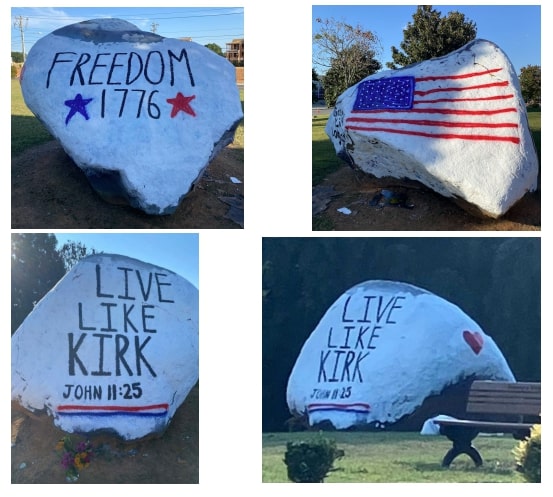
What they painted was unmistakably patriotic.
An American flag.
A heart.
The phrase “Freedom 1776.”
And a biblical reference: “Live Like Kirk — John 11:25.”
To Stout, it was a message of faith, hope, and remembrance.
To school officials, however, it would quickly become something else entirely.
The Message Disappears
What happened next shocked the student.
According to the lawsuit, the tribute remained visible only briefly.
School officials painted over it.

The message was gone.
The tribute erased.
But that was only the beginning.
The following day, according to court filings, the situation escalated dramatically.
A school-wide communication from Principal Susan Nichols informed students and families that the spirit rock had been vandalized.
The message reportedly stated that the artwork was unauthorized.
It further suggested that school policies had been violated.
Even more alarming, it indicated that law enforcement had been contacted.
Suddenly, what Stout believed had been a permitted expression of faith and remembrance was being portrayed as potential misconduct.
The accusation spread quickly.
Students talked.
Parents talked.
Community members talked.
Social media lit up.
The label attached to the incident was powerful.
Vandalism.

For a teenager with college aspirations and a reputation to protect, it was a devastating word.
And according to Stout, it was false.
From Student to Suspect
The situation became even more serious.
After acknowledging to school officials that she had painted the rock, Stout says she was pulled from class.
What happened next forms one of the most controversial portions of the lawsuit.
According to the complaint, she was instructed to write a statement admitting what she had done.
She was also allegedly ordered to surrender her cellphone.
Officials reportedly wanted access to her call history.
For Stout, the experience felt surreal.
One moment she believed she had permission to paint the rock.
The next she felt like a suspect in a criminal investigation.
The emotional toll was immediate.
Friends asked questions.
Rumors spread.
Students discussed the situation throughout the school.
Online commentary intensified.
And amid the confusion, the teenager at the center of the controversy found herself publicly associated with accusations she insisted were untrue.
A New Policy Appears
Then came another development.
The school district announced changes to its speech rules governing the spirit rock.
Future messages, officials said, would need to be “inclusive,” demonstrate “positive school spirit,” remain in “good taste,” and avoid political or religious content.
The timing immediately drew attention.
Critics argued the district appeared to be rewriting the rules after the fact.
Supporters of Stout questioned why a message had been permitted one day and effectively prohibited the next.
Constitutional advocates began paying close attention.
The issue was no longer merely about a painted rock.
It was becoming a broader debate about viewpoint discrimination.
Could schools allow certain messages while banning others?
Could religious viewpoints be excluded from a public forum where other forms of expression had previously been permitted?
The answers carried significant legal implications.
The District Changes Its Story
As public scrutiny intensified, cracks began appearing in the district’s original narrative.
According to the family, school officials privately informed them that the investigation had been closed.
No disciplinary action would be taken.
But publicly, the damage remained.
The vandalism accusation lingered.
The public record had not been corrected.
For weeks, confusion persisted.
Then came a major reversal.

Approximately one month after the original incident, the district issued another communication.
This time, officials acknowledged several critical facts.
The painting had not been vandalism.
The student code of conduct had not been violated.
Law enforcement had not been contacted.
The clarification represented a dramatic departure from the original characterization of events.
Yet for Stout and her family, it wasn’t enough.
They argued the district still refused to apologize.
Meanwhile, they say the consequences continued.
The Cost of a Public Accusation
In today’s digital age, reputational damage can spread with breathtaking speed.
According to Stout, classmates began treating her differently.
Online criticism intensified.
Hostile messages appeared.
Threats emerged.
The controversy transformed a high school student into the center of a politically charged national debate.
Supporters rallied behind her.
Critics attacked her.
Social media amplified every development.
For a teenager navigating school, friendships, and future plans, the experience became overwhelming.
The family’s legal complaint paints a picture of a student who felt isolated, targeted, and publicly humiliated despite believing she had followed the rules.
Whether viewed through a political lens or a constitutional one, the emotional consequences were impossible to ignore.
Enter the Lawyers
Eventually, the dispute moved from the school hallway to federal court.
Alliance Defending Freedom, one of the nation’s most prominent legal organizations focused on constitutional and religious liberty issues, took up Stout’s case.
The lawsuit alleged violations of multiple constitutional protections.
The First Amendment.
The Fourth Amendment.
The Fifth Amendment.
The Fourteenth Amendment.
The complaint argued that school officials had effectively weaponized an investigation against a student because they disagreed with her message.
It accused the district of censorship, retaliation, and unequal treatment.
Most explosively, it argued that the district applied different standards depending on the viewpoint being expressed.
The Double Standard Allegation
One of the most significant claims in the lawsuit involved events that occurred years earlier.
According to the complaint, students in 2020 painted a Black Lives Matter message featuring a “Black Power” fist on the same spirit rock.
When other students later painted over the artwork, the school board reportedly responded very differently.
An emergency meeting was held.
Students were allowed to repaint the message.
Additional political slogans appeared.
Messages including “No Justice. No Peace,” “I Can’t Breathe,” and “End Police Brutality” were reportedly permitted.
For Stout’s legal team, this history became a critical part of their argument.
If political messages had been allowed previously, why was her message treated differently?
If one viewpoint was protected, why wasn’t another?
These questions strike at the heart of First Amendment jurisprudence.
The government—including public schools—generally cannot discriminate against speech solely because officials disagree with the viewpoint being expressed.
Whether that principle applied in this specific case became one of the central legal issues.
A Settlement That Changed Everything
After months of litigation, negotiations, and legal pressure, the school district agreed to settle.
The terms were significant.
The Charlotte-Mecklenburg Board of Education agreed to adopt a new student free speech policy.
The district also agreed to issue a public statement clarifying what happened.
Most notably, the district agreed to pay $95,000 to Stout’s legal team.
While settlements do not necessarily represent admissions of legal liability, they often reflect a recognition of litigation risks.
For supporters of Stout, the agreement amounted to a major victory.
For the district, it offered an opportunity to move forward.
For constitutional scholars, it represented another chapter in the ongoing battle over free expression in America’s public schools.
The Statement That Changed the Narrative
Perhaps the most consequential element of the settlement was the board’s official statement.
The district reaffirmed that the students’ painting of the spirit rock did not violate school policies.
It acknowledged that the painting was not vandalism.
It clarified that law enforcement had not been contacted.
And perhaps most importantly, it expressed regret for what the student experienced.
For Stout, those words carried enormous significance.
For months, she had insisted she did nothing wrong.
Now the district was publicly confirming that position.
The reversal was extraordinary.
The same institution that once publicly characterized the incident as vandalism was now publicly stating the opposite.
A Personal Victory
For Stout, the settlement was about more than money.
It was about clearing her name.
In public comments following the agreement, she described the experience as painful and unfair.
She maintained that she had followed the rules.
She argued that school officials had treated her like a criminal.
And she expressed hope that other students would never endure a similar experience.
Her message resonated with many supporters who viewed the case as emblematic of broader concerns regarding religious freedom and free expression.
They saw a teenager standing up against a powerful institution.
And ultimately, they saw her prevail.
The National Debate
The controversy arrives at a time when schools across America are increasingly finding themselves on the front lines of cultural and political disputes.
Questions about free speech, religion, political expression, identity, and student rights have become flashpoints in communities nationwide.
School boards face intense pressure from competing constituencies.
Parents demand transparency.
Activists demand accountability.
Students demand freedom to express themselves.
Balancing those interests is rarely easy.
Yet constitutional protections remain.
And courts continue reminding public institutions that those protections apply even when speech is controversial.
Perhaps especially when it is controversial.
Beyond One School, Beyond One Student
The significance of the Stout case extends far beyond a single campus in North Carolina.
It raises fundamental questions about the role of public schools in a democratic society.
Should students be allowed to express political views?
Should religious viewpoints receive equal treatment?
How should schools handle controversial messages?
Where is the line between maintaining order and suppressing speech?
These questions are unlikely to disappear.
If anything, they are becoming more important.
As America grows more polarized, schools increasingly serve as arenas where constitutional principles collide with modern cultural conflicts.
The spirit rock controversy illustrates how quickly those collisions can occur—and how high the stakes can become.
The Final Lesson
In the end, what began with a painted rock became something much larger.
A student sought to honor someone she admired.
School officials responded with accusations.
A community became divided.
Lawyers entered the picture.
Constitutional questions emerged.
And a federal lawsuit forced a major school district to rethink its policies.
Months later, the outcome was clear.
The student would receive vindication.
The district would issue a public statement.
A new free speech policy would be implemented.
And a case that started with paint and a Bible verse would become a powerful reminder of a principle embedded deeply within the American experiment:
The right to speak freely does not disappear at the schoolhouse gate.
And when institutions forget that lesson, the consequences can be far more costly than anyone initially imagines.