Adele, Gaga, Sam Smith all said the same thing about Amy Winehouse. She gave them permission.
Adele, Lady Gaga, Sam Smith, Lana Del Rey, Ellie Goulding, Billie Eilish, every one of them has named Amy Winehouse as the reason they believed what they did was possible. Not just as an influence, as permission. And understanding what that permission actually was explains everything about the music of the last 20 years.
But to understand what Amy Winehouse gave to the generation of artists who came after her, you need to understand what the music industry looked like before she arrived. Because the world that Frank entered in 2003, and that Back to Black transformed in 2006, was not a world that was waiting for what she brought.
It was a world that had spent years moving in the opposite direction. The early 2000s were the years of maximum polish, of Auto-Tune and Pro Tools, and the comprehensive digitization of popular music production. The years when the tools available to producers had become so sophisticated that the distance between a raw performance and a finished record had grown almost infinite.
A voice could be corrected, a rhythm could be quantized, an emotion could be manufactured through compression and reverb, and the strategic deployment of silence. The music that dominated radio in those years was extraordinary in its technical accomplishment, and in many cases extraordinary in its emotional vacancy.
It was music that had been optimized for every variable except the one that Amy Winehouse was about to demonstrate was the only one that ultimately mattered. The artists who dominated those years were extraordinary performers, but the music they made, the music that the industry had learned to produce efficiently and sell reliably, had been built around a specific understanding of what audiences wanted.
An understanding that had been tested and refined through focus groups and radio play and chart data until it was very good at doing exactly what it was designed to do. It reached people. It moved people. It did not, in most cases, tell them the truth. The truth was complicated. The truth involved specific details about specific feelings that could not be compressed into a chorus that needed to work in 40 markets simultaneously.
The truth involved the kind of emotional precision that focus groups tended to round down into something more broadly acceptable because broadly acceptable was what the machinery was built to produce. The music industry in 2003 was extraordinarily good at making music that a large number of people could listen to with discomfort.
[snorts] Amy Winehouse was about to make music that a large number of people would listen to with recognition. That is a different thing. Recognition requires specificity. Recognition requires the artist to have committed to a particular truth rather than a general one. Recognition requires, most fundamentally, honesty, the willingness to say the actual thing at the cost of saying only the actual thing and nothing more comfortable.
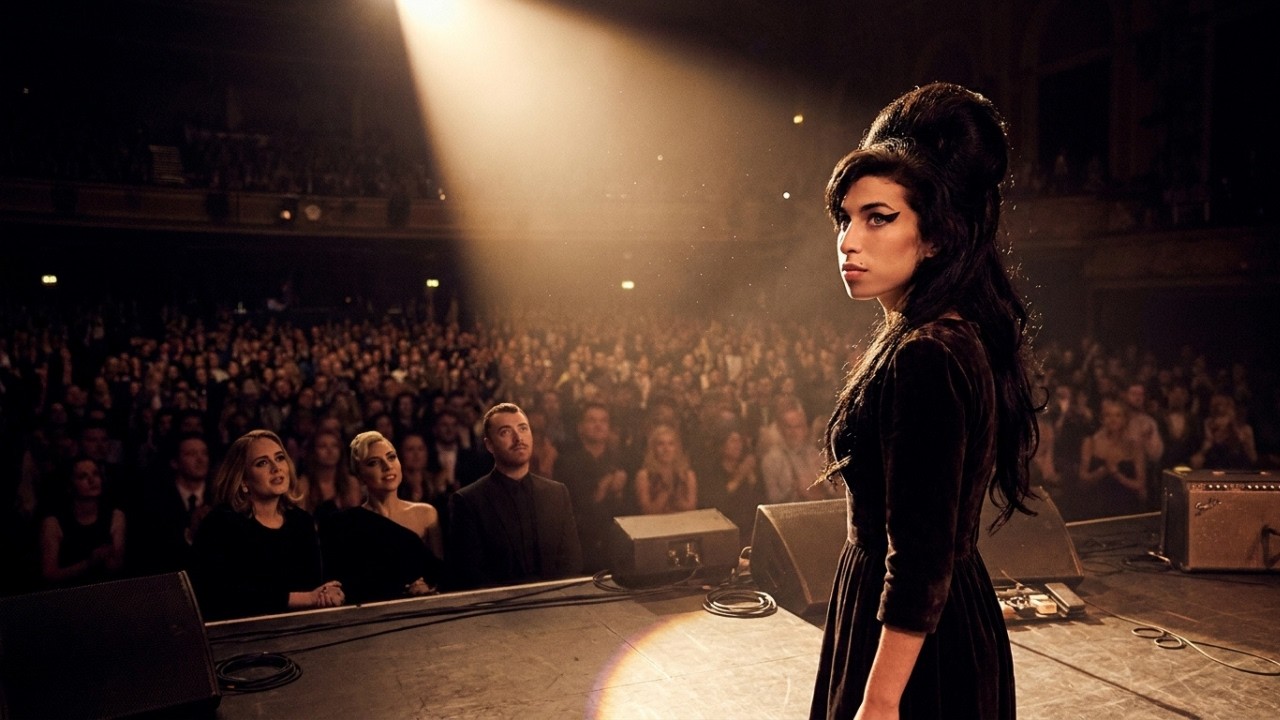
She was honest. That was the whole of it. She was honest in a way that the music industry had spent years building tools to avoid. Honest in a way that the formats and the formulas and the production pipelines were specifically designed to sand down and smooth out and make palatable. She sat down with Salaam Remi in Miami and wrote songs about what was actually happening to her in the actual words that described it without the protective distance of metaphor or the safety net of a calculated persona.
And the world heard it and recognized it immediately, not as a new thing, but as the thing that music was supposed to be, the thing it had been before the optimization took over. Returned. Adele was 15 years old when Frank was released. She has said what that album did to her with the specificity of someone who has thought about it carefully for a long time.
In a concert in Boston in 2016, she stopped between songs and addressed it directly. Not in a prepared speech, not in an interview, but in the middle of a show to the people in the room because it needed to be said in a way that felt real. She said she felt she owed so much of her career to Amy Winehouse.
She said Amy paved the way for artists like her and made people excited about British music again. She said Amy was fearlessly hilarious and blasé about the whole thing. She said she did not think Amy ever realized just how brilliant she was and how important she is. And she said it all in the present tense.
How important she is, not was, because the thing Amy had demonstrated did not stop being true when she died. What Adele had heard in Frank at 15 was permission. Not permission to sound like Amy. Adele does not sound like Amy, was never trying to sound like Amy, has always been recognizably and completely herself, but permission to be honest.
Permission to write about real heartbreak in real language. Permission to stand at a microphone and say the actual thing, rather than a polished approximation of the actual thing. Permission to be a British woman making music that was rooted in the American soul tradition without apologizing for the ambition.
Permission to believe that the music you made from your real experience could connect with people who had not shared that experience but would recognize something essential in it. 21, Adele’s second album, picked up where Back to Black left off in ways that were structural rather than sonic. It was built the same way, from real grief in real language, with the understanding that the specificity of personal experience was not a limitation but the source of universality.
It sold 20 million copies. It won six Grammys. It produced songs that are still played at every karaoke night and every breakup and every quiet late night moment when someone needs to hear something true. All of that came, in some measure, from what Adele had learned when she was 15 and Frank came out and she understood for the first time what music could do when it did not flinch.
Lady Gaga arrived at Amy’s influence from a different angle. Gaga and Amy did not sound alike. Their musical worlds were different. Their aesthetics were different. Their relationship to spectacle and to persona were different in almost every way. But what Gaga said about Amy in the days after her death was not about music.
It was about something prior to music, the possibility of existing as an artist on your own terms in an industry that was constantly pressuring everyone toward something more digestible. She said Amy was the flu for pop music. She said, “Everybody got a little bit of the flu and fell in love with her.” The metaphor is stranger and more precise than it might initially appear.
A flu is not something you choose to catch. It bypasses your preferences and your defenses and gets into you whether you were looking for it or not. What Amy had done to the industry, to the culture, to the generation of artists watching her was exactly that. She had not argued for a new kind of music or presented a manifesto or built a movement.
She had simply made something so undeniably real that it spread person to person the way things spread when they are true. Gaga also said Amy changed pop music forever and that she remembered knowing there was hope and feeling not alone because of her. These are not the words of a fan describing an artist they admire. These are the words of someone describing a moment of recognition, the recognition that what you were trying to do, the kind of artist you were trying to be was possible.
That someone had done it, that the world had received it, that you did not have to choose between being yourself and being heard. Sam Smith’s career, the voice, the emotional directness, the willingness to write about love and loss without the ironic distance that had characterized so much of the music of the decade before is a direct line from what Amy had demonstrated.
Not an imitation, a continuation. The understanding absorbed at 11 years old from a record by a 20-year-old from Southgate that the most honest thing was the most powerful thing and that the power did not diminish with time. Ellie Goulding said Amy helped pave the way for females like her in America. This is a more specific claim than it might initially appear.
The British female artist in America was not, before Amy, a particularly well-established category. The American market had its own relationship with British music. It had welcomed the Beatles and the Rolling Stones and a series of guitar-led British invasions, but the British female soul singer, the British woman making music in the American tradition rather than an identifiably British one, was rarer.
Amy had walked into that space without negotiating for it, without modifying what she was to fit the market’s expectations, and the market had responded to her on her own terms. She had demonstrated that the terms were acceptable, that the space existed, that a British woman could stand at a microphone and sing in the tradition of Dinah Washington and Billie Holiday, and the world would not ask her to explain herself.
Goulding, Adele, Duffy, Estelle, the generation of British female artists who broke America in the years after Back to Black, walked through a door that Amy had opened. Not by planning to open it, not by strategizing about market positioning or genre crossover. By being exactly who she was, and being that person so completely that the door opened around her.
Lana Del Rey said she believed in Amy Winehouse. She said she knew she was not with us anymore, but she believed she was who she was, and in that way she got it right. That sentence is worth pausing on. She got it right. Not she was talented, not she was successful, not she was influential. She got it right.
The specific and rare achievement of being fully yourself in a public context, of making the thing you needed to make regardless of what the industry wanted from you, of refusing the compromise that the system offered, and accepting the cost of that refusal. Del Rey had been watching that from the beginning. Her own aesthetic, the cinematic sadness, the romanticized personal mythology, the willingness to make music that was unfashionable by the standards of the moment and therefore permanent by the standards of everything else, owed
something to the understanding that Amy had made real. That the only sustainable artistic position was the authentic one. Billie Eilish, who was 2 years old when Frank was released and 10 years old when Amy died, represents the furthest reach of the influence, the generation for whom Amy’s permission had simply been part of the atmosphere.
They did not choose to absorb it. It was already there, already part of what British and American popular music was, already integrated into the understanding of what a young woman with a voice and something to say could do. Eilish’s music is not Amy’s music, but the world in which Eilish’s music existed was shaped by Amy’s existence in it.
The Library of Congress citation noted this lineage explicitly. The list of artists it named as having been shaped by Amy, Adele, Estelle, Duffy, Lady Gaga, Eliza Doolittle, Rumer, Ellie Goulding, was not complete. It was illustrative, a sampling of a chain that extended further than any single citation could contain.
There is a word that keeps appearing in the accounts of artists who were shaped by Amy, a word that is not usually used in the music industry because the music industry tends to operate in the language of influence and inspiration and market positioning rather than in the language of moral permission. The word is permission.
Adele used it implicitly in every concert tribute and every interview where she described what Frank had given her. Gaga used it explicitly in the specific claim that Amy had made it possible to believe what she was doing was possible. Sam Smith used it when they described what hearing Frank at 11 had done to their relationship with music.
Permission is different from influence. Influence changes how you sound. Permission changes what you believe you are allowed to do. An artist who influences you might change your chord progressions or your production choices or the way you construct a hook. An artist who gives you permission changes something prior to all of that.
Changes the fundamental assumption about what music is for and what you are allowed to bring to it. Amy gave the generation after her permission to be honest, permission to be specific, permission to write from the inside of an experience rather than from a safe distance from it. Permission to believe that the most personal thing was the most universal thing and that the audience would meet you there if you trusted them enough to go all the way.
What Amy gave all of them was not a sound. Sounds date. Sounds belong to their moment. What she gave them was an understanding of what music could be when it did not flinch, when the artist trusted the audience enough to tell them the actual thing in the actual words with the actual voice without the production and the persona and the careful management of how the emotion was received.
She had been 20 years old when Frank demonstrated it for the first time. 23 when Back to Black confirmed it as not a fluke, but a method. 27 when she died having made two albums and changed the direction of popular music and given an entire generation of artists the thing they needed most.
Not a sound, not a style, not a formula, permission. Adele said it best in that concert in Boston in 2016 between songs to the people in the room, “I feel like I owe so much of my career to her. She was speaking for herself. She was also speaking for the 11-year-old Sam Smith and the teenage Lady Gaga who caught the flu and the Lana Del Rey who believed in her and the Billie Eilish who grew up in the world she had made.
Amy Winehouse did not realize just how brilliant she was and how important she is, but the artists who came after her did and they have been saying so in the only way that ultimately counts ever since.