After Back to Black Amy Winehouse performed for 85 people in an Irish church They still talk about
Six weeks after Back to Black was released, Amy Winehouse flew to one of the most remote corners of Ireland on a stormy winter night to perform in a church that held 85 people. No lights, no production, just her voice, a guitarist, and a bassist. The people who were in that room say it was the greatest performance they ever saw.
But to understand why that night in Dingle matters, why a documentary was made about it six years later, why the people who were there still talk about it the way they do, you need to understand the specific moment it occupied in Amy Winehouse’s life. Because December 3rd, 2006, was not a random date. It was a threshold.
And what was on the other side of it was something that nobody standing in that church on that stormy winter night could have fully anticipated. Back to Black had been released on October 27th, 2006, six weeks earlier. The album that Amy had written in the aftermath of Blake Fielder-Civil’s first departure, that she had recorded in five days with Mark Ronson in Greenwich Village, and completed with the Dap-Kings in Brooklyn.
That album was now in the world. It was already climbing the charts in the United Kingdom. It was already generating the kind of critical attention that suggested something unusual had happened. But it had not yet become what it was going to become. The Grammy nominations were still two months away. The five Grammy awards were still 14 months away.
The tabloid circus, the cameras outside her flat, the front pages, the endless documentation of her decline, had not yet fully assembled itself around her. Amy Winehouse in December 2006, was a 23-year-old woman who had just made the best album of her life, and had not yet had to live inside the consequences of it.
She was on the cusp, and Dingle caught her there. The Other Voices festival had been running since 2002 with a philosophy that was almost entirely contrary to how contemporary music television worked. Where other programs pursued production values and spectacle, Other Voices sought out intimacy and authenticity. Where other shows sought out the biggest venues and the largest audiences, Other Voices sought the smallest, a church in a village that most people in the world had never heard of with an audience that could be counted rather than estimated.
Philip King, who had founded the series and who understood its logic better than anyone, had a theory about what the remoteness of Dingle did to the artists who came there. Philip King, the director of Other Voices, the Irish television music series that had been filming in Dingle every winter since 2002, had a theory about the village that he offered to journalists and documentary makers with the conviction of someone who had watched it prove itself true again and again.
He said, “You don’t just go to Dingle by accident.” He said the village was located on the edge of the known world on the peninsula in the southwest corner of Ireland, accessible by car only, surrounded by Atlantic water on three sides, as far from a metropolitan center as it is possible to get while still being in Europe.
He said artists who came there sensed something about the location. He said it coaxed out of them performances that no other venue could produce. Ray Davies had been there, Ryan Adams had been there, The National had been there. Every winter musicians traveled to a village of fewer than 2,000 people to perform in a church that held 85, and almost all of them came away saying it was unlike anything else they had done.
Amy flew in on a stormy December night. The weather on the Kerry coast in December is not incidental, it is architectural. The Atlantic comes in from the west with nothing between it and the Irish coast except open water. And in winter, the wind carries a particular quality that people describe as clarifying. It removes things.
Artists who came to Dingle for other voices sometimes said they had not understood why they were going until they arrived. The journey itself, the turbulence, the narrow roads in the dark, the sense of arriving somewhere genuinely apart from the world they had left was part of what the festival offered.
Amy flew in on a stormy December night. The weather on the Kerry coast in winter is not the weather of a concert venue. It is the weather of the actual Atlantic, which does not particularly care about schedules or sound checks or the logistics of television production. The flight from London to Kerry Airport would have been turbulent.
The drive from the airport to Dingle along the narrow roads of a peninsula with the ocean below would have been dark and wet and wild in the specific way that the southwest of Ireland is wild in December. She arrived ready to sing and ready to talk. That phrase from the documentary that BBC Arena made about the night six years later captures something essential about who Amy was in Dingle.
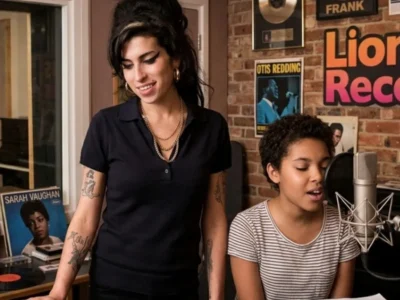
She was not the fragile, besieged figure that the tabloids would spend the next five years photographing. She was a 23-year-old musician who had just made something extraordinary and who was that December night simply herself. Sharp, funny, direct, interested in the world around her, wearing a black vest over a white bra with skinny jeans and trainers, utterly at ease in a way that people who knew her from her public appearances said was rare to see outside of private settings.
A taxi driver named Paddy Kennedy drove her from the airport to Dingle. Kennedy was a local man, the kind of person who had been driving musicians and artists and visitors to the village as part of the Other Voices operation, who had seen enough famous people arrive in the back of his cab to have a calibrated sense of what they were actually like when nobody was watching.
He remembered Amy. Six years later, when the documentary crew came back to Dingle to interview the people who had encountered her that night, Kennedy was one of the first people they found. What he remembered about the journey, about the woman who sat in the back of his car and talked to him like a person rather than a passenger, became one of the more unexpected portraits of her in the documentary record.
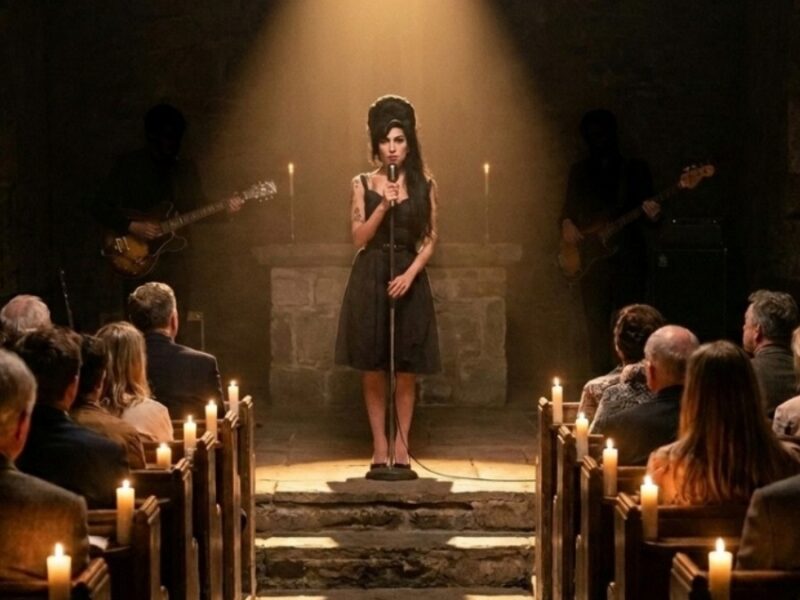
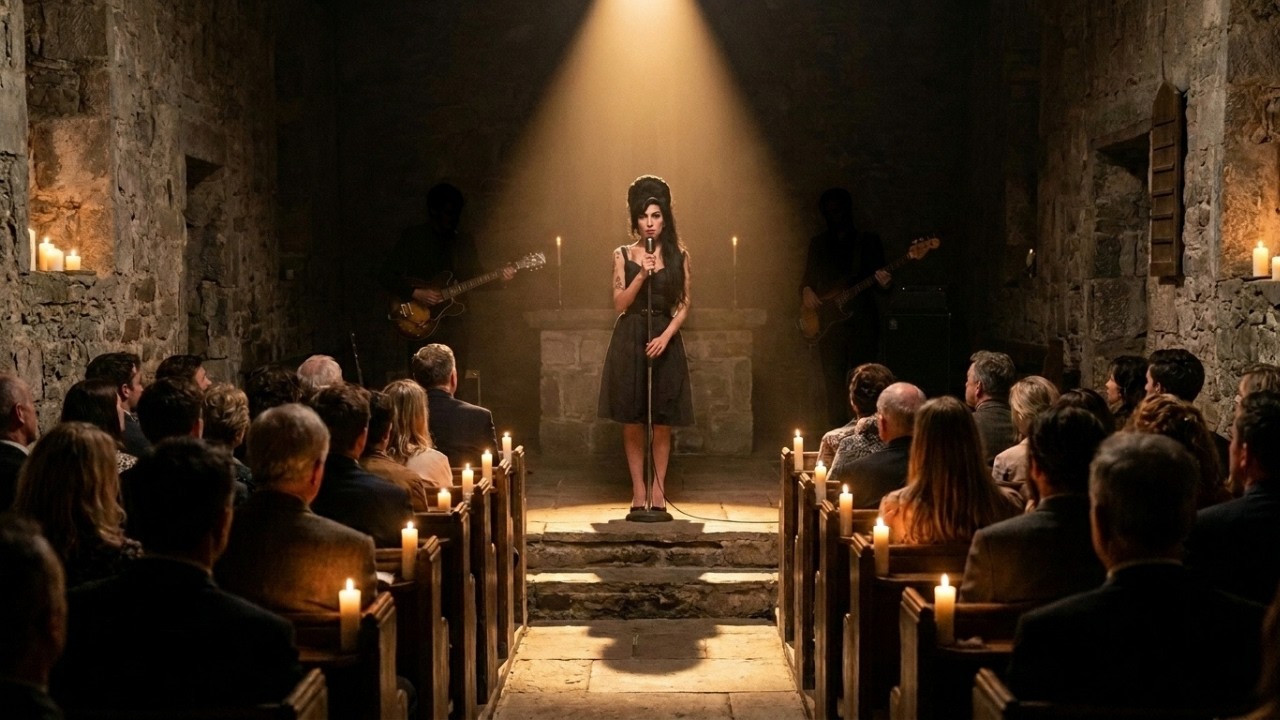
The Church of Saint James in Dingle was built in 1807. It is a small Anglican church, spare, stone-walled, with wooden pews, and the particular acoustic quality of a room that was designed for voices rather than instruments. The Other Voices stage occupied one end of the church. The audience, 85 people, the maximum the building would hold, sat in the pews and on folding chairs and watched from distances that in any other context would have been considered uncomfortably close to a performer of Amy’s stature.
There was no distance in Saint James that night. The sound check had already given Reverend Mart Hanley, the church’s minister, a sense of what was about to happen. Hanley was a man whose relationship to music was theological rather than professional. He understood song as a form of prayer, as something that the physical space of a church was designed to amplify and consecrate.
He had watched musicians perform in Saint James over the years of Other Voices with the patient attention of someone who was witnessing something that overlapped with his own vocation. He had heard good voices. He had heard voices that understood what a room like that required, the restraint, the directness, the willingness to let the acoustic do work that amplifiers would normally do.
Hanley had agreed to host other voices in his church every winter as part of the festival’s arrangement with the village, and he had seen many performances in that space. He had not heard anything quite like Amy Winehouse at the microphone during soundcheck. When the documentary crew came back 6 years later and asked him what he remembered, the first thing he talked about was not the music.
Amy took the stage just after 9:00 in the evening. She was accompanied by two musicians, her guitarist and her bassist Dale Davis, who would later describe the night with the particular combination of awe and grief that characterized the recollections of everyone who had been close to her in the good years.
No backing tracks, no production, no theatrical lighting or pyrotechnics or any of the apparatus that live performance had come to require at the scale Amy was about to start operating at. Just the voice, two instruments, and 85 people in a 200-year-old church on the edge of the Atlantic. She sang six songs from Back to Black, acoustic stripped-back versions that removed everything from the album except the thing that had always been underneath it, the voice and what the voice was saying, and the absolute refusal to say it from anything other
than the place where it was true. Rehab, stripped of the Dap-Kings horn section and the reverb and the production polish, became something rarer and more immediate than the recorded version. Valerie, which was not yet the hit it would become after Mark Ronson released his version in 2007 sounded in that church like a love song from a different century.
Back to Black itself, the title track, was devastating in the way that songs are devastating when there is nothing between the singer and the song and nowhere for either of them to hide. The people in the pews said they pinched themselves. That phrase appears in more than one account of that night. The sense of being present for something that was not quite real, that was too good to be happening in this specific room, in this specific village, in this specific December.
They were 85 people who had come to a small church in the southwest corner of Ireland on a winter night and were watching one of the greatest voices of the century perform to them from a distance of 15 ft with nothing between her and the song. After the performance, Amy sat down with John Kelly, the presenter of Other Voices at the time, for an interview that became in retrospect one of the most valuable documents of who she was before the world finished deciding what she was.
She was funny. She was irreverent. She talked about her musical influences, Mahalia Jackson, Sarah Vaughan, Thelonious Monk, Ray Charles, The Shangri-Las, with the fluency of someone who had absorbed them rather than studied them, who could talk about them the way you talk about people you know rather than artists you admire.
She made jokes. She was 23 years old and she had just performed six songs from a new album in a church in Ireland and she was happy in the specific uncomplicated way that she was happy when the music had been good and nothing else was required of her. What the interview captured was something that the tabloid record of Amy Winehouse almost entirely failed to capture, her intelligence.
Not the intelligence of someone performing intelligence for an interviewer, but the natural unforced quality of a person who had thought seriously about music since she was a child and who could talk about it with the kind of precision that comes from genuine knowledge rather than received opinion. She talked about Mahalia Jackson the way someone talks about a singer they have listened to alone in their own room for their own reasons.
She talked about Thelonious Monk with the familiarity of someone who had played along to his records. She was a 23-year-old from Southgate who happened to know more about the history of American music than most music journalists and who wore that knowledge lightly as something personal rather than something to display. Kelly was a good interviewer, the kind who listened rather than performed, who allowed space rather than filling it.
The combination of his patience and Amy’s directness produced exchanges that felt genuinely unguarded. She said things she had probably not planned to say. She laughed at things she had not expected to find funny. She was, for the duration of that interview, entirely herself. The interview contained one exchange that people who watched the documentary tend to remember.
Kelly asked her something about her background, about where she came from, and Amy, deploying the humor that was always her first response to anything that required her to be earnest about herself, said, “The Russian bankers loved me, see, because I’m a Russian Jew.” She said it in the full London vernacular of a 23-year-old from Southgate who was not going to take herself seriously just because a BBC camera was pointed at her.
The people who watched the documentary said it was one of the most recognizably Amy moments in it, the way she turned attention back into laughter, the way she held the serious thing lightly. Dale Davis, her bassist, said she burned so bright. He said it in the documentary six years after the night in question, in the way that musicians talk about a colleague who is gone, with the directness that grief sometimes produces, the willingness to say the thing plainly because the occasion is past and the plain thing is the true
thing. The documentary that BBC Arena made about the night, Amy Winehouse, the day she came to Dingle, was broadcast in 2012, the year after her death. It was, by the assessment of the critics who reviewed it, one of the most honest and restrained pieces of documentary filmmaking about her that existed. The word tragedy was not mentioned until 38 minutes in.
The film did not reach for the tabloid narrative or try to read the events of December 3rd, 2006 as portents of what was coming. It simply went back to the village and talked to the people who had been there and let them describe what they had seen. What they had seen was Amy Winehouse six weeks after Back to Black, before the Grammys and before the circus and before the years that followed.
What they had seen was the performance, the real performance, the one that happened when all the apparatus had been stripped away and there was nothing left except a woman and her voice and 85 people in a church who had been lucky enough to be in the right place. The documentary ends with the village itself, the church, the street outside, the harbor, the Atlantic.
It ends with the people who were there describing what they remember in the specific, unhurried way that genuine memory works when it has not been processed into a story. They do not reach for the tragic frame. They do not describe December 3rd, 2006 as the last good night or as a portent or as anything other than what it was, a night when a young woman with an extraordinary voice came to a small church in an Irish village and sang to them like it was the only thing in the world that mattered.
Philip King said, “You don’t just go to Dingle by accident.” He was right about the village. He was also right in a way he may not have intended about Amy. She did not go to Dingle by accident. She went because something in her understood that the edge of the known world was exactly where she needed to be, where the voice was enough, where nothing else was required.
She has not been back, but the church is still there. And the people who were in it on December 3rd, 2006, still remember what it sounded like when she sang.