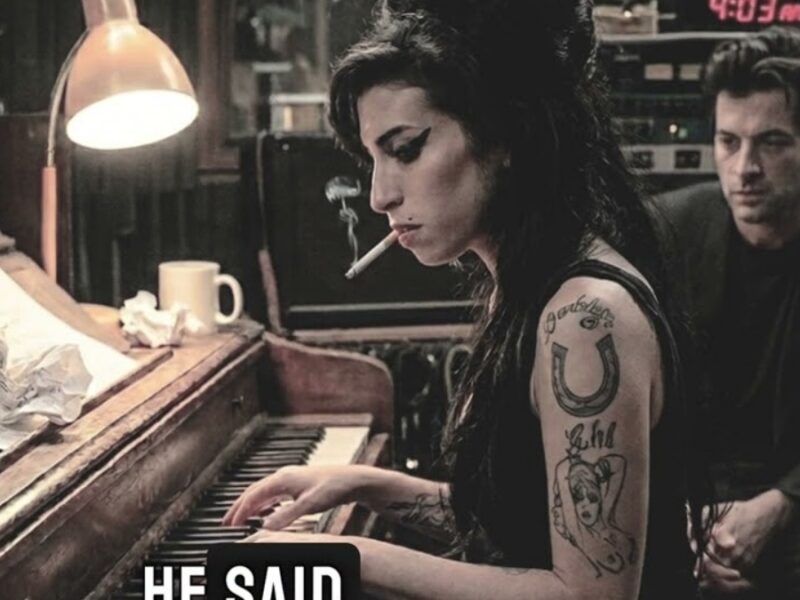
Everyone warned Mark Ronson about Amy Winehouse. What he found changed everything.
Before Mark Ronson met Amy Winehouse, everyone he spoke to said the same thing. Good luck with that. I heard she’s been working on that album forever. He walked into the studio expecting chaos. What he found instead changed both of their lives. But to understand what happened in that New York studio in March 2006, you need to understand who Mark Ronson was at that point and how little he had to lose.
Because the story of Back to Black is not just the story of Amy Winehouse. It is the story of two people who found each other at exactly the moment each of them needed to be found. Ronson in 2006 was a producer on the way up, rather than one who had arrived. He had made his name as a DJ, had produced some well-regarded records, had built a studio in Greenwich Village where he worked with artists who were interested in the same thing he was interested in, the relationship between contemporary music and the classic American and British sounds of the 1950s and 1960s.
He was known in the right circles. He was not yet known everywhere. He was, by his own later account, just happy to have any gig. The gig came through a publishing connection. Amy and Ronson shared the same publishing company, and someone at that company had the idea that they might work well together. Amy had already recorded the Salaam Remi portion of what would become Back to Black, five songs made in Miami with the producer who had worked with her since before Frank, in the intimate and collaborative way that their sessions
always had. What the album still needed was the other half, the more produced half, the half that would take the raw emotional material Amy had been writing and build around it something that sounded like it had come from a different era, cleaner and more deliberate than the Miami recordings, with the specific sonic quality of 1960s girl group pop that Amy had been listening to obsessively.
Someone thought Mark Ronson might be the person to do that. He heard the warnings before he heard the music. Everyone in his world who knew anything about Amy Winehouse offered the same assessment. Good luck with that. She’s been working on that album forever. She’s difficult. She’s unreliable.
Whatever version of Amy Winehouse had been presenting itself to the music industry in the months before March 2006, the version that had been photographed in increasingly desperate states, the version whose personal life had been generating more column inches than her music, was the version that had preceded her into every professional room she entered.
Ronson walked into the meeting in spite of the warnings, or perhaps because he was not in a position to be choosy. He was a producer who was looking for work, and an opportunity had presented itself, and the specific nature of the opportunity, working with the woman who had made Frank, the album that had startled critics with its jazz sophistication and its songwriting intelligence, was interesting enough to override whatever concerns the advance warnings had generated.
Between the Miami sessions and the New York meeting, something important had happened in Amy’s personal life. Blake Fielder-Civil had left. He had gone back to a former girlfriend with the abruptness that would become a recurring feature of their relationship. Suddenly, without gradual transition, just gone.
And Amy, who had loved him with the same absence of half measures that characterized everything she did, was carrying the grief of that departure in the specific way that she carried things, completely, without the self-protective distance that most people use to make pain manageable, and with the growing certainty that the feeling, unprocessed and unresolved, needed to go somewhere.
It was going to go into the album. That was always where things went. Frank had come from a version of the same place, from the accumulated emotional material of her early 20s, from relationships and observations and the sharp self-aware intelligence that had been there since she was a teenager performing in jazz clubs and writing lyrics that surprised people with their precision.
Back to Black was going to come from something raw than that, from a specific person, a specific departure, a specific grief that had not yet softened into something she could look at from a distance. Amy arrived at his Greenwich Village studio and immediately did something he had not anticipated. She did not talk about the album.
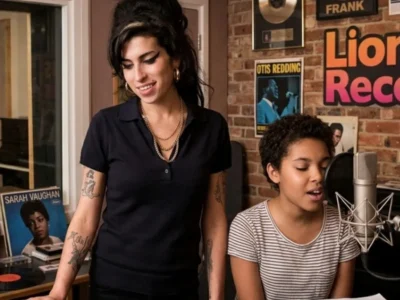
She did not discuss her vision for the record or what she wanted the songs to sound like or what had been working in the Miami sessions with Ronson. She talked about music she loved. She pulled out records, 60s girl group records, the Shangri-Las specifically, the Ronettes, the particular sound of Phil Spector’s wall of production and the female vocal groups that had recorded over it.
She played them to Ronson the way someone plays music to a new person when they want to find out quickly whether that person understands what matters. It was a test, though not a conscious one. It was simply how Amy communicated, through the music she loved rather than through descriptions of what she was trying to make.
Ronson understood immediately. He had been working in precisely this tradition, the retrofitting of classic sounds to contemporary production, the respectful and creative excavation of American and British musical history. The records Amy was playing were records he knew and loved. The conversation that followed was the conversation of two people who speak the same language and have just discovered it about each other.
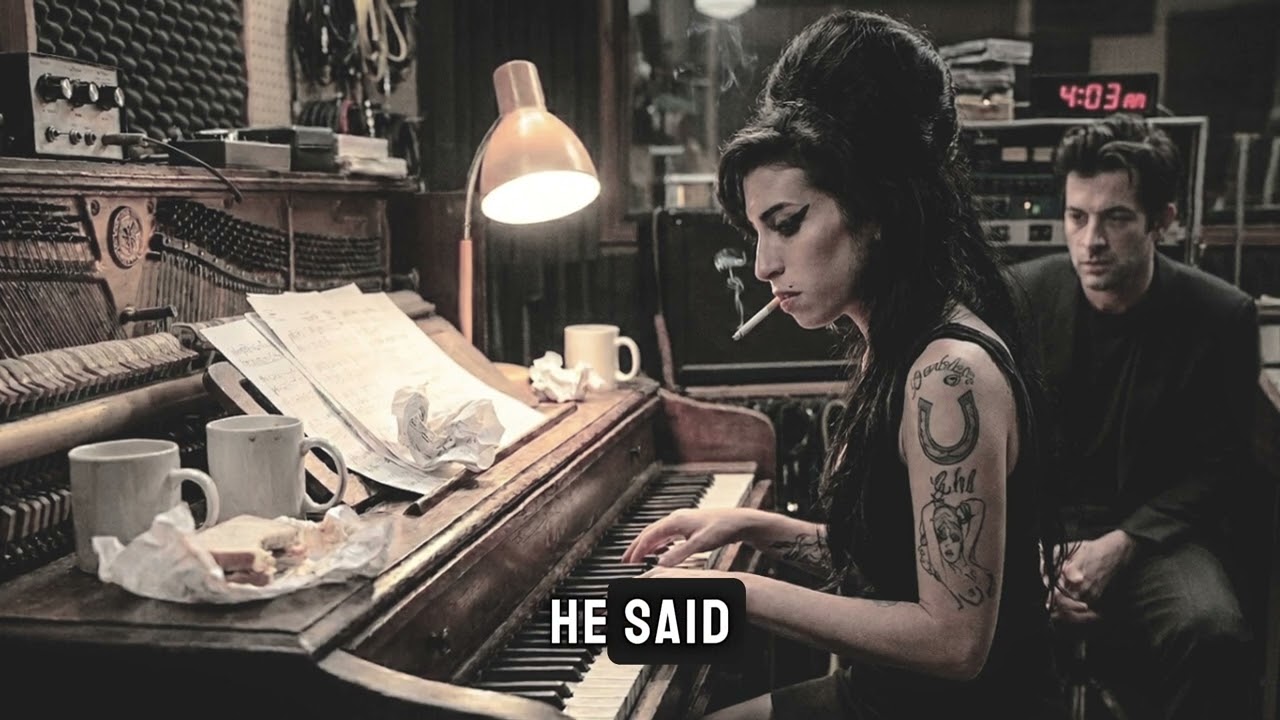
She left and Ronson stayed up all night. He told himself he had nothing to play her yet, which was true. He had heard what she liked, and he had an instinct about what might work, but an instinct is not a song, and he needed to build something before she came back. So, he sat down at his piano in the Greenwich Village studio and started finding the chords.
What he arrived at was simple, a piano figure, not complicated, not showing off, built from the kind of chord movement that 1960s pop had used and that had the specific emotional quality of something going down rather than up, of ending rather than beginning. He put a kick drum behind it, a tambourine, and what he described as tons of reverb, the reverb that gives old recordings their particular dustiness, the sense of distance in time that makes something feel like it comes from somewhere further away than a studio in New York
in 2006. He worked until 4:00 in the morning with what he later admitted were entirely basic plugins, no special equipment, no sophisticated signal chain, just the tools he had and the instinct he was following. He fell asleep not knowing if it was any good. Amy came back the next day. Ronson played her what he had made.
She listened with what he described as a dead stare, the expression she wore when she was taking something in that gave nothing about what she was thinking. She did not smile, she did not react, she sat and she listened, and Ronson watched her face and understood nothing from it and began to believe, in the way that people believe the worst when there is no evidence either way, that he had failed.
Then she looked at him and said, “I love it. That’s what I want my whole album to sound like.” She stayed for 5 days. In those 5 days, in the Greenwich Village studio where Ronson had stayed up until 4:00 in the morning building a piano riff, Amy Winehouse wrote the lyrics to six songs that would become the core of Back to Black.
She wrote them the way she wrote everything, quickly, directly, from the place where the feeling was, rather than from a distance from it. Blake Fielder-Civil had left her for the first time several months earlier. The grief of that departure, which she had been carrying and which had not diminished with time, was the material.
She was not constructing emotion, she was reporting it. The title track, Back to Black, she wrote in an hour and a half. She went into a back room with a pen and a piece of paper, and she came out 90 minutes later with lyrics that Ronson, reading them for the first time, questioned. Not because they were bad, because they were so specific, so direct, so stripped of the kind of metaphorical distance that lyrics usually use to make personal feeling universally accessible, that he was not sure they would translate. He
said afterward that he felt really stupid about the thing he said. He had told Amy he was not sure the chorus would work. The lines about saying goodbye and words about dying a hundred times. He had wondered if they were too stark, too unadorned, too much like someone simply describing what had happened to them, rather than making art from it.
Amy had looked at him and said nothing. She did not argue, did not defend her lyrics, did not explain why the starkness was the point. She was someone who trusted what she had written in a way that did not require external validation, and the question of whether the chorus would work was going to be answered by the recording, not by a conversation in a studio.
The chorus worked. After the Greenwich Village sessions, Amy and Ronson went to Brooklyn, Daptone Records, the independent soul and funk label run by Gabriel Roth, whose house band, the Dap-Kings, had been recording in an anti-modern style that matched exactly what Back to Black needed, had a studio that operated on principles that were almost entirely opposite to how contemporary records were made.
No Pro Tools, everything to tape. Drums, piano, guitar, and bass all recorded together in one room with one microphone on the drums with spill between the instruments with the imperfections and the bleed that digital recording had spent two decades trying to eliminate. The Dap Kings were not a session band in the conventional sense, musicians hired to execute someone else’s arrangements on a schedule.
They were a working band with their own aesthetic, their own history, their own sense of what music was supposed to sound like and how it was supposed to be made. Sharon Jones, their regular frontwoman, had been recording with them in the specific style that Daptone had developed, the style that treated modern recording technology as an obstacle rather than an asset, that preferred the warmth of analog to the clarity of digital, that believed the imperfections of live recording were not problems to be solved but qualities to be preserved.
Ronson had understood immediately that this was the right place to record the band parts for Back to Black. The Dap Kings sound was the sound that Amy’s vocals needed around them, not too clean, not too produced, with the grain and the weight and the slight roughness that made it feel like something that had been made by human beings in a room rather than assembled by software.
When the Dap Kings heard Amy sing for the first time in that Brooklyn studio, they understood the same thing that every musician who had ever heard her understood, that this was someone operating at a level that changed the nature of the session they had thought they were walking into. Amy recorded her vocals before the full band parts were in place.
She sang over stripped-back arrangements, and then Ronson and the Dap-Kings built the record around those vocals, adding the drums, the bass, the guitars, the organ that gave certain songs their churchy weight. The vocals were recorded first because Amy’s voice was the architecture, and everything else was decoration. That was the correct order.
That was the only order. There was one additional element that Ronson added without telling her. The strings and the brass, the orchestral arrangements that give Back to Black its particular drama, that push certain songs from the intimate into the operatic, were recorded at Metropolis Studios in London after Amy had left New York.
Ronson conducted the sessions himself. Amy was not there. She did not know they were happening. He told Fader in 2015 with the slight awkwardness of someone confessing to a benign deception that he had to do the orchestra behind her. >> [snorts] >> He was not certain she would agree to it.
He was not certain it was what she wanted, but he was certain it was what the songs needed, and so he made the decision without her and hoped she would hear it the same way he did. She did. What the strings and the brass added to Back to Black was not ornamentation, it was weight. It was the difference between a record that sounded like a person describing their heartbreak and a record that sounded like heartbreak itself.
The full, formal, almost ceremonial quality of a feeling that has been given its proper magnitude. The mournful strings on the title track, the tolling bell that opens it, the horns that push through the bridge, all of it added up to something that transcended the personal source material and became instead a document of something universal.
In Brooklyn, on the day the sessions were finishing, Ronson watched Amy walk down the street toward the subway. She was walking on top of the yellow lines in the road, balancing the way children walk on things. She was not famous yet in the way she was about to become famous.
She was just a 23-year-old woman from North London who had just finished making a record with a producer she had met 5 days ago. Nobody on that Brooklyn street knew who she was. Ronson said it was one of the last times he saw her carefree and anonymous. Back to Black was released in October 2006. It went to number one in the United Kingdom within weeks and entered the American charts higher than any British female artist had debuted before it.
The six songs Ronson had produced, made in 5 days with basic plugins and a piano riff built overnight on nothing but instinct and Shangri-Las records, won five Grammy Awards, sold 30 million copies, and were named among the greatest recordings of the 21st century. Ronson has said that he wishes it had taken longer.
Not because the record needed more time, it did not, and the urgency was the point, but because if it had taken longer, he would have more memories. Five days was not enough time to accumulate the kind of sustained recollection that the work deserved. He was in the room where it happened and it happened so quickly that he was almost not there.
He fell asleep at 4:00 in the morning with a piano riff and basic plugins and no idea if any of it was any good. Amy came back the next day, listened with a dead stare, and said four words that became one of the greatest albums of the century. I love it. That’s what I want my whole album to sound like. She was right.
She was always right about that.