He heard a voice and asked who it was. They said: I’m not allowed to tell you.
A producer played a recording to an Island Records executive and was asked one question. Who is that singer? He said, “I’m not allowed to tell you.” That answer would send the executive on a month’sl long search across London’s music industry for a 19-year-old girl from Southgate that nobody was supposed to know about yet.
But to understand why Amy Winehouse was a secret, you need to understand what the British music industry looked like in 2002. Because the world she was trying to enter was not a world that was looking for someone like her. The early 2000s were the years of pop idol, the years of manufactured talent, of television competitions that took ordinary people and processed them into something the industry already knew how to sell.
Simon Cowell was becoming the most powerful figure in British popular music, not by discovering artists, but by producing them, by taking raw material and shaping it according to a formula that had been tested and proven, and that the radio stations and the television channels and the record shops all understood.
The music industry had found a system, and the system was working, and there was very little appetite for anything that did not fit inside it. Amy Winehouse did not fit inside it. She was 19 years old and she had been signed to 19 Management, Simon Fuller’s company, the same company that managed the Spice Girls, not because anyone knew what to do with her, but because her best friend Tyler James had sent a demo tape to a teenage scout named Nick Shamansky.
And Shamansky had heard the tape and understood with the instinct of someone who had not yet learned to doubt his own instincts that he was listening to something extraordinary. He had signed her. He was paying her £250 a week against future earnings. He was keeping her quiet while he figured out the next move. The keeping quiet part was deliberate.
Shamansky had taken Amy to America in early 2002, her first time leaving the country to work with a producer named Salam Remy in Miami. Remy had produced for the Fujis and for Nas, and he had an understanding of jazz and hip hop that matched Amy’s own in a way that Shamansky had recognized immediately. They had spent weeks in Miami riding around in a rented convertible and recording in Rey’s studio and finding between the three of them the outlines of what the music could be.
What came out of those sessions in Miami was something that the people in the room could feel was real in a way that most music they encountered was not. Remy said later that Amy and he were jazz and hiphop nuts together. that one minute they would be on the keys, next minute guitar, next minute double bass. He said it dropped her insecurity, the sense that you had to be the most accomplished musician to be respected by other musicians.
Amy was not the most accomplished musician in the room. She did not need to be. What she had was something that technical accomplishment could not replicate. The ability to make a lyric sound like she was saying it rather than singing it. to find inside a melody the specific emotional note that the words required and deliver that note with complete conviction.
What emerged was something that did not sound like anything else on British radio in 2002. It sounded like a 19-year-old girl from Southgate who had grown up on Sinatra and Dina Washington and Salt and Peppa and had found a way to make all of those things into something entirely her own. Shamansky knew that the moment this music reached the wrong ears, the wrong people would try to change it.
The music industry’s instinct, when presented with something it did not recognize, was not to listen more carefully. It was to find the nearest familiar category and push the unfamiliar thing inside it. He had seen it happen to other artists. He was not going to let it happen to Amy, so he kept her hidden.
The recordings circulated in a very small circle. Producers who worked in Amy’s orbit heard her voice. Session musicians who played with her heard it. The manager of a production duo called the Lewinsson brothers heard it and used her as a vocalist on some of their own productions under an agreement that her identity would not be disclosed.
She was a recording industry secret performing under her own name at jazz clubs in North London. The Cobden Club was a regular while the people who knew about her tried to build a situation in which she could be introduced to the wider industry on terms that would protect what she was. It was at this point that Darcus Beast walked into his office at Island Records and a producer sat down across from him and played him something.
Beast was the ANR representative at Island, the person whose job it was to find new talent and understand what to do with it. He was good at his job in the specific way that the best ANR people are good at it. Not by following formulas or chasing trends, but by listening to music the way a person listens rather than the way an industry listens, with the part of himself that responded to something real rather than the part that was calculating whether it would sell.
He had been at Island long enough to have heard a great many things. He had not heard anything quite like what came out of the speaker in his office that afternoon. He asked one question. Who is that? The producer looked at him and said, “I’m not allowed to tell you.” This answer delivered to a man who had just heard something that made him want to stop everything else he was doing and find the person behind the voice was perhaps the least satisfying response he had ever received in a professional context. He asked again. The producer
was apologetic but firm. He had agreed to keep the singer’s identity confidential. He was not going to break that agreement. Be spent months trying to find out. He called 19 management. They would not return his calls. He asked around the music industry following chains of connection that led to dead ends or to people who knew something but would not say it.
He was by his own later account determined in a way that he had rarely been determined about anything in his career. Not because he had a strategic reason to find this artist. Not because he had run a calculation about market position or demographic appeal, but because he had heard a voice that had done something to him and he needed to know whose voice it was.
The months of searching had a particular quality that bees described later with the combination of frustration and compulsion that characterizes the pursuit of something you cannot explain to anyone else. He knew what he had heard. He knew that what he had heard was significant. The problem was that knowing those things did not help him find the person.
and the music industry which operates on relationships and favors and the careful management of information was not releasing what it knew. He tried every channel he had. He called producers. He called management companies. He asked musicians. He followed chains of connection that led to people who said they did not know anything or knew something they would not say.
The mystery surrounding the singer, which had been deliberate, a strategy designed to protect her from premature exposure to an industry that might try to change her, was working exactly as intended. It was just working against the wrong person. He eventually found out through Felix Howard, a songwriter who had been working with the Suga Babes and who knew Amy from the overlapping world of North London music.
Howard played Bees some songs he had been working on that featured her. The name was Amy Winehouse. She was 19. She had already recorded a number of tracks with Salam Remy and had signed a publishing deal with EMI, but she was not yet signed to a record label. Bees moved immediately. He introduced Amy to his boss, Nick Gatfield, the head of Island Records.
Gatfield heard what Bees had heard. The enthusiasm was shared and it was immediate. But by the time Ireland was ready to make a formal offer, something had changed in the landscape. The secret had begun to leak. EMI and Virgin had both become aware of Amy Winehouse and were starting to make moves. What had been a carefully managed piece of confidential information was becoming a competition.
Island One. Whether this was because of the strength of their offer, or because of Darkest Bees’s months of determined searching, had given him a relationship with Amy’s management that the other labels could not quickly replicate. The result was the same. Amy Winehouse signed to Island Records in 2002.
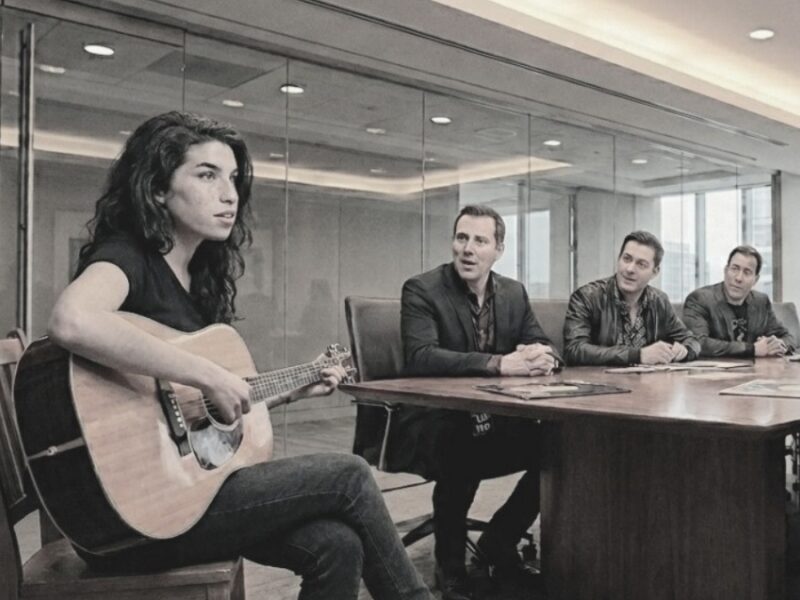
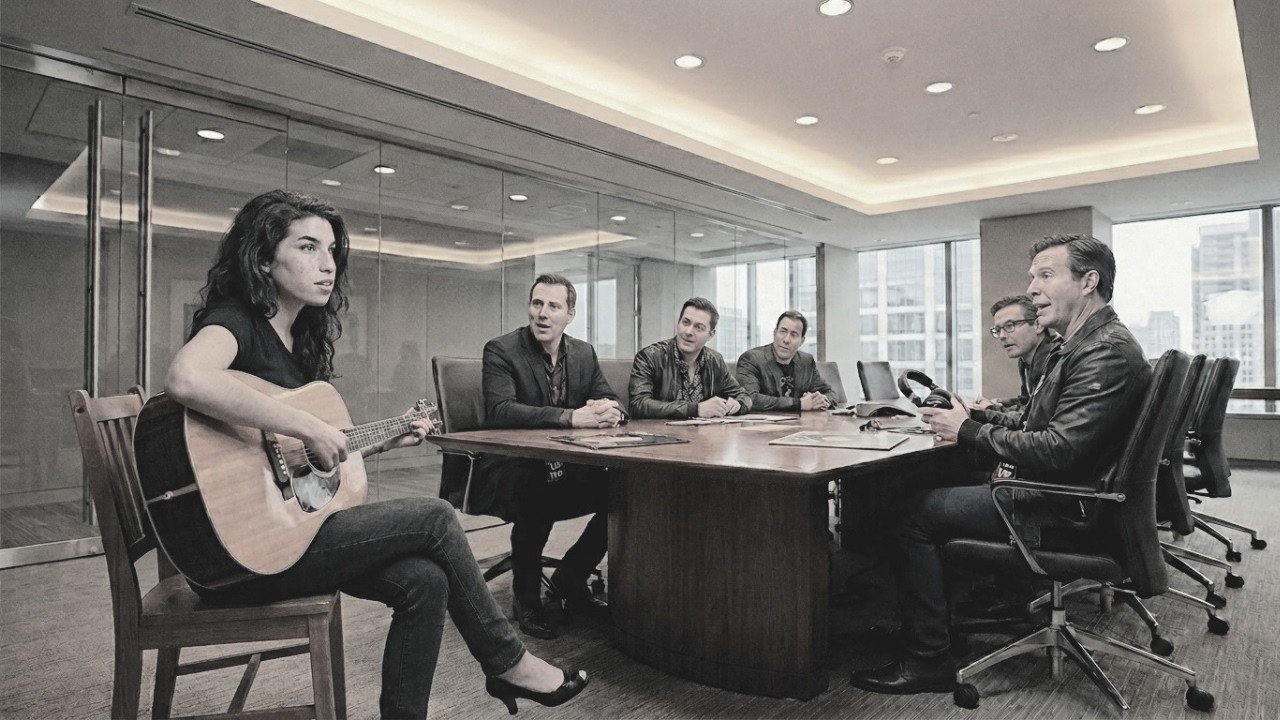
She was 19 years old, and she was being paid £250 a week. and she was by the account of everyone who had encountered her music in any form something that had not been seen before. What happened next in the island records head office is documented in footage that appears in Af Capadilla’s 2015 documentary. Bees had arranged for Amy to perform a live audition for the full company, not just for the executives who had already decided they wanted to sign her, but for the entire staff.
His reasoning was simple and confident. If she just sat down in front of the whole company and sang acoustically, people would be blown away. He knew this because she had already blown him away. He trusted what he had heard. Amy sat down in a chair in the Island Records head office. She had a guitarist with her.
She was 19 years old and she had never had a record deal before. And she was about to sing for a room full of music industry professionals who had heard many hundreds of auditions and had learned over years in the business to be selective about their enthusiasm. She sang I heard Love is Blind. The song was one she had written herself, a jazz inflected piece about knowing you are being deceived by someone you love and choosing to look the other way.
Written with the kind of emotional precision that most songwriters spend entire careers trying to develop, and that Amy had arrived at apparently by simply paying attention to her own feelings and writing them down as honestly as she could. The melody moved through the kind of harmonic territory that jazz singers navigated and pop singers generally avoided.
The lyric was funny and devastating in equal measure, and the voice that delivered it was the voice that darkest Beast had heard coming out of a speaker in his office and had spent months tracking down. Nick Shamanssky, watching from the side of the room, said afterward that it was a genuine jaw-dropping moment. He said you could see every person in that room thinking the same thing at exactly the same time.
He said it was the happiest professional moment he had experienced after the months of rejections and the careful management of the secret and the negotiations with multiple record labels. They had finally signed the deal and now the people who had signed it were watching the room confirm person by person that they had been right. What the room was thinking in Shamansk’s telling was three words.
What the [ __ ] is this? Not as a question, as a recognition, as the specific and irreversible understanding that something had just walked into the room that was going to change things that could not be categorized or processed through the existing systems that was simply undeniably real. The aftermath of the signing contained a detail that anyone who knew Amy would recognize as entirely in character.
A year after the audition, frustrated by what she felt was a botched promotional campaign for Frank, the marketing she called [ __ ] the promotion she called terrible, she gave an interview in which she called the people at Island idiots. she added with the particular Amy qualification that made the insult both worse and somehow more charming.
But they’re nice idiots, so you can’t be like, “You’re an idiot. They know that they’re idiots.” Nick Shamansky, her manager, said this killed the buzz that people were saying they would never work with her again, asking who the [ __ ] did she think she was. What nobody asked in the immediate outrage was whether she was right.
The promotion had been problematic. The marketing had not done justice to what the album was. Frank deserved better than it got commercially, and Amy, who had a directness that operated independently of strategic calculation, had simply said so in the most direct way available to her. She was 19 when she sat in that chair in the Island Records office and sang one song.
She was 20 when she said exactly what she thought about the people who had signed her in the pages of a national magazine. Both of those moments were the same person. The voice and the honesty and the refusal to be something she was not, those things had always been the same thing. Amy Winehouse signed to Island Records in 2002 and released Frank in October 2003.
The album won an Ivor Noll award and was shortlisted for the Mercury Prize and introduced her voice to anyone who was paying attention. It sold over a million copies in the United Kingdom and drew comparisons to Sarah Vaughn and Nina Simone and Erica Badu from critics who were trying to locate her in a tradition and finding that the tradition kept expanding to accommodate her.
3 years later, she made back to black. And the room that had thought, “What the [ __ ] is this?” when a 19-year-old girl sat down in a chair and sang one song, found out what it was. It was one of the greatest voices of the century, sitting in a chair in an office in London, waiting to be