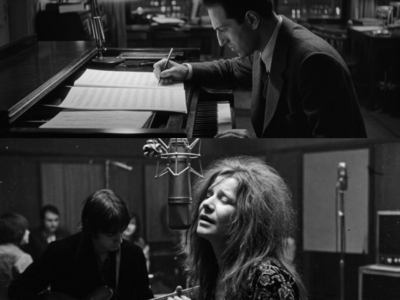
Leonard Cohen Sang Chelsea Hotel for 41 Years After Janis Died He Never Stopped Feeling Bad About It
Spring 1968, the Chelsea Hotel, New York City, room 424. Leonard Cohen had been living in the hotel for several months. He had come from Montreal, from a life as an established poet and novelist to try to become a folk singer in New York. He was 33 years old in an era when the music industry told him he was too old.
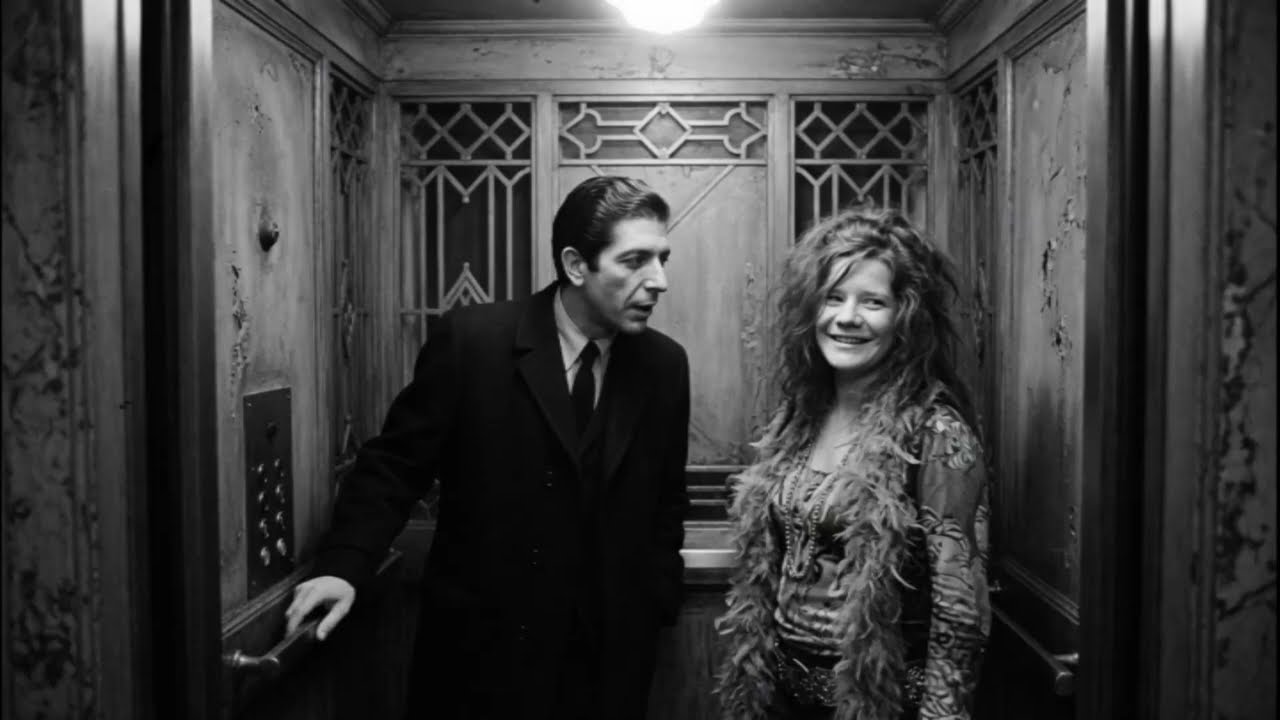
His debut album had come out the previous year to modest reviews and modest sales. He was not yet what he would become. Late one night or early one morning, he got into the hotel’s elevator. The door opened. A woman got in, wild hair, wild clothes, more energy than the elevator knew how to hold.
It was Janis Joplin from room 41A oven. She was in New York recording Cheap Thrills at Columbia Studios. She was 25 years old and already famous in a way Cohen was still working toward. He gathered himself. He spoke, “Are you looking for someone?” She said, “Yes. I’m looking for Kris Kristofferson.” Cohen was not Kris Kristofferson.
He was considerably shorter than Kris Kristofferson. He said, “Anyway, little lady, you’re in luck. I am Kris Kristofferson.” She knew he was not. She never let on. “Those were generous times,” Cohen said later. “Great generosity prevailed in those doomed decades. We fell into each other’s arms through some process of elimination,” he told Rolling Stone.
“She wasn’t looking for me. I wasn’t looking for her. But there we were. In the morning, she left.” He saw her a few times after that, not many. The world was moving fast for both of them. Then she died, and a year later he wrote a song, The Chelsea Hotel, a building that deserves its own biography.
It opened in 1884 on West 23rd Street in Manhattan. By the 1960s it had become something specific, the place where the people who were making American culture went to live when they couldn’t afford anything better or when they wanted to be around others of their kind. Dylan Thomas drank himself to death there.
Sid Vicious killed Nancy Spungen there. Arthur Miller hid there after his divorce from Marilyn Monroe. Bob Dylan wrote “Sara” there. Joni Mitchell wrote “Chelsea Morning” there. Andy Warhol filmed “Chelsea Girls” there. Jack Kerouac, Allen Ginsberg, Jackson Pollock, Patti Smith, Jimi Hendrix, at some point all of them lived in or passed through those marble hallways.
Cohen had heard about it before he arrived. “I had heard about the Chelsea Hotel as being a place where I might meet people of my own kind, and I did. It was a grand, mad place. Janis Joplin was one of the people of his kind he met there. She was, in a specific and important sense, the most significant. “Chelsea Hotel No.
2″ was first performed publicly on March 23rd in 1972 at the Royal Albert Hall in London. It was recorded 2 years later for his 1974 album “New Skin for the Old Ceremony”. In the song, Cohen describes the encounter with a woman at the hotel without naming her. The song is intimate and specific and slightly cold in the way Cohen’s songs were always slightly cold.
The precision of a man who understood distance as a form of honesty. When he introduced the song in concert, he would describe the encounter. He told the story of the elevator, the Kris Kristofferson line, the generosity of those doomed decades. He described her in terms that were generous and also in one line explicit. He named her.
He first revealed it publicly on May 25th, 1976 at a concert in Montreux, Switzerland. “She would not have minded,” he said. “My mother would have minded. You was wrong about whether she would have minded.” Or at least he came to believe he was wrong because Janis Joplin had told her own version of the encounter, not about Cohen specifically by name.
She named him alongside Jim Morrison as two prominent men who had given her nothing. Her words were electric and entirely Joplin. Sometimes you’re with someone and you’re convinced they have something to tell you. So maybe nothing’s happening, but you keep telling yourself something’s happening. He’s just not saying anything.
He’s moody or something. So you keep being there, pulling, giving, rapping. And then all of a sudden about 4:00 in the morning you realize that this person’s just lying there. She was describing the specific disappointment of expecting something from someone because of who they were, because of the idea of them, and finding the person behind the idea was absent. She had done it twice.
Morrison and Cohen, the two most poetically self-serious men in rock music in 1968. And both of them had given her nothing. Cohen’s version, generous times, two people finding each other through elimination. Janis’s version, a man lying there, not present, leaving her to carry the whole room.
Both versions are probably true. That is how it goes. In 1994 at a BBC radio interview, Leonard Cohen said something that stayed with him for the rest of his life. There was the sole indiscretion in my professional life that I deeply regret because I associated a woman’s name with a song. I’ve always disliked the locker room approach to these matters.
I’ve never spoken in any concrete terms of a woman with whom I’ve had any intimate relationships, and I named Janis Joplin in that song. I don’t know when it started, but I connected her name with the song, and I’ve been feeling very bad about that ever since. It’s an indiscretion for which I’m very sorry, and if there is some way of apologizing to a ghost, I want to apologize now for having committed that indiscretion.
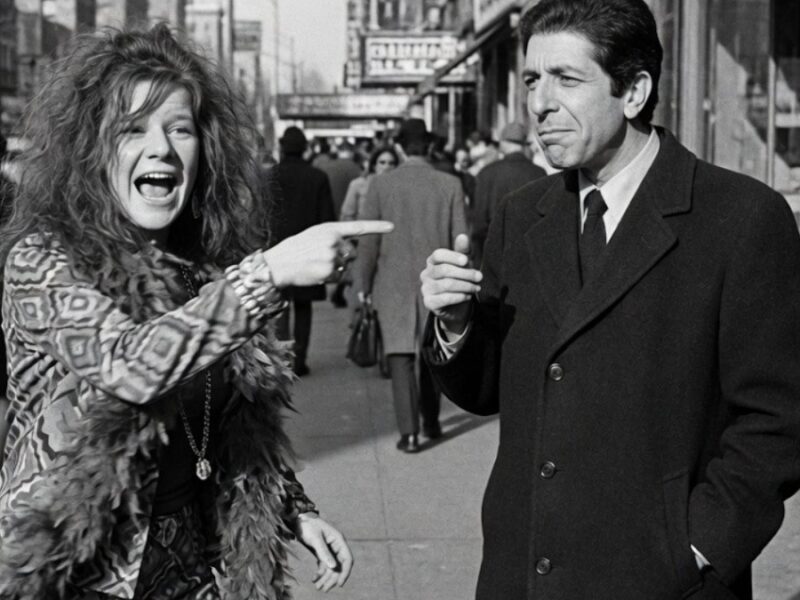
He was apologizing to a ghost. She had been dead for 24 years. He continued to play the song. He never stopped playing it, but he stopped telling the story of who it was about. The apology was made. The song kept going. The last time Leonard Cohen saw Janis Joplin was on 23rd Street in New York City. He didn’t know it was the last time.
She spotted him on the street. She called out, “Hey man, you in town to read poetry for old ladies?” That was her assessment of his career. That was her version of a greeting. Sharp and warm and funny and pointed, the way Joplin was always sharp and warm and funny and pointed. He laughed. He must have. You couldn’t not.
That was the last time. She died a short while after. He found out and wrote the song. “He was saddened by her death,” he told Sounds UK in 1976. “Not because someone dies, that in itself isn’t terrible, but I liked her work so much. She was so good that you feel the body of work she left behind is just too brief.
There are certain kinds of artists that blaze in a very bright light for a very brief time. The Rimbauds, the Shelleys, Tim Buckley, people like that. And Janis was one of them. Here is what this story asks you. Have you ever said something about someone, told a story, shared a detail, named a name, and then spent years wishing you hadn’t?” Leonard Cohen was one of the most careful, precise, controlled men in the history of songwriting. He chose every word.
He revised everything. He was known for taking years to finish a single song. And the one thing he regretted for the rest of his life was not a poorly chosen word in a lyric. It was naming someone who could not speak for herself. He apologized to a ghost. She was not there to accept or decline.
The song is still played. The last time he performed in public at a concert in 2013, Chelsea Hotel number two was in the set. He sang it for 41 years after she died. I remember you well in the Chelsea Hotel. He did remember. That much was always clear. Subscribe. The next story goes somewhere nobody has taken you before.