San Francisco Had Two Queens in 1967 — They Made Opposite Choices and Only One of Them Survived
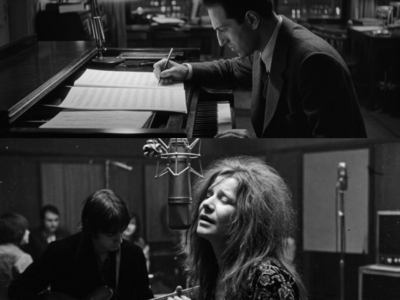
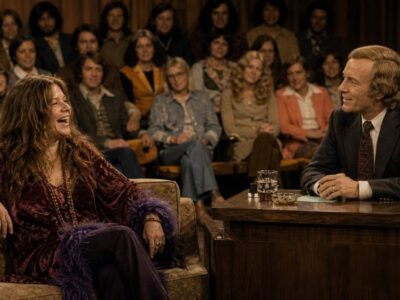
In 1967, San Francisco had two queens. Their names were Janis Joplin and Grace Slick. They shared the same city. They shared the same stages. They shared the same world, the Fillmore, the Avalon Ballroom, the Haight-Ashbury scene that was for one extraordinary year the center of American music.
They were both women in rock at a time when being a woman in rock was still considered a category, not a given. They were both 24, 25 years old. They were both on magazine covers and festival bills and the same rotating circuit of the most important venues in California. And they were completely, fundamentally, irreconcilably different.
Grace Slick is still alive. She is 84 years old. She became a painter after she stopped performing. She gives occasional interviews. She says what she thinks, which she has always done. Janis Joplin died in 1970. She was 27. This is the story of two women who answered the same question. What does a female voice in rock and roll sound like? In such different ways that both answers were right and neither could be the other.
Grace Slick was born October 30th, 1939 in Highland Park, Illinois. She grew up in a comfortable upper middle class family. She attended Finch College in New York, a finishing school for women of her class. She studied art. She got married. She was living the life she was supposed to live. Then she went to a Jefferson Airplane show in San Francisco in 1965.
She came home and told her husband she was going to be a rock singer. She was 25 years old. She formed a band called The Great Society. Two years later, she joined Jefferson Airplane. She brought two songs with her, Somebody to Love and White Rabbit. Both became top 10 hits. Both became anthems of the Summer of Love.
Both are still played on every classic rock radio station in America. Her voice was unlike anything in rock music at the time. Controlled, architectural. She built a note the way an engineer builds a bridge, knowing exactly where it started, exactly where it ended, exactly how much weight it needed to carry. She was never not in command of what she was doing.
Not for a single note, not for a single performance, not for a single interview in her 50-year public life. She was also, by every account, formidably intelligent, formidably opinionated, and completely uninterested in being liked by anyone who didn’t interest her first. Janis Joplin was born January 19th, 1943 in Port Arthur, Texas. She grew up in a struggling middle-class family.
She went to Lamar State College of Technology. She left. She went to San Francisco. She came back to Texas. She tried to be ordinary. She failed. She went back to San Francisco and joined Big Brother and the Holding Company in 1966. She brought no songs with her. She brought a voice that nobody had heard before and a wound that nobody could see and a need to give everything to every room she walked into every night, every time, without reservation or calculation or any interest whatsoever in controlling the gap between who she was and what the audience saw.
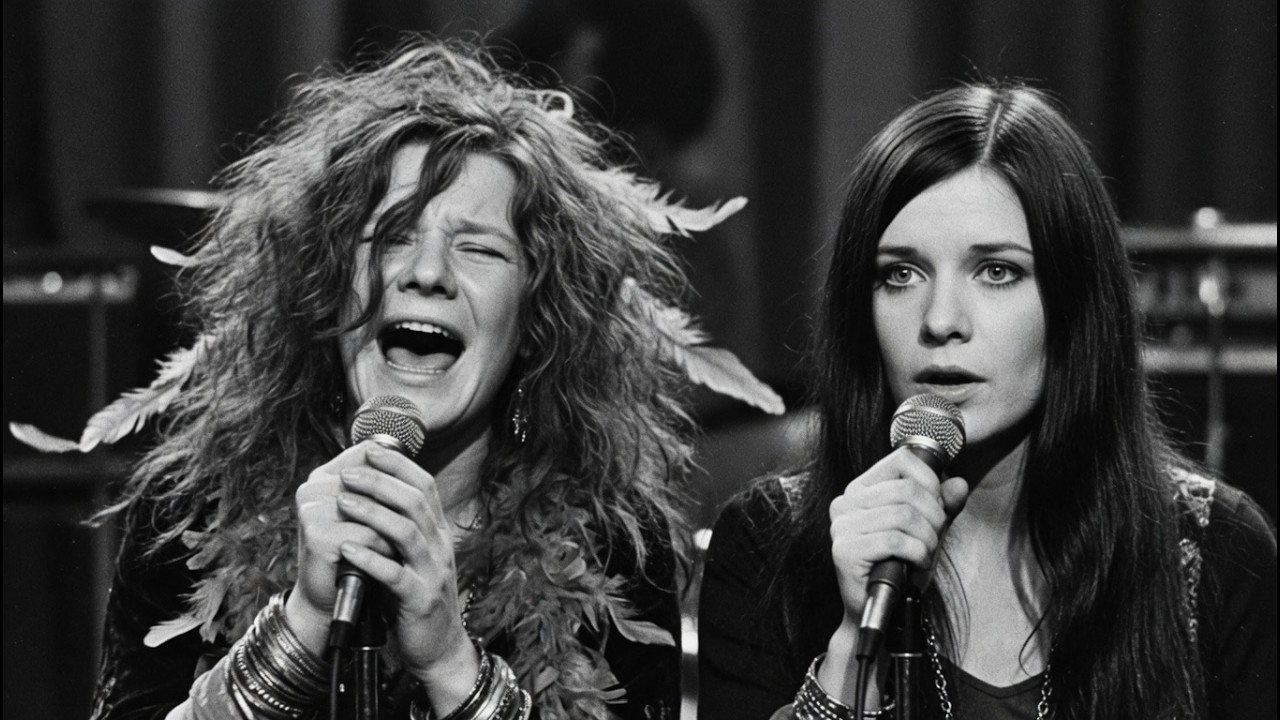
There was no gap. That was the point. They shared stages, not often and not by design, but they were in the same world and the world was small. The Fillmore, the Avalon, the festivals. Jefferson Airplane and Big Brother and the Holding Company were both part of the same scene, the same circuit, the same extraordinary moment when San Francisco was inventing something new.
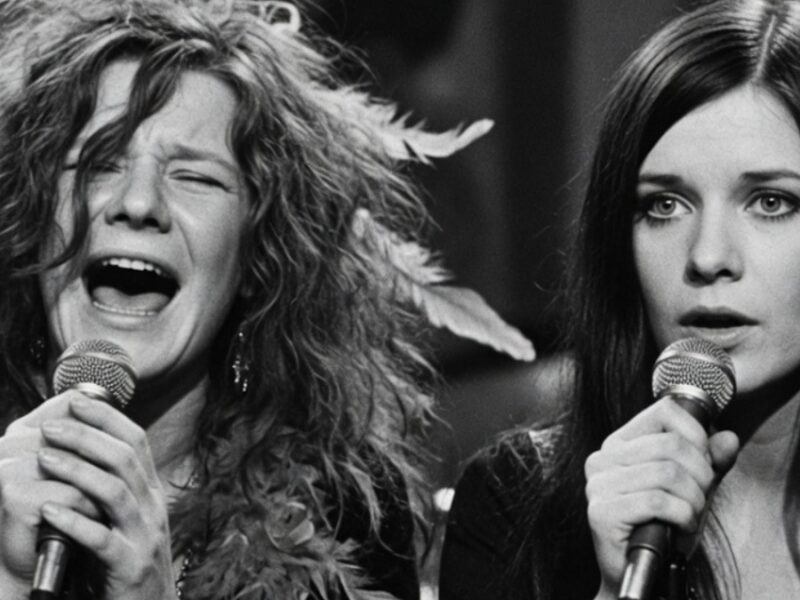
Grace Slick watched Janis Joplin perform. She has talked about it over the years, not effusively. Grace Slick does nothing effusively. But with the specific precision of someone who understood exactly what she was watching and found it both extraordinary and completely foreign to her own approach. She said in various interviews across the decades, “Janis sang from the gut.
Grace sang from the head. Neither of them was wrong. They were just answering different questions.” What Grace saw when she watched Janis was someone who had found the one thing that no amount of technique could replicate. The complete surrender of the performer to the performance. Janis did not perform pain.
She reported from inside it. She did not perform joy. She was inside it. There was no translation between the feeling and the sound. The sound was the feeling unmediated. Grace Slick could not do that. Would not do that. Had built her entire identity on the controlled distance between the feeling and the sound.
On the understanding that the performance was not the person. On the belief that the greatest singers were the ones who could give an audience the impression of rawness while maintaining complete internal command. She was also right. The differences between them were visible in everything. On stage, Janis wore feathers and beads and things that moved.
Grace wore what fit the image she had constructed, which was often striking and always deliberate. Janis moved as if she had forgotten her body was a body. Grace moved as if she had choreographed every gesture. Off stage, Janis sought warmth. She bought drinks for strangers. She sat in the corner of bars alone on her birthday.
She needed the room to love her. Grace Slick has never, by any available evidence, needed a room to love her. She has always seemed completely sufficient to herself, a rare quality in performers who tend by nature toward the addictive comfort of audience approval. With drink. Both of them drank. Both of them drank heavily across this period.
The difference was that Grace Slick survived her drinking. She got sober. She kept going. She is 84 years old and painting and occasionally saying exactly what she thinks in interviews. Janis Joplin did not survive hers. Grace Slick has been asked about this, about survival, about the specific calculus of who makes it and who doesn’t, about why she is here and Janis is not.
She has answered with the directness that characterizes everything she says. She has essentially said, “Luck and stubbornness and the specific decision at some point to want to be alive more than she wanted to feel everything all the time.” Janis Joplin, by everything she ever said and did and sang, could not make that decision.
Not because she didn’t want to be alive, but because feeling everything all the time was not a choice she was making. It was what she was. The voice and the feeling were the same thing. You could not separate them without stopping the voice. They were at Monterey at the same time. Jefferson Airplane performed on Saturday night, the night before Janis.
Grace Slick at the microphone, controlled and powerful. 24 hours later, Janis Joplin at the same festival, the same general stage, and Mama Cass in the audience mouthing the word, “Wow.” The same festival. The same weekend. The same city that had produced both of them. Two completely different answers. Grace Slick stopped performing in 1989.
She said she was too old for it. Not physically, but conceptually. She could not get on a stage and be the thing she had been in 1967. And she had no interest in being a diminished version of it. She became a painter instead. She is very good at it. She says what she thinks about everything and has no apparent interest in being careful.
She is 84 years old and alive. Janis Joplin gave everything to every room for four years and died at 27. There is no moral to this. There is no lesson that says be more like Grace and you will survive. The specific thing that made Janis Joplin what she was, the inability to separate the feeling from the sound, the complete surrender of the self to the performance, was also the thing that made her incapable of the kind of self-preservation that survival requires.
She was not careless with her life. She was generous with it. She gave it to the music, to the audience, to the night, to the moment. She gave it away in pieces every time she walked onto a stage and held nothing back. Grace Slick held something back. That something was herself and it kept her alive. Here is what this story asks you.
Is there something you do? Something you give to others or to your work where the question is how much of yourself to put in? Where the people who give everything burn out and the people who hold something back last longer? Janis Joplin gave everything every time. She lasted four years at the top and 27 years total.
Grace Slick held something back. Not out of coldness, out of self-possession. She lasted 50 years in music and is still alive at 84. Both of them were San Francisco in 1967. Both of them were the answer to the question of what a female voice in rock could be. Both of them were right. Only one of them is still here to tell you. Subscribe.
The next story goes somewhere nobody has taken you before.