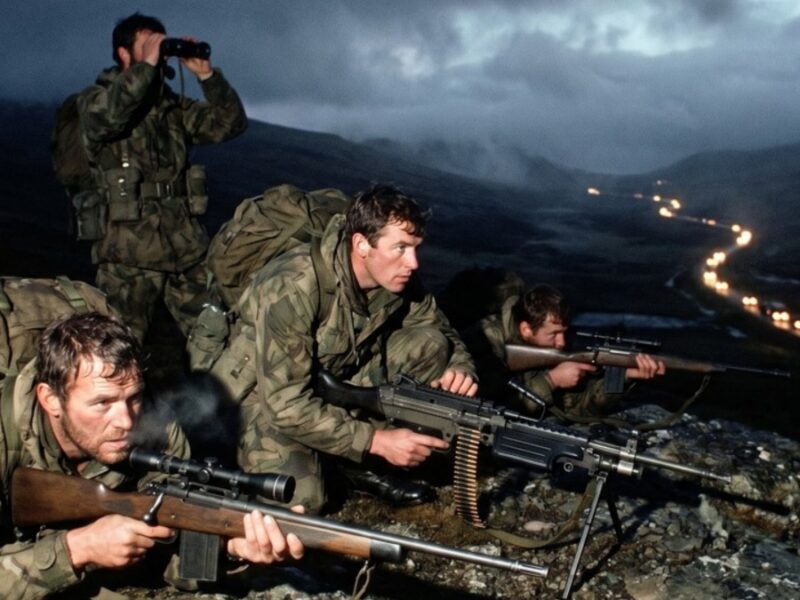
The Argentine Commander Said the High Ground Was His. D Squadron Had Already Taken It.
May 26th, 1982. General Mario Menendez, the Argentine commander of the Falkland Islands garrison, is reviewing his situation map in the command post at Port Stanley. The western approaches to Stanley, the route any British ground advance must use, are marked with red lines indicating Argentine-held positions.
Mount Kent, the dominant high ground commanding the entire western approach, is circled and annotated in his own hand, held. Menendez marks through the western ridgelines with a confident stroke. This is ours. This is the approach we defend. His chief of staff nods in agreement. The situation report for Buenos Aires is being drafted on exactly the same basis.
On Mount Kent itself, 42 km from the Port Stanley command post, 42 Commando Royal Marines are helicoptering onto the summit in multiple Sea King lifts. They are not landing on Argentine-held ground. They are landing on a position that D Squadron 22 SAS has occupied for 4 days. 4 days of fighting off Argentine counterattacks across three consecutive nights.
4 days of holding the key terrain in the Falklands while the Argentine intelligence system reported it as contested, as unresolved, as probably in the process of being recovered. The Marines land and the SAS begin to pack their equipment for the handover. D Squadron’s 4-day occupation of Mount Kent is over. The position is being handed to a force large enough to make Menendez’s mistake visible even from Port Stanley.
His May 25th situation report described the Mount Kent area as contested. The word was already wrong when he wrote it. It will be completely wrong within 24 hours. The ground was never his to lose after May 22nd. D Squadron had already taken it. General Mario Menendez’s map was accurate in the way that all intelligence maps are accurate until the moment they are not.
His dispositions on paper represented the Argentine force structure as it had been assessed, reported, and updated through a chain of officers who were themselves working from assessments rather than direct observation. The map showed the Argentine Fourth Infantry Regiment covering the western approaches to Stanley, approximately 400 men deployed across three ridgeline positions.
Mount Kent at the apex, Two Sisters flanking it to the north, and Mount Longdon anchoring the northern end of the line. The plan was tactically sound on paper. Mount Kent was the anchor of the entire western defense, the dominant terrain feature from which Argentine observation posts could see the approach roads from San Carlos, coordinate artillery fire, and direct the regimental response to any British advance from the west.
If Mount Kent held, the approach to Stanley from the west was covered, and the Argentine defensive plan had a logical structure that required any British ground advance to fight through three mutually supporting ridgeline positions before reaching the town. Menendez reviewed the map and the plan on May 25th and found no reason to revise his confidence in the western defense.
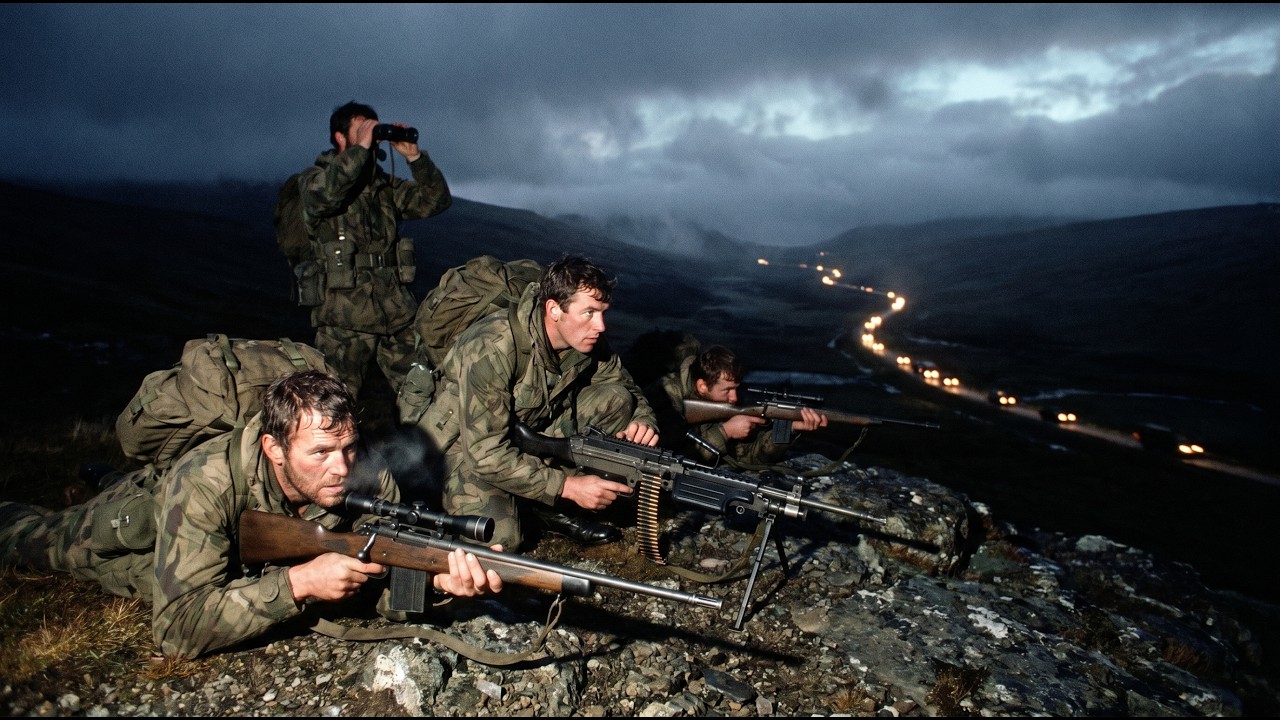
He had received reports of contact in the Mount Kent area. The reports described possible British patrol activity, unconfirmed contacts, small arms fire heard at night. None of the reports described the situation accurately, which was that D Squadron had been in permanent concealed positions on the summit since May 22nd and had fought off three Argentine counterattacks over three consecutive nights, each larger than the last, each failing at greater cost.
The intelligence failure that produced Menendez’s map was not a failure of individual carelessness by any one officer in the chain. It was structural. The reporting chain filtered upward, each level adding a qualifier that softened the previous level’s assessment. And by the time the picture reached Menendez, it reflected the institutional expectation rather than the physical ground.
No single officer had lied. No single officer had been deliberately negligent. Each had reported what he could confirm from his own position. The accumulation of those confirmations produced a strategic portrait of a situation that did not exist. Menendez’s map was a portrait of what he expected to hold, drawn in the language of military certainty, with every layer of uncertainty stripped out before it reached his desk. His map was wrong.
The summit was gone. The annotated word held was 4 days incorrect before he read it. The Argentine Fourth Infantry Regiment’s defensive plan was built around the Mount Kent anchor with the precision that a sound tactical plan requires. The regiment’s three battalion groups occupied a series of ridgeline positions on the approaches to Stanley, each chosen to maximize fields of fire, mutual support, and the observation advantage that high ground provides to a defending force.
The regimental commander briefed his battalion commanders on May 24th, the day after the second Argentine counterattack against D Squadron’s summit position had failed. The Kent line holds. We anchor from there and let them come to us. It was a reasonable plan for a defending force that held the ground it was defending.
A regiment on good terrain with prepared positions and mutual support between its elements has substantial advantages over an attacker moving across open approaches. The Argentine battalion commanders went back to their positions with a clear understanding of the plan and a genuine belief in its viability. None of them had physically been to the Mount Kent summit in the previous 4 days.
Their understanding of the Kent anchor was based on reports from their own observation posts, which were on the lower ridgelines watching the approach routes from San Carlos and had heard gunfire on the previous three nights without being able to confirm its source or its outcome. The observation posts were reporting what they could see and hear from their positions on the lower slopes. They could not see the summit.
They heard gunfire that the Argentine reporting system was logging as possible contact, probable British patrol, unconfirmed British presence. D Squadron was above them in concealed positions on the summit fighting off counterattacks that the Argentine patrol system was dispatching upward from below each night.
The three nights of contact were not being reported as three nights of failed Argentine counterattacks on a firmly held British position. They were being reported as unconfirmed contacts in the Mount Kent area, language that preserved the institutional assumption that the summit remained unoccupied by a permanent British force rather than displacing that assumption with what was actually happening.
The regimental commander’s May 24th briefing, the Kent line holds, was the product of this reporting chain. He believed it completely. The summit was not his and he did not know it. The Argentine intelligence gap on Mount Kent was structural and its structure was invisible from inside it. The Argentine patrols operating around the mountain in the period from May 22nd to May 25th were performing their tasks correctly by any standard that could be applied to patrol operations in the terrain and conditions they faced.
They patrolled the lower approaches and the intermediate ridgelines. They reported what they heard and what they could confirm from their assigned positions. The problem was not that they were negligent, it was that what they heard was categorized and reported in a language that matched their patrol mandate rather than the physical reality on the summit.
The Argentine patrol system was designed to detect British movement and to report British contact. It reported British contact on each of the three nights. What it could not report was the permanence of the British position above them because detecting permanence requires climbing to the summit and establishing visual confirmation, and no patrol commander was going to climb a summit where gunfire had been heard on each of the previous three nights without specific orders to do so.
The orders did not come because giving those orders required the regimental commander to understand that the summit was occupied and needed confirmation. And his existing assessment was that the summit was the site of possible British patrol activity rather than a defended and permanent British position.
The gap was self-sealing. Understanding that the summit needed checking required the information the checking would have produced. One Argentine patrol commander, having heard gunfire on the second night, filed a report with the assessment “Possible enemy patrol, unconfirmed contact, situation continuing, recommend monitoring.
” He did not climb toward the sound of the gunfire because climbing toward confirmed contact at night on unfamiliar terrain without orders was not within his patrol’s remit. That decision was individually correct and operationally catastrophic. It preserved his patrol. It preserved the intelligence gap simultaneously. The Argentine intelligence system was generating technically accurate reports.
Each patrol accurately described what it had encountered from its own position that collectively produced a false strategic picture. D Squadron occupied the gap between what the Argentine patrols could see and what was actually happening on the summit, stayed concealed during daylight hours and fought at night when the Argentine patrols climbed toward them from below.
D Squadron began its move toward Mount Kent on the night of May 19th, 1982 as part of the broader plan for the SAS to seize the dominant high ground ahead of the conventional 3 Commando Brigade advance from the San Carlos beachhead. The operation was a helicopter insertion, a sequence of Sea King lifts from HMS Hermes that delivered the advance elements to the lower slopes under cover of darkness with the main body following over the subsequent 48 hours as the helicopter tasking and weather windows allowed.
The approach from the landing zones to the summit was on foot carrying the loads that a sustained multi-day occupation of an exposed high-altitude position in the Falklands autumn required, weapons, ammunition, observation and communication equipment, rations sufficient for several days, sleeping systems, demolition charges for position hardening, and spare radio batteries.
The weight per man was in the range of 60 to 80 lb. The terrain was peat bog at the base of the mountain, exhausting to cross in poor visibility, transitioning to broken rock and steep ground near the summit approaches. Movement was at night. The advance elements reached the lower slopes by the early hours of May 20th.
The summit was approached from the north using the dead ground on the ridgeline’s northern face to mask movement from the Argentine observation posts known to be operating on the lower southern and eastern slopes. The summit itself was reached and confirmed empty at approximately 0200 on May 22nd. Argentine equipment was discovered, a 120 mm mortar base plate, empty ammunition boxes, discarded ration materials indicating a recent occupation that had been withdrawn.
The Argentine local commander had ordered the summit garrison pulled back to the lower ridgeline positions in the days before the SAS insertion on the tactical calculation that the summit was exposed and difficult to resupply except by helicopter. It was a decision that seemed locally sound and proved strategically catastrophic.
The summit was not defensible from below. It was only defensible from the summit itself by a force willing to hold it at night against attacks from multiple directions in darkness and cold. By withdrawing the summit garrison, the Argentine local commander handed D Squadron the dominant terrain feature of the entire Falklands campaign without a fight.
Major Delves reached the summit, confirmed it empty, and told the men around him two words. They left. A pause. Good. D Squadron moved into their positions. The work of keeping the summit began that same night. Before we dive in, drop a comment and let us know where you are watching from.
If you haven’t already, make sure you hit the subscribe button to not miss any story. And check out our Patreon in the description. We post full uncensored stories there. Every graphic detail, every brutal moment, nothing redacted. Stories YouTube won’t allow. Now, let’s get into it. Chapter two. The first Argentine counterattack came on the night of May 22nd to 23rd within hours of D Squadron completing their summit occupation.
Approximately 20 troops climbed the northern approach in the dark moving in a loose column that D squadron’s forward sentry positions detected at approximately 400 m. The contact lasted 35 minutes. The Argentine element was engaged at close range, suffered casualties in the initial exchange, and withdrew into the darkness below the ridgeline leaving equipment behind. No SAS casualties.
The second night, May 23rd to 24th, brought a substantially larger force. The contact analysis conducted the following morning estimated Argentine strength at 80 to 100 troops with a machine gun element deployed on the lower ridge that provided sustained suppressive fire while the assault element climbed the northern face.
The contact lasted 140 minutes. It reached its most intense phase between 90 and 120 minutes when the Argentine assault element closed to within 80 m of the forward positions before the volume and accuracy of the GP PMG arcs forced the advance to stop. One SAS trooper received shrapnel wounds from an Argentine grenade in the contact’s second phase.
Wound serious but not incapacitating, treated on the position and kept in the line. The Argentine element withdrew again leaving evidence on the approach route of the scale of their commitment and the level of casualties they had sustained. A Chinook resupply arrived in the afternoon of May 24th between the second and third contacts restoring the position’s ammunition state.
The third night, May 24th to 25th, brought the largest Argentine commitment yet. Over 120 troops with organic mortar support. The mortars registered on the summit perimeter from the lower slopes and firing for effect throughout the contact period. The fighting lasted 190 minutes.
By its end, ammunition reserves were reduced to levels that made a fourth night at the same scale a serious planning concern that Delves was already calculating. The Argentine battalion commander who led the third night’s assault reported upward that the British position appeared to be defended by company strength or larger.
He had estimated the defending force at 10 times the actual number. There were 60 men on the summit. The Argentine force could not understand how 60 men were stopping over a hundred from taking the position. They tried three times over three nights to find the answer through force. The ground told them nothing they were willing to hear.
Menendez’s situation reports on the Mount Kent area across the period May 22nd to 25th document the progressive recognition of a situation his intelligence system had been structurally unable to describe accurately from the beginning. The May 22nd report, sent on the morning following D Squadron’s summit confirmation, contact in the Mount Kent area, possible British patrol, situation monitoring.
The May 23rd report, the morning after the first counterattack failed, confirmed British patrol activity on lower Kent slopes, multiple infantry-sized contacts reported overnight, Argentine forces engaging, assessment, probing action, no permanent British presence established on summit. The May 24th report, the morning after the second larger counterattack failed, British presence on Kent confirmed to ridge level strength unknown, fourth infantry engaged in active clearance operations, progress slow due to terrain, contact ongoing.
The May 25th report to Buenos Aires, Mount Kent area assessed as contested, British forces present in strength, clearance operations continuing with resolution expected over the next 24 to 48 hours. Each of those four reports is exactly one step behind the actual situation at the moment it was written. By the time Menendez was writing contested on May 25th, D Squadron had been on the summit for 72 hours and had stopped three Argentine counterattacks with a combined Argentine commitment of over 200 men across three nights.
Contested was the word the institutional reporting system produced when the incoming information could no longer support the previous language of denial, but had not yet arrived at the accuracy required to use the word lost. The contested framing implied that the outcome was still open, that the Fourth Infantry’s clearance operations were making progress.
That implication was false. Nothing the Fourth Infantry had attempted had moved the British force 1 m from the summit. Menendez reviewed the May 25th report and asked his staff officer for the Fourth Infantry’s current assessment. The staff officer replied they were attempting to clear the position and expected progress. Menendez said, “Good.
” That word was not cynicism or deliberate optimism. It was the genuine confidence of a commander receiving the processed output of a reporting chain that had described four days of failure as progress in the making. The situation report that Menendez sent to the Argentine Joint Command in Buenos Aires on May 25th described the Mount Kent area as contested.
That word was the Argentine military’s institutional formulation for a situation in which ground was being disputed and the outcome remained operationally open. Contested carried specific meaning in Argentine military reporting language. Action ongoing. Both sides present. Resolution pending. Position not formally assessed as lost.
It meant the Fourth Infantry was working on the problem. It meant the western approaches were still being defended in some meaningful sense. What it did not convey and what the joint command in Buenos Aires needed to understand and did not, was that the key terrain anchor of the entire western defense had been occupied and held by a British force for three consecutive days.
That three progressive Argentine counterattacks to recover it had failed at escalating cost, and that the force holding it was about to be replaced by a 600-man conventional marine formation, which would transform what had been a covert SAS position into the forward start line for the British main advance on Stanley. Contested implied a genuinely two-sided contest, that Argentine forces retained a realistic and near-term prospect of recovering the position.
The actual situation was not two-sided. D Squadron was on the summit, and the Argentine attempts to dislodge them had failed on each of three nights. The Argentine forces at the base of the mountain were not contesting the summit in any militarily meaningful sense. They were attacking a held British position without knowing its strength, without understanding how long it had been held, and without understanding the strategic consequence of three consecutive failures to dislodge it.
Buenos Aires was receiving the word contested. The summit had a different word for what was happening, though there was no reporting mechanism to send it south. 24 hours after Menendez filed the contested report, 42 Commando heli- coptered onto the summit, and the irreversibility of the situation became impossible for the reporting chain to process away.
The word contested was no longer in anyone’s vocabulary after May 26th. It had been the wrong word from the start. 42 Commando Royal Marines arrived on Mount Kent by Sea King helicopter on May 26th, 1982. The insertion was conducted in multiple lifts over several hours through the morning. Each aircraft depositing a section of Marines onto the summit while D Squadron consolidated their equipment, packed their dead loads, and prepared the handover brief.
Colonel Nick Vaux, commanding 42 Commando, received the ground brief from Major Delves on the summit’s eastern edge looking down the northern approach route that the Argentine counterattacks had used on each of the three previous nights. Delves described the Argentine positions confirmed during the three nights of contact, the northern approach vector the initial contact had used, the machine gun position on the intermediate ridge that had supported the second night assault from a fixed point, the mortar registration line confirmed on
the third night from the sound signatures and impact pattern, the estimated total Argentine committed strength across all three nights based on the contact analysis, the physical evidence left on the approach routes, and the scale of ammunition expended against the position. He described the current ammunition state after the third night’s expenditure and the partial restoration from the Chinook resupply on the 24th.
He described the SAS casualty, one wounded, still on the position, movement capable. He described the three nights in the order they occurred, each detail placed in the sequence it happened in the language of a man who had been keeping notes in the dark and was now reading them back in daylight. Vaux listened to the entire brief without interrupting.
When Delves finished, Vaux asked one question. “How many men did you have here?” Delves told him the number was 60. Vaux was quiet for a moment looking down the northern approach route, then he said, “Right.” He did not elaborate. The word right in that usage carried the full weight of a professional soldier’s acknowledgement of what 60 men had done on a piece of ground that 600 Marines were now moving to occupy.
D Squadron began their withdrawal from the summit shortly after. Behind them, 42 Commando was already deploying into the positions D Squadron had maintained since May 22nd. In Port Stanley, Menendez’s command post had begun receiving the Fourth Infantry’s first reports describing multiple heavy-lift helicopter sorties on Mount Kent summit.
The word contested was already obsolete. The word lost had not yet been formally written. The helicopter sorties were about to write it in language that no qualifier could process away. The Argentine intelligence picture on Mount Kent finally updated to an accurate description of the situation on the evening of May 26th when the Fourth Infantry’s patrol and observation reports confirmed multiple heavy-lift helicopter insertions on the summit and the observation of conventional infantry weapons, crew-served weapons, and the
general indicators of a battalion-level force deployment. The patrol reports were clear in a way that no previous Mount Kent report had managed to be. The position was occupied. The strength was assessed at battalion level. The occupation appeared permanent and the character of the force, conventional infantry, not special forces, indicated a strategic intention rather than an operational probe.
Menendez received the consolidated report and stood over the situation map. He asked his staff officer the question that the previous four days had made inevitable, “When did the British take Mount Kent?” The staff officer worked backward through the reporting chain reviewing the contact logs and patrol reports for May 22nd to May 26th finding the point at which British occupation became physically confirmed rather than qualified as possible or unconfirmed.
The estimate came back, “Approximately May 22nd, sir.” Menendez was still looking at the map. “4 days.” He said it once, quietly, to the room. The arithmetic of what that meant was not complicated. For 4 days, the Argentine defensive plan for the western approaches to Stanley had been operating on the basis of a false anchor position.
For 4 days, the 4th infantry had been conducting clearance operations against a held British position without understanding what they were attacking, without understanding the size of the defending force, without understanding that each night’s failure was structural rather than contingent, and without understanding that three consecutive failed counterattacks were not evidence that a fourth might succeed, but evidence that the position had been permanently lost after the first night.
For 4 days, Menendez had been reporting to Buenos Aires in language “Contested, clearance ongoing, progress expected.” That accurately described nothing about the actual situation on the summit. The western approach to Stanley had been open for British exploitation from May 22nd. The adjustment Menendez now needed to make, reorienting the 4th infantry to a defensive geometry that no longer included the Mount Kent anchor, had to be made in days.
The plan had assumed weeks. He made the adjustment. It was not enough. Mount Kent became the forward start line for the British main advance on Stanley within days of 42 Commandos arrival on the summit. The final phase of the land campaign used the Kent position as the launch point from which 3 Commando Brigade attacked the Argentine defensive line on the night of June 11th to 12th.
Three. Para attacked Mount Longdon in a night assault against prepared Argentine defensive positions that produced some of the fiercest close-quarter fighting of the entire Falklands campaign. 23 British soldiers were killed at Mount Longdon and many more wounded in fighting that lasted through the night and into the early hours of June 12th.
Sergeant Ian McKay was killed leading an assault against an Argentine machine gun position that was preventing his platoon from advancing. He was awarded a posthumous Victoria Cross. 42 Commando attacked Two Sisters the same night in a separate night assault that was similarly costly. Both objectives were eventually taken and the Argentine defensive line in the west began its final collapse.
The relationship between the Mount Kent seizure 3 weeks earlier and the cost and character of those battles at Longdon and Two Sisters was direct and traceable. The Argentine defenders at Mount Longdon and Two Sisters were fighting in positions they had adjusted to and occupied in haste after Mount Kent was lost without the depth of preparation, the mutual observation advantage, and the defensive geometry that a plan properly anchored on a held Mount Kent would have provided.
They fought with the determination of men in their final defensive positions in a war that was moving toward its conclusion. Their failure was not a failure of individual courage or commitment. It was the operational consequence of a defensive structure undermined at its primary anchor point 3 weeks before the main assault began.
Undermined by 60 SAS operators who had approached the summit in the dark and held it for four nights against progressively larger Argentine efforts to take it back. The cost at Longdon and Two Sisters was real and documented. The cost without D Squadron’s 4 days on Kent would have been different in ways the operational planners understood and recorded in documents that were subsequently classified.
The Argentine military’s post-war review of the Falklands campaign addressed the Mount Kent intelligence failure in language that was measured, institutional, and precise. Precise in the way that institutional self-examination is precise when it is attempting to be accurate without being damaging to the institution that commissioned the review.
The finding on Mount Kent read, “The intelligence picture for the Mount Kent area was incomplete during the period May 22nd to 26th, 1982 due to the combined effect of difficult terrain limiting patrol access to the summit approaches, the operational pressures of the period which constrained the available reconnaissance effort, and the nature of the contact reports received which did not provide sufficient clarity to revise the initial assessment of the summit status.
” The opportunity to reinforce or recover Mount Kent before the British permanent occupation was established was not identified within the time frame that would have permitted effective action. The wording was precisely considered. Not identified was the review’s institutional language for no one in the reporting chain recognized the significance of what the patrol reports were collectively describing until four days after D Squadron had set in and three counterattacks had failed.
Incomplete picture was the language for the reporting chain was producing technically accurate reports that collectively supported a false strategic assessment. The review did not attribute the failure to Menendez, to the fourth infantry regimental commander, to any individual patrol commander, or to any specific report.
The failure was distributed across the system and the system’s review described it that way. What the review did not say, but what any reader who worked through the timeline would arrive at independently, was that the Argentine Army had sent three escalating night counterattacks against the summit over three consecutive nights, and had not, after any one of those three failures, ordered a mounted daylight reconnaissance to determine what they were actually attacking in what strength and with what permanence.
The three failures were available as evidence. The evidence was not used to revise the intelligence picture. The picture held its assumptions until 42 Commando’s arrival made the correction unavoidable. The British post-war assessment of special forces operations in the Falklands acknowledged D Squadron’s contribution to Mount Kent in language that was direct, classified, and largely outside public view for many years after the campaign.
The formal finding on the Kent operation was specific. The seizure of Mount Kent by D Squadron, 22 SAS, on May 22nd, 1982, and the subsequent holding of that position through three nights of counterattack against progressively larger Argentine forces provided the forward anchor from which 3 Commando Brigade planned and launched its main advance on Stanley, and constitutes an operation of exceptional tactical difficulty achieved with exceptional economy of force.
That finding was classified at a level that kept it out of the regimental history, out of the campaign operational narrative, and out of the published accounts of the Falklands that circulated through the 1980s and 1990s. The public record of the campaign did give Mount Kent significant attention. It features in 42 Commando’s published operational narrative, and in the brigade-level accounts describing the position as the start line for the main advance.
But, D Squadron’s role in seizing and holding the summit in the four days before the conventional handover was minimally referenced in accessible accounts. The metal recognition for the Kent holding action was sparse relative to what the operation had involved. Three nights of counterattack against forces that grew each night with diminishing ammunition and one casualty being treated on the position and with the strategic outcome of the western approach contingent on not yielding the summit produced a formal recognition
record that the reviewing officers in the post-war assessment described in their notes as insufficient relative to the achievement. The debrief record D Squadron brought back from the summit was detailed in a way that reflected their training and discipline. Engagement logs maintained through all three nights, ammunition records by position and by contact phase, contact notes written in darkness and organized in sequence for the handover brief.
The post-war reviewer annotated the debrief section, three nights, 60 men held. The annotation was in green ink. The classification tab went on top of it. The Mount Kent operation is examined at Hereford as a case study in three specific categories. Holding ground against escalating force with diminishing resources across multiple contacts, position adaptation in the gap between contacts without compromising concealment or tactical advantage and command judgment under the compounding pressure of three nights of fighting, an
open question about fourth night sustainability and the knowledge that the position’s strategic value made early withdrawal for resupply, a decision with consequences far beyond the immediate tactical problem. The directing staff identified three specific decision points in the operation, treated as minimum competence requirements for the command level involved.
The ammunition management calculation after the third night that produced the borderline fourth night assessment, rather than an immediate request for conventional reinforcement. The position adaptation implemented after the second night’s contact when the Argentine northern approach vector was confirmed as the primary axis, and the maintenance of the position’s covert character through three nights of fighting.
Despite the Argentine forces below knowing that something was on the summit. Those three decisions are examined in sequence because each one built on the previous, and missing any one of them would have produced a different outcome. The same operation is taught at the Argentine Command and Staff College as a case study in a specific category of intelligence failure.
The failure to treat reports of patrol contact and unconfirmed engagement in a critical terrain area as evidence of a gap in the intelligence picture, rather than as evidence of the absence of a permanent threat. The Argentine instructor formulation of the lesson is exact, and it has remained consistent through multiple iterations of the course.
The commander marked the ground as his. The lesson is not that he was wrong to do so. The lesson is that he had not checked, not wrong, unchecked. That distinction separates an assessment that was incorrect because the available information was false from an assessment that was incorrect because the available information had not been gathered to test the assumption it was replacing.
Menendez had no inaccurate information about Mount Kent in his reporting chain. He had an absence of confirmed information that his reporting system had filled with an institutional assumption derived from the last known state. The absence was five days long. The five days contained three escalating night counterattacks, a confirmed permanent British occupation, and the loss of the primary terrain anchor of the western defense of Stanley.
Both institutions teach the operation from their own side of the hill. The full lesson of Mount Kent requires both sides syllabi read simultaneously. Do the work on the summit that makes the position sustainable through the third night, and check the ground before you put your pen on the map and call it yours.