What Delta Force Put in Their Report After the SASR Took the Compound First
They handed the Americans the second biggest air base in Iraq with the kettle already on. More than 50 MiG fighters, 8,000 tons of explosives, and not one Australian killed taking any of it. When the Americans finally saw the size of the force that did it, they could hardly believe the count.
The general defending that desert commanded 16,000 men. And by the time he signed his surrender at a folding table, nearly all of them had run. So what did his soldiers see out there that made an entire army quit before the Americans even crossed the border? The border between Jordan and Iraq isn’t a fence. It’s a long mound of pushed up sand [music] and dirt called a burm.
And on the night of 19th March 2003, it sat quiet under a sky full of stars. No lights out there, no towns, just cold desert air and the smell of dust and engine oil. On the Jordanian side, a line of strangelooking vehicles waited in the dark with their motors running low. Land Rovers, but not the kind any farmer would know. Six wheels, no roof, no doors, no windscreen, just a steel frame, racks of fuel and water, and big machine guns mounted where a family might put their shopping.
The men sitting in them were Australian. They came from the Special Air Service Regiment, and they’d flown halfway around the world to be here on this exact patch of sand on this exact night. These were the men of B and C troop one squadron. In a few weeks, an American general would shake his head at what so few of them were about to do.
But none of that had happened yet. Right now, there was only the burm, the dark, and the slow crawl of minutes before the order came. The patrol commander sat in the front of his vehicle and watched the line of sand ahead of him. He checked his weapon three times. He checked the radio twice. There was nothing left to check, so he listened.
The desert at night makes small sounds. Wind moving grit across metal. A man shifting his boots. Somewhere down the line, someone took a long breath and let it out slow. The job waiting on the other side of that burm was bigger than anything on the map made sense of. Somewhere out in western Iraq were launch sites for Scud missiles.
And if even one of those missiles flew west and landed in Israel, the whole war could change in a single night. The Australians had been given a simple instruction with an enormous shadow behind it. Get in. Find them. Stop them. The order came. Engines lifted from a hum to a growl, and the first vehicles rolled at the burm and climbed it, tires biting into the loose sand.
Steel frames tipping forward as they came down the far side. Just like that, they were in Iraq. No gate, no sign, no moment of ceremony. One second they were in Jordan, and the next they were inside a country at war. And the only thing that marked the line was the feeling in every man’s chest. They drove into the dark with their lights off.
The drivers wore night vision goggles and through them the desert glowed a soft green. Every rock and dip standing out like something from a dream. The vehicles spread out and kept moving. 10 km then 20 pushing deeper with every minute. The land out here was flat and hard. A crust of stone and grit running all the way to the horizon in every direction.
There was nothing to hide behind. Whatever found them out here would find them in the open. 30 km in, the night stopped being empty. Far ahead, a set of headlights swung across the dark and steadied, pointing their way. Then another set, Iraqi vehicles moving and moving towards them. Every man in the patrol saw it at the same time, and every man did the same quiet things.
Hands found grips. Thumbs found safety catches. The big 50 caliber guns swung slowly around on their mounts until they pointed at the lights. Some accounts say the shots about to be fired in this stretch of desert may have been among the very first of the entire war. Though not one man behind those guns had any way to know it.
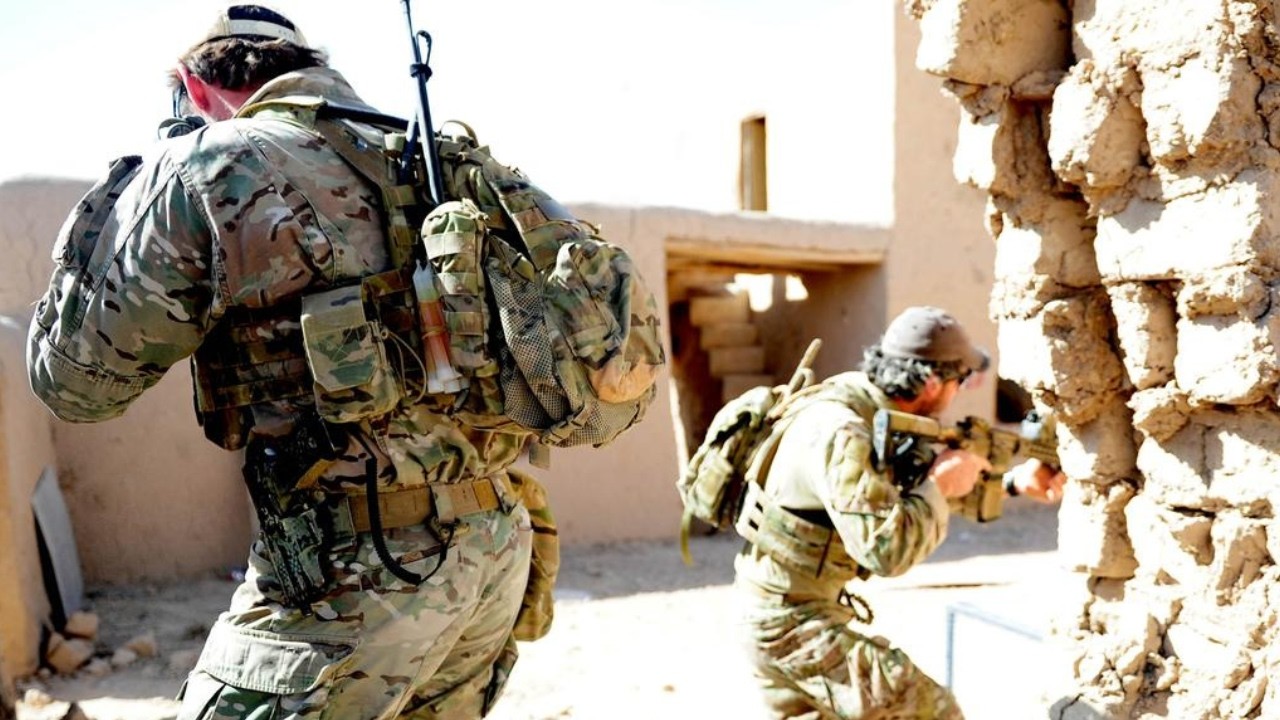
Not fired by an American tank crew or a British soldier. Fired by Australians in open trucks 30 km inside Iraq before most of the world even knew the war had started. The patrol commander kept his eyes on the lights and felt his heart find a hard, steady beat. Strange picture when you think about it. The biggest armies on Earth were lined up far away on other borders.
Hundreds of thousands of soldiers waiting beside tanks worth millions of dollars. And here at the front edge of everything sat a handful of Australians in vehicles with no roof, no doors, and no armor at all. If things went wrong in the next few minutes, help was a very long way away. The headlights kept coming closer now, close enough that he could hear the faint wine of their engines under the wind.
He raised one hand, held it still, and waited. The lights came on fast and then the night tore open. The big gun spoke first. Short hammering bursts that lit the desert in flashes and tracer rounds floated out across the dark like sparks blown off a fire. It didn’t last long. Fights like this almost never do. Within minutes, the Iraqi vehicles were stopped or gone, and the Australians were moving again deeper into the country, leaving the smell of burnt powder hanging in the air behind them.
One of the first actions of the entire war, and the [music] men who fought it didn’t even slow down. But B and C troop were only part of the plan. At that same time, far above the desert, the rest of the squadron was coming in a different way. A troop came by air. They sat strapped inside American MH47 helicopters, huge twin rotor machines flown by US Army crews with their vehicles chained down beside them.
The helicopters flew low and fast through the dark. And they kept flying on and on more than 600 km from their staging base in Jordan. Think about that number for a moment. 600 km. That’s almost like flying from Sydney to Melbourne at night over enemy ground to step out the back of a ramp into a country at war.
If anything went wrong out there, no rescue was coming quickly. The men inside knew it and they sat with the noise of the rotors filling their chests and they waited. Whatever happened next, they wouldn’t be raiding and running home. They were going out there to stay. The helicopters flared in the dark and settled onto the desert floor. 600 km from safety.
Ramps dropped. Vehicles rolled out into the cold night air. And within minutes, the aircraft were gone. Their sound fading away to the south, leaving a troop alone in the silence with the whole of western Iraq around them. One troop. Roughly 40 men with their vehicles dropped 600 km deep, holding a slice of desert that war planners would normally hand to a brigade.
Sounds like madness until you know who these men were. The Special Air Service Regiment was born in 1957, raised in Western Australia, and shaped from the very start for one kind of work. Going far, staying long, living off whatever fit in a vehicle or on a man’s back. In Vietnam, their small patrols slipped into the jungle for weeks at a time and moved so quietly the enemy began to fear the ground itself.
Stories spread among the North Vietnamese about men who left no tracks and gave no warning. The patrols were tiny, often just five men, but the fear they carried was far bigger than their numbers. That was the trick the regiment learned early and never forgot. You don’t need to be everywhere.
You only need the enemy to believe you might be. By 2002, that old skill had a brand new test. In Afghanistan, Australian SAS patrols spent week after week in the mountains watching, reporting, and cutting off enemy fighters trying to slip away. The Americans noticed. The man running the entire war noticed. General Tommy Franks, the American commander of everything in that part of the world, later said it plainly and on the record.
The Australian SAS, he said, had incredible tactical skills, and their operations cutting off the enemy were among the most effective actions of his whole campaign. Hold on to that. The most powerful military on Earth, with all its tanks and jets and satellites, looked at a few hundred Australians and called their work some of the best in the war.
That respect is the reason a troop was sitting in American helicopters at all. The Americans didn’t lend their best aircraft to just anyone. So when Iraq came, the Australians were given the West. And they brought the strangest war machine in the whole invasion, the long range patrol vehicle. Six wheels built on a Land Rover with the roof, doors, and windscreen all stripped away.
to an American officer raised on armored vehicles. It looked like something was missing. Everything was missing. There was no steel plate to stop a bullet. Nothing between a man’s chest and the desert but his shirt. What it had instead was speed, range, and teeth. a 50 caliber machine gun that could smash an engine block, a second machine gun beside it, and javelin missiles that could kill a tank from far beyond the reach of anything firing back.
The men checked their weapons and spread their vehicles out across the stony ground. Somewhere out in that darkness were the missile launchers they’d come to find and an Iraqi army of 16,000 men. On paper, at least standing in their way. The Australians started their engines and went looking for it. Now the real work began.
And the real work was a kind of misery no movie ever shows. The desert of western Iraq in [music] March is cold at night. Cold enough to make a man’s hands ache on a steel gun grip. And by midday, the same ground bakes under a sun that dries the sweat off your skin before you feel it. The wind never really stops. It carries grit into everything, into food, into rifles, into the corners of your eyes.
The men lived in their vehicles, slept beside them in shallow scrapes in the ground, and ate cold [music] rations so no cooking fire would give them away. Days blurred into each other. The vehicles were their homes, their store rooms, and their only way out. And out there, hidden somewhere in all that emptiness, was the reason they’d come.
Scud missiles, long [music] steel rockets that could be driven around on trucks, hidden under nets, and fired west towards Israel in minutes. Back in 1991, missiles fired from this same desert had slammed into Israeli cities. If it happened [music] again, Israel might strike back and if Israel entered the war, the whole alliance against Saddam could crack apart.
That was the weight riding in those open Land Rovers. Not just their own lives, the shape of the entire war. So they hunted. Patrols of a few vehicles fanned out across the stony plane, watching the roads, checking the Wadis, sitting still for hours with binoculars on a distant building. And the desert wasn’t empty. Iraqi forces were out there, too.
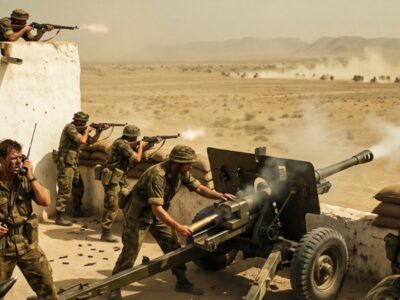
And they came hunting in their own way in four-wheel drives with machine guns bolted to the back. Fast, light vehicles full of armed men racing across the same flat ground. When the two sides met, the fights were sudden and savage. A patrol would spot dust on the horizon, then shapes inside the dust, and then everything [music] happened at once.
The 50 caliber guns hammered out long bursts, brass casing spilling onto the floor of the vehicles, the stink of gunm smoke whipping away in the wind. The Iraqi gunners fired back and their rounds cracked past men who had nothing around them but air. No armor, no doors, nothing.
One bullet in the wrong place would be enough. The Australians entered that danger the only way they could with speed and aim. The patrols moved while they fought. They hit first, hit hard, and were somewhere else before the enemy could settle their sights. Some of those fights ran on and on across the desert. Gun trucks chasing and turning under that huge empty sky, more like a sea battle than anything fought on land.
And when something appeared that was too big to fight, the Australians had one more weapon. One with no shape at all. A radio. A patrol commander would go still, read out a string of numbers, and somewhere far above, unseen aircraft would listen. On 24 March, the Australian headquarters confirmed what that sounded like on the ground.
An Australian patrol had found an enemy site holding what appeared to be missile handling gear. The exact thing they’d been sent to kill. They called the strike. The bombs came down. The site stopped existing. Picture one of those nights from the Iraqi side for a moment. You’re a soldier at a lonely outpost and the patrol you sent out at sunset hasn’t come back. The radio gives you nothing.
Then somewhere out in the blackness, you hear engines. Not the engines you know. Faster moving wrong. You fire at sounds. The sounds move. And in the morning, there’s nothing to see at all. Just tire tracks crossing each other in the dust and the burnt shell of a vehicle that used to hold men you knew.
Day after day, week after week, this was the war in the West. The Australians took risks that looked insane on paper. Tiny groups brushing up against an army of thousands. And they kept winning the small. Sharp fights that nobody back home would ever hear about. Every burnt out gun taught the Iraqi soldiers the same lesson. The desert wasn’t theirs anymore.
Then slowly something changed. And at first, the Australians couldn’t say what it was. The roads got quieter. The dust trails on the horizon grew rare then stopped. Outposts that should have sent patrols sent none. Whole stretches of desert that had been crawling with armed vehicles now sat silent under the sun day after day like the country itself was holding its breath.
Something was happening inside the Iraqi army out there in the west. Something big. The Australians driving through that growing silence had no way of knowing it yet, but they were about to find out exactly what their little war had done. The answer arrived on 15 April 2003 at a captured compound about 60 km west of the city of Ramadi and it arrived wearing the uniform of an Iraqi general.
His name was Major General Muhammad Tumea and on paper he was one of the most powerful men in the country. He commanded the entire western district of Iraq. Every soldier and every base from the edge of Rammani all the way out to the borders with Jordan and Syria. The very desert the Australians had been fighting across for weeks.
The outposts that had gone quiet. The patrols that had stopped coming. All of it answered to him. 16,000 men. That was the size of the army under his command. An army more than 100 times bigger than the Australian force hunting through his territory. The force that had hunted him through his own desert worked in troops, about 40 men with their vehicles to a slice of his territory.
Any American officer reading that file had to stop at the arithmetic and ask the only question it allows. You did that with 40 men? Now he stood in a dusty courtyard waiting to give it all away. An American Blackhawk helicopter came in low and settled onto the ground and outstepped Colonel Curtis Pototts of the United States Army.
Special forces soldiers guarded the general and his deputy. Someone set up a small folding table in the middle of the courtyard, the kind of table you might see at a school fet, [music] and the two men sat down across from each other while an interpreter passed the words between them.
They talked for about 40 minutes. Then the general signed the papers and Colonel Pots said afterwards that this was the only official surrender of Iraqi armed forces in the whole war. But it was something the general admitted at that table [music] that tells the real story. He said most of his entire command had not been captured. They hadn’t been killed.
They’d simply run away and they’d started running only 5 days after the war began. Stop and sit with that for a second. 5 days. The army of Western Iraq didn’t fall at the end of some long and bloody battle. It began falling apart almost at once in the very first week, right when small groups of Australians in open land rovers started appearing out of the darkness, shooting up patrols, calling down air strikes and vanishing before anyone could answer back.
The general soldiers never knew how many enemies were out there. They couldn’t count them. They couldn’t find them. They couldn’t catch them. So, night after night, in lonely outposts across that enormous desert, men looked at the darkness, thought about the burnt trucks and the missing patrols and made a private choice.
They took off their uniforms and went home. The Australians hadn’t destroyed that army with bullets. There were never enough Australians for that. And to be fair, they weren’t alone out there. American and British special forces were running their own hidden wars in other corners of the West. And together, the pressure never let up.
But in the slice of desert the Australians owned, the weapon that broke the enemy wasn’t the 50 caliber gun or the Javelin missile. It was fear. The fear that the next set of engine sounds in the dark was coming for you. An army can survive losing soldiers. It can’t survive losing belief. Thea’s army lost its belief in the first week.
And after that, it was just 16,000 men waiting for an excuse to leave. This quiet courtyard is where the campaign in the west actually broke. And the strangest part is that nothing about it looked like breaking. No famous battle for the history books. There was a courtyard, a card table, a tired general, and a signature. The men who caused it weren’t even there.
They were still out in the desert, sunburnt and filthy, with no idea the enemy commander had just signed away the very ground they were driving on. And with the Western District gone, its soldiers scattered to their homes, one prize sat out there in the desert, suddenly naked. the biggest air base in western Iraq.
Runways stretching more than 4 km, 25 footy fields laid end to end. And as the Australians were about to discover, an entire air force that had never taken off in those same April days, as the Western District was collapsing, the squadron got new orders. The patrols that had spent weeks scattered across the desert now turned and began rolling towards a single point on the map.
Their target was the place called Al-Assad, and there was nothing else like it in western Iraq. The numbers alone are hard to picture. Al-Assad was the second biggest air base in the entire country. Its outer fence ran for about 21 km. A loop so long that driving around it would take the best part of an hour. Inside sat two enormous runways built to launch the fastest jets Iraq owned.
The longer one a strip of concrete that would take a man an hour to walk from end to end. Spread between the runways stood 33 hardened shelters. Huge humps of steel and concrete built by Yuguslav engineers in the 1980s. Each one designed to keep an aircraft safe even if a bomb landed right on top of it. This wasn’t an airfield.
It was a fortress the size of a town. And before the war, it had been home to the heart of Saddam’s air force. A place like that should have been a nightmare to attack. War planners would normally look at those fences and shelters and start counting the soldiers needed in the thousands with bombers overhead and tanks at the front and hospital beds ready behind.
By every rule in the book, taking Al-Assad meant a battle. The Australians drove up to it in their roofless six-wheelers and found the battle was already over. The base was almost undefended. The garrison that was supposed to fight for it had melted away like the rest of General Tama’s army, and the men who were meant to be in those guard towers were already at home with their families.
The patrols pushed through the outer fence, weapons up, eyes sweeping the long rows of buildings, hearts ready for a fight that never came. Commandos from the fourth battalion, Royal Australian Regiment, came in to help the SAS secure the huge site. Because even an empty fortress this size was too big for a squadron to hold alone.
Room by room, shelter by shelter, they cleared it. The loudest sound on the base was their own boots. Now, here’s the part where an honest storyteller has to stop and say something plainly. Some versions of this story make the capture of Al-Assad sound like a desperate gunfight. It wasn’t. The official record is clear that the base was huge but undefended and the Australians who were there have never pretended otherwise.
But don’t let that fool you into thinking the prize wasn’t earned. The battle for Al-Assad was fought and won in the weeks before anyone reached its gates. It was won in those running fights in the dark, in the air strikes, in the slow strangling fear that emptied the Iraqi army out of the west one deserter at a time. The Australians didn’t skip the fight for Alisad.
They’d already finished it, spread out across thousands of square kilometers of desert before the base ever came into view. That’s not luck. That’s what winning looks like when it’s done properly. And then they found out what they’d actually captured. The men began opening the hardened shelters. And inside them, sitting quiet in the dark like museum pieces, were fighter jets.
Hidden under camouflage to fool the satellites and bombers overhead. Iraq had given up on winning in the sky, so it had tried to hide its air force instead. Some aircraft elsewhere in Iraq were later found literally buried in the sand. At Al-Assad, the Australians swept shelter after shelter, and the count kept climbing.
By the time the counting was done, the Australians had captured more than 50 aircraft. Among them were MiG 25 Foxbats, monsters built for nearly three times the speed of sound, some of the fastest military jets ever made anywhere on Earth. A fighting force built around one squadron, roughly 150 men at its core, backed by commandos and specialists, with no tanks and no armor anywhere among them, had just taken an entire air force without a single jet getting off the ground, and the aircraft were only part of it.
Stacked in bunkers and storage areas across the base sat close [music] to 8 million kg of explosive ordinance. 8,000 tons [music] of bombs, shells, missiles, and ammunition. Specialists from Australia’s incident response regiment moved in and began the careful, nervous work of checking those stockpiles, making sure none of it hid chemical weapons.
Other soldiers got to work on the runways, patching the holes left by coalition air strikes. And before long, the strip was good enough for giant Hercules transport planes [music] to land on. The fortress Saddam built was now working for the other side. Stories like this one sit locked behind official silence, and digging them out is the whole reason this channel exists.
If you want more of them, subscribe now because the next part of this one is the part nobody saw coming. Among the soldiers, a story spread that’s been told with a grin ever since. That once the base was secure, somebody got the kettle going, because some things stayed true no matter where the army is. Make of that what you will.
What’s certain is what the flag photos show. Australians, burnt brown by weeks of desert sun, standing on Saddam’s second greatest air base with a captured air force parked behind them. and the [music] Americans hadn’t yet arrived in the West at all. On 25 April 2003, 10 days after General Tala signed his surrender, the lead vehicles of the United States Army’s Third Armored Cavalry Regiment finally crossed the border into Iraq.
Hold that date in your mind because it’s the quiet punchline of this entire story. The third armored cavalry regiment was the force assigned to take charge of Anbar, the giant western province that holds the desert, the border crossings, and al-Assad itself. This was one of the most famous units in the American army.
with a history running back to 1846. And it didn’t travel light. [music] It rolled into Iraq as task force rifles, a combat team of 8,300 troopers with tanks, artillery, helicopters, and a supply train stretching back for kilometers. A magnificent force built for exactly the kind of war everyone had expected the West to be.
And by the time its first tank tracks touched Iraqi sand, there was almost nothing left for it to do there. The desert it was sent to conquer had already surrendered. The general it might have fought was already in custody. The great air base at the center of its new province had already been captured, cleared, counted, and repaired, and the flag flying over it was Australian.
The plan was never meant to go this way. The Americans were supposed to come in through Turkey in the north, but Turkey said no at the last moment, and the whole regiment had to sail around and come through Kuwait instead, weeks behind schedule. Nobody planned for a few hundred Australians to end up so far ahead of an armored regiment.
But war doesn’t grade you on the plan, it grades you on the result. And the result was simple. 8,300 Americans arrived to garrison, a desert that about 150 Australians fighting alongside their American and British special forces partners had already broken. In May, the formal handover happened. The Australians passed Al-Assad to the Third Armored Cavalry Regiment and began packing for home.
Picture that moment from the American side. You’re a young trooper who’s trained for months for a desperate battle in the West. You’ve heard the briefings about missile sites and loyalist fighters. And your first real task in Iraq is to take the keys to a captured fortress from a sunburn Australian who’s been living in an open truck since March.
He walks you past row after row of captured MiG fighters the way a farmer might show you his sheds. No one wrote down what was said in those moments. and any movie version of it would be a guess. But the numbers ask their own question and they ask it of anyone who looks at them. The question first asked over the surrender papers now hung over every map table in Qatar.
It wasn’t a silly question. It was the sound of one way of war meeting another at a moment when only one of them had a result to show. The American way said you win with mass, with armor, with more of everything than the enemy can survive. And that method had just taken Baghdad, so nobody should mock it.
But the West had asked a different exam question, one with no front line, no city to take, and no army willing to stand still. The Australians had answered it for a fraction of the Fuel One armored regiment burns in a week, and every planner who did that arithmetic in 2003 carried it into the next 20 years of war.
While the world’s cameras pointed at Baghdad and the falling statues, a different audience was quietly pulling files on the West. Because the people who study war for a living had noticed something the public never would. Inside American planning rooms, the Western Desert campaign was pulled apart and [music] examined because it had proven something every future war would have to reckon with.
And there was one more number that made the lesson sting. Through six weeks of fighting, across all those contacts and air strikes and night drives deep inside enemy ground, the Australians hadn’t lost a single soldier killed in action. An entire campaign waged in vehicles with no armor at all, and every man came home. The fighting was over.
The squadron flew back to Australia, back to Perth, back to families who could never be told the details. But this story has one more chapter because 18 months later, in a quiet ceremony, the country found a way to say what the secrecy wouldn’t allow. The men came home to Perth in the middle of 2003, and home was Campbell Barracks, a cluster of buildings near the beach in a suburb called Swanborn.
The ocean there is cold and blue, about as far from the brown dust of Anbar as a place can be. They came home to wives and kids, to mates and barbecues, to a country going about its business. And almost nobody in that country knew what they’d done. That’s the strange bargain at the heart of the regiment. These men had just pulled off one of the finest special operations campaigns in Australian history.
And they couldn’t talk about it. Not to the newspapers, not at the pub. Most of them not even fully to their own families. The army doesn’t release their names. Their faces are blurred in photographs. A man could stand in line at the supermarket in Perth, 2 weeks after handing Saddam’s second biggest air base to the United States Army, and the person beside him would never know.
The silence isn’t modesty. It’s the rule, and it protects them and the men still serving. But it has a price. and the price is that the country they fought for can’t properly say thank you to their faces. So in November 2004, 18 months after the squadron came home, the country found another way. On 27th November 2004, a new award was announced for one squadron of the special air service regiment.
It was called the unit citation for gallantry. And here’s what makes it remarkable. The award itself was brand new. It had been created as the highest honor Australia can give to a whole unit, reserved for extraordinary gallantry in action. And in the entire history of the country, no unit had ever received one.
Not at Gallipoli, not at Cakakota, not even at Longan whose men would wait another 14 years for theirs. The award didn’t exist in those days. And when it finally did exist, the very first name engraved on it was one squadron Sassa for Iraq. The official wording is worth hearing exactly as it was written.
The citation honors the squadron for extraordinary gallantry in action involving the development and execution of Bolt. Innovative plans in support of complex high-risk operations in Operation Falconer in Iraq in 2003. Read that again slowly. Bold innovative plans, complex, high-risk operations. That’s the careful buttoned up language of official doing its best to describe open Land Rovers charging through the dark 30 km inside enemy ground against an army 100 times their size.
It’s the government’s way of saying what the soldiers themselves would never say out loud. That what happened in that desert was extraordinary and everyone who saw the files knew it. Because the unit was honored rather than individuals, the citation did something the secrecy normally prevents. It thanked all of them at once.
The patrol commanders and the drivers, the gunners on the 50s and the signalers reading out grid numbers for air strikes. The medics, the mechanics who kept those overloaded vehicles alive through weeks of desert punishment. The commandos from Forra who helped clear Alisad. The specialists who spent careful days among 8,000 tons of explosives.
None of their names appear. All of their work does. In the years that followed, small pieces of the story began to surface. The journalist Ian Mcfedran gathered interviews for a book on the regiment, speaking with the prime minister, the army’s chief, and former commanding officers of the Sassar.
Men like Gus Gilmore and Tim Macauan who could talk about the regiment’s culture even where the operational details stayed locked away. And through all those accounts, one theme keeps coming back. The men of the regiment never described the Iraq campaign as a miracle or an adventure. They describe it as a job done the way they trained their whole careers to do it.
The boldness that amazed everyone else was to them simply the standard. And what about the men we followed at the start of this story? The soldiers of B and C troop sitting at the burm on that cold night in March watching headlights come towards them in the dark. They’re in their 50s and 60s now. Some stayed in uniform and went on to Afghanistan, carrying the lessons of the western desert into a different and harder war.
Some left the army and slipped quietly into ordinary Australian life, where they coach footie teams and run small businesses and stand at dawn services on Anzac Day with medals that draw curious looks. The specific men by name the public will likely never know. Their stories sit in classified files and in the memories of the small number of people who were there.
But the answer to the question that began this story is now complete. By the end, the Americans who read the files were asking the question the numbers force on anyone. How a force that small had done it. And the commander who ran the whole war had already called Australian SAS work some of the most effective he’d seen. The men responsible came home, said nothing, and let a few official engraved words say it for them.
First ever awarded. Extraordinary gallantry. And on the other side of the world, the fortress they captured was about to become one of the most famous military bases on Earth. The Australians went home, and the base they captured began a second life none of them could have imagined. Al-Assad didn’t go quiet after the handover.
It grew. The Americans looked at those long runways, the bomb-proof shelters, and the endless space, and they saw exactly what Saddam’s engineers had seen 20 years earlier. The perfect stronghold for the West. Over the years that followed, the base swelled into the largest American outpost in all of Western Iraq.
a desert city with thousands of troops, its own hospital, its own bus routes, even its own cinema. Soldiers called it the Western Green Zone. Nearly every convoy, every helicopter, every operation in Anbar province for years to come traced back one way or another to those runways the SAS patched [music] up in April 2003.
The base became so important that presidents came to visit. In December 2018, the president of the United States and the first lady flew into Al-Assad to greet the troops at Christmas. A year later, the vice president did the same at Thanksgiving. Each time, the camera showed the great shelters and the endless flat horizon, and millions of people around the world watched without ever hearing the name of the small force that took the place to begin with.
Then came the night the whole world finally looked at al-Assad. In January 2020, after a period of dangerous tension, Iran fired a wave of ballistic missiles across the border. And the target was Al-Assad air base. The missiles came down out of the dark onto those same runways, those same shelters, the same stretches of concrete where Australian soldiers had once walked in the quiet of an April morning.
American troops huddled in bunkers as the ground shook. The story led news broadcasts in every country on Earth. And for a few days, the words al-Assad were on millions of lips. Almost none of the reports mentioned how the base had fallen into coalition hands in the first place. The biggest moments of this story have a habit of happening with no cameras around.
Back in Australia, the legacy lives in quieter places. It lives at Campbell Barracks in Swanborn, where the regiment trains the next generation, and where the Iraq campaign is studied as a model of how the regiment is meant to fight. [music] Far from home, deep in enemy ground, badly outnumbered, and winning anyway.
It lives in the Australian War Memorial in Canberra, where photographs from the campaign hang on public display. An Australian flag flying over a captured Iraqi airfield. A six- wheeled Land Rover bristling with guns parked in front of a MIG. Visitors walk past them every day, and most have no idea they’re looking at one of the boldest campaigns their country ever fought.
And it lives in the way other armies think. The Western Desert campaign of 2003 became a case study pulled apart in staff colleges and planning rooms. Proof of an old idea that keeps being forgotten, and keeps being proven again. Wars aren’t always won by the side with the most steel. Sometimes they’re won by the side the enemy can’t find, [music] can’t count, and can’t stop thinking about at 3:00 in the morning.
An army the size of an entire country town did not run from 150 Australians. They ran from what those Australians made them believe was out there in the dark. That’s the lesson of the West, and it was taught from the seat of a Land Rover with no doors. Tell us in the comments which forgotten Australian operation deserves the next one.
There’s one last picture worth holding on to. Somewhere in Perth today, an unremarkable man in his 60s pours hot water into a mug. Nothing about him says he once drove an open truck across a hostile desert at night. Nothing says an army of 16,000 men broke apart rather than face him and a handful of his mates. Nothing says the most powerful military on Earth still studies what he did and still asks in plain disbelief how so few men could possibly have done it.
He’s never needed anyone to know. The kettle clicks off. He makes the tea. And that in the end may be the most Australian thing about the whole story. The job was extraordinary. The men never were if you ask them. They did it. Handed over the keys and put the kettle on.