Why the Viet Cong Stopped Hunting Australians in the Jungle and Called Them Ma Rung
November 1967. Phuoc Tuy Province, Vietnam. The jungle at night smells like rot and standing water and something older than both. There are men in it, moving slowly, single file. Five of them, maybe six. They haven’t spoken in 4 hours. They won’t speak again until morning. The Viet Cong knew the Australians were operating in their territory.
They had watched the helicopters come and go. They had tracked patrol routes. They had mapped patrol timings. They had done everything they knew how to do. They still couldn’t find them. Not the way you’d expect. Not by chance. Not by contact. Not by the sound of movement or the smell of cigarettes or the crack of a snapped branch. Nothing.
It unsettled them in a way they didn’t have language for it first. Then they found what the men had left behind, which was almost nothing. A flattened space where a shelter had been. The faintest impression in the dirt. Something that had been there and was now gone. The unit they were looking for had a name. The Viet Cong gave it to them.
They called them Ma Rung. Ghosts of the jungle. How do you earn that name from an enemy who is trying to kill you? The answer started in 1962. Australia entered the Vietnam War that year, initially as military advisers. By 1966, that commitment had become something much larger. The first Australian Task Force established its base at Nui Dat, a former rubber plantation turned forward operating base inside Phuoc Tuy Province, a coastal stretch of jungle, rice paddy, and plantation country southeast of Saigon.
The Task Force area covered roughly 4,000 square kilometers. It included dense jungle corridors, river lines, coastal hills, and a sprawl of territory that D445 Battalion had operated out of for years before the Australians arrived. That was where they trained, resupplied, moved their wounded, and disappeared to when external pressure came.
The Australian strategy was not to bomb them out of it. It was to go in after them. That job fell to 1 Squadron, Special Air Service Regiment. 1 Squadron had arrived at Nui Dat in March 1967, rotating in to replace the previous deployment. By mid-year, the squadron was operating throughout Phuoc Tuy Province.
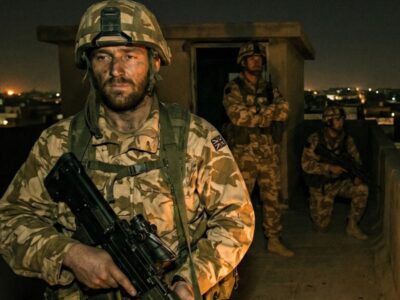
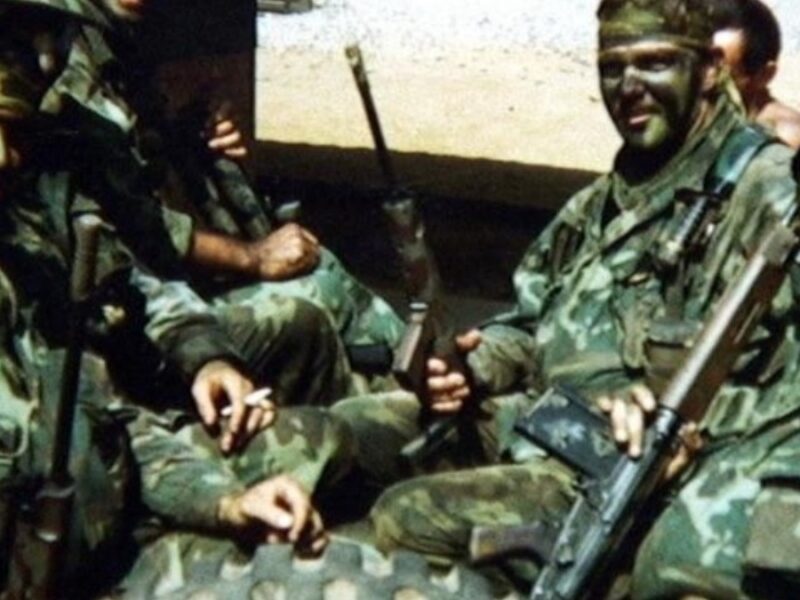
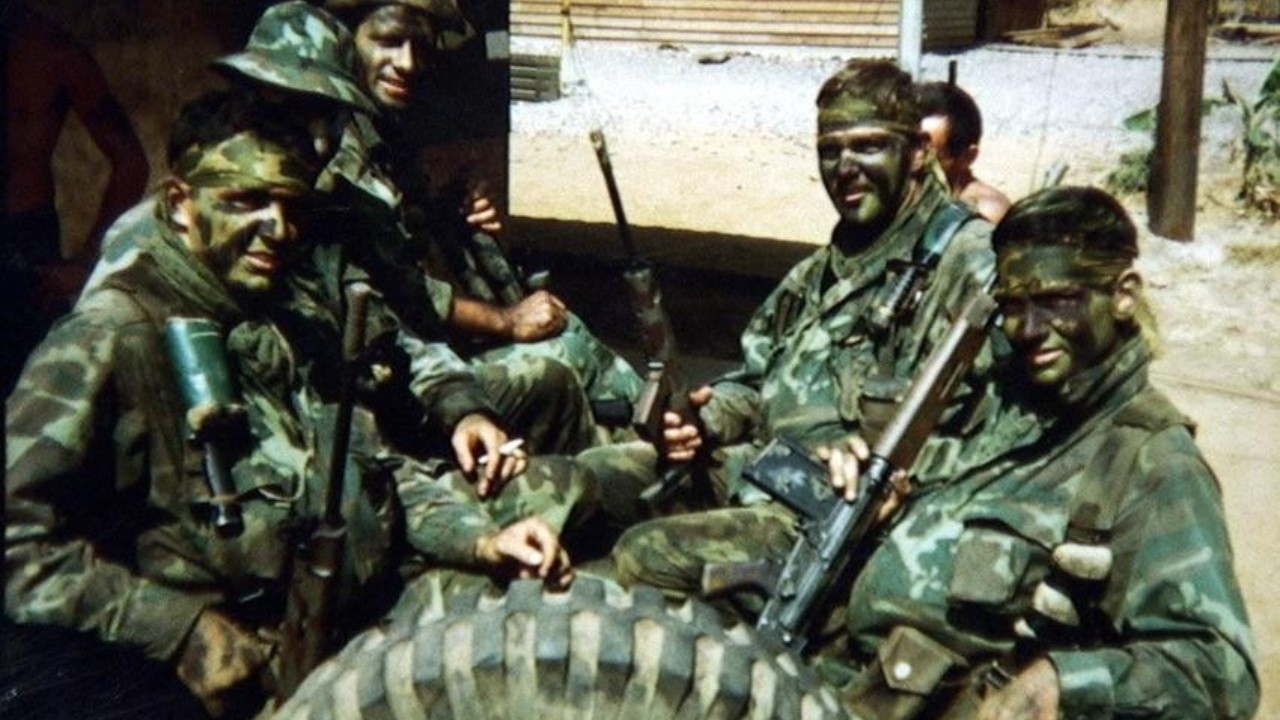
Patrols went into jungle the infantry units couldn’t effectively penetrate into the areas the D445 Battalion considered safe. Into the terrain the Viet Cong had used for years without serious challenge. Small patrols, five men, sometimes six, 10 to 12 days in the jungle at a time. No visible support, no noise, no contact unless it was forced on them.
The terrain they worked in was not jungle the way most people picture it. Phuoc Tuy Province had sections of triple canopy growth, meaning three distinct layers of vegetation above the ground. Almost no light reached the jungle floor. The undergrowth was thick enough that visibility measured in meters, 10, sometimes five.
Moving through it without leaving trace required a pace that most soldiers found almost impossible to sustain. The D445 Battalion already knew this. The Viet Cong were very good in this terrain. They had spent years in it. They had tracker teams, observation posts, and a network of local informants who could report movement from the jungle edge.
The D445 Battalion were experienced fighters. They were local. They knew Phuoc Tuy province better than any external force that had ever entered it. Which made what happened over the months that followed worth paying close attention to. The mud in the province held impressions for hours after a patrol passed.
A boot mark, a disturbed leaf, a broken stem at the wrong angle. The D445 Battalion could read terrain the way a mechanic reads an engine. They knew what normal looked like. They knew what a man moving through jungle left behind. One squadron was about to change what that looked like. The squadron operated on a principle every man understood before they went in.
Every step mattered. Every sound decision mattered. Not just in the moments before potential contact, but across every hour of the 10 or 12 days a patrol spent in the field. A patrol that held its discipline for 11 days and broke it on the 12th had not been invisible. It had been invisible for 11 days. The D445 Battalion had not yet encountered a force that operated this way.
They were about to spend months trying to solve a problem they had never faced before. One Squadron’s role in Phuoc Tuy province was reconnaissance. Finding things. Tracking the D445 Battalion’s movement patterns, supply routes, and command positions across terrain the infantry couldn’t effectively cover. This work required a specific kind of discipline that went beyond training or fitness.
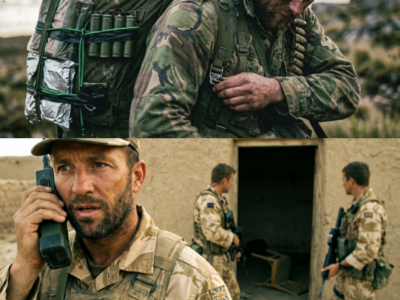
The patrols couldn’t be seen. They couldn’t be heard. They couldn’t leave behind anything that confirmed they had been in an area. Every piece of equipment was padded or taped against noise. Radio protocol was stripped to the minimum. Movement was slow enough that the jungle absorbed it. That slowness was a weapon.
A patrol that moved quickly was a patrol that made noise. Noise brought contact, and contact for a five-man team operating deep in enemy-controlled territory with no immediate support was close to a death sentence. So, they moved slowly hour after hour day after day watching, mapping, listening. The Viet Cong, meanwhile, were watching for them.
The D445 Battalion knew the Australians were operating in the province. They had seen Royal Australian Air Force helicopters inserting and extracting patrols from the jungle edge. They had intercepted radio signals. They had found boot prints, though far fewer than they expected. They established listening posts along likely patrol routes and sent tracker teams into areas where Australian activity had been reported.
The trackers found almost nothing. A footprint here. A bent leaf there. Evidence that someone had been present, but gone so cleanly that the track died within a few hundred meters. It wasn’t the kind of evidence that told them where the patrol had gone, how many men were involved, or when they would be back. The D445 Battalion reorganized their response.
They moved listening posts and extended their tracker teams’ areas of operation. Local informants were tasked to report any sounds from the jungle edges, any movement seen at dawn or dusk. The information came back incomplete every time. The absence wasn’t random. Conventional units moved through Phuoc Tuy province constantly and the D445 knew how to find them, how to follow them, how to set the right kind of reception when the moment came.
But these patrols were different. They weren’t invisible by luck or good fortune. They were invisible by method. And the method left almost no trace for even the most experienced tracker to work with. One Squadron wasn’t just passing through. They were studying the D445 the way a scientist studies a subject, building a body of knowledge about movement patterns, supply timing, and the routes between Viet Cong controlled areas and the villages along the jungle edge.
What do you do with an enemy you cannot locate? The regiment selected for a specific kind of person, not the most aggressive, not the loudest in the room, the most controlled. Men who could hold a standard of movement and silence when everything around them was degraded. Heat, insects, wet, exhaustion, the particular weight of knowing that a single mistake in this terrain could end the patrol.
This showed in the results. During 1 Squadron’s first tour in Vietnam, the Squadron mounted 246 patrols across Phuoc Tuy province. They killed 83 Viet Cong and recorded 15 more as possible. Their own casualties across those months were minimal. The patrol record, in other words, was not just about staying hidden.
It was about what happened when these men chose not to be. And the D445 battalion, across those same months, was producing a pattern in its own experience that told the story better than any account could. Tracker teams sent into areas where Australian patrols had been reported were returning with cold trails or not returning at all.
The contacts that did happen were almost never the result of the D445 finding the Australians. They were the result of the Australians finding the D445 and then deciding the moment was right. The D445 commanders were experienced men. They knew how to read what that pattern meant.
They were hunting an enemy who was hunting them back and the enemy was better at it. It was around this time in accounts that survived from the conflict that a name began to circulate among Viet Cong units operating in Phuoc Tuy province, Ma Rung. Ghost of the jungle. The phrase came from a framework the D445 battalion applied to things they couldn’t otherwise explain.
Men who moved through the jungle without disturbing it, who appeared from nowhere, struck when and where they chose, and vanished back into the canopy, who didn’t follow the rules that applied to every other force the D445 had ever encountered in this terrain. What do you call that? The patrols kept going. One squadron kept operating and the D445 battalion began changing their behavior in ways that confirmed what the assessments back at Nui Dat was starting to show.
They were reacting to one squadron, not pursuing them. Something had shifted in the province. The question didn’t stay theoretical for long. One squadron maintained a sustained presence across Phuoc Tuy province through the second half of 1967 and into 1968. Not one patrol. Rotating teams through overlapping cycles that denied D445 Battalion any extended period of relief inside what had been their controlled territory.
The deep jungle sealed over each patrol as it went in. Triple canopy, no wind at ground level. The kind of dark that sits on your shoulders. The D445 Battalion sent tracker teams into areas where SASR activity had been reported. They established listening posts along likely patrol routes and at jungle entry points.
Local guides with deep knowledge of the terrain were brought in to help identify where the patrols might be moving. None of it worked. The tracker teams found traces, impressions, the ghost of a patrol route, but the tracks died. They led nowhere. Listening posts recorded sounds that turned out to be nothing or signals already gone by the time anyone moved toward them.
The local guides could read this jungle. So could one squadron, and one squadron had learned to move through it in a way that even experienced local trackers couldn’t follow by conventional means. The usual signifiers simply weren’t there. No broken stems in a sequence that held. No disturbance in the leaf litter that lasted long enough to read.
Nothing that constituted a trail in any sense a tracker could reliably work with. The D445 Battalion was facing something they hadn’t planned for. Not a stronger force, not a better armed force, a force operating by entirely different rules. A force that used the jungle the way the jungle uses itself. Quietly, without announcement, leaving almost nothing behind.
This is the point in the story where the channel matters. If you’re watching because you want to understand what made elite forces genuinely different, not in the marketing sense, but in the operational sense. This channel has more stories like this one. Subscribe if you haven’t. There’s more coming. Back to the province.
One Squadron’s sustained presence was producing something beyond intelligence reports. It was producing a change in the balance of the region. The D445 battalion, which had operated in Phuoc Tuy with relative freedom for years, was now spending significant time and resource trying to locate an enemy it couldn’t find.
That was time and resource pulled away from everything else they needed to do. The task force at Nui Dat was beginning to see the results. And the D445 battalion was running out of explanations. The intelligence One Squadron was producing had a direct operational effect. Patrols mapped supply routes, located movement corridors between Viet Cong controlled areas, and the villages along the jungle edge, recorded timing patterns, and identified temporary positions.
Over months of slow, methodical work, they built a picture of the D445’s operations that no infantry unit could have assembled because no infantry unit could have moved where One Squadron moved and stayed hidden doing it. This was not headline work. No set piece battles. No dramatic engagements. The operation ran on patience, on discipline, on the willingness to hold the standard of the patrol for 10 days at a stretch in jungle that never stopped making demands.
But the patience had consequences. As the intelligence picture filled in, the task force was able to act more precisely on D445 movement. Operations that might previously have found nothing were now timed and targeted. The freedom of movement the D445 battalion had exercised for years inside what was supposed to be their controlled territory began to erode.
And the D445 could feel it. When contact came, it came on one squadron’s terms. Patrols identified D445 units moving along routes they had been watching. They reported the contact and set the conditions for the response. What they wouldn’t do was engage at a disadvantage. Contact was always the last resort. When it came, it came at a moment of their choosing.
The patrol record confirmed the result. 246 missions 83 Viet Cong killed against minimal Australian casualties. A consistent pattern of contacts initiated on Australian terms against an experienced local force that had every home terrain advantage and knew it. The D445 commanders read what the numbers meant. Their tracker teams couldn’t find the Australians.
Their listening posts couldn’t fix the Australians positions. Their local informants reported signs of movement but couldn’t turn those signs into a target. And when contact came, it came at the wrong moment, in the wrong configuration, at the initiative of the other side. It wasn’t a manpower problem. The D445 wasn’t outnumbered.
It wasn’t a firepower problem. One squadron patrols were five or six men with only what fit on their backs. It wasn’t a technology problem. The jungle equalized technology. It was a method problem. The Australians had developed a way of moving through this terrain, a way of observing and reporting and choosing contact that the D445 battalion’s considerable experience couldn’t counter.
Every tool applied to find them failed. Every tracker sent in came back with a cold trail or didn’t come back at all. The name Mach Rung had begun as a field observation, the kind of language soldiers reach for when something doesn’t fit the categories they have. By this stage in the campaign, it had become something more.
It wasn’t just a nickname. It was a tactical assessment. The question for the D445 battalion’s commanders was no longer how to find them. The question was whether finding them was possible. The answer came through the pattern of the campaign itself. One squadron rotated out in February 1968. Two squadron came in.
Three squadron followed in turn. The last Australian SASR squadron was withdrawn in October 1971. Six years of rotation through Phuoc Tuy province and beyond. In that six-year deployment, the Australian and New Zealand SAS in Vietnam conducted nearly 1,200 patrols. They killed 492 Viet Cong. Their own losses were one killed in action, a kill ratio of more than 30 to one.
The MR Rung name doesn’t appear in official Australian military records. It circulates in secondary accounts, in the testimonies of Vietnamese veterans interviewed after the war, in the historical analysis done by researchers working from both sides of the conflict. The men who served in the regiment are, in the main, people who don’t discuss operational detail.
That is entirely consistent with what the regiment is. But the operational record doesn’t need the anecdote. 246 patrols by one squadron in their first tour alone. Nearly 1,200 across six years and three squadrons. A kill ratio that speaks for itself. A consistent record of contacts initiated on Australian terms against an experienced local force that had every home terrain advantage.
The D445 battalion changed how they operated in Phuoc Tuy province. They modified their movement patterns. They spent resources trying to locate a threat they couldn’t define. Resources that had previously gone toward their primary mission. Not broken, not routed, changed. Forced to react. Compelled to spend energy on a problem with no clean solution because the force creating the problem couldn’t be found.
A force that is already there. That has already seen you. That makes you spend your energy reacting rather than acting. In terrain you thought you owned. You call them May Ruong when nothing else fits. The name outlasted the men who earned it. Other squadrons rotated in after one squadron left. The war in Phuoc Tuy province continued for years after the last Australian Special Forces unit departed.
The D445 kept fighting until the war’s end. The D445 never fully worked out how the Australians moved. They adapted their tactics in response to what they were experiencing. They never identified the method clearly enough to counter it. The traces the SASR left were too faint, too deliberate. Too carefully managed across too many successive patrols by too many successive squadrons.
The jungle absorbed them all. This is worth sitting with. The May Ruong story is not a story about weapons or firepower or numerical advantage. No single dramatic moment made the Australian SASR what they were in Vietnam. It was something quieter. The men who served in those patrols are now, most of them, old.
Some are gone. They didn’t write memoirs about what they did in Phuoc Tuy. They didn’t give interviews. The regiment doesn’t encourage that. And the men who self-select for the regiment tend not to want it. What they left behind is the record. The patrol counts. The kill ratios. The pattern in the data that tells you, regardless of who is talking, what actually happened in Phuoc Tuy province across those six years.
Small groups of men went into enemy-controlled territory and made themselves impossible to find. They went back 246 times in one tour alone. They did it across six years. And the force that had owned that terrain, the force that knew it better than any outsider, should have been able to know it, eventually gave them a name.
That name didn’t come from a victory parade or a regimental history or a politician’s speech. It came from the jungle. From the mouths of the men who were in it when the VC rung past through. Who couldn’t catch them. Who couldn’t explain them. Who eventually stopped trying to find words for what they were and gave them one instead.
Ghosts. That is a different kind of record and it is the only kind that matters.